Sviluppo locale a base culturale: quando funziona e perché? Alla ricerca di un framework di riferimento

Titolo Rivista PRISMA Economia - Società - Lavoro
Autori/Curatori Pier Luigi Sacco, Guido Ferilli, Blessi Giorgio Tavano
Anno di pubblicazione 2013 Fascicolo 2012/1
Lingua Italiano Numero pagine 19 P. 9-27 Dimensione file 664 KB
DOI 10.3280/PRI2012-001003
Il DOI è il codice a barre della proprietà intellettuale: per saperne di più clicca qui

Qui sotto puoi vedere in anteprima la prima pagina di questo articolo.

Se questo articolo ti interessa, lo puoi acquistare (e scaricare in formato pdf) seguendo le facili indicazioni per acquistare il download credit. Acquista Download Credits per scaricare questo Articolo in formato PDF
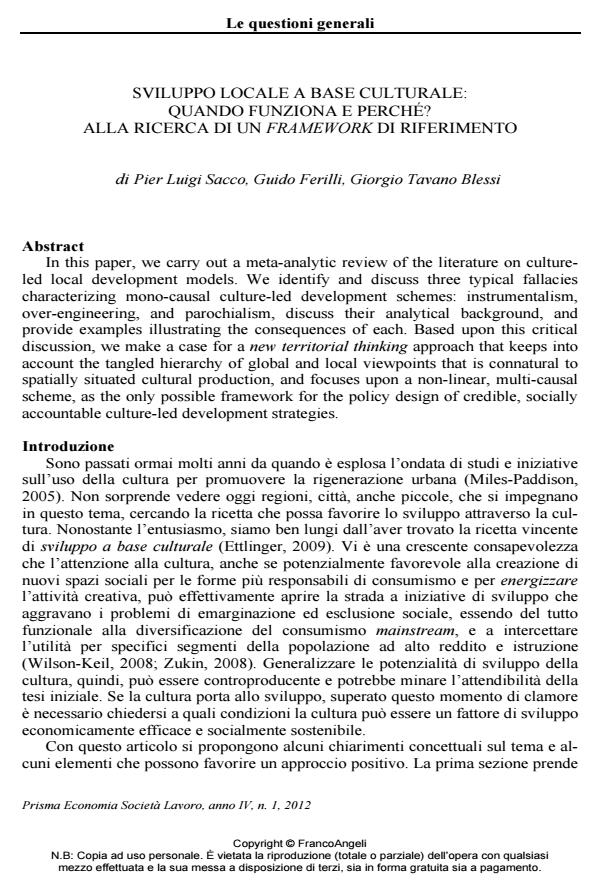
Anteprima articolo

FrancoAngeli è membro della Publishers International Linking Association, Inc (PILA)associazione indipendente e non profit per facilitare (attraverso i servizi tecnologici implementati da CrossRef.org) l’accesso degli studiosi ai contenuti digitali nelle pubblicazioni professionali e scientifiche

In this paper, we carry out a meta-analytic review of the literature on cultureled local development models. We identify and discuss three typical fallacies characterizing mono-causal culture-led development schemes: instrumentalism, over-engineering, and parochialism, discuss their analytical background, and provide examples illustrating the consequences of each. Based upon this critical discussion, we make a case for a new territorial thinking approach that keeps into account the tangled hierarchy of global and local viewpoints that is connatural to spatially situated cultural production, and focuses upon a non-linear, multi-causal scheme, as the only possible framework for the policy design of credible, socially accountable culture-led development strategies.

  1. Bassett K., Griffiths R., Smith I., (2002) “Cultural Industries”, Cultural Clusters and the City: The Example of Natural-History Film Making in Bristol, Geoforum, 33, pp. 165-177
  2. Baumol W.J., Bowen W.G., (1968) Performing Arts: The Economic Dilemma, The MIT Press, Cambridge Massachusetts
  3. Bayliss D., (2004) “Ireland’s Creative Development: Local Authority Strategies for Culture-led Development”, Regional Studies, 38, 817-831. DOI: 10.1080/0034340042000265296
  4. Becattini G., (2004) Industrial Districts. A New Approach to Industrial Change, Edward Elgar, Cheltenham
  5. Bielby W.T., (2004) “Rock in a Hard Place: Grassroots Cultural Production in the Post-Elvis Era”, American Sociological Review, 69, pp. 1-13. DOI: 10.1177/000312240406900209
  6. Bontje M., Musterd S., (2009) “Creative Industries, Creative Class and Competitiveness: Expert Opinions Critically Appraised”, Geoforum, 40, pp. 843- 852. DOI: 10.1016/j.geoforum.2009.07.001
  7. Borén T., Young C., (2012) “Getting Creative with the ‘Creative City’? Towards New Perspectives on Creativity in Urban Policy”, International Journal of Urban and Regional Research, in corso di pubblicazione
  8. Bourdieu P., (1987) Distinction: A Social Critique of the Judgement of Taste, Harvard University Press, Cambridge Massachusetts
  9. Capel-Tatjer L., (2009) Culture, Technology and Creativity as Drivers of Urban Regeneration in Barcelona, mimeo, Universitat Rovira i Virgili, Tarragona
  10. Caves R.E., (2002) Creative Industries: Contracts between Art and Commerce, Harvard University Press, Cambridge Massachusetts
  11. CBC, (2008) Valuing Culture. Measuring and Understanding Canada’s Creative Economy, The Conference Board of Canada Ottawa
  12. Clark D.A., (2008) “The Capability Approach: Its Development, Critiques, and Recent Advances”, in Ghosh R., Gupta K.R., Maiti P., Development Studies, vol. 2, Atlantic Publishers, New Dehli, pp. 105-127
  13. Comunian R., (2011) “Rethinking the Creative City. The Role of Complexity, Networks and Interactions in the Urban Creative Economy”, Urban Studies, 48, pp. 1157-1179. DOI: 10.1177/0042098010370626
  14. Cotter L., (2005) “Globalization + Irish Art = ?”, Third Text, 19, pp. 15-26. DOI: 10.1080/09528820412331318523
  15. Cunningham S., (2009) Trojan Horse or Rorschach Blot? Creative Industries Discourse Around the World, International Journal of Cultural Policy, 15, pp. 375-386. DOI: 10.1080/10286630902977501
  16. Curran D., Van Egeraat C., (2010) Defining and Valuing Dublin’s Creative Industries, Office of International Relations and Research, Dublin City Council, Dublino
  17. Currid E. and Williams S., (2010) The Geography of Buzz: Art, Culture and the Social Milieu in Los Angeles and New York, Journal of Economic Geography, 10, pp. 423-451. DOI: 10.1093/jeg/lbp032
  18. Dembski S., Salet W., (2010) “The Transformative Potential of Institutions: How Symbolic Markers Can Institute New Social Meaning in Changing Cities”, Environment and Planning A, 42, pp. 611-625. DOI: 10.1068/a42184
  19. EC, (2010) Green Paper. Unlocking the Potential of Cultural and Creative Industries, The European Community, Bruxelles
  20. Esteva G., Prakash M.S., (1998) Grassroots Post-Modernism, Zed Books, Londra
  21. Ettlinger N., (2009) “Surmounting City Silences: Knowledge Creation and the Design of Urban Democracy in the Everyday Economy”, International Journal of Urban and Regional Research, 33, pp. 217-230. DOI: 10.1111/j.1468-2427.2009.00840.x
  22. Evans G., (2001) Cultural Planning: An Urban Reinassance?, Routledge, Londra
  23. Aghion P., Howitt P., (1998) Endogenous Growth Theory, The MIT Press, Cambridge, Massachusetts
  24. Atkinson R., Easthope H., (2009) “The Consequences of the Creative Class: The Pursuit of Creativity Strategies in Australia’s Cities”, International Journal of Urban and Regional Research, 33, pp. 64-79. DOI: 10.1111/j.1468-2427.2009.00837.x
  25. Evans G., (2009) “Creative Cities, Creative Space and Urban Policy”, Urban Studies, 46, pp. 1003-1040. DOI: 10.1177/0042098009103853
  26. Ferilli G., Sacco P.L., Tavano Blessi G., (2012) “Cities as Creative Hubs: From the Instrumental to the Functional Value of Culture-Led Local Development”, in Fusco Girard L., Nijkamp P. (a cura di), Sustainable city and creativity, Ashgate, Farnham, pp. 245-270
  27. Florida R., (2002) The Rise of the Creative Class. And How It’s Transforming Work, Leisure, Community, and Everyday Life. New York: Basic Books
  28. Florida R., (2005) The Flight of the Creative Class. The New Global Competition for Talent. HarperBusiness, New York
  29. Florida R., (2007) Who’s Your City? How the Creative Economy is Making Where to Live the Most Important Decision of Your Life. Basic Books, New York
  30. Frey B.S., Jegen R., (2001) “Motivational Crowding Theory”, Journal of Economic Surveys, 15, pp. 589-611. DOI: 10.1111/1467-6419.00150
  31. Fujita M., (2007) “Towards the New Economic Geography in the Brain Power Society”, Regional Science and Urban Economics, 37, pp. 482-490. DOI: 10.1016/j.regsciurbeco.2007.04.004
  32. Gaffikin F., Morrissey M., (2011) “Community Cohesion and Social Inclusion: Unravelling a Complex Relationship”, Urban Studies, 48, pp. 1089-1118. DOI: 10.1177/0042098010374509
  33. Garcia B., (2005) “Deconstructing the City of Culture: The Long-Term Cultural Legacies of Glasgow 1990”, Urban Studies, 42, pp. 841-868. DOI: 10.1080/00420980500107532
  34. Giddens A., (1973) The Class Structure of the Advanced Societies, Hutchinson University Library, Londra
  35. Glaeser E.L., Kallal H.D., Scheinkman J.A., Shleifer A., (1992) “Growth in Cities”, Journal of Political Economy, 100, pp. 1126-1152. DOI: 10.1086/261856
  36. Glaeser E.L., Resseger M.G., (2010) “The Complementarity Between Cities and Skills”, Journal of Regional Science, 50, pp. 221-244. DOI: 10.1111/j.1467-9787.2009.00635.x
  37. Goldbard A., (2006) New Creative Community. The Art of Cultural Development, New Village Press, Oakland Ca.
  38. Greffe X., (2010) Urban Cultural Landscapes: An Economic Approach, EBLA/CSS Center Working Paper 1-2010, Torino
  39. Grodach C., (2010) “Beyond Bilbao: Rethinking Flagship Cultural Development and Planning in Three California Cities”, Journal of Planning Education and Research, 29, pp. 353-366. DOI: 10.1177/0739456X09354452
  40. GSA, (2005) Creative Industries in South Australia, The Government of South Australia Adelaide
  41. Hazime H., (2011) “From City Branding to E-brands in Developing Countries: An Approach to Qatar and Abu Dhabi”, African Journal of Business Management, 5, pp. 4731-4745
  42. Henderson J.V., (2007) “Understanding Knowledge Spillovers”, Regional Science and Urban Economics, 37, pp. 497-508. DOI: 10.1016/j.regsciurbeco.2006.11.010
  43. HKADC, (2005) Hong Kong Arts and Cultural Indicators, Hong Kong Arts Development Council, Hong Kong
  44. Hoyman M., Faricy C., (2009) “It Takes a Village: A test of the Creative Class, Social Capital and Human Capital Theories”, Urban Affairs Review, 44, pp. 311-333. DOI: 10.1177/1078087408321496
  45. Hutton T.A., (2004) “The New Economy of the Inner City”, Cities, 21, pp. 89-108. DOI: 10.1016/j.cities.2004.01.002
  46. Jaffe E.D., Nebenzahl I.D., (2006) National Image and Competitive Advantage, Copenhagen Business School Press, Copenhagen
  47. Scitovsky T., (1976) The Joyless Economy, Oxford University Press, Oxford
  48. Scott A.J., (2000) The Cultural Economy of Cities: Essays on the Geography of Image-Producing Industries, Sage, London
  49. Kanna A., (2012) “Urbanist Ideology and the Production of Space in the United Arab Emirates: An Anthropological Critique”, in Peterson M., McDonogh G. (a cura di), Global downtowns, University of Pennsylvania Press, Philadelphia, pp. 90-109
  50. KEA European Affairs, (2006) The Economy of Culture in Europe. Report for the European Community, Bruxelles
  51. Keohane R.O., Nye J.S.Jr., (1998) “Power and Interdependence in the Information Age”, Foreign Affairs, 77, pp. 81-94. DOI: 10.2307/20049052
  52. KIA, (2009) Economic Contributions of Thailand’s Creative Industries, Kenan Institute Asia, Bangkok
  53. Kleymeyer C.D. (a cura di), (1994) Cultural Expression and Grassroots Development: Cases from Latin America and the Caribbean, Lynne Rienner Publishers, Boulder, Co.
  54. Knudsen B., Florida R., Stolarick K., Gates G., (2008) “Density and Creativity in U.S. Regions”, Annals of the Association of American Geographers, 98, pp. 461-478. DOI: 10.1080/00045600701851150
  55. Landry C., (2000) The Creative City. A Toolkit for Urban Innovators, Earthscan, London, 2008
  56. Lazzeretti L., Boix R., Capone F., (2008) “Do Creative Industries Cluster? Mapping Creative Local Production Systems in Italy and Spain”, Industry and Innovation, 15, pp. 549-567. DOI: 10.1080/13662710802374161
  57. Lynch, A. (1996) Thought Contagion: How Beliefs Spread Through Society. Basic Books, New York
  58. Malmberg A., Power D., (2005) “(How) Do (Firms in) Clusters Create Knowledge?”, Industry and Innovation, 12, pp. 409-341. DOI: 10.1080/13662710500381583
  59. Markusen A., (2006) “Urban Development and the Politics of Creative Class: Evidence from the Study of Artists”, Environment and Planning A, 38, pp. 1921-1940. DOI: 10.1068/a38179
  60. Marshall A., (1920) Principles of Economics, Macmillan, London
  61. Mele C., (2000) Selling the Lower East Side. Culture, Real Estate, and Resistance in New York City, The University of Minnesota Press, Minneapolis
  62. MICA, (2009) Singapore Cultural Statistics 2004-2008 in Brief, Ministry of Information, Communication, and the Arts, Singapore
  63. Miles M., (1997) Art, Space and the City. Public Art and Urban Futures, Routledge, London
  64. Miles S., Paddison R., (2005) “Introduction: The Rise and Rise of Culture-led Urban Regeneration”, Urban Studies, 42, pp. 833-839. DOI: 10.1080/00420980500107508
  65. Miles S., (2009) “‘Our Tyne’: Iconic Regeneration and the Revitalisation of Identity in NewcastleGateshead”, Urban Studies, 42, pp. 913-926. DOI: 10.1080/00420980500107326
  66. Mill J.S., (1864) Utilitarianism, seconda edizione, Longman, Green, Longman, Roberts, and Green, London
  67. Mizzau L., Montanari F., (2008) “Cultural Districts and the Challenge of Authenticity: The Case of Piedmont, Italy”, Journal of Economic Geography, 8, pp. 651-673. DOI: 10.1093/jeg/lbn027
  68. Mommaas H., (2004) “Cultural Clusters and the Post-Industrial City: Towards the Remapping of Urban Cultural Policy”, Urban Studies, 41, pp. 507-532
  69. Montgomery J., (2005) “Beware the ‘Creative Class’. Creativity and Wealth Creation Revisited”, Local Economy, 20, pp. 337-343. DOI: 10.1080/02690940500298706
  70. Nussbaum M.C., (2000) Women and Human Development: The Capabilities Approach, Cambridge University Press, Cambridge. DOI: 10.1017/CBO9780511841286
  71. O’Callaghan C., Linehan D., (2007) “Identity, Politics and Conflict in Dockland Development in Cork, Ireland: European Capital of Culture 2005”, Cities, 24, pp. 311-323. DOI: 10.1016/j.cities.2007.01.006
  72. O’Callaghan C., (2011) “Urban Anxieties and Creative Tensions in the European Capital of Culture 2005: ‘It Couldn’t Just Be About Cork, Like’”, International Journal of Cultural Policy, 18, pp. 185-204. DOI: 10.1080/10286632.2011.567331
  73. Palmer R. and Rae, (2004) European Cities and Capitals of Culture, Palmer/Rae Associates, Bruxelles
  74. Palmer R., Richards G., Dodd D., (2011) European Culture Capital, Report 2, ATLAS, Anrhem
  75. Peck J., (2005) “Struggling with the Creative Class”, International Journal of Urban and Regional Research, 29, pp. 740-770. DOI: 10.1111/j.1468-2427.2005.00620.x
  76. Polèse M., Stren R.E., (a cura di) (2000) The Social Sustainability of Cities: Diversity and the Management of Change, University of Toronto Press, Toronto
  77. Ponzini D. and Rossi U., (2010) “Becoming a Creative City: The Entrepreneurial Mayor, Network Politics and the Promise of Urban Renaissance”, Urban Studies, 47, pp. 1037-1057. DOI: 10.1177/0042098009353073
  78. Porter M.E., (1985) Competitive Advantage. Creating and Sustaining Superior Performance, The Free Press, New York
  79. Porter M.E., (1989) The Competitive Advantage of Nations., The Free Press, New York
  80. Porter M.E., (1995) “The Competitive Advantage of the Inner City”, Harvard Business Review, 73/3, pp. 55-71
  81. Porter M.E., (1998) “Clusters and the New Economics of Competition”, Harvard Business Review, 76/6, pp. 77-90
  82. Porter M.E., (2000) “Location, Competition and Economic Development: Local Clusters in a Global Economy”, Economic Development Quarterly, 14, pp. 15-34. DOI: 10.1177/089124240001400105
  83. Porter M.E., (2003) “Building the microeconomic foundations of prosperity: Findings from the microeconomic competitiveness index”, Global competitiveness report 2002-2003, World Economic Forum, Harvard University Press, Cambridge Massachusetts, pp. 29-56
  84. Potts J., Cunningham S., Hartley H., Ormerod P., (2008) “Social Network Markets: A New Definition of the Creative Industries”, Journal of Cultural Economics, 32, pp. 167-185. DOI: 10.1007/s10824-008-9066-y
  85. Robeyns I., (2006) “Three Models of Education: Rights, Capabilities and Human Capital”, Theory and Research in Education, 4, pp. 69-84. DOI: 10.1177/1477878506060683
  86. Roodhouse S., (2010) Cultural Quarters: Principles and Practice, Intellect, Bristol
  87. Rose F., (2011) The Art of Immersion, W.W. Norton, New York
  88. Ruby C., Desbons D., (2002) “Des friches pour la culture?”, EspacesTemps.net, 1/5/02, http://espacestemps.net/document338.html
  89. Sacco P.L., (2010) “The Economics of Cultural Quarters”, in Roodhouse S., op. cit.
  90. Sacco P.L., Segre G., (2009) “Creativity, Cultural Investment and Local Development: A New Theoretical Framework for Endogenous Growth”. in Fratesi U., Senn L. (a cura di), Growth and innovation of competitive regions, Springer, Berlino, pp. 281-294
  91. Sacco P.L., Tavano Blessi G., (2007) “European Culture Capitals and Local Development Strategies: Comparing the Genoa 2004 and Lille 2004 Cases”, Homo Oeconomicus, 24, pp. 111-141
  92. Sacco P.L., Tavano Blessi G., (2009) “The Social Viability of Culture-Led Urban Transformation Processes: Evidence from the Bicocca District, Milan”, Urban Studies, 46, pp. 1115-1135. DOI: 10.1177/0042098009103857
  93. Santagata W., (2002) “Cultural Districts, property Rights and Sustainable Economic Growth”, International Journal of Urban and Regional Research, 26, pp. 9-23. DOI: 10.1111/1468-2427.00360
  94. Sassoon D., (2006) The Culture of the Europeans from 1800 to the Present, Harper Press, London
  95. Scott A.J., (2004) “Cultural-Product Industries and Urban Economic Development. Prospects for Growth and Market Contestation in Global Context”, Urban Affairs Review, 39, pp. 461-490. DOI: 10.1177/1078087403261256
  96. Sen A.K., (1985) Commodities an Capabilities, Oxford University Press, Oxford
  97. Sen A.K., (1999) Development as Freedom, Knopf, New York
  98. UNCTAD, (2008) Creative Economy Report, The United Nations Conference on Trade and Development, Ginevra
  99. Storper M., Scott A.J., (2009) “Rethinking Human Capital, Creativity and Urban Growth”, Journal of Economic Geography, 9, pp. 147-167. DOI: 10.1093/jeg/lbn052
  100. Verganti R., (2009) Design Driven Innovation: Changing the Rules of Competition by Radically Innovating What Things Mean, Harvard University Press, Cambridge Massachusetts
  101. Waitt G., Gibson C., (2009) “Creative Small Cities: Rethinking the Creative Economy in Place”, Urban Studies, 46, pp. 1223-1246. DOI: 10.1177/0042098009103862
  102. Waldzinski D., Chodkowska E., (2009) “Parochialism-Revitalization-Development. How to Build the Economic and Cultural Environment by Changing the Local Space”, paper presentato alla Conferenza “Multiculturalism, Conflict and Belonging Gloval”, Mansfield College, Oxford
  103. Wilson D., Keil R., (2008) “The Real Creative Class”, Social and Cultural Geography, 9, pp. 841-847. DOI: 10.1080/14649360802441473
  104. Yigitcanlar T., Velibeyoglu K., Martinez-Fernandez C., (2008) “Rising Knowledge Cities: The Role of Urban Knowledge Precincts”, Journal of Knowledge Management, 12, pp. 8-20. DOI: 10.1108/13673270810902902
  105. Yoshimoto M., (2003) “The Status of Creative Industries in Japan and Policy Recommendations for Their Promotion”, NLI Research Paper, Tokyo, NLI Research Institute
  106. Zientara P., (2008) “Polish Regions in the Age of a Knowledge-Based Economy”, International Journal of Urban and Regional Research, 32, pp. 60-85. DOI: 10.1111/j.1468-2427.2008.00776.x
  107. Zipp S., (2009) “The Battle of Lincoln Square: Neighborhood Culture and the Rise of Resistance to Urban Renewal”, Planning Perspectives, 24, pp. 409-433
  108. Zukin S., (2008) “Consuming Authenticity: From Outposts of Difference to Means of Exclusion”, Cultural Studies, 22, pp. 724-748
  109. [CP1] “A Conceptual Regulatory Framework for Design and Evaluation of Complex, Participative Cultural Planning Strategies”, International Journal of Urban and Regional Research, in corso di pubblicazione
  110. [CP2] “Culture 3.0: A New Perspective for the EU Active Citizenship and Social and Economic Cohesion Policy”, in European House for Culture (a cura di), Access to the Culture Platform, pp.195-213
  111. [CP3] Culture as an Engine of Local Development Processes: System-wide Cultural Districts, vol. 1, Theory. Growth and Change, in corso di pubblicazione
  112. [CP4] Culture as an Engine of Local Development Processes: System-wide Cultural Districts, vol. 2, Prototype Cases. Growth and Change, in corso di pubblicazione.

  • Enabling real property. How public real estate assets can serve urban regeneration Ezio Micelli, in TERRITORIO 87/2019 pp.93
    DOI: 10.3280/TR2018-087015
  • Abandoned Buildings in Contemporary Cities: Smart Conditions for Actions Alessia Mangialardo, Ezio Micelli, pp.19 (ISBN:978-3-030-35549-4)

Pier Luigi Sacco, Guido Ferilli, Blessi Giorgio Tavano, Sviluppo locale a base culturale: quando funziona e perché? Alla ricerca di un framework di riferimento in "PRISMA Economia - Società - Lavoro" 1/2012, pp 9-27, DOI: 10.3280/PRI2012-001003