Pharmaceutical economics

Titolo Rivista ECONOMIA E POLITICA INDUSTRIALE
Autori/Curatori William S. Comanor, Stuart O. Schweitzer
Anno di pubblicazione 2014 Fascicolo 2014/1
Lingua Italiano Numero pagine 28 P. 55-82 Dimensione file 101 KB
DOI 10.3280/POLI2014-001004
Il DOI è il codice a barre della proprietà intellettuale: per saperne di più clicca qui

Qui sotto puoi vedere in anteprima la prima pagina di questo articolo.

Se questo articolo ti interessa, lo puoi acquistare (e scaricare in formato pdf) seguendo le facili indicazioni per acquistare il download credit. Acquista Download Credits per scaricare questo Articolo in formato PDF
Anteprima articolo

FrancoAngeli è membro della Publishers International Linking Association, Inc (PILA)associazione indipendente e non profit per facilitare (attraverso i servizi tecnologici implementati da CrossRef.org) l’accesso degli studiosi ai contenuti digitali nelle pubblicazioni professionali e scientifiche

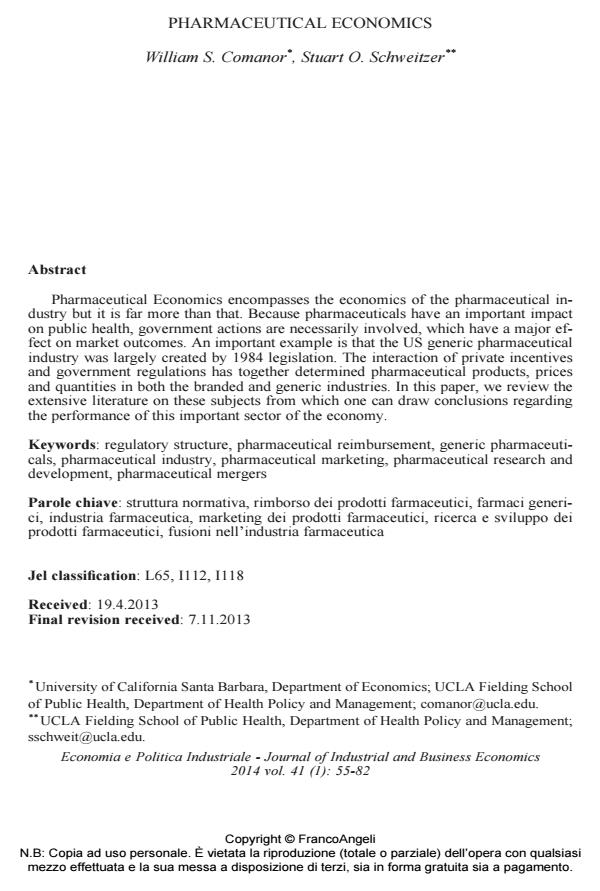
Pharmaceutical Economics encompasses the economics of the pharmaceutical industry but it is far more than that. Because pharmaceuticals have an important impact on public health, government actions are necessarily involved, which have a major effect on market outcomes. An important example is that the US generic pharmaceutical industry was largely created by 1984 legislation. The interaction of private incentives and government regulations has together determined pharmaceutical products, prices and quantities in both the branded and generic industries. In this paper, we review the extensive literature on these subjects from which one can draw conclusions regarding the performance of this important sector of the economy.

Parole chiave:Regulatory structure, pharmaceutical reimbursement, generic pharmaceuticals, pharmaceutical industry, pharmaceutical marketing, pharmaceutical research and development, pharmaceutical mergers

Jel codes:L65, I112, I118

  1. Reiffen D.E., Ward M.E. 2005. Generic drug industry dynamics. Review of Economics and Statistics, 87 (1): 37-49, DOI: 10.1162/0034653053327694
  2. Reinhart U. 2001. Perspectives on the pharmaceutical industry. Health Affairs, 20 (5): 136-149, DOI: 10.1377/hlthaff.20.5.136
  3. Rosenthal M.B., Berndt E.R., Donohue J.M., Frank R.G. 2003. Demand Effects of Recent Changes in Prescription Drug Promotion. Henry J. Kaiser Foundation: Menlo Park.
  4. Scherer F.M. 2000. The pharmaceutical industry, in Culyer B.J., Newhouse J.P. (eds.) Handbook of Health Economics. Elsevier: New York.
  5. Scherer F.M. 2001. The link between gross profitability and pharmaceutical R&D spending. Health Affairs, 20 (5): 216-220, DOI: 10.1377/hlthaff.20.5.216
  6. Scherer F.M. 2010. Pharmeceutical innovation, in Hall B., Rosenberg N. (eds.) Handbook of the Economcis of Technological Industry. Elsevier: Amsterdam.
  7. Schwartzman D. 1976. Innovation in the Pharmaceutical Industry. The Johns Hopkins University Press: Baltimore.
  8. Schweitzer S.O. 2007. Pharmacuetical Economics and Policy. Oxford University Press: New York.
  9. Schweitzer S.O. 2013. How the US Food and Drug Administration can solve the prescription drug shortage problem. American Journal of Public Health, 103 (5): e1-e5, DOI: 10.2105/AJPH.2013.301239
  10. Schweitzer S.O., Comanor W.S. 2011. Prices of pharmaceuticals in poor countries are much lower than in wealthy countries. Health Affairs, 30 (8): 1553-1561, DOI: 10.1377/hlthaff.2009.0923
  11. Scott Morton F. 1999. Entry decisions in the generic pharmaceutical industry. The RAND Journal of Economics, 30 (3): 421-440, DOI: 10.2307/2556056
  12. Scott Morton F. 2000. Barriers to entry, brand advertising, and generic entry in the US pharmaceutical industry. International Journal of Industrial Organization, 18 (7): 1085-1104, DOI: 10.1016/S0167-7187(98)00057-5
  13. Scriabine A. 1999. The role of biotechnology in drug development, in Landau R., Achilladelis B., Scriabine A. (eds.) Pharmaceutical Innovation. Chemical Heritage Press: Philadelphia.
  14. Sorrell v. IMS Health, Inc. 2011. 131 S. Ct. 2653, 2659, 180 L. Ed. 2d 544, unpublished.
  15. Spence M.M., Teleki S.S., Cheetham T.C., Schweitzer S.O., Millares M. 2005. Directto-consumer advertising of COX-2 inhibitors: effect on appropriateness of prescribing. Medical Care Research and Review, 62 (5): 544-559, DOI: 10.1177/1077558705279314
  16. Stafford R.S. 2008. Regulating off-label drug use. Rethinking the role of the FDA. New England Journal of Medicine, 358 (14): 1427-1429, DOI: 10.1056/NEJMp0802107
  17. United States Census Bureau. 2011. Statistical Abstract of the United States. US Government Printing Office: Washington.
  18. United States Congress, Office of Technology Assessment. 1993. Pharmaceutical R&D: Costs, Risks and Rewards. OTA-H-522. US Government Printing Office: Washington.
  19. United States Congressional Budget Office. 2009. Pharmaceutical R&D and the Evolving Market for Prescription Drugs. US Government Printing Office: Washington.
  20. United States v. Caronia. 2012. WL 5992141, (US Court of Appeals, 2d Cir., Dec. 3, 2012), unpublished.
  21. Weiss D., Naik P., Weiss R. 2009. The ‘Big Pharma’ dilemma: develop new drugs or promote existing ones?. Nature Reviews/Drug Discovery, 8 (2): 533, DOI: 10.1038/nrd2923
  22. Wright R. 1996. How Zantac became the best-selling drug in history. Journal of Health Care Marketing, 16 (4): 24-29.
  23. Gray A., Manasse H.R. 2012. Shortages of medicines: a complex global challenge. Bulletin of the World Health Organization, 90 (3): 158-158A, DOI: 10.2471/BLT.11.101303
  24. Hay J.W. 2004. Evaluation and review of pharmaeconomic models. Expert Opinion in Pharmacotherapy, 5 (9): 1867-1880, DOI: 10.1517/14656566.5.9.1867
  25. Henderson R., Cockburn I. 1996. Scale, scope, and spillovers: the determinants of research productivity in drug discovery. The RAND Journal of Economics, 27 (1): 32-59, DOI: 10.2307/2555791
  26. IMS. 2011. The Use of Medicines in the United States: Review of 2010. IMS: Parsippany.
  27. IMS. 2012. The Global Use of Medicines: Outlook Through 2016. IMS: Parsippany.
  28. Intriligator M. 1996. Drug Evaluations: Type I vs Type II Errors. Research Program in Pharmaceutical Economics and Policy. UCLA: Los Angeles.
  29. Karki L. 2005. Review of FDA law related to pharmaceuticals: the hatch-waxman act, regulatory amendments and implications for drug patent enforcement. Journal of the Patent & Trademark Office Society, 87: 602-620.
  30. Kessler D.A., Rose J.L., Temple R.J., Schapiro R., Griffin J.P. 1994. Therapeutic-class wars. Drug promotion in a competitive marketplace. New England Journal of Medicine, 331: 1250-1353, DOI: 10.1056/NEJM199411173312007
  31. Kozlowski S., Woodcock J., Midthun K., Behrman Sherman R. 2011. Developing the nation’s biosimilars program. New England Journal of Medicine, 365 (5): 385-388.
  32. Langenfeld J., Maness R. 2003. The cost of PBM ‘self-dealing’ under a Medicare prescription drug benefit, unpublished.
  33. Leffler K.B. 1981. Persuasion or information? The economics of prescription drug advertising. Journal Of Law & Economics, 24 (1): 45-74, DOI: 10.1086/466973
  34. Lichtenberg F.R. 2003. Pharmaceutical innovation, mortality reduction, and economic growth, in Murphy K.M., Topel R.H. (eds.) Measuring the Gains from Medical Research, an Economic Approach. University of Chicago Press: Chicago.
  35. Lichtenberg F.R., Sun S.X. 2007. The impact of Medicare part D on prescription drug use by the elderly. Health Affairs, 26 (6): 1735-1744, DOI: 10.7208/chicago/9780226551791.003.0004
  36. Ling D.C., Berndt E.R., Kyle M.K. 2002. Deregulating direct-to-consumer marketing of prescription drugs: effects on prescription and over-the-counter product sales. Journal of Law and Economics, 45 (S2): 691, DOI: 10.1086/368004
  37. Lu Z.J., Comanor W.S. 1998. Strategic pricing of new pharmaceuticals. Review of Economics and Statistics, 80 (1): 108-118, DOI: 10.1162/003465398557212
  38. Ma Q., Lu A.Y.H. 2011. Pharmacogenetics, pharmacogenomics, and individualized medicine. Pharmacological Reviews, 63 (2): 437, DOI: 10.1124/pr.110.003533
  39. Manning W.G., Newhouse J.P., Duan N., Keeler E.B., Leibowitz A. 1987. Health insurance and the demand for medical care: evidence from a randomized experiment. The American Economic Review, 77 (3): 251-277.
  40. Miller H.I. 2000. To America’s Health: A Proposal to Reform the food and Drug Administration. Hoover Institution Press: Stanford.
  41. Miller R.D. Jr., Frech H.E. 2004. Healthcare Matters: Pharmaceuticals, Obesity and the Quality of Life. American Enterprise Institute: Washington.
  42. Munos B. 2009. Lessons from 60 years of pharmaceutical innovation. Nature Reviews/Drug Discovery, 8 (12): 959-968, DOI: 10.1038/nrd2961
  43. Peltzman S. 1973. An evaluation of consumer protection legislation: the 1962 drug amendments. Journal of Political Economy, 81 (5): 1049-1091, DOI: 10.1086/260107
  44. Pharmaceutical Research and Manufacturers of America. 2003. Pharmaceutical Industry Profile. PhRMA: Washington.
  45. Comanor W.S., Schweitzer S.O. 2007. Determinants of drug prices and expenditures. Managerial and Decision Economics, 28 (4-5): 358-370, DOI: 10.1002/mde.1346
  46. Comanor W.S., Scherer F.M. 2013. Mergers and innovation in the pharmaceutical industry. Journal of Health Economics, 32 (1): 106-113, DOI: 10.1016/j.jhealeco.2012.09.006
  47. Cook-Deegan R., DeRienzo C., Carbone J., Chandrasekharan S., Heaney C., Conover C. 2010. Impact of gene patents and licensing practices on access to genetic testing for inherited susceptibility to cancer: comparing breast and ovarian cancers with colon cancers. Genet Med, 12 (4 Supplement): S15-38, DOI: 10.1097/GIM.0b013e3181d5a67b
  48. Danzon P.M., Chua L.W. 2000. Cross-national price differences for pharmaceuticals: how large, and why? Journal of Health Economics, 19 (2): 159-195, DOI: 10.1016/S0167-6296(99)00039-9
  49. Danzon P.M., Pauly M. 2002. Health insurance and the growth of pharmaceutical expenditures. Journal of Law and Economics, 45 (2): 587-613, DOI: 10.1086/368005
  50. Danzon P.M., Nicholson S., Pereira N.S. 2005. Productivity in pharmaceutical biotechnology RD: the role of experience and alliances. Journal of Health Economics, 24 (2): 317-339, DOI: 10.1016/j.jhealeco.2004.09.006
  51. Danzon P.M., Epstein A., Nicholson S. 2007. Mergers and acquisitions in the pharmaceutical and biotech industries. Managerial and Decision Economics, 28 (4-5): 307-328, DOI: 10.1002/mde.1343
  52. Danzon P.M., Furukawa M.F. 2008. International prices and availability of pharmaceuticals in 2005. Health Affairs, 27 (1): 221-233, DOI: 10.1377/hlthaff.27.1.221
  53. DiMasi J.A., Hansen R.W., Grabowski H.G., Lasagna L. 1991. Cost of innovation in the pharmaceutical industry. Journal of Health Economics, 10 (2): 107-142, DOI: 10.1016/0167-6296(91)90001-4
  54. DiMasi J.A., Hansen R.W., Grabowski H.G. 2003. The price of innovation: new estimates of drug development costs. Journal of Health Economics, 22 (2): 151-185, DOI: 10.1016/S0167-6296(02)00126-1
  55. Duggan M., Scott Morton F. 2006. The distortionary effects of government procurement: evidence from medicaid prescription drug purchasing. Quarterly Journal of Economics, 121 (1): 1-30, DOI: 10.1093/qje/121.1.1
  56. Duggan M., Scott Morton F. 2010. The effect of Medicare Part D on pharmaceutical prices and utilization. American Economic Review, 100 (1): 590-607, DOI: 10.1257/aer.100.1.590
  57. Esposito D. 2006. Copayments and the Demand for Perscription Drugs. Routledge: London.
  58. Fierce Biotech. 2013. The Biotech Market Share Report, published online.
  59. Frank R.G., Salkever D.S. 1997. Generic entry and the pricing of pharmaceuticals. Journal of Economics and Management Strategy, 6 (1): 75-90, DOI: 10.1111/j.1430-9134.1997.00075.x
  60. Gellad W. F., Schneeweiss S., Brawarsky P., Lipsitz S., Hass J. 2008. What if the federal government negotiated pharmaceutical prices for seniors? An estimate of national savings. Journal of General Internal Medicine, 23 (9): 1435-1440, DOI: 10.1007/s11606-008-0689-7
  61. Grabowski H.G. 2007. Competition between generic and branded drugs, in Sloan F.A., Hseih C.-R. (eds.) Pharmaceutical Innovation. Cambridge University Press: Cambridge (UK), DOI: 10.1017/CBO9780511618871.009
  62. Grabowski H.G., Vernon J.M. 1994. Returns to R&D on new drug introductions in the 1980s. Journal of Health Economics, 13 (4): 383-406, DOI: 10.1016/0167-6296(94)90010-8
  63. Grabowski H.G., Vernon J.M., DiMasi J.A. 2002. Returns on research and development for 1990s new drug introductions. Pharmacoeconomics, 20 (Supplement 3): 11-29, DOI: 10.2165/00019053-200220003-00002
  64. Berndt E.R. 2002. Pharmaceuticals in U.S. health care: determinants of quantity and price. The Journal of Economic Perspectives, 16 (4): 45-66, DOI: 10.1257/089533002320950975
  65. Bhattacharya J., Vogt W.B. 2003. A simple model of pharmaceutical price dynamics. Journal of Law and Economics, 46 (2): 599-626, DOI: 10.1086/378575
  66. Blume-Kohout M.E., Sood N. 2013. Market size and innovation: effects of Medicare Part D on pharmaceutical research and development. Journal of Public Economics, 97 (1): 327-336, DOI: 10.1016/j.jpubeco.2012.10.003
  67. Boldrin M., Levine D.K. 2013. The case against patents. Journal of Economic Perspectives, 27 (1): 3-22, DOI: 10.1257/jep.27.1.3
  68. Bond R.S., Lean D.F. 1979. Sales, promotion, and products differentiation in two prescription drug markets. Staff Report to the fTC 46.
  69. Boslaugh S. 2008. Encyclopedia of Epidemiology. Sage Publications: Thousand Oaks.
  70. Carpenter D. 2010. Reputation and Power: Organizational Image and Pharmaceutical Regulation at the fDA. Princeton University Press: Princeton.
  71. Carpenter D., Sin G. 2007. Policy tragedy and the emergence of regulation: the food, drug, and cosmetic act of 1938. Studies in American Political Development, 21(02): 149-180, DOI: 10.1017/S0898588X0700020X
  72. Caves R.E., Whinston M.D., Hurwitz M.A., Pakes A., Temin P. 1991. Patent expiration, entry, and competition in the US pharmaceutical industry. Brookings Papers on Economic Activity. Microeconomics: 1-66, DOI: 10.2307/2534790
  73. Clarkson K. 1977. Intagible Capital and Rates of Return: Effects of Research and Promotion on Profitability. American Enterprise Institute for Public Policy Research: Washington.
  74. Cockburn I.M. 2004. The changing structure of the pharmaceutical industry. Health Affairs, 23 (1): 10, DOI: 10.1377/hlthaff.23.1.10
  75. Cockburn I.M., Henderson R. 1994. Racing to invest? The dynamics of competition in ethical drug discovery. Journal of Economics & Management Strategy, 3 (3): 481-519, DOI: 10.1111/j.1430-9134.1994.00481.x
  76. Cockburn I.M., Henderson R.M. 2001. Scale and scope in drug development: unpacking the advantages of size in pharmaceutical research. Journal of Health Economics, 20 (6): 1033-1057, DOI: 10.1111/j.1430-9134.1994.00481.x
  77. Comanor W.S. 2007. The economics of research and development in the pharmaceutical industry, in Sloan F.A., Hsieh C.R. (eds.) Pharmaceutical Innovation. Cambridge University Press: New York, DOI: 10.1017/CBO9780511618871.004
  78. Granlund D. 2010. Price and welfare effects of a pharmaceutical substitution reform. Journal of Health Economics, 29 (6): 856-865, DOI: 10.1016/j.jhealeco.2010.08.003

William S. Comanor, Stuart O. Schweitzer, Pharmaceutical economics in "ECONOMIA E POLITICA INDUSTRIALE " 1/2014, pp 55-82, DOI: 10.3280/POLI2014-001004