Aims and Scope
Editorial Board
Contacts + Address
Referee
Indexing
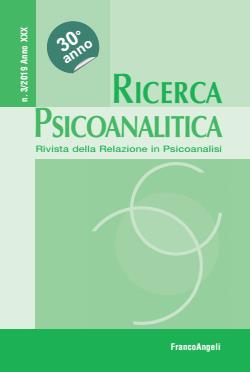
Ricerca Psicoanalitica, the Italian journal of relational psychoanalysis, is a member of the Council of Editors of Psychoanalytic Journals. During its twenty years of life, it has systematically carried on an invaluable work of cultural exchange, updating, and original elaboration of psychoanalytic issues, always in touch with the most innovative national and international debate. The list of authors is proof of that. Ricerca Psicoanalitica was born in 1990 on an initiative of the Italian Society of Relational Psychoanalysis (SIPRe) and it is, first of all, a scientifically dedicated journal, faithful to its initial commitment: «Ricerca Psicoanalitica», as the editorial of the very first number asserts, «is characterized by two irrevocable choices: clinical usefulness - strictly connected to an adequate theorization - and reflection on the method». Still today, our journal aims to be a useful tool, both clinically and theoretically oriented and particularly devoted to epistemology. «"Relation"», as it is written in the same editorial, «first of all means "mutual conditioning" between organism and object, which is the actual context where psychological structures and subjectivities, as well as identities, are formed». Such a statement sounds like fulfilled prophecy, because now, twenty years later, it marks an extraordinary turning point in psychoanalysis. I am referring to the impact infant research and theory of the complex systems are having on the study of the mind and on psychoanalysis. In particular, the importance of the non-dynamic unconscious, both in health and in illness, along with the new conception of subjectivity as an eco-self-organized system are being increasingly acknowledged as essential factors in the intense and continuous interaction between subject and object (world). «We have begun to think», sais Daniela De Robertis in a recent contribution, «that interpretation based on repressed contents brought to consciousness is not at all the focus of change. Change does not concern the conscious insight, but the area of procedural knowing, which is implicit, unconscious, and not verbal.» (Coscienza, livelli di espansione e tempo. Alcuni spunti per la cura psicoanalitica. Ricerca Psicoanalitica, 1/2009: 137). At the moment, these front-ranking themes are the Ariadne’s thread which connects the different areas of examination of Relational Psychoanalysis and its different areas of specialization: adult-, couple-group-, family-psychoanalysis or rather, as we prefer to say, psychoanalysis with the adult, with the couple, with the group, and so on.
Scientific Editor in chief: Alberto Lorenzini. Editorial Board: Daniela De Robertis (Roma); Paola Brizzolara (Genova); Paolo Milanesi (Milano), Francesco Noseda (Milano) Rossella Torretta (Milano), Giancarlo Marenco (Torino). Scientific Board: Neil Altman (New York), Paul Laurent Assoun (Parigi), George E. Atwood (New Brunswick), Lewis Aron (New York), Marco Bacciagaluppi (Milano), Beatrice Beebe (New York), Romano Biancoli (Bologna, † 2009), Bernard Brandchaft (New York), Philip M. Bromberg (New York), Nicolas Duruz (Lausanne), Michael Ermann (Monaco), Antonino Ferro (Pavia), James L. Fosshage (New York), Pier Francesco Galli (Bologna), Adrienne Harris (New York), Irwin Hirsch (New York), Edgar Levenson (New York), Giovanni Magnani (Roma, † 2006), Jody Messler Davies (New York), Paolo Migone (Parma), Stephen A. Mitchell (New York, † 2000), Thomas H. Ogden (San Francisco), Meinrad Perrez (Fribourg), Gustavo Pietropolli Charmet (Milano), Paul Roazen (Toronto, † 2005), Albert Rhus (Vienna), Hal Sampson (San Francisco), Joyce Slochower (New York), Charles Spezzano (San Francisco), Robert D. Stolorow (Los Angeles), Joseph Weiss (San Francisco).
La Rivista utilizza una procedura di referaggio doppiamente cieco (double blind peer review process), i revisori sono scelti in base alla specifica competenza. L’articolo verrà inviato in forma anonima per evitare possibili influenze dovute al nome dell’autore. La redazione può decidere di non sottoporre ad alcun referee l’articolo perché giudicato non pertinente o non rigoroso né rispondente a standard scientifici adeguati. I giudizi dei referee saranno inviati all’autore anche in caso di risposta negativa.
FrancoAngeli is fully aware of the importance to ensure the long-term survival of Web-based scholarly publications for the benefit of the greater global research community.
We are member of
Clockss e Portico, two institutional initiatives born with the aim to ensure the enduring usability, authenticity, discoverability, and accessibility of content over the very long-term.
Info:
Home - CLOCKSS;
Publishers – Portico.