|
|
| |
|
|
|
Peer Reviewed Journal |
|
|
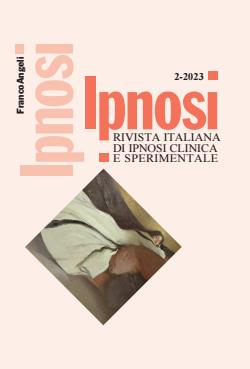
IPNOSI
Rivista italiana di ipnosi clinica e sperimentale
2 issues per year, ISSN 1971-0461, ISSNe 1972-4985
Subscription fees
2013
Institutional subscriber, companies:
Print (VAT included): Italy € 31,50; Other countries € 57,00 Online only (VAT excluded): € 34,50
Info about print subscription
Info about online licence
Universities:
online (current + back issue, perpetual access, plus licence )
Info online licence
Personal subscriber:
Print Italy € 27,50; Print Other countries € 50,00; Online only € 23,50
Info about subscription
|
|
|
|
|
|
Aims and Scope
Editorial Board
Contacts + Address
Referee
Indexing
To contact the editorial office:Editorial Staff: Gabriela Sandra Rivellino - Via Tagliamento, 25 - 00198 Roma - Telefono e Fax: 06.8548205 - e-mail: ipnosii@libero.it
The historical evolution of hypnosis reveals a common link with many other psychotherapies - a gradual transformation involving a reduction of suggestive intervention in favour of a more natural process that respects the individual's human qualities and restores the strength of their resources. The hypnosis of the past, which for countless centuries was based primarily upon mystical concepts and the power of suggestion, authority and charisma, was artificially constructed and essentially supernatural. Thanks largely to the work of Milton Erickson, today's "New Hypnosis" tends to manifest itself as a widespread natural condition. Simple observation is not always capable of distinguishing this condition from the waking state, which can arise spontaneously and repeatedly. This innovative and naturalistic 'Ericksonian' concept has been reinforced by the recent development of neuro-imaging methods which allow for detailed investigation of the role of hypnosis in the working brain and in neuro-science in general. The scientific journal Ipnosi aims to provide an ideal forum for psychotherapists, researchers, doctors, psychiatrists, scholars in general, and anyone interested in hypnosis and its various applications in an international setting characterised by deep and continuous change.
Chief Director: Camillo Loriedo. Director: Giuseppe De Benedittis. Editorial Manager: Mario Marazzi Editorial Board:Claudio Mammini (Capo Redattore), Renzo Balugani, Roberto Blarasin, Consuelo Casula, Luca Carcassi, Anna Guerrera, Emanuele Mazzone, Antonella Monini, Leonardo Moretti, Antonio Piro, Federica Tagliati, Camillo Valerio Review Board: Giuseppe De Benedittis, Giuseppe Ducci, Antonella Bianchi di Castelbianco, Michele Modenese
La Rivista utilizza una procedura di referaggio doppiamente cieco (double blind peer review process), i revisori sono scelti in base alla specifica competenza. L’articolo verrà inviato in forma anonima per evitare possibili influenze dovute al nome dell’autore. La redazione può decidere di non sottoporre ad alcun referee l’articolo perché giudicato non pertinente o non rigoroso né rispondente a standard scientifici adeguati. I giudizi dei referee saranno inviati all’autore anche in caso di risposta negativa.The Journal uses a double-blind peer review process. Reviewers are chosen for their expertise. The article will be sent anonymously to reviewers to avoid possible influences due to the name of the author. The editors may decide not to submit the article to any referee in the case it is judged as not relevant, not rigorous or not meeting appropriate scientific standards. Reviewers' evaluations will be sent to the author also in case of negative response.
FrancoAngeli is fully aware of the importance to ensure the long-term survival of Web-based scholarly publications for the benefit of the greater global research community.
We are member of Clockss e Portico, two institutional initiatives born with the aim to ensure the enduring usability, authenticity, discoverability, and accessibility of content over the very long-term.
Info: Home - CLOCKSS;
Publishers – Portico.
|
|
 |
|
|
|
|
|