BOOKS BY PAOLO VENERI

Fabiano Compagnucci, Paolo Veneri

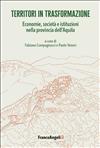
Territori in trasformazione

Economie, società e istituzioni nella provincia dell’Aquila

Questo volume propone una lettura originale delle trasformazioni territoriali della provincia dell’Aquila, assumendola come caso emblematico delle tensioni che attraversano molti territori montani. Il volume ricostruisce le traiettorie demografiche, economiche e sociali del territorio, mettendo in luce i meccanismi cumulativi che alimentano polarizzazione, vulnerabilità e disuguaglianze, ma anche le risorse e le opportunità su cui costruire strategie di sviluppo più efficaci.

cod. 11820.48

Antonio G. Calafati

Le città della terza Italia.

Evoluzione strutturale e sviluppo economico

Uno sguardo all’evoluzione strutturale recente delle città della Terza Italia, quella centrale, con lo scopo di identificare le strutture che determineranno le traiettorie di crescita e di sviluppo future. Obiettivo del testo è contribuire a definire un meta-modello per individuare le traiettorie potenziali di sviluppo delle città – e le politiche di regolazione – in una fase di profondo cambiamento dei fattori di competizione territoriale.

cod. 365.923

Andrea Cirilli, Paolo Veneri

Spatial structure and mobility patterns: towards a taxonomy of the Italian urban systems

RIVISTA DI ECONOMIA E STATISTICA DEL TERRITORIO

Fascicolo: 1 / 2009

Spatial structure and mobility patterns: towards a taxonomy of the Italian urban systems - Urban spatial organization has become a wide field of research in the last years, since it is thought to be an important determinant of the city’s performance from many points of view. Nevertheless, Italian urban spatial organization has not been studied in depth and a general description of the Italian urban territory is lacking. The aim of this work is to build a taxonomy of the Italian cities where the latter are conceptualised as agglomeration of contiguous municipalities on the basis of their patterns of spatial organization and commuting-to-work mobility. For this purpose, three preliminary steps had to be carried out. First of all, the major Italian urban systems have been identified, following a functional approach that is based on the principle of maximum self-containment of commuters’ flows. Secondly, original indicators have been built to gain a better understanding of cities’ spatial organization and of their patterns of mobility. Thirdly, the relation between these two dimensions has been investigated through a multivariate statistical analysis. The results of the analysis show that variables of spatial organization especially urban dispersion and of mobility patterns are closely related and that cities might be aggregated in five groups, ranging from the most compact and transitoriented cities to the most dispersed and car-oriented ones.

Andrea Cirilli, Paolo Veneri

Le città nello sviluppo economico dell'Emilia Romagna

RIVISTA DI ECONOMIA E STATISTICA DEL TERRITORIO

Fascicolo: 1 / 2007

Objectives Emilia Romagna is one of the largest and richest regions in Italy. Its development model and its spatial organization have raised much interest in the scientific as well as in the political debate. This region, in particular, shows a very clear-cut urban polycentrism, with most of the major cities being located along Via Emilia. The aim of this paper is to investigate the relation between urban and regional development in Emilia Romagna, in order to assess the role that each city has played in the long-run economic trajectory of this region. Methods and Results To gain a better understanding of the relation existing between urban and regional development, the long-run trajectories of the region’s major urban systems have been analysed comparatively, following a local development economics approach. The underlying idea in this paper is that regional development results from the sum of the local systems’ economic performances. In this perspective, the analysis has highlighted two stylized facts: firstly, a small number of relevant urban systems explain the bulk of the regional population and employment dynamics over the last five decades (1951-2001). Secondly, these urban systems have made different contributions to the region’s development. The comparative analysis, indeed, shows that these cities have followed different trajectories in the long-run, despite a common cultural and institutional background. Such differences in performance should be interpreted in the light of the structural heterogeneity among Emilia Romagna’s cities, as pointed out in this paper. It seems to be the case that the initial conditions of the urban systems have played a significant role in determining their long-run trajectories, through path-dependence mechanisms. The analysis is carried out using descriptive statistics that have been calculated on Italian Census data. The units of analysis are the 13 largest cities conceptualized as functional urban systems in the Emilia Romagna region in terms of population and employment levels in 2001. Conclusions The city performances within Emilia Romagna’s territory differ widely. Thus, more contributions should be made to explain why cities are characterized by heterogeneous structures and have reached different growth rates, despite a relatively homogenous territorial background. Given their heterogeneity and their importance in the regional economy, the urban systems of Emilia Romagna should become preferential units of analysis both for the researcher and the policy-maker. Policy-makers, in particular, should recognise the crucial role that such cities may play in the regional economic process and hence devise policies specifically tailored to them.