
RISULTATI RICERCA
La ricerca ha estratto dal catalogo 105550 titoli

This paper provides a sociological overview of the concept of social capital and explores how it is related to the notion of health. The theoretical section of the study addresses the issue of an operational definition of social capital and conducts detailed analysis of the dimensions and forms of the concept that stand out in terms of importance in the field of health research. It also takes into consideration the most significant causal mechanisms identified between social capital and health outcomes. The empirical part of the paper features analysis of data on the connection between social capital and self-perceived health, collected during the first survey conducted in Italy by the Osservatorio sulle Strategie di Consumo delle Famiglie (Observatory on Consumption Strategies in the Family). The survey shows that community social capital, generally expressed in terms of family trust, may, depending on the subject’s social milieu of origin, not play any role in determining the level of self-perceived health in Italy. Alternatively, it may play either of two roles, acting as a multiplier or a substitute with regard to positive causal processes determined by parameters of a socio-demographic nature.
The reflections of Davide Galesi are developed through three stages. At first, Galesi shows the different thereotical conceptions on social capital between macro (Putnam and Fukuyama) and micro (Bourdieu and Coleman) levels. At second, Galesi describes the use of the social capital concept in sociology of health and in epidemiology pointing out the lack of applications. Finally, Galesi proposes a link between social capital and not for profit organization, with examples in the organizational field.
The essay presents firstly the elements which constitute the concept of social capital we privilege in this contest, dwelling upon dimensions and levels they are composed of. Secondly it reports the results of a research conducted on young people living in the cities of Bologna and Trento about job meanings, the process of production of these meanings, and factors influencing their elaboration. The sociological perspective of research adopted, paying attention to the social construction of meanings, make it possible to point out how the social capital resources are often connected with the ways to relate to the job typical of the young people.
Il calcio italiano professionistico è stato definito dalla stampa e dalla TV un sistema malato e mercificato caratterizzato da numerose criticità e forme di comportamenti devianti messi in pratica da stili manageriali e sistemi di governance non sempre adeguati da parte delle società sportive. Le criticità evidenziate sono emerse già a partire dal 2006 grazie alla diffusione delle note vicende di Calciopoli. Le cause di tali criticità sono in parte riconducibili alla crisi finanziaria globale e in parte ad una cattiva gestione manageriale e di governance da parte delle società sportive che, negli ultimi dieci anni, hanno contribuito a trasformare lo sport più antico del mondo in una vera e propria industria culturale: dell’intrattenimento televisivo e dello spettacolo. Il presente lavoro intende stimolare delle riflessioni sulle eventuali cause responsabili dei comportamenti devianti che contraddistinguono questo mondo: a partire dalla situazione attuale di crisi economico-finanziaria che mette a dura prova molte delle società sportive in questione, e individuare le eventuali tipologie dei comportamenti che si sono configurati all’interno della struttura sociale del sistema e che hanno a che fare con il capitale sociale delle aziende che lo gestiscono.
This work provides some evidence for the Italian regions that social capital, under a broad definition, can have a positive impact on development outcomes. Our empirical analysis includes measures of social capital related to the enforcement of formal norms, the extent of social networks, the provision of local public goods. We show that in the less developed regions of Italy, the so-colled Mezzogiorno, the level of social capital is lower compared to the advanced regions and, at the same time, the productive activities born a smaller share of the cost due to the social capital deficit. This result leads to a «wrong» incentive towards the underinvestment in social capital and locks the Southern regions in a trap at a low level of both economic development and social capital development. Absent suitable shocks or policy interventions, this out-come is self-reinforcing.

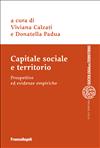
Capitale sociale e territorio.
Prospettive ed evidenze empiriche
I diversi contributi raccolti nel volume sviluppano riflessioni e casi di studio che rappresentano modalità e ambiti in cui il capitale sociale diventa risorsa di innovazione per lo sviluppo regionale, anche facendo leva sugli strumenti offerti dal digitale.
cod. 1561.101

Capitale sociale e territorio.
Risorse per l'azione locale
cod. 1740.103
This qualitative study sheds light on the nexus between social capital resources and CEO perceptions of competitive advantages and disadvantages in family firms. Drawing on a rich body of empirical evidence, the analysis shows that CEO perceptions differ depending on the owner-family’s degree of emotional attachment to or detachment from the business, emphasizing how the interactions between the family and the business system play a key role in shaping the CEO’s perceptions of competitive advantages and disadvantages in a family firm. Keywords: f

In view of the extension and indeterminacy of the metaphor of social capital, the aim of the paper is to provide a preliminary, theoretically valid foundation for the concept of social capital. It does so first by restricting the term’s semantic range to social relations of communitarian type (communitarian capital) and then by entirely abandoning the metaphor of capital and replacing it with the Parsonian concept of ‘generalized symbolic medium of interchange’. The conclusion of this process is that the medium of influence, institutionally based on prestige, is the concept corresponding to that of communitarian capital.
L’articolo intende esplorare il calcio come vettore d’integrazione degli immigrati (Ambrosini, 2017 e 2014). Il calcio amatoriale (Gasparini, 2018) ha consentito agli immigrati di sperimentare il dialogo con la comunità di accoglienza e il capitale sociale sportivo (Putnam, 2000; Coleman, 1988; Bourdieu, 1986, 1988, Vinnai, 2003) ha creato nuove forme di solidarietà tra etnie diverse. La ricerca ha analiz-zato la questione dell’integrazione attraverso l’impatto del capitale sociale del cal-cio amatoriale (Gasparini e Beaud, 2018; Gasparini, 2013; Vinnai, 2003). Lo stu-dio (Yin, 2013; Glaser e Strauss, 1967) è stato condotto in Sicilia (Ragusa e Gela). Sono state realizzate 60 interviste. Dai colloqui sono emersi i significati simbolici (Schütz, 1982) costruiti dagli immigrati nelle comunità d’accoglienza, scaturiti dal-le interazioni con gli operatori dei centri e gli istruttori della scuola calcio.
Assuming that the concept of social capital has a heuristic capacity if applied to the study of international migrations, the article employs it as a key to understand the features of Moroccan immigration in Lombardy, with specific attention to female immigration, which is less known and investigated by the research in Italy. By making use of the concept of social capital is possible to explain settlement strategies of the Moroccans and their integration dynamics in the local labour market. However, studying the peculiarity of these phenomena, it becomes clear that it is necessary to consider the different types of social capital as first Putnam and more recently Woolcock and Fiedl suggested, distinguishing by three types: bonding, bridging, linking in order to understand which one is the more common in an ethnic group, the Moroccans, that is described as a familistic community. Furthermore, the article tries to investigate both the link existing between social capital and human capital, and the role that local institutions could have in developing social capital.