The car as a necessity: the Bassa Pianura Bergamasca
Journal title TERRITORIO
Author/s Paola Pucci, Giovanni Lanza, Giulia Galbiati
Publishing Year 2026 Issue 2024/110
Language Italian Pages 13 P. 91-103 File size 516 KB
DOI 10.3280/TR2024-110009
DOI is like a bar code for intellectual property: to have more infomation
click here
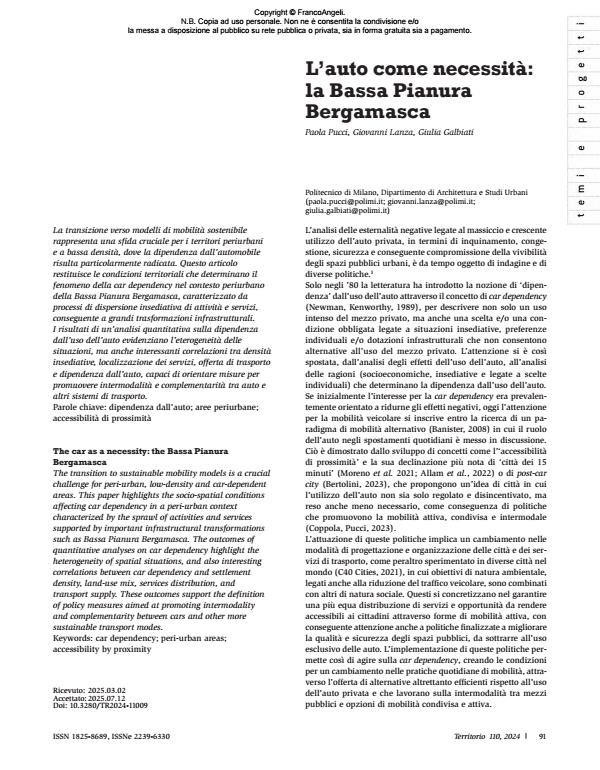
Below, you can see the article first page
If you want to buy this article in PDF format, you can do it, following the instructions to buy download credits
FrancoAngeli is member of Publishers International Linking Association, Inc (PILA), a not-for-profit association which run the CrossRef service enabling links to and from online scholarly content.
The transition to sustainable mobility models is a crucial challenge for periurban, lowdensity and cardependent areas. This paper highlights the sociospatial conditions affecting car dependency in a periurban context characterized by the sprawl of activities and services supported by important infrastructural transformations such as Bassa Pianura Bergamasca. The outcomes of quantitative analyses on car dependency highlight the heterogeneity of spatial situations, and also interesting correlations between car dependency and settlement density, landuse mix, services distribution, and transport supply. These outcomes support the definition of policy measures aimed at promoting intermodality and complementarity between cars and other more sustainable transport modes.
Keywords: car dependency; periurban areas; accessibility by proximity
- Alì A., Lanzani A., 2020, «Nello spazio periurbano della metropoli estesa». Territorio, 93: 3743. DOI: 10.3280/TR2020093006
- Allam Z., Bibri S.E., Chabaud D., Moreno C., 2022, «The ‘15Minute City’ concept can shape a netzero urban future». Humanities and Social Sciences Communications, 9, 1: 15.
- Bertolini L., 2020, «From ‘streets for traffic’ to ‘streets for people’». Transport Reviews, 40, 6: 734753. DOI: 10.1080/01441647.2020.1761907
- Bertolini L., 2023, «La città oltre l’automobile: fattori, potenzialità, sfide». In: Coppola P.L., Pucci P., Pirlo G. (a cura di), Mobilità & Città: verso una postcar city. Ottavo Rapporto Urban@it sulle città. Bologna: Il Mulino, 3346.
- Blandin L., Vecchio G., Hurtubia R., TiznadoAitken I., 2024, «Car dependency in the urban margins: The influence of perceived accessibility on mode choice». Transportation Research Part A: Policy and Practice, 184.
- Boeing G., 2020, «Off the Grid…and Back Again?». Journal of the American Planning Association, 87, 1: 123137. DOI: 10.1080/01944363.2020.1819382
- Buchanan C., 1963, Traffic in Towns The Buchanan Report. London: Penguin. C40 Cities Climate Leadership Group, C40 Knowledge Hub, 2021, «How to build back better with a 15 minutes city?». www.c40knowledgehub. org/s/article/Howtobuildbackbetterwitha15minutecity (accesso: 2025.01.14).
- Centro studi ‘Lelio Pagani’, 2022, Logistica e territorio geografie, governance territoriale e strumenti di regolazione/pianificazione. www.provincia.bergamo.it/cnvpbgrm/po/mostra_news.php?id=1211&area=H (accesso: 2025.01.12).
- Coppola P.L., Pucci P., 2023, «Post car city un modello in cerca di politiche». In: Coppola P.L., Pucci P., Pirlo G. (a cura di), Mobilità & Città: verso una postcar city. Ottavo Rapporto Urban@it sulle città. Bologna: Il Mulino.
- Dallari F., Curi S., 2020, a cura di, Regional Logistic Performance. La Regione Logistica Milanese e l’Europa a confronto. Milano: Camera di Commercio di Milano Monza Brianza Lodi, https://ester.milomb. camcom.it/sites/default/files/ricerca/allegati/RegionalLogisticsPerformance.pdf (accesso: 2025.01.11). Donolo C., 2007, Sostenere lo sviluppo. Ragioni e speranze oltre la crescita. Milano: Mondadori.
- Elldér E., Haugen K., Vilhelmson B., 2020, «When local access matters: A detailed analysis of place, neighbourhood amenities and travel choice». Urban Studies, 59, 1: 120139. DOI: 10.1177/0042098020951001
- Ewing R., Cervero R., 2010, «Travel and the Built Environment». Journal of the American Planning Association, 76, 3: 265294. DOI: 10.1080/01944361003766766
- Hunecke M., Haustein S., Böhler S., Grischkat S., 2008. «AttitudeBased Target Groups to Reduce the Ecological Impact of Daily Mobility Behavior». Environment and Behavior, 42, 1: 343.
- Jiang Y., Gu P., Chen Y., He D., Mao Q., 2017. «Influence of land use and street characteristics on car ownership and use: Evidence from Jinan, China». Transportation Research Part D: Transport and Environment, 52: 518534. DOI: 10.1016/J.TRD.2016.08.030
- Keller R., Vance C., 2013. «Landscape pattern and car use: Linking household data with satellite imagery». Journal of Transport Geography, 33: 250257. DOI: 10.1016/J.JTRANGEO.2013.07.006
- Lanza G., Pucci P., Carboni L., 2023, «Measuring accessibility by proximity for an inclusive city». Cities, 143, 104581.
- Litman T., 2007, ed., WinWin Transportation Solutions. Cooperation for Economic, Social and Environmental Benefits. Victoria: Victoria Transport Policy Institute. www.vtpi.org/winwin.pdf (accesso: 2025.01.12).
- Litman T., 2014, «Congestion Evaluation Best Practices», ITED 2014 International Transportation Economic Development Conference. www. vtpi.org/ITED_congestion.pdf (accesso: 2025.01.12).
- Mattioli G., Colleoni M., 2016, «Transport Disadvantage, Car Dependence and Urban Form». In: Pucci, P., Colleoni, M. (eds.), Understanding Mobilities for Designing Contemporary Cities. Research for Development. Cham: Springer.
- Mattioli G., Anable J., Vrotsou K., 2016, «Car dependent practices». Transportation Research Part A: Policy and Practice 89: 5672.
- Mattioli G., 2021, «Transport poverty and car dependence: A European perspective». Advances in Transport Policy and Planning, 8: 101133.
- Moreno C., Allam Z., Chabaud D., Gall C., Pratlong F., 2021, «Introducing the 15Minutes City: Sustainability, Resilience and Place Identity in Future PostPandemic Cities». Smart Cities 4, 1:93111.
- Newman P., Kenworthy J.R., 1989, Cities and automobile dependence: An international sourcebook. Aldershot: Gower Technical.
- Newman P., Kenworthy J., 2006, «Urban Design to Reduce Automobile Dependence». Opolis, 2: 3552, -- https://escholarship.org/uc/item/2b76f089 (accesso: 2025.01.09).
- Pucci P., 2020, «I territori dell’auto elettrica: oltre il paradigma urbanocentrico», Archivio di studi urbani e regionali, 128:1437. DOI: 10.3280/ASUR2020128003
- Pucci P., Carboni L., Lanza G., 2022, «Accessibilità di prossimità per una città più equa. Sperimentazione in un quartiere di Milano», Territorio, 99: 4052. DOI: 10.3280/TR2021099006
- Provincia di Bergamo, 2020, Piano Territoriale di Coordinamento Provinciale. www.provincia.bergamo.it/cnvpbgrm/zf/index.php/serviziaggiuntivi/index/index/idtesto/2256 (accesso: 2025.01.08). Regione Lombardia, 2022, Piano Territoriale Regionale della Lombardia. www.regione.lombardia.it/wps/portal/istituzionale/HP/DettaglioRedazionale/servizieinformazioni/entieoperatori/territorio/pianificazioneregionale/pianoterritorialeregionaleptr, (accesso: 2025.01.08). Saeidizand P., Fransen K., Boussauw K., 2022, «Revisiting car dependency: A worldwide analysis of car travel in global metropolitan areas». Cities, 120, 103467.
- Staricco L., Vitale Brovarone E., 2020, «Implementing TOD around suburban and rural stations». Urban Research & Practice, 13, 3: 276299. DOI: 10.1080/17535069.2018.1541475
- Yang, L., Ding C., Ju Y., Yu B., 2021. «Driving as a commuting travel mode choice of car owners in urban China: Roles of the built environment». Cities, 112: 103114. DOI: 10.1016/J.CITIES.2021.103114
- Yin C., Shao C., Wang X., 2019, «Exploring the impact of built environment on car use: does living near urban rail transit matter?». Transportation Letters, 12, 6: 391398. DOI: 10.1080/19427867.2019.1611196
- Tveter E., Welde M., 2022, «The wider local impacts of new roads: A case study of 10 projects». Transport Policy, 115: 164180.
- Wang X., Yin C., Zhang J., Shao C., Wang S., 2021. «Nonlinear effects of residential and workplace built environment on car dependence». Journal of Transport Geography, 96: 103207.
- Wiersma J., Bertolini L., Straatemeier T., 2016, «How does the spatial context shape conditions for car dependency?». Journal of Transport and Land Use, 9: 3555.
- Wiersma J.K., 2020, «Commuting patterns and car dependency in urban regions». Journal of Transport Geography, 84, 102700.
Paola Pucci, Giovanni Lanza, Giulia Galbiati, L’auto come necessità: la Bassa Pianura Bergamasca in "TERRITORIO" 110/2024, pp 91-103, DOI: 10.3280/TR2024-110009