Trasformazioni evolutive nella psicoterapia cognitiva
Journal title PSICOBIETTIVO
Author/s Alessandra Muscetta
Publishing Year 2013 Issue 2013/2
Language Italian Pages 14 P. 27-40 File size 135 KB
DOI 10.3280/PSOB2013-002003
DOI is like a bar code for intellectual property: to have more infomation
click here
Below, you can see the article first page
If you want to buy this article in PDF format, you can do it, following the instructions to buy download credits
FrancoAngeli is member of Publishers International Linking Association, Inc (PILA), a not-for-profit association which run the CrossRef service enabling links to and from online scholarly content.
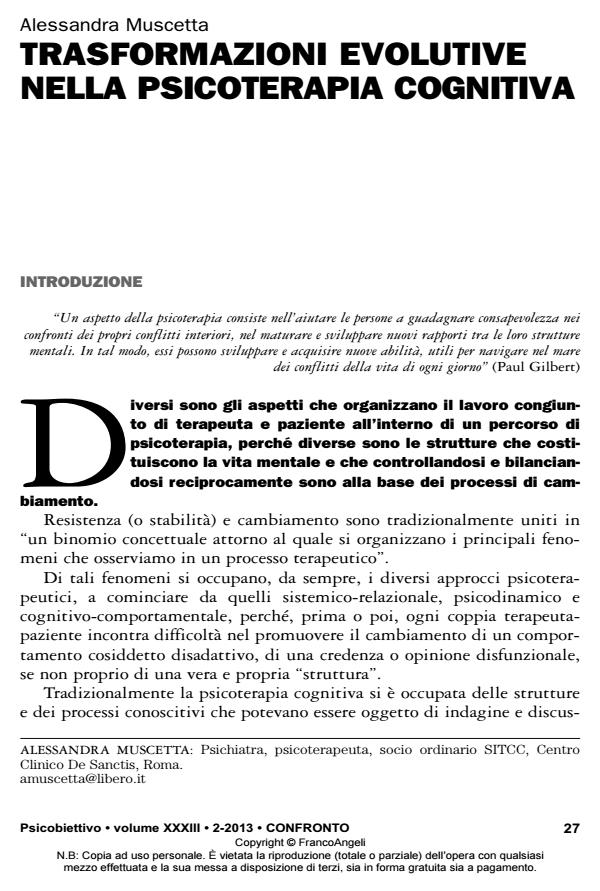
Looking at the very broad view of the clinical cognitive theory, the paper purposes some reflections on what are the active ingredients that lead to change during psychotherapy: reference is made to some of the major theoretical contributions, such as the Attachment Theory, the Control Mastery Theory and the Dialectical Model- Behavior. In recent years, all these theories have contributes to change the role of the cognitive therapist transforming him from a mere facilitator of change to a real "actor" who is active in the therapeutic process, allowing the expansion of strategies and intervention techniques integrating and strengthening them thanks to the phenomena observed in the therapeutic relationship. At this point the history of patient, his social skills and his motivational attitude help consistently the therapist in achieving the agreed goals through a renewed and more effective intrinsic motivation to care.
Keywords: Therapeutic Relationship; Adherence to Treatment; Interpersonal Cycles; Motivation; Change.
- Barnett J. et al. (2012) “Motivational Interviewing for adolescent substance use: A review of the literature”, Addictive Behaviors, 37, 12: 1325-1334
- Cionini L. (2002) Psicoterapie: modelli a confronto, Carocci, Roma
- Gilbert P. (1989) Human nature and suffering, Lawrence Erlbaum Ass., Hove
- Gilbert P., Leahy R.L. (2009) La relazione terapeutica in terapia cognitivo comportamentale, Eclipsi, Firenze
- Holmes J. (2004) Psicoterapia per una base sicura, Raffaello Cortina, Milano
- Lambruschi F. (2004) Psicoterapia cognitiva dell’età evolutiva. Procedure di assesment e strategie psicoterapeutiche, Bollati Boringhieri, Torino
- Liotti G. (1990) “La resistenza al cambiamento delle strutture cognitive”,
- Psicobiettivo, 10, 3
- Liotti G. (2012) Il paradigma relazionale nel cognitivismo clinico” in “La svolta relazionale, Raffaello Cortina, Milano
- Liotti G., Monticelli F. (a cura di) (2008) I sistemi motivazionali nel dialogo clinico, Raffello Cortina, Milano
- Manaresi F. (a cura di) (2012) L’intervento clinico in età evolutiva, Carocci, Roma
- Pancheri L., Paparo F. (2003) “Fattori terapeutici specifici: il self-righting”, Rivista di Psichiatria, 38, 3
- Safer D., Telch C., Chen E. (2012) Binge Eating e bulimia: il trattamento dialettico comportamentale, Raffello Cortina, Milano
- Safran J.D., Muran J.C. (2003) Teoria e pratica dell’alleanza terapeutica, Laterza, Roma-Bari
- Safran J.D., Segal Z.V. (2003) Il processo interpersonale in psicoterapia cognitiva, Feltrinelli, Milano
- Semerari A. (1996) “Resistenza e cambiamento in psicoterapia. il modello cognitivista”, Psicobiettivo, suppl. vol. 1
- Semerari A. (2000) Storia, teorie e tecniche della psicoterapia cognitiva, Laterza, Roma-Bari
- Shore A. (2003) La regolazione degli affetti e la regolazione del Sé, Astrolabio, Roma
Alessandra Muscetta, Trasformazioni evolutive nella psicoterapia cognitiva in "PSICOBIETTIVO" 2/2013, pp 27-40, DOI: 10.3280/PSOB2013-002003