Schelling’s Theory of Spatiality and its Realist Curvature in the Philosophy of Pavel Florensky.
Journal title RIVISTA DI STORIA DELLA FILOSOFIA
Author/s Andrea Dezi
Publishing Year 2019 Issue 2019/1
Language Italian Pages 23 P. 35-57 File size 101 KB
DOI 10.3280/SF2019-001003
DOI is like a bar code for intellectual property: to have more infomation
click here
Below, you can see the article first page
If you want to buy this article in PDF format, you can do it, following the instructions to buy download credits
FrancoAngeli is member of Publishers International Linking Association, Inc (PILA), a not-for-profit association which run the CrossRef service enabling links to and from online scholarly content.
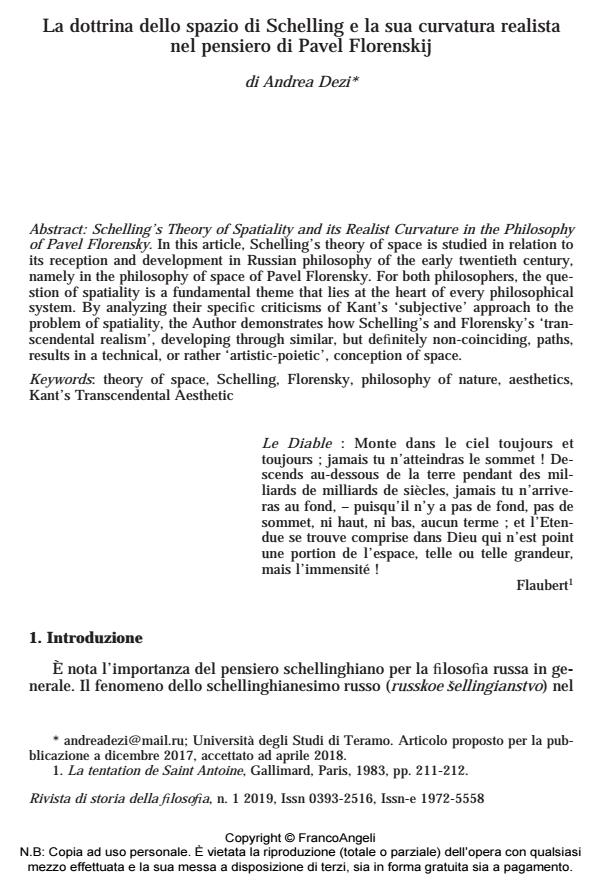
In this article, Schelling’s theory of space is studied in relation to its reception and development in Russian philosophy of the early twentieth century, namely in the philosophy of space of Pavel Florensky. For both philosophers, the question of spatiality is a fundamental theme that lies at the heart of every philosophical system. By analyzing their specific criticisms of Kant’s ‘subjective’ approach to the problem of spatiality, the Author demonstrates how Schelling’s and Florensky’s ‘transcendental realism’, developing through similar, but definitely non-coinciding, paths, results in a technical, or rather ‘artistic-poietic’, conception of space.
Keywords: Theory of space, Schelling, Florensky, philosophy of nature, aesthetics, Kant’s Transcendental Aesthetic
- - Schelling 2016: Friedrich Wilhelm Joseph Schelling, Sui principi sommi. Filosofia della rivelazione (1841/42), trad. it. a cura di Francesco Tomatis, Bompiani, 2016.
- - Schelling 2017: Friedrich Wilhelm Joseph Schelling, Sistema dell’intera filosofia e della filosofia della natura in particolare, trad. it. a cura di Andrea Dezi, Beatrix Editions, London, 2017.
- - SW (seguita da un numero romano indicante il volume, e la cifra araba indicante la pagina): Friedrich Wilhelm Joseph Schelling, F.W.J. von Schellings sämmtliche Werke, hg. v. Karl Friedrich August Schelling, Stuttgart und Augsburg, Cotta, 1856-61.
- - Bach 2005: Thomas Bach, (Hrsg.), Schelling in Rußland. Die frühen naturphilosophischen Schriften von Daniil Michajlovic Vellanskij. (1774-1847), Basilisken-Presse, Marburg/Lahn, 2005.
- - Berdjaev 1946: Nicolai Berdjaev, Russkaja ideja, YMCA Press, Paris, 1946.
- - Bielfeldt 2008: Sigrun Bielfeldt, Selbst oder Natur. Schellings Anfang in Rußland, Sagner, München, 2008.
- - Bosco 2005: Nynfa Bosco, Vladimir Solov’ëv. Cristianità e modernità, Messaggero, Padova, 2005.
- - Buchheim 2015: Thomas Buchheim, Die Idee des Existierenden und der Raum, «Kant-Studien», CVI, (2015), 1, pp. 36-66.
- - Choruˇzij 1996: Sergej Sergeeviˇc Choruˇzij, Filosofskij simvolizm P.A. Florenskogo I ego ˇziznennye istoki, in: Aa.Vv., P.A. Florenskij: pro et contra, RHGI, 1996, San Pietroburgo, pp. 525-557.
- - Dezi 2013: The Existence (Dasein) of Light. The Principle of Light as unprethinkable Being, in: Aa.Vv., Nature and Realism in Schelling’s Philosophy, Accademia University Press, Torino, 2013, pp. 115-130.
- - Dezi 2017a: Andrea Dezi, Lo spazio come riflesso della realtà dell’Assoluto. Note sull’evoluzione dell’ontologia schellinghiana, «Schelling-Studien, Internationale Zeitschrift zur klassischen deutschen Philosophie», V (2017), pp. 119-133.
- - Dezi 2017b: Andrea Dezi, L’identità della natura con il mondo delle idee, ovvero l’identità di Essere e Nulla nell’idealismo assoluto di Schelling, in Friedrich Wilhelm Joseph Schelling, Sistema dell’intera filosofia e della filosofia della natura in particolare, Beatrix Editions, London, 2017, pp. 613-638.
- - Florenskij 2000a: Pavel Aleksandroviˇc Florenskij, Soˇcinenija v ˇcetyrech tomach, Tomo 3,1, Mysl’, Mosca, 2000.
- - Florenskij 2000b: Pavel Aleksandroviˇc Florenskij, Stat’i i issledovanija po istorii i filosofii iskusstva i arheologii. Mysl’, Mosca, 2000.
- - Florenskij 2015: Pavel Aleksandroviˇc Florenskij, Iz istorii antiˇcnoj filosofii, Akademi ˇceskij Proekt, Mosca, 2015.
- - Florenskij 2016: Pavel Aleksandroviˇc Florenskij, Scritti sullo spazio, Vol. I, a cura di Andrea Dezi, Beatrix Editions, Londra, 2016.
- - Florenskij P.V. 2011: Pavel Vasil’eviˇc Florenskij, Obretaja put´: Pavel Florenskij v universitetskie gody, Vol. I, Progress-Traditsija, Mosca, 2011.
- - Genisaretskij 2000: Oleg Igoreviˇc Genisaretskij, Prostranstvennost’ v ikonologii i èstetike svjaˇsennika Pavla Florenskogo, in: Pavel Aleksandroviˇc Florenskij, Stat’i i issledovanija po istorii i filosofii iskusstva i arheologii. Mysl’, Mosca, 2000, pp. 9-46.
- - Gulyga 1992: Arsenij Gulyga, Schelling und der russische Idealismus des XX Jahrhunderts, «Deutsche Zeitschrift für Philosophie», XL (1992), 1-2, pp. 101-117.
- - Hamburg, Poole 2010: Gary M. Hamburg, Randall A. Poole, A History of Russian Philosophy. 1830-1930, Cambridge University Press, Cambridge, 2010.
- - Kamenskij 1980: Zakhar Kamenskij, Russkaja filosofija XIX veka i ˇSelling, Nauka, Mosca, 1980.
- - Kant 1968: Immanuel Kant, Kritik der reinen Vernunft, Suhrkamp Verlag, Frankfurt am Main, 1968.
- - Koyré 1929: Alexandre Koyré, La philosophie et le problème national en Russie au début du XIXe siècle, Librairie Honoré Champion, Paris, 1929.
- - Lazarev 1990: Valentin Lazarev, Filosofija rannego i pozdnego ˇSellinga, Nauka, Mosca, 1990.
- - Lipiˇc 2009: Tamara Lipiˇc, Russkoe romantiˇceskoe ˇsellingianstvo pervoj poloviny XIX v., «Vestnik Tambovskogo universiteta», VIII (2009), pp. 134-137.
- - Müller 2013: Olaf Müller, Goethes Pech mit Schelling. Optimistische Blicke auf ein ideengeschichtliches Fiasko, in: Aa.Vv., Nature and Realism in Schelling’s Philosophy, Accademia University Press, Torino, 2013, pp. 131-186.
- - Papadopoulo 1995: Alexandre Papadopoulo, SEUIL, Introduction à la philosophie russe, Paris, 1995.
- - Pavljuˇcenkov 2016: Nicolaj Pavljuˇcenkov, ˇSelling i russkoe bogoslovie XIX–XX vv., «Filaretovskij al’manach», XII (2016), pp. 155-172.
- - Pustarnakov 1998: Vladimir Pustarnakov, Filosofija ˇSellinga v Rossii, RChGI, San Pietroburgo, 1998.
- - Rezvych 2003: Petr Rezvych, Die Rezeption der Philosophie Schellings in Russland, «Philosophisches Jahrbuch», 110 (2), 2003, pp. 347-358.
- - Schelling 1989. Friedrich Wilhelm Joseph Schelling, Einleitung in die Philosophie, hg. von Walter Ehrhardt, frommann-holzboog, Stuttgart-Bad Cannstatt, 1989.
- - Schelling 2011: Friedrich Wilhelm Joseph Schelling, Invito alla filosofia, trad. it. A cura di Andrea Dezi, Accademia University Press, Torino, 2011.
- - Schelling 2014: Friedrich Wilhelm Joseph Schelling, Esposizione del processo della natura, trad. it. a cura di Andrea Dezi, Accademia University Press, Torino, 2014.
- L'idea dell'esistente e il mondo al di fuori dell'idea. Sull'Esposizione del processo della natura di Schelling del 1843/44 Ludovica Neri, in RIVISTA DI STORIA DELLA FILOSOFIA 4/2024 pp.580
DOI: 10.3280/SF2023-004004
Andrea Dezi, La dottrina dello spazio di Schelling e la sua curvatura realista nel pensiero di Pavel Florenskij in "RIVISTA DI STORIA DELLA FILOSOFIA" 1/2019, pp 35-57, DOI: 10.3280/SF2019-001003