When Perseverance is Diabolical: Exit, Voice, and Loyalty as Mechanisms for Sustaining Organizational Wrongdoing
Journal title SOCIOLOGIA DEL LAVORO
Author/s Sara Rocchi
Publishing Year 2025 Issue 2025/172
Language Italian Pages 18 P. 225-242 File size 197 KB
DOI 10.3280/SL2025-172011
DOI is like a bar code for intellectual property: to have more infomation
click here
Below, you can see the article first page
If you want to buy this article in PDF format, you can do it, following the instructions to buy download credits
FrancoAngeli is member of Publishers International Linking Association, Inc (PILA), a not-for-profit association which run the CrossRef service enabling links to and from online scholarly content.
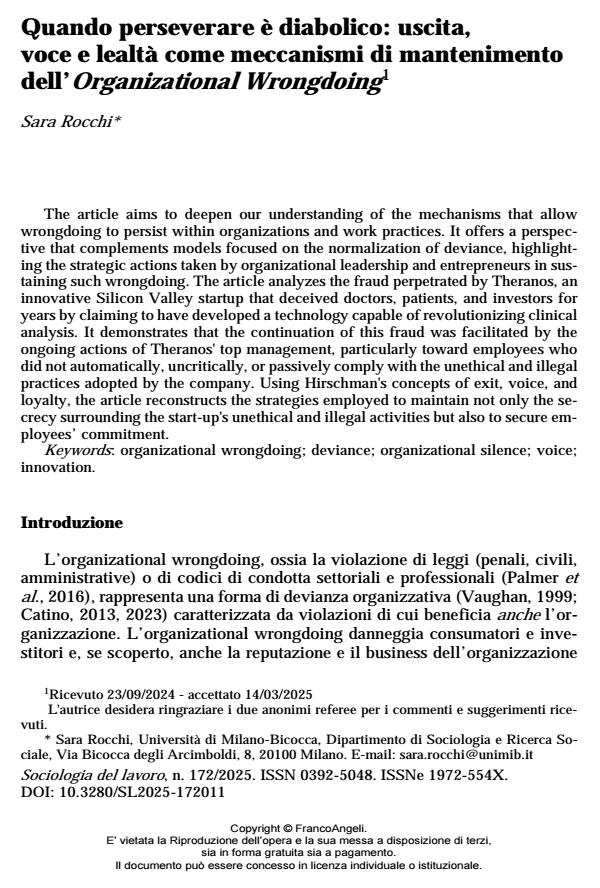
The article aims to deepen our understanding of the mechanisms that allow wrongdoing to persist within organizations and work practices. It offers a perspective that complements models focused on the normalization of deviance, highlighting the strategic actions taken by organizational leadership and entrepreneurs in sustaining such wrongdoing. The article analyzes the fraud perpetrated by Theranos, an innovative Silicon Valley startup that deceived doctors, patients, and investors for years by claiming to have developed a technology capable of revolutionizing clinical analysis. It demonstrates that the continuation of this fraud was facilitated by the ongoing actions of Theranos' top management, particularly toward employees who did not automatically, uncritically, or passively comply with the unethical and illegal practices adopted by the company. Using Hirschman's concepts of exit, voice, and loyalty, the article reconstructs the strategies employed to maintain not only the secrecy surrounding the start-up's unethical and illegal activities but also to secure employees’ commitment.
Keywords: organizational wrongdoing; deviance; organizational silence; voice; innovation.
- ABC News (2019). The Dropout (Part 1-4).
- Allen M.M.C. (2014). Hirschman and Voice. In: Wilkinson A., Donaghey J., Dundon T. e Freeman R., a cura di, The Handbook of Research on Employee Voice. Cheltenham and New York: Edward Elgar Press.
- Ashforth B., Anand V. (2003). The normalization of corruption in organizations. Research in Organizational Behavior, 25: 1-52. DOI: 10.1016/S0191-3085(03)25001-
- Burris E.R. (2012). The risks and rewards of speaking up: managerial responses to employee voice. The Academy of Management Journal, 55: 851-875.
- Butterfield K.D., Trevino L.K., e Weaver G.R. (2000). Moral Awareness in Business Organizations: Influences of Issue-Related and Social Context Factors. Human Relations, 53: 981-1018. DOI: 10.1177/001872670053700
- Carreyrou J. (2019). Una sola goccia di sangue. Segreti e bugie di una startup nella Silicon Valley. Milano: Mondadori.
- Catino M. (2013). Organizational Myopia: Problems of Rationality and Foresight in Organizations. New York: Cambridge University Press.
- Catino M. (2023). Scapegoating: How Organizations Assign Blame. Cambridge: Cambridge University Press.
- Colomer J.M. (2000). Exit, Voice, and Hostility in Cuba. The International Migration Review, 34: 423-442. DOI: 10.1177/01979183000340020
- Culiberg B., Mihelic K.K. (2017). The evolution of whistleblowing studies: A critical review and research agenda. Journal of Business Ethics, 146: 787-803.
- Dehkharghani L.L., Paul J., Maharati Y. e Menzies J. (2022). Employee silence in an organizational context: A review and research agenda. European Management Journal.
- Donaghey J., Cullinane N., Dundon T. e Wilkinson A. (2011). Reconceptualising employee silence: Problems and prognosis. Work, employment and society, 25: 51-67. 10.1177/0950017010389239
- Dowding K., John P., Mergoupis T. e Van Vugt M. (2000). Exit, voice and loyalty: Analytic and empirical developments. European Journal of Political Research, 37: 469-495. DOI: 10.1111/1475-6765.0052
- Dyer J., Gregersen H., Christensen C.M. (2011). The Innovator’s DNA. Mastering the five skills of disruptive innovators. Harvard: Harvard Business Review Press.
- Eisenhardt K.M., Graebner M.E. (2007). Theory building from cases: Opportunities and challenges. The Academy of Management Journal, 50: 25-32.
- European Commission (2018). Whistleblower Protection. Testo disponibile al sito: https:// ec.europa.eu/info/sites/info/files/placeholder_11.pdf. Ultimo accesso: 7 gennaio 2025
- Farrell D., Rusbult C.E. (1985). Understanding the retention function: A model of the causes of exit, voice, loyalty and neglect behaviors. Personnel Administrator, 30: 129-140. DOI: 10.1007/BF0138504
- Fleming P., Zyglidopoulos S., Boura M. e Lioukas S. (2022). How Corruption is Tolerated in the Greek Public Sector: Toward a Second-Order Theory of Normalization. Business & Society, 61: 191-224. DOI: 10.1177/000765032095486
- Gabbioneta C., Clemente M. e Greenwood R. a cura di (2023a). Organizational wrongdoing as the “foundational” grand challenge: definitions and antecedents, Vol. 84, London: Emerald Publishing Limited.
- Gabbioneta C., Clemente M. e Greenwood R. a cura di (2023b). Organizational wrongdoing as the “foundational” grand challenge: consequences and impact, Vol. 85, London: Emerald Publishing Limited.
- Galbraith J. (1977). Designing Complex Organizations. Reading, MA: Addison-Wesley.
- Garfinkel H. (1956). Conditions of Successful Degradation Ceremonies. American Journal of Sociology, 61: 420-424. DOI: 10.1086/22180
- Gephart R.P. (1978). Status Degradation and Organizational Succession: An Ethnomethodological Approach. Administrative Science Quarterly, 23: 553-581. DOI: 10.2307/239258
- Greve H., Palmer D. e Pozner J.E. (2010). Organizations Gone Wild: The Causes, Processes, and Consequences of Organizational Misconduct. Academy of Management Annals, 4: 53-107. DOI: 10.5465/1941652100365418
- Griffin III O.H. (2022). Promises, deceit and white-collar criminality within the Theranos scandal. Journal of White Collar and Corporate Crime, 3: 109-121. DOI: 10.1177/2631309X2095383
- Hildreth J., Gino F. e Bazerman M. (2016). Blind loyalty? When group loyalty makes us see evil or engage in it. Organizational Behavior and Human Decision Processes, 132: 16-36.
- Hirschman A.O. (1993). Exit, Voice, and the Fate of the German Democratic Republic: An Essay in Conceptual History. World Politics, 45: 173-202. DOI: 10.2307/295065
- Hirschman A.O. (1970). Exit, Voice, and Loyalty: Responses to Decline in Firms, Organizations, and States. Cambridge, MA: Harvard University Press.
- Hoffmann E.A. (2006). Exit and Voice: Organizational Loyalty and Dispute Resolution Strategies. Social Forces, 84: 2313-2330.
- Jones T.M. (1991). Ethical decision making by individuals in organizations: An issue-contingent model. Academy of Management Review, 16: 366-395. DOI: 10.2307/25886
- Kleinig J. (2022). Loyalty. Stanford Encyclopedia of Philosophy. Testo disponibile al sito: https://plato.stanford.edu/entries/loyalty/. Ultimo accesso: 2 settembre 2024.
- Kunda G. (1992). Engineering Culture: Control and Commitment in a High-Tech Corporation. Philadelphia: Temple University press.
- Lam L.W., Xu A.J. (2019). Power imbalance and employee silence: The role of abusive leadership, power distance orientation, and perceived organisational politics. Applied Psychology, 68: 3, 513-546. https://doi.org/10.1111/apps.12170
- Manzo C., Pais I. (2017). I fondatori di startup in Italia tra agency e struttura. Una ricerca esplorativa. Quaderni di Sociologia, 73: 9-28.
- Marciano C., Molino M. (2022). Spiriti Innovativi. Una ricerca empirica sulle caratteristiche personali e sul comportamento lavorativo degli innovatori in Italia. Sociologia del Lavoro, 162: 229-250. DOI: 10.3280/SL2022-16201
- Mergen A., Ozbilgin M.F. (2021). Understanding the Followers of Toxic Leaders: Toxic Illusio and Personal Uncertainty. International Journal of Management Reviews, 23: 45-63. https://doi.org/10.1111/ijmr.12240
- Milliken F.J., Morrison E.W. e Hewlin P.F. (2003). An Exploratory Study of Employee Silence: Issues that Employees Don’t Communicate Upward and Why. Journal of Management Studies, 40: 1453-1476. DOI: 10.1111/1467-6486.0038
- Morrison E.W., Milliken F.J. (2000). Organizational silence: a barrier to change and development in a pluralistic world. Academy of Management Review, 25: 706-731. DOI: 10.2307/25920
- O’Day R. (1974). Intimidation Rituals: Reactions to Reform. The Journal of Applied Behavioral Science, 10: 373-386. DOI: 10.1177/00218863740100031
- Pais I., Peretti P. e Spinelli C. (2014). Crowdfunding. La via collaborativa all’imprenditorialità. Milano: EGEA.
- Palmer D. (2012). Normal Organizational Wrongdoing: A Critical Analysis of Theories of Misconduct in and by Organizations. Oxford: Oxford.
- Palmer D., Smith-Crowe K. e Greenwood R., a cura di (2016). Organizational Wrongdoing: Key Perspectives and New Directions. New York: Cambridge University Press.
- Palmer D., Weiss T. (2022). The unique vulnerabilities of entrepreneurial ventures to misconduct. In: Eberhart R.N., Lounsbury, M. e Aldrich H.A., a cura di, Entrepreneurialism and society: New theoretical perspectives, vol. 81. London: Emerald Publishing Limited.
- Pfarrer M.D., DeCelles K.A., Smith K.G. e Taylor M.S. (2008). After the fall: Reintegrating the corrupt organization. Academy of Management Review, 33: 730-749.
- Pirone F. (2019). Il valore dell’imprenditorialità nel contesto della nuova cultura del capitalismo. In: Buffardi A. e Savonardo L., a cura di, Culture digitali, in-novazione e startup. Il modello Contamination Lab. Milano: EGEA.
- Ramella F. (2015). Sociologia dell’Innovazione Economica. Bologna: Il Mulino.
- Rest J.R. (1986). Moral development: Advances in research and theory. New York: Praeger.
- Rosso B.D., Dekas K.H. e Wrzesniewski A. (2010). On the meaning of work: A theoretical integration and review. Research in Organizational Behavior, 30: 91-127.
- Scheaf D.J., Wood M.S. (2022). Entrepreneurial fraud: A multidisciplinary review and synthesized framework. Entrepreneurship Theory and Practice, 46: 607-642. DOI: 10.1177/1042258721100181
- Schnatterly K., Gangloff K.A. e Tuschke A. (2018). CEO wrongdoing: A review of pressure, opportunity, and rationalization. Journal of Management, 44: 2405-2432. DOI: 10.1177/014920631877117
- Silver K., Garofalo P. (2024). Excusing Corporate Wrongdoing and the State of Nature. Academy of Management Review,
- Thérèse S., Martin B. (2010). Shame, scientist! Degradation rituals in science. Prometheus, 28: 97-110. DOI: 10.1080/08109028.2010.49486
- Tourish D., Willmott H. (2023). Despotic leadership and ideological manipulation at Theranos: Towards a theory of hegemonic totalism in the workplace. Organization Studies, 44: 1801-1824. DOI: 10.1177/0170840623117180
- U.S. District Court (2020). Third Superseding Indictment UNITED STATES OF AMERICA ELIZABETH A. HOLMES and RAMESH "SUNNY" BALWANI, CR 18-0258 EJD.
- Vaughan D. (1999). The Dark Side of Organizations: Mistake, Misconduct, and Disaster. Annual Review of Sociology, 25: 271-305.
- Warren D.E. (2019). The persistence of organizational deviance: When informal sanctioning systems undermine formal sanctioning systems. Business ethics quarterly, 29: 1, 55-84.
- Williams M. (2022). Elizabeth Holmes and Theranos: A play on more than just ethical failures. Business Information Review, 39: 23-31. DOI: 10.1177/0266382122108889
- Withey M.J., Cooper W.H. (1989). Predicting exit, voice, loyalty, and neglect. Administrative Science Quarterly, 34: 521-539. DOI: 10.2307/239356
Sara Rocchi, Quando perseverare è diabolico: uscita, voce e lealtà come meccanismi di mantenimento dell’Organizational Wrongdoing in "SOCIOLOGIA DEL LAVORO " 172/2025, pp 225-242, DOI: 10.3280/SL2025-172011