From the political ecology of industrial plantations to the restoration of more-than-human livability: ecological repair in the late-industrial landscape in Gela, Sicily

Journal title ARCHIVIO STORICO PER LA SICILIA ORIENTALE
Author/s Alessandro Lutri, Manuel Andrea Zafarana
Publishing Year 2025 Issue 2023/1-2
Language Italian Pages 30 P. 219-248 File size 243 KB
DOI 10.3280/ASSO2023-002-010
DOI is like a bar code for intellectual property: to have more infomation click here

Below, you can see the article first page

If you want to buy this article in PDF format, you can do it, following the instructions to buy download credits
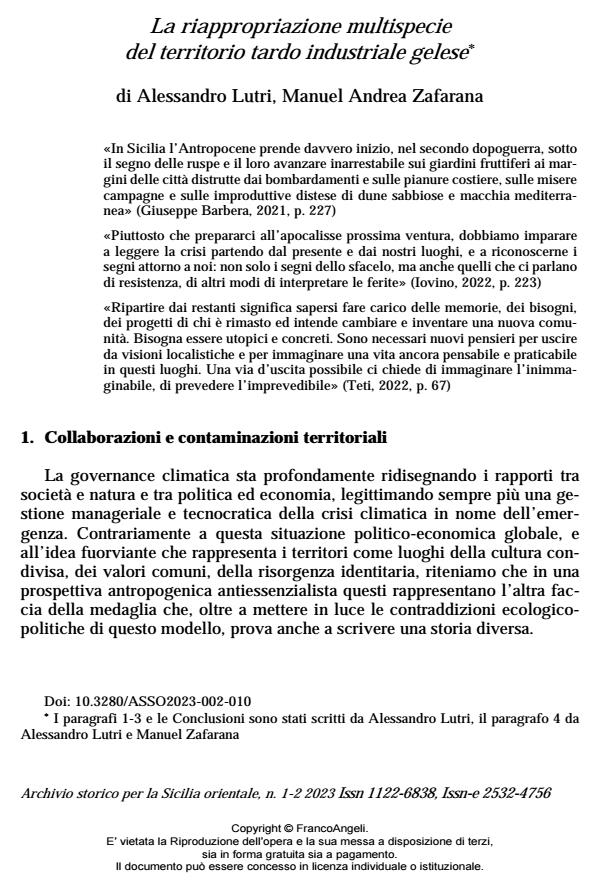
Article preview

FrancoAngeli is member of Publishers International Linking Association, Inc (PILA), a not-for-profit association which run the CrossRef service enabling links to and from online scholarly content.

In a processual and transformative perspective, the issue keep in mind the challenge of American anthropologist Anna Tsing to “take threats to livability very seriously”, focusing the ethnographic attention about “the risorgence of livability more-than-human” in the late-industrialism landscape of Gela. A multispecies risorgence which sign the movement from the ecology of industrial plantations (agricultural and fossil) of Sixty-Seventy years, to a multispecies ecology in the Ninety- Twenty thousand years, oriented beyond the conservation of biodiversity, through an innovative agroecological production. This socioecological deep transformation began with the re-ownership of late-industrialist landscape, through the increment of biodiversity produced by the stagional arrive white storks in past decade, and through the ecological-political engagement of environmental local actvists, with the conservative and agroecological project “Geloi Wetland”. The issue show how the growth of biodiversity, the experiences and projects of nature conservation in landscape of Gela, are the product to stand out of multispecies sociality sustained by ecological-politic projects which clashing the “ecology of proliferation [that] kill the lively beings which are not recognize as resources [that] promotes illness and pollution”. By a transformative anthropology, the engagement to “take threats to livability very seriously” it has been translate in a ontological transformation of anthropological lens in a multispecies sense, including beyond the anthropogenic human mark also the ecology of more-than-human relationships.

Keywords: Gela, industrial plantations, environmentalism, multispecies ethnography, more-than-human livability.

  1. Becucci, S., (a cura), 2004, La città sospesa. Legalità, sviluppo e società civile a Gela, EGA editore, Torino
  2. Barbera, G., 2021, Il giardino del Mediterraneo. Storie e paesaggi da Omero all’Antropocene, Il Saggiatore, Milano
  3. Benadusi, M., Lutri, A., Sajia, L., 2021, L’Antropocene capovolto. Agire con i terri-tori, accorciare le distanze, in Benadusi, M., Lutri, A., Sajia, L. (a cura), Si putis-si. Riappropriazione, gestione e recupero dei territori siciliani, Ed.it, Firenze, pp. 9-43
  4. Bense, A.R., 2006, Was Sie schon immer über den Klapperstorch wissen wollten.. Zu den kulturhistorischen Grundlagen des Kinderbringers. Charadrius, 41(1-2), 66-73.
  5. Bianchi, F., Lutri, A., 2018, Un altro mondo è possibile. Collaborare per trasforma-re, in «Cambio. Rivista sulle trasformazioni sociali», vol. 1, n. 15, pp. 5-14
  6. Bindi, L., Conti, M., Belliggiano, A., 2022, “Sense of Place, Biocultural Heritage, and Sustainable Knowledge and Practces in Three Italian Rural Regeneration Processes”, in Sustainability, vol. 14
  7. Brightman, M., Lewis, J. (eds), 2017, The Anthropology of Sustainability. Beyond Development and Progress, Palgrave, New York
  8. Comunale D., Maraffa I. & Balsamo S., 2023, La via Fabaria 300 chilometri in cammino da Agrigento all’Etna, Logo srl, Borgoricco (PD)
  9. Dugan P. J. & Jones T., 1995, Ecological change in wetlands: a global overview. Waterfowl and Wetland Conservation in the 1990s: A Global Perspective, 34-38
  10. Ferger S.W. & Schwaderer G., 2016, The European Stork Villages – a successful combination of nature conservation and sustainable development of rural are-as, In: The White Stork: studies in biology, ecology and conservation Eds. L. Jerzak, J. Shephard, J.I. Aguirre, J. Shamoun-Baranes, P. Tryjanowski Zielona Góra
  11. Huryna H., Brom J. & Pokorny J., 2014, The importance of wetlands in the energy balance of an agricultural landscape. Wetlands Ecology and Management, 22 (4): 363-381.
  12. Kiik, L., 2018, “Wild-ing the Ethnography of Conservation: Writing’s Nature Value and Agency In”, in Anthropological Forum, vol. 28, n. 3, pp. 217-235
  13. Kiik, L., 2019, “Conservationland: toward the anthropology of professionals in global nature conservation”, in Critique of Anthropology, vol. 39, n. 4, pp. 391-419
  14. Kronenberg J., Bochenski M., Dolata P.T., Jerzak L., Profus P., Tobólka M., Tryjanowski P., Wuczynski A. & Zolnierowicz K.M., 2013, Znaczenie bociana bialego Ciconia ciconia dla spoleczenstwa: analiza z perspektywy koncepcji uslug ekosystemów [The social importance of White Stork Ciconia ciconia: an analysis from the perspective of ecosystem services]. Chronmy Przyrode Ojczysta 69 (3), pp. 3-27
  15. Kronenberg, J., Andersson, E., Tryjanowski, P., 2017, “Connecting the social and the ecological in the focal species concept: case study of White Stork”, in Na-ture Conservation, vol. 22, pp. 79-105
  16. Kuemmerle T., Hostert P., Radeloff V. C., van der Linden S., Perzanowski K. & Kruhlov I., 2008. Cross-border comparison of post-socialist farmland aban-donment in the Carpathians. Ecosyst. 11, pp. 614-628.
  17. Junk W. J., An S., Finlayson C. M., Gopal B., Kvet J., Mitchell S. A., Mitsch W. & Robarts R. D., 2013, Current state of knowledge regarding the world’s wetlands and their future under global climate change: a synthesis. Aquatic sciences, 75(1): 151-167.
  18. Iovino, S., 2022, Paesaggio civile. Storie di ambiente, cultura e resistenza, Il Sag-giatore, Milano
  19. Marchioni, M., Hytten, E., 1970, Industrializzazione senza sviluppo. Gela, una sto-ria meridionale, Franco Angeli, Milano
  20. Monbiot, G., 2022, Il futuro è sottoterra. Un’indagine per sfamare il mondo senza divorare il pianeta, Mondadori, Milano
  21. Monbiot, G., Tozzi, A., 2018, Selvaggi. Il rewilding della terra, dei mari e della vita umana, Piano B, Milano
  22. Mongelli F., D’Alessandro G., Vicari G.V., Vicari M., Buscemi P., Rizzo R.A., Liar-do V., Zafarana S. & Ravalli T.+, 2022, Museo Civico Niscemi, Ragusa Prin-tart.
  23. Moore, H., 2017, “What Can sustainability Do For Anthropology ? in Brightman, M., Lewis, J. (eds), The Anthropology of Sustainability. Beyond Development and Progress, Palgrave, New York, pp. 67-80
  24. Nilsson L., 1989, 500 år i Skåne? Den vita storkens historia i Sverige. Anser 28: 115-124
  25. Orlowski G., 2005, Endangered and declining bird species of abandoned farmland in south-western Poland, Agr. Ecosyst. Environ. 111: 231-236.
  26. Orlowski G., 2010, Effect of boundary vegetation and landscape features on di-versity and abundance of breeding bird community of abandoned crop fields in south-western Poland. Bird Study 57: 175-182.
  27. Pellizzoni, L., 2011, “Il futuro di un’area a rischio: ambiente, economia e società”, in Saitta., P., Spazi e società a rischio. Ecologia, petrolio e mutamento a Gela, Think Thanks edizioni, Napoli, p. 177-205
  28. Rimberth C., 2013, The swedish white stork reintroduction programme. Lund Uni-versity, Lund, 67.
  29. Rival, L., 2017, “Anthropology and the Nature-Society Development Nexus”, in Brightman, M., Lewis, J. (eds), The Anthropology of Sustainability. Beyond Development and Progress, Palgrave, New York, pp. 183-206
  30. Saitta., P., 2011, Spazi e società a rischio. Ecologia, petrolio e mutamento a Gela, Think Thanks edizioni, Napoli
  31. Schleupner C., 2010, GIS-based estimation of wetland conservation potentials in Europe. In International Conference on Computational Science and Its Appli-cations (pp. 193-209). Springer, Berlin, Heidelberg.
  32. Strang, V., “The Gaia Complex: Ethical Challenges to an Anthropocentric Com-mon Future”, in Brightman, M., Lewis, J. (eds), The Anthropology of Sustaina-bility. Beyond Development and Progress, Palgrave, New York, pp. 207-228
  33. Teti, V., 2022, La restanza, Einaudi, Torino
  34. Trigilia, C., 1992, Sviluppo senza autonomia. Effetti perversi delle politiche nel Mezzogiorno, Il Mulino, Bologna
  35. Trigilia, C., 1998, “Il Sud in mezzo al guado”, in Meridiana. Rivista di storia e scienze sociali, n. 31, pp. 89-98
  36. Tsing, A., 2017, “A Threat to Holocene Resurgence Is a Threat to Livability”, in Brightman, M., Lewis, J. (eds), The Anthropology of Sustainability. Beyond Development and Progress, Palgrave, New York, pp. 51-67
  37. Tsing, A., 2021, Il fungo alla fine del mondo. La possibilità di vivere nelle rovine del capitalismo, Keller, Rovereto (ediz. orig. 2015)
  38. Tsing, A., Mathews, S., Bubandt, N., 2019, “Patchy Anthropocene: Landscape Structure, Multispecies History, and Retooling of Anthropology”, in Current Anthropology, Vol. 60, Supplement 20, pp. 186-97
  39. Zafarana M.A., 2020. La Cicogna bianca (Ciconia ciconia) in Sicilia: biologia e azioni di conservazione del progetto Geloi Wetland, Tesi di dottorato in Scienze della Terra e dell’Ambiente XXXIII Ciclo 2017-2020, Università degli Studi di Catania.
  40. Zafarana M.A., Rannisi G, Grasso R., Spena M.T., Murabito L., Rizzo F. & Surdo S., 2020. La Cicogna bianca Ciconia ciconia (Aves Ciconiidae) in Sicilia: ag-giornamento a trent’anni dalla colonizzazione, in Naturalista siciliano, S. IV, XLIV (1-2): 95-114.
  41. Zafarana M.A. & Lutri A., 2022. L’Antropocene nella terra dei fuochi gelese. Ri-comporre i legami economici e socio ecologici con Geloi Wetland. 1° Convegno SISAm - Società Italiana di Storia Ambientale. Catania, 22/24 Settembre 2022. DOI: 10.13140/RG.2.2.29031.32169

Alessandro Lutri, Manuel Andrea Zafarana, La riappropriazione multispecie del territorio tardo industriale gelese in "ARCHIVIO STORICO PER LA SICILIA ORIENTALE" 1-2/2023, pp 219-248, DOI: 10.3280/ASSO2023-002-010