Technical and environmental cost-benefit analysis of strategies towards a green economy in the electricity sector in Libya
Journal title ECONOMICS AND POLICY OF ENERGY AND THE ENVIRONMENT
Author/s Yasser F. Nassar, Hala J. El-Khozondar, Mansour A. Salem, Abubaker Alatrash, Wael A. Salah, Mohammed J. Bashir, Mohamed H. Elnaggar
Publishing Year 2025 Issue 2025/2
Language English Pages 35 P. 133-167 File size 1028 KB
DOI 10.3280/EFE2025-002007
DOI is like a bar code for intellectual property: to have more infomation
click here
Below, you can see the article first page
If you want to buy this article in PDF format, you can do it, following the instructions to buy download credits
FrancoAngeli is member of Publishers International Linking Association, Inc (PILA), a not-for-profit association which run the CrossRef service enabling links to and from online scholarly content.
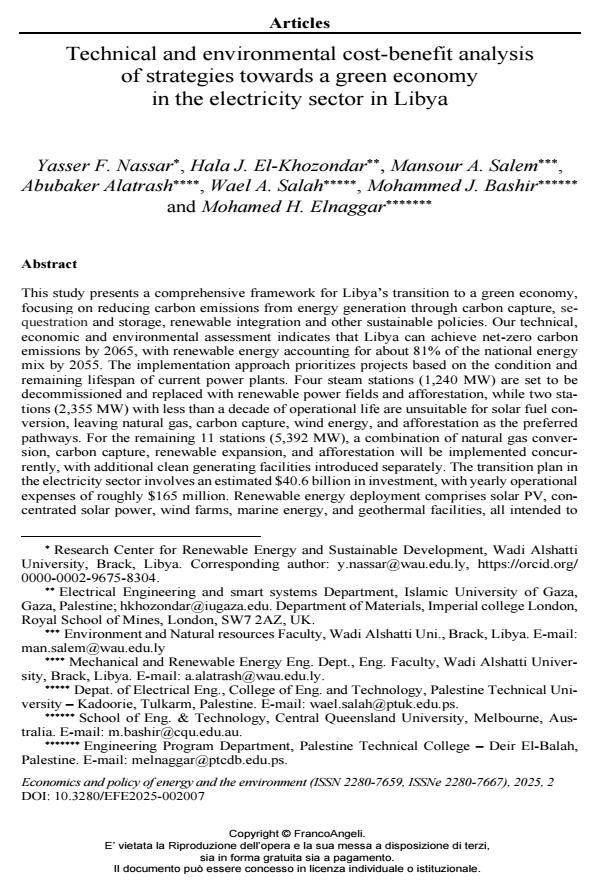
This study presents a comprehensive framework for Libya’s transition to a green economy, focusing on reducing carbon emissions from energy generation through carbon capture, sequestration and storage, renewable integration and other sustainable policies. Our technical, economic and environmental assessment indicates that Libya can achieve netzero carbon emissions by 2065, with renewable energy accounting for about 81% of the national energy mix by 2055. The implementation approach prioritizes projects based on the condition and remaining lifespan of current power plants. Four steam stations (1,240 MW) are set to be decommissioned and replaced with renewable power fields and afforestation, while two stations (2,355 MW) with less than a decade of operational life are unsuitable for solar fuel conversion, leaving natural gas, carbon capture, wind energy, and afforestation as the preferred pathways. For the remaining 11 stations (5,392 MW), a combination of natural gas conversion, carbon capture, renewable expansion, and afforestation will be implemented concurrently, with additional clean generating facilities introduced separately. The transition plan in the electricity sector involves an estimated $40.6 billion in investment, with yearly operational expenses of roughly $165 million. Renewable energy deployment comprises solar PV, concentrated solar power, wind farms, marine energy, and geothermal facilities, all intended to replace old units and meet future demand. Pilot projects like the Brack hybrid renewable station demonstrate that complete energy coverage may be achieved while lowering dependency on fossil fuels and CO2 emissions. Furthermore, largescale afforestation initiatives will help to reduce carbon emissions and ensure further environmental benefits, with return on investment through the sale of CO2 credits commencing within the first few years. Collectively, these policies provide a realistic route for Libya to develop a sustainable, diverse, and lowcarbon power industry.
Keywords: Green economy, energy industry, alternative and environmentally friendly energies, negative carbon emission systems, netzero carbon.
Jel codes: Q01, Q21, Q35, Q48, Q51
- Techno economic analysis of 60 MW wind power farm in Agadez and Tahoua regions for grid connected electricity production Ismaïlou Manzo, Abdou Latif Bonkaney, Acoucacar Ali, Saïdou Madougou, in The Engineering Economist /2026 pp.1
DOI: 10.1080/0013791X.2026.2677887 - High-Resolution Assessment of the Impact of Geographic Variations and Roof Parameters on PV Performance in Ireland Aiza Ahmad, Niamh Power, Evan Finegan, in Solar Energy Advances 100150/2026 pp.100150
DOI: 10.1016/j.seja.2026.100150 - Performance evaluation of solar irradiance transposition models and seasonal tilt angle optimisation using long-term data in a semiarid climate Saaransh Choudhary, Shiv Lal, Sumit Verma, in Next Energy 100728/2026 pp.100728
DOI: 10.1016/j.nxener.2026.100728 - Multi-scenario optimization of future energy mix for strategic energy planning in Morocco Hamza El Hafdaoui, Mohammed Abbas Hattati, Nouriddine Houran, Oumaima Mahir, Abdelilah Rochd, in Renewable Energy Focus 100828/2026 pp.100828
DOI: 10.1016/j.ref.2026.100828 - Multi-algorithm optimization of hybrid biomass-wind-solar energy systems for sustainable regional power supply Moslema Hoque Oeishee, Munyem Ahammad Muyeed, A.S. Nazmul Huda, Shameem Hasan, Shameem Ahmad, in Energy Conversion and Management: X 102182/2026 pp.102182
DOI: 10.1016/j.ecmx.2026.102182 - Review on multi-source, multi-storage hybrid renewable energy systems in agricultural energy efficiency Ikram Beraoud, Mhamdi Hicham, Abdelkarim El Khantach, Reda Yaagoubi, Hakim Bennani, Jmili Mohammed, Guissi Khalid, in Results in Engineering 112306/2026 pp.112306
DOI: 10.1016/j.rineng.2026.112306 - Shifting carbon emission dominance across subway lifecycle phases: A refined subsystem-interaction assessment Jing Pu, Chen Cai, Shijun Chen, Ru Guo, Ruimin Lin, Xingyu Ding, Jia Liu, Kaiming Peng, Xiangfeng Huang, in Environmental Impact Assessment Review 108485/2026 pp.108485
DOI: 10.1016/j.eiar.2026.108485 - Towards Resilient and Decarbonized Energy Systems: A Multi-Agent Approach to Microgrid Coordination Marcel García, Jose Aguilar, Donghui Shi, in Renewable Energy Focus 100874/2026 pp.100874
DOI: 10.1016/j.ref.2026.100874 - Defying Uncertainty: Reliable Barrier Coverage in Unstable Energy-Harvesting Networks Pei Xu, Shi-Long Han, Chih-Yung Chang, Diptendu Sinha Roy, in IEEE Sensors Journal /2026 pp.23439
DOI: 10.1109/JSEN.2026.3706080 - Large-scale substitution of natural gas with electrical counterparts in residential and commercial sector of a developing country Muhammad Junaid Khan Jadoon, Syed Ali Abbas Kazmi, Zafar A. Khan, Fahim Ahmed Ibupoto, in Renewable Energy Focus 100909/2026 pp.100909
DOI: 10.1016/j.ref.2026.100909 - Energy storage and flexibility sizing for renewable integration pathways:A multi-stage techno-economic optimisation framework Gergo Varhegyi, Mutasim Nour, in Renewable Energy Focus 100910/2026 pp.100910
DOI: 10.1016/j.ref.2026.100910 - Aerodynamic loads on a rooftop PV tracker: SST–RANS analysis across a full tilt sweep Shchasiana Arhun, Dmitrij Bogdan, Andrii Avershyn, Alexey Voropay, Oleksandr Dziubenko, Andrii Hnatov, in Engineering Applications of Computational Fluid Mechanics 2654927/2026
DOI: 10.1080/19942060.2026.2654927 - Techno-economic and environmental feasibility of large-scale hybrid renewable energy system for coastal megaprojects: a case study of Ras El-Hekma, Egypt Ahmed Sobhy, Mona Mohamed, Ahmed Kalas, Medhat H. Elfar, in Scientific Reports 19376/2026
DOI: 10.1038/s41598-026-58436-8 - AI for EV battery health: Statistical meta-analysis and Autonomous Intelligence Pyramid Subrahmanyam Tanala, Appalabathula Venkatesh, in Next Sustainability 100461/2026 pp.100461
DOI: 10.1016/j.nxsust.2026.100461 - Risk prioritization in Libyan construction projects using FAHP: political and financial drivers in a fragile environment Ali Gassim Shetwan, Sassi Rekik, Delmaria Richards, Yasser Nassar, Athar Bahjat Abu Ajina, Johnson Herlich Roslee Mensah, in Discover Civil Engineering 31/2026
DOI: 10.1007/s44290-026-00419-9 - Synchronous condenser allocation for enhanced stability of renewable energy-dominated grids Dhanuja Lekshmi J, Chitaranjan Phurailatpam, Zakir H Rather, in Renewable Energy Focus 100906/2026 pp.100906
DOI: 10.1016/j.ref.2026.100906 - Analysis of a grid/wind/hydrogen hybrid energy system for producing electricity, vehicle fuel and freshwater for Gaza Strip-Palestine Hala J. El-Khozondar, Yasser F. Nassar, Rifa J. El-Khozondar, Mohamed Elnaggar, Wael A. Salah, Sassi Rekik, Monaem Elmnifi, Mohamed Khaleel, Llahm Omar Ben Dalla, in Fuel 140358/2027 pp.140358
DOI: 10.1016/j.fuel.2026.140358 - Carbon footprint life cycle assessment of cement industry in Libya Mohamed A. Inweer, Hassan A. Salem, Khalid A. Khalid, Yasser F. Nassar, Mansour A. Salem, Abdelsalam A. Akasha, Khaled A. Amer, Monaem Elmnifi, Sassi Rekik, Mohamed Khaleel, Hala J. El-Khozondar, in Discover Concrete and Cement 37/2025
DOI: 10.1007/s44416-025-00037-1 - Adaptive multi-operator differential evolution based on binary tree population for optimal power flow with stochastic wind and solar power Jinhan Yao, Xu Chen, Ye Yuan, in Renewable Energy Focus 100902/2026 pp.100902
DOI: 10.1016/j.ref.2026.100902 - Applying MO-Jaya and machine learning to evaluate mixed renewable energy schemes for rural electrification Belal A. M. Abuhamra, Ashley Olebogeng, in Environment, Development and Sustainability /2026
DOI: 10.1007/s10668-026-07678-7 - Energy balance and economic analysis of rural distributed generation systems using biogas Andriele Rimoldi, Samuel Nelson Melegari de Souza, Juliano de Souza, Doglas Bassegio, Joseane Bortolini, Michael Collin Vargas, in Waste Management & Research: The Journal for a Sustainable Circular Economy 0734242X261462307/2026
DOI: 10.1177/0734242X261462307 - Comparative performance analysis for solar tracking systems in mid-latitude climates: Insights from a one-year experimental study Ali Kibar, Ogan Karabaş, Mehmet Bayraktutar, Serkan Sezen, Engin Özdemir, Abdülvehhab Kazdaloğlu, Muzaffar Ali, Ahmet Çağlar, Kadri Süleyman Yiğit, in Proceedings of the Institution of Mechanical Engineers, Part C: Journal of Mechanical Engineering Science 09544062261470274/2026
DOI: 10.1177/09544062261470274 - Dynamic expert project assessment for green wind energy park investments via molecular fuzzy reinforcement learning decision-making technique Gang Kou, Serhat Yüksel, Hasan Dinçer, Merve Acar, Serkan Eti, Ümit Hacıoğlu, in International Journal of Electrical Power & Energy Systems 111835/2026 pp.111835
DOI: 10.1016/j.ijepes.2026.111835 - Optimization of building thermal and electrical energy consumption through heat recovery from cryptocurrency miners Abolfazl Gargoori Motlagh, Matin Ahmadi Renani, Mehran Hajiaghapour-Moghimi, Mehdi Vakilian, Mehrdad Setayesh Nazar, in Next Energy 100771/2026 pp.100771
DOI: 10.1016/j.nxener.2026.100771
Yasser F. Nassar, Hala J. El-Khozondar, Mansour A. Salem, Abubaker Alatrash, Wael A. Salah, Mohammed J. Bashir, Mohamed H. Elnaggar, Technical and environmental cost-benefit analysis of strategies towards a green economy in the electricity sector in Libya in "ECONOMICS AND POLICY OF ENERGY AND THE ENVIRONMENT" 2/2025, pp 133-167, DOI: 10.3280/EFE2025-002007