How can abuses of power be prevented, treated, and sanctioned in psychoanalysis? The proposal of the “fourth pillar” of psychoanalytic training
Journal title PSICOTERAPIA E SCIENZE UMANE
Author/s Giovanni Foresti
Publishing Year 2025 Issue 2025/4
Language Italian Pages 7 P. 622-628 File size 271 KB
DOI 10.3280/PU2025-004003
DOI is like a bar code for intellectual property: to have more infomation
click here
Below, you can see the article first page
If you want to buy this article in PDF format, you can do it, following the instructions to buy download credits
FrancoAngeli is member of Publishers International Linking Association, Inc (PILA), a not-for-profit association which run the CrossRef service enabling links to and from online scholarly content.
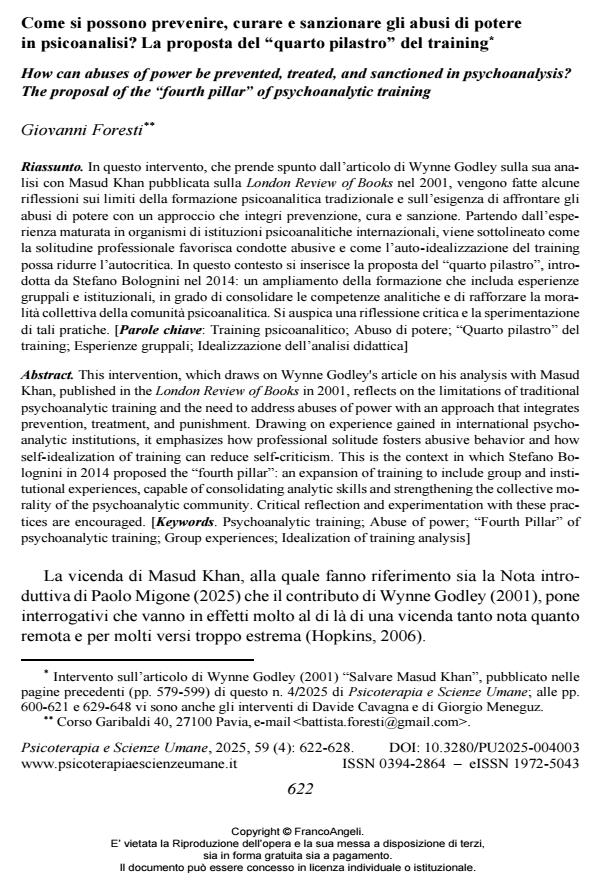
This intervention, which draws on Wynne Godley's article on his analysis with Masud Khan, published in the London Review of Books in 2001, reflects on the limitations of traditional psychoanalytic training and the need to address abuses of power with an approach that integrates prevention, treatment, and punishment. Drawing on experience gained in international psychoanalytic institutions, it emphasizes how professional solitude fosters abusive behavior and how self-idealization of training can reduce self-criticism. This is the context in which Stefano Bolognini in 2014 proposed the “fourth pillar”: an expansion of training to include group and institutional experiences, capable of consolidating analytic skills and strengthening the collective morality of the psychoanalytic community. Critical reflection and experimentation with these practices are encouraged.
Keywords: Psychoanalytic training; Abuse of power; “Fourth Pillar” of psychoanalytic training; Group experiences; Idealization of training analysis
- Bloom H. (1994). The Western Canon: The Books and School of the Ages. New York: Harcourt Brace (trad. it.: Il canone occidentale. I libri e le scuole delle età. Milano: CDE, 1996; Milano: Rizzoli, 2008).
- Bolognini S. (2014). Verso un modello di training quadripartito: www.spiweb.it/news/stefano-bolognini.
- Erlich H.S. & Erlich-Ginor M. (2018). Psychoanalytic training – who is afraid of evaluation? International Journal of Psychoanalysis, 99, 5: 1129-1143. DOI: 10.1080/00207578.2018.1489703
- Freud S. (1937). Analisi terminabile e interminabile. Opere, 11: 497-535. Torino: Boringhieri, 1979.
- Gabbard G.O. & Lester E.P. (1995). Boundaries and Boundary Violations in Psychoanalysis. New York: Basic Books (trad. it.: Violazioni del setting. Milano: Raffaello Cortina, 1999).
- Godley W. (2001). Saving Masud Khan. London Review of Books, 23, 4: 3-7 (trad. it.: Salvare Masud Khan. Con una Nota introduttiva di Paolo Migone. Psicoterapia e Scienze Umane, 2025, 59, 4: 579-599. DOI: 10.3280/PU2025-004001)
- Hopkins L. (2006). False Self: The Life of Masud Khan. New York: Other Press.
- Migone P. (2025). Nota introduttiva [alla traduzione italiana dell’articolo di Wynne Godley, 2001]. Psicoterapia e Scienze Umane, 59 4: 580-586. DOI: 10.3280/PU2025-004001
Giovanni Foresti, Come si possono prevenire, curare e sanzionare gli abusi di potere in psicoanalisi? La proposta del “quarto pilastro” del training in "PSICOTERAPIA E SCIENZE UMANE" 4/2025, pp 622-628, DOI: 10.3280/PU2025-004003