Between wishing and refusing to know: pain, body and identity
Journal title PSICOTERAPIA PSICOANALITICA
Author/s Elisabetta Fattirolli, Maria Grazia Pini
Publishing Year 2025 Issue 2025/2
Language Italian Pages 17 P. 53-69 File size 137 KB
DOI 10.3280/PSP2025-002004
DOI is like a bar code for intellectual property: to have more infomation
click here
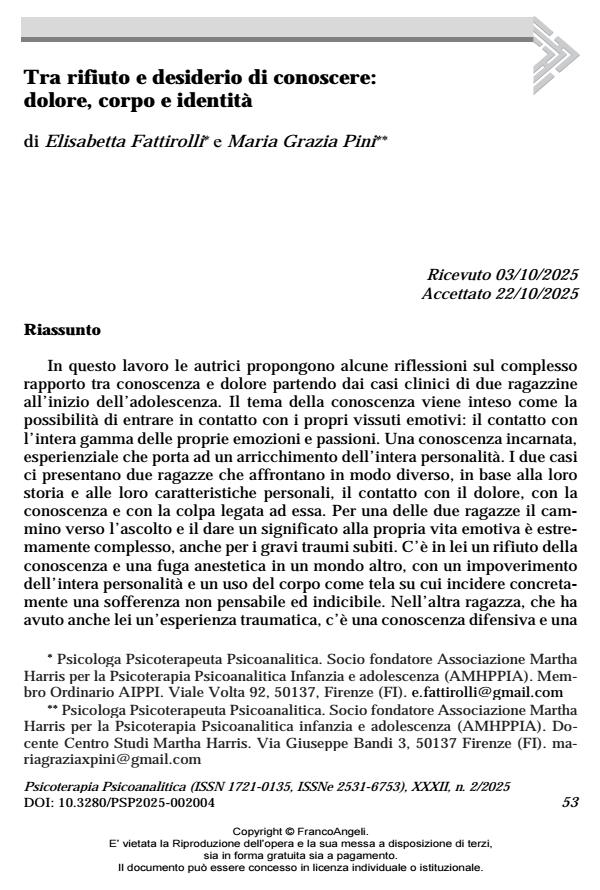
Below, you can see the article first page
If you want to buy this article in PDF format, you can do it, following the instructions to buy download credits
FrancoAngeli is member of Publishers International Linking Association, Inc (PILA), a not-for-profit association which run the CrossRef service enabling links to and from online scholarly content.
In this work, the authors offer reflections on the complex relationship between knowledge and pain, starting with the clinical cases of two young girls in early adolescence. Knowledge is understood as the possibility of coming into contact with one’s own emotional experiences: contact with the full range of one’s emotions and passions. This embodied, experiential knowledge leads to an enrichment of the entire personality. The paper regards the cases of two girls who, on the basis of their history and personal characteristics, deal with pain, knowledge, and the guilt associated with it in different ways. For one of the two girls, the path to listening and finding meaning in her emotional life is extremely complex, partly due to the severe trauma she has suffered. She rejects knowledge and seeks an anesthetic escape into another world, impoverishing her entire personality and using her body as a canvas on which to concretely engrave unthinkable and unspeakable suffering. In the other girl, who also had a traumatic experience, there is a defensive knowledge and a tendency to conform to what she thinks one should be, which risks keeping her imprisoned in a false self and inauthentic relationships.
Keywords: knowledge, pain, emotional experiences, traumatic experience, adolescence, body.
- Artoni Schlesinger C. (2006). Adozione ed oltre. Immagini, parole e pensieri dall’altro mondo. Roma: Borla.
- Bion W. R. (1963). Elementi di psicoanalisi. Roma: Armando, 1966.
- Biondo D. (2017). Mondo digitale e dolore evolutivo. Rivista di Psicoanalisi, (63)(1): 235-252. DOI: 10.26364/RDPS2017.16-262
- Bollas C. (1987). L’ombra dell’oggetto. Trad. it. Milano: Raffaello Cortina, 2018.
- Botella C.& S. (2001). La raffigurabilità psichica. Trad. it. Roma: Astrolabio, 2014.
- De Masi F. (2006). Vulnerabilità alla psicosi. Milano: Raffaello Cortina.
- Gaddini E. (1981). Fantasie difensive precoci e processo psicoanalitico. In: Scritti. Milano: Raffaello Cortina, 1989.
- Gaddini E. (1982). Terapia e conoscenza in psicoanalisi. In: Scritti. Milano: Raffaello Cortina, 1989.
- Green A. (1980). La madre morta. In: Narcisismo di vita, narcisismo di morte. Trad. it. Roma: Borla, 1985.
- Flynn G. (2006). Sulla pelle. Trad. it. Casale Monferrato: Piemme.
- Marion P. (2016). Prospettive attuali nella variabilità e complessità nell’identità di genere. Richard&Piggle, 24(4): 344-355. DOI: 10.1711/2604.26802
- Meltzer D. (1986). Studi di metapsicologia allargata. In: Applicazioni cliniche del pensiero di Bion. Trad.it. Milano: Raffaello Cortina, 1987.
- Meltzer D. (1992). Il Claustrum. Trad. it. Roma: Borla, 1995.
- Nicolò A. (2021). Rotture evolutive. Milano: Raffaello Cortina.
- Lemma A. (2022). Le identità transgender. Trad. it. Milano: FrancoAngeli.
- Luzzatto L. (2020). Le crisi adottive: un’opportunità?. Milano: FrancoAngeli.
- Norbury J. (2022). Grande panda e piccolo drago. Milano: Rizzoli.
- Ogden T.H. (2022). Prendere vita nella stanza di analisi. Milano: Raffaello Cortina.
- Ogden T.H. (2025). Essere vivi. Esplorazioni psicoanalitiche. Milano: Raffaello Cortina.
- Polacco Williams G. (1997). Paesaggi interni e corpi estranei. Milano: Mondadori, 1999.
- Symington J. (1985). The Survival Function of Primitive Omnipotence. International Journal of Psycho-Analysis, 66: 481-488.
- Steiner J. (1993). I rifugi della mente. Trad it. Torino: Bollati Boringhieri, 1996.
- Tisseron S. (2014). Clinica del virtuale. Fantasticare, sognare o immaginare. AeP - Adolescenza e Psicoanalisi, IX, 1, 15-26.
- Winnicott D.W. (1949). L’intelletto e il suo rapporto con lo psiche-soma. In: Winnicott D.W., Dalla pediatria alla psicoanalisi. Firenze: Martinelli, 1975.
- Winnicott D.W. (1960). La distorsione dell’Io in rapporto al Vero e Falso sé. In Trad. it. Winnicott D.W., Sviluppo affettivo e ambiente. Roma: Armando, 1974.
- Winnicott D.W. (1971/74). La Paura del crollo. In trad. it. Esplorazioni psicoanalitiche. Milano: Raffaello Cortina, 1995.
- Zorzi Meneguzzo L. (2022). Vicissitudini conoscenza in psicoanalisi. Tra protezioni e prospettive. Gli Argonauti, 164, 2: 49-64.
Elisabetta Fattirolli, Maria Grazia Pini, Tra rifiuto e desiderio di conoscere: dolore, corpo e identità in "PSICOTERAPIA PSICOANALITICA" 2/2025, pp 53-69, DOI: 10.3280/PSP2025-002004