The montagnaterapia approach in schizophrenia spectrum disorders

Journal title RIVISTA SPERIMENTALE DI FRENIATRIA
Author/s Matteo Tonna
Publishing Year 2025 Issue 2025/3
Language Italian Pages 16 P. 11-26 File size 677 KB
DOI 10.3280/RSF2025-003002
DOI is like a bar code for intellectual property: to have more infomation click here

Below, you can see the article first page

If you want to buy this article in PDF format, you can do it, following the instructions to buy download credits
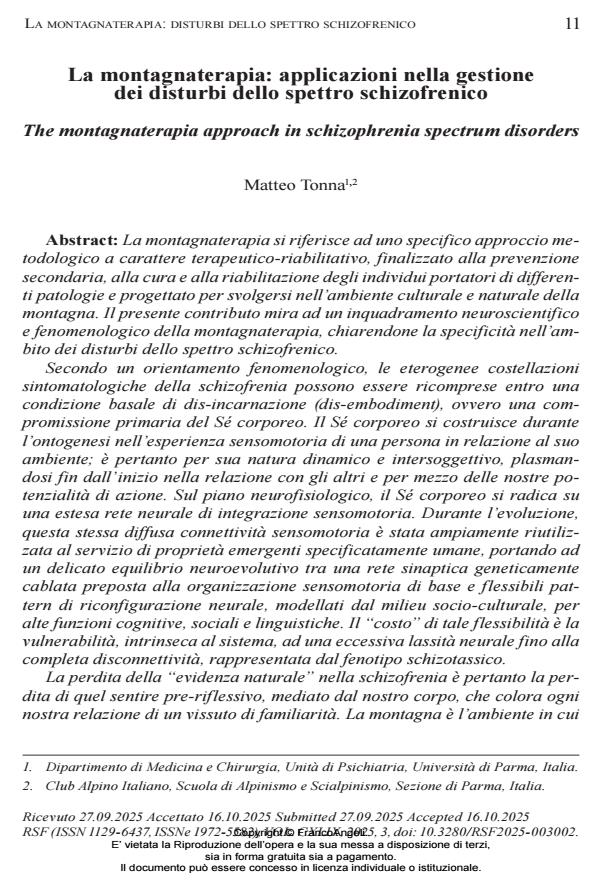
Article preview

FrancoAngeli is member of Publishers International Linking Association, Inc (PILA), a not-for-profit association which run the CrossRef service enabling links to and from online scholarly content.

The term montagnaterapia (aka Therapy with/through/within Mountains) refers to a specific methodological approach aimed at the prevention, treatment and rehabilitation of different psychopathological disorders, within and through the natural and cultural environment of the mountains. This contribution seeks to elucidate the phenomenological and neurophysiological underpinnings of this approach, with special reference to schizophrenia spectrum disorders. According to a phenomenological perspective, the different symptom dimensions of schizophrenia lie on a basal condition of selfdisembodiment, i.e., an early and subtle disruption of the bodily self. The bodily self is inherently dynamic and intersubjective, as it unfolds during development within a web of sensorimotor relationships between the subject and its environment. In this vein, it is shaped by the encounters with other subjects, and constrained by our possibilities of action. From a neurophysiological framework, the bodily self is rooted in a widespread sensorimotor connectivity. The sensorimotor background has been extensively exploited during evolution for typically human, “emergent” properties. This has led to an evolutionary balancing between genetically driven sensorimotor processing and flexible neural configurations, bioculturally directed, for higher cognitive, social and language functions. The “cost” for this high flexibility is the inherent vulnerability to an excessive neural looseness up to complete dysconnection of the sensorimotor system, as it occurs in the schizotaxic phenotype. The “loss of natural evidence” of individuals with schizophrenia is thus the loss of that prereflective bodily awareness, which imbues our experiences with a sense of familiarity. Mountains represent the environment in which this peculiar “naturality” can be reconstructed. In the mountains, every experience returns to basic levels, in which elementary, essential stimuli from our bodily sensations are a powerful means of affective and cognitive reorganization.

Keywords: bodily self, sensorimotor, neurodevelopment dysconnectivity, negative symptoms

  1. [1.] Owen MJ, O’Donovan MC, Thapar A, Craddock N. Neurodevelopmental hypothesis of schizophrenia. The British Journal of Psychiatry 2011; 198: 1735.
  2. [2.] Walther S, Strik W. Motor symptoms and schizophrenia. Neuropsychobiology 2012; 66: 7792. DOI: 10.1159/00033945
  3. [3.] Presta V, Paraboschi F, Marsella F, Lucarini V, Galli D, Mirandola P, et al. Posture and gait in the early course of schizophrenia. PLoS One 2021; 16: e0245661.
  4. [4.] Tonna M, Lucarini V, Borrelli DF, Parmigiani S, Marchesi C. Disembodiment and language in schizophrenia: an integrated psychopathological and evolutionary perspective. Schizophenia Bulletin 2023; 49: 16171.
  5. [5.] Di Cosmo G, et al. Bodyenvironment integration: Temporal processing of tactile and auditory inputs along the schizophrenia continuum. Journal of Psychiatric Research 2021; 134: 20814.
  6. [6.] Ferroni F, Ardizzi M, Magnani F, Ferri F, Langiulli N, Rastelli F et al. Tooluse extends peripersonal space boundaries in schizophrenic patients. Schizophrenia Bulletin 2022; 48: 108593.
  7. [7.] Ferroni F, Ardizzi M, Ferri F, Tesanovic A, Langiulli N, Tonna M et al. Schizotypy and individual differences in peripersonal space plasticity. Neuropsychologia 2020; 147: 107579.
  8. [8.] Powers AR 3rd, Hillock AR, Wallace MT. Perceptual training narrows the temporal window of multisensory binding. Journal of Neuroscience 2009; 29: 1226574. DOI: 10.1523/JNEUROSCI.350109.200
  9. [9.] Anderson ML. Neural reuse in the organization and development of the brain. Developmental Medicine & Child Neurology 2016; 58: 36.
  10. [10.] Gallese V, Cuccio V. The neural exploitation hypothesis and its implications for an embodied approach to language and cognition: insights from the study of action verbs processing and motor disorders in Parkinson’s disease. Cortex 2018; 100: 21525.
  11. [11.] Mazzuca C, Fini C, Michalland AH, Falcinelli I, Da Rold F, Tummolini L et al. From affordances to abstract words: the flexibility of sensorimotor grounding. Brain Sciences 2021; 11: 1304.
  12. [12.] Bufill E, Agustí J, Blesa R. Human neoteny revisited: the case of synaptic plasticity. American Journal of Human Biology 2011; 23: 72939.
  13. [13.] Tonna M. The evolution of symbolic thought: at the intersection of schizophrenia psychopathology, ethnoarchaeology, and neuroscience. Culture, Medicine and Psychiatry 2024; 48: 90017.
  14. [14.] Tonna M, Lucarini V, Lucchese J, Presta V, Paraboschi F, Marsella F et al. Posture, gait and selfdisorders: an empirical study in individuals with schizophrenia. Early Intervention in Psychiatry. 2023; 17: 44761.
  15. [15.] Crow TJ. Schizophrenia as the price that homo sapiens pays for language: a resolution of the central paradox in the origin of the species. Brain Research Reviews 0173(99)0002962000; 31: 11829.
  16. [16.] RamirezMahaluf JP, Tepper Á, Alliende LM, Mena C, Castañeda CP et al. Dysconnectivity in schizophrenia revisited: abnormal temporal organization of dynamic functional connectivity in patients with a first episode of psychosis. Schizophrenia Bulletin 2023; 49: 70616.
  17. [17.] Bleuler E. Dementia praecox oder Gruppe der Schizophrenien. In: Aschaffenburg G, ed. Handbuch der psychiatrie. Leipzig: Deuticke; 1911.
  18. [18.] Chaslin P. Éléments sémiologie et clinique mentales. Paris: Asselin et Houzeau; 1912.
  19. [19.] Lenzenweger M. Schizotaxia, schizotypy, and schizophrenia: Paul E. Meehl’s blueprint for the experimental psychopathology and genetics of schizophrenia. Journal of Abnormal Psychology. 2006; 115: 195200. DOI: 10.1037/0021843X.115.2.19
  20. [20.] Park S, Baxter T. Schizophrenia in the flesh: revisiting schizophrenia as a disorder of the bodily self. Schizophrenia Research 2022; 242: 1137.
  21. [21.] Northoff G, Duncan NW. How do abnormalities in the brain’s spontaneous activity translate into symptoms in schizophrenia? From an overview of resting state activity findings to a proposed spatiotemporal psychopathology. Progress in Neurobiology 2016; 1456: 2645.
  22. [22.] Parnas J, Handest P. Phenomenology of anomalous selfexperience in early schizophrenia. Comprehensive Psychiatry 2003; 44: 12134.
  23. [23.] Fuchs T, Schlimme JE. Embodiment and psychopathology: a phenomenological perspective. Current Opinion in Psychiatry 2009; 22: 5705.
  24. [24.] Stanghellini G. Embodiment and schizophrenia. World Psychiatry 2009; 8: 569.
  25. [25.] Ciaunica A, Constant A, Preissl H, Fotopoulou K. The first prior: from coembodiment to cohomeostasis in early life. Consciousness and Cognition 2021; 91: 103117.
  26. [26.] MerlauPonty M. Phénomènologie de la perception. Paris: Gallimard; 1945.
  27. [27.] Trevarthen C. The self born in intersubjectivity: the psychology of an infant communicating. In: Neisser U., ed. The perceived self: ecological and interpersonal sources of selfknowledge. Published online: Cambridge University Press; 1993, p. 12173.
  28. [28.] Blankenburg W. Der Verlust der natürlichen Selbstverständlichkeit: Ein Beitrag zur Psychopathologie symptomarmer Schizophrenien. Stuggart: Enke; 1971.
  29. [29.] Heidegger, M. Sein und Zeit. Halle: Max Niemeyer, Verlag Tübingen; 1927.
  30. [30.] Binswanger L. Martin Heideggers Einfluß auf die Wissenschaften. Bern: A. Francke; 1949.
  31. [31.] Škodlar, B, Henriksen MG. Toward a phenomenological psychotherapy for schizophrenia. Psychopathology 2019; 52: 11725. DOI: 10.1159/00050016
  32. [32.] Conrad K. Die beginnende Schizophrenie. Stuttgart: Thieme Verlag; 1958.
  33. [33.] Lucarini V, Magnani F, Ferroni F, Ardizzi M, Giustozzi F, Volpe R et al. Peripersonal space plasticity in relation to psychopathology and anomalous subjective experiences in individuals with earlyonset and adultonset schizophrenia. Early Intervention in Psychiatry 2025; 19: e13613.
  34. [34.] Martin LAL, Melchert D, Knack M, Fuchs T. Relating movement markers of schizophrenia to selfexperience a mixedmethods study. Frontiers in Psychiatry 2023; 14: 1212508.
  35. [35.] Probst M, Knapen, Poot G, Vancampfort D. Psychomotor therapy and psychiatry: what’s in a name? The Open Complementary Medicine Journal 2010; 2: 10513. DOI: 10.2174/1876391X01002001010
  36. [36.] Hátlová, B. The effect of psychomotor therapy on mental health in inpatient schizophrenia treatment: a randomized, doubleblind intervention study. Acta Gymnica 2020; 50: 838.
  37. [37.] Vancampfort D, Firth J, Schuch F, Rosenbaum S, De Hert M, Mugisha J et al. Physical activity and sedentary behavior in people with bipolar disorder: a systematic review and metaanalysis. Journal of Affective Disorders 2016; 201:14552.
  38. [38.] Koivukangas J, Tammelin T, Kaakinen M, Mäki P, Moilanen I, Taanila A et al. Physical activity and fitness in adolescents at risk for psychosis within the Northern Finland 1986 Birth Cohort. Schizophrenia Research 2010; 116: 1528.
  39. [39.] Röhricht F, Papadopoulos N. A treatment manual: body oriented psychological therapy for chronic schizophrenia. London: Newham Centre for Mental Health, unpublished manuscript; 2010.
  40. [40.] Sormunen E, Saarinen MM, Salokangas RKR, Telama R, HutriKähönen N, Tammelin T, et al. Effects of childhood and adolescence physical activity patterns on psychosis riska general population cohort study. Nature Partners Journal series Schizophrenia 2017; 3: article number 5.
  41. [41.] Martin LAL, Koch SC, Hirjak D, Fuchs T. Overcoming disembodiment: the effect of movement therapy on negative symptoms in schizophrenia a multicenter randomized controlled trial. Frontiers in Psychology 2016; 7: 483.
  42. [42.] Koch SC, Riege RFF, Tisborn K, Biondo J, Martin L, Beelmann A. Effects of dance movement therapy and dance on healthrelated psychological outcomes. A metaanalysis update. Frontiers in Psychology 2019; 10: 1806.
  43. [43.] Xu Y, Cai Z, Fang C, Zheng J, Shan J, Yang Y. Impact of aerobic exercise on cognitive function in patients with schizophrenia during daily care: a metaanalysis. Psychiatry Research 2022; 312: 114560.
  44. [44.] Swora E, Boberska M, Kulis E, Knoll N, Keller J, Luszczynska A. Physical activity, positive and negative symptoms of psychosis, and general psychopathology among people with psychotic disorders: a metaanalysis. Journal of Clinical Medicine 2022; 11: 2719.
  45. [45.] Vulpio A, Amorosi S, Magnani F, Ottoni R, Marchesi C, Tonna M. Embodied psychomotor therapy in patients with schizophrenia. European Psychiatry 2023; 66: S10456.

Matteo Tonna, La montagnaterapia: applicazioni nella gestione dei disturbi dello spettro schizofrenico in "RIVISTA SPERIMENTALE DI FRENIATRIA" 3/2025, pp 11-26, DOI: 10.3280/RSF2025-003002