Leveraging the tax shield: Capital structure decisions in privately-held firms
Journal title FINANCIAL REPORTING
Author/s Anna Alexander, Luca Menicacci
Publishing Year 2025 Issue 2025/2
Language English Pages 32 P. 27-58 File size 260 KB
DOI 10.3280/fr202519852
DOI is like a bar code for intellectual property: to have more infomation
click here
Below, you can see the article first page
If you want to buy this article in PDF format, you can do it, following the instructions to buy download credits
FrancoAngeli is member of Publishers International Linking Association, Inc (PILA), a not-for-profit association which run the CrossRef service enabling links to and from online scholarly content.
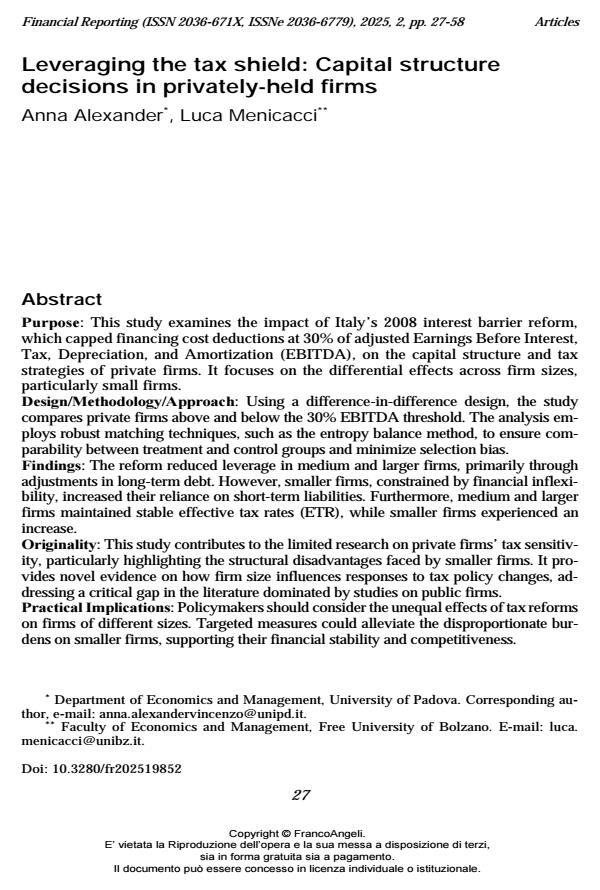
Purpose: This study examines the impact of Italy’s 2008 interest barrier reform, which capped financing cost deductions at 30% of adjusted Earnings Before Interest, Tax, Depreciation, and Amortization (EBITDA), on the capital structure and tax strategies of private firms. It focuses on the differential effects across firm sizes, particularly small firms. Design/Methodology/Approach: Using a difference-in-difference design, the study compares private firms above and below the 30% EBITDA threshold. The analysis em-ploys robust matching techniques, such as the entropy balance method, to ensure com-parability between treatment and control groups and minimize selection bias. Findings: The reform reduced leverage in medium and larger firms, primarily through adjustments in long-term debt. However, smaller firms, constrained by financial inflexi-bility, increased their reliance on short-term liabilities. Furthermore, medium and larger firms maintained stable effective tax rates (ETR), while smaller firms experienced an increase. Originality: This study contributes to the limited research on private firms’ tax sensitiv-ity, particularly highlighting the structural disadvantages faced by smaller firms. It pro-vides novel evidence on how firm size influences responses to tax policy changes, ad-dressing a critical gap in the literature dominated by studies on public firms. Practical Implications: Policymakers should consider the unequal effects of tax reforms on firms of different sizes. Targeted measures could alleviate the disproportionate bur-dens on smaller firms, supporting their financial stability and competitiveness.
Keywords: capital structure, financial policy, tax avoidance, tax planning, debt tax shield
Jel codes: G32, H25, H26, M41, M48
- Hanlon, M., & Heitzman, S. (2022). Corporate debt and taxes. Annual Review of Financial Economics, 14(1), 509-534.
- Haufler, A., & Runkel, M. (2012). Firms’ financial choices and thin capitalization rules under corporate tax competition. European Economic Review, 56(6), 1087-1103.
- Heaton, J. B. (2002). Managerial optimism and corporate finance. Financial Man-agement-Tampa, 31(2; SEAS SUM), 33-46. DOI: 10.1515/9781400829125-022
- Alberternst, S. & Sureth-Sloane, C. (2015). Interest Barrier and Capital Structure Response (WU International Taxation Research Paper Series No. 2015-09). Available at SSRN: https://ssrn.com/abstract=2563572 or
- Altman, E. I. (2013). Predicting financial distress of companies: Revisiting the Z-Score and ZETA ® models. In: Handbook of Research Methods and Applications in Empirical Finance (pp. 428-456). DOI: 10.4337/9780857936097
- Amihud, Y., Lev, B., & Travlos, N. G. (1990). Corporate control and the choice of investment financing: The case of corporate acquisitions. The Journal of Fi-nance, 45(2), 603-616.
- Ang, J. S., Cole, R. A., & Lin, J. W. (2000). Agency costs and ownership structure. The Journal of Finance, 55(1), 81-106. DOI: 10.1111/0022-1082.00201
- Bar-Yosef, S., D’Augusta, C., & Prencipe, A. (2019). Accounting research on pri-vate firms: State of the art and future directions. The International Journal of Accounting, 54(02), 1950007. DOI: 10.1142/S1094406019500070
- Berryman, J. E. (1993). Small business failure and bankruptcy: What progress has been made in a decade?. Small Enterprise Research, 2(1-2), 5-27.
- Beuselinck, C., Elfers, F., Gassen, J., & Pierk, J. (2023). Private firm accounting: the European reporting environment, data and research perspectives. Accounting and Business Research, 53(1), 38-82. DOI: 10.1080/00014788.2021.1982670
- Bianchi, P. A., Marra, A., Masciandaro, D., & Pecchiari, N. (2022). Organized crime and firms’ financial statements: evidence from criminal investigations in Italy. The Accounting Review, 97(3), 77-106. DOI: 10.2308/TAR-2019-0079
- Bigelli, M., & Sánchez-Vidal, J. (2012). Cash holdings in private firms. Journal of Banking & Finance, 36(1), 26-35.
- Bilicka, K. A., Qi, Y., & Xing, J. (2020), Real Responses to Anti-tax Avoidance: Evidence from the UK Worldwide Debt Cap (April 1). -- Available at SSRN: https://ssrn.com/abstract=3682284 or
- Boccaletti, S., Ferrando, A., Rossi, E., & Rossolini, M. (2025). European SMEs’ growth: the role of market-based finance and public financial support. Small Business Economics, 64, 691-727.
- Bonacchi, M., Marra, A., & Zarowin, P. (2019). Organizational structure and earn-ings quality of private and public firms. Review of Accounting Studies, 24(3).
- Bradley, M., Jarrell, G. A., & Kim, E. H. (1984). On the existence of an optimal capital structure: Theory and evidence. The Journal of Finance, 39(3), 857-878. DOI: 10.2307/2327950
- Brav, O. (2009). Access to capital, capital structure, and the funding of the firm. The Journal of Finance, 64(1), 263-308.
- Cassar, G., & Holmes, S. (2003). Capital structure and financing of SMEs: Austral-ian evidence. Accounting & Finance, 43(2), 123-147.
- Chircop, J., Fabrizi, M., Malaspina, P. & Parbonetti, A. (2023). Anti-Mafia Police Actions, Criminal Firms, and Peer Firm Tax Avoidance. Journal of Accounting Research, 61(1), 243-277. DOI: 10.1111/1475-679X.12455
- Cole, R. A. (2013). What do we know about the capital structure of privately held US firms? Evidence from the surveys of small business finance. Financial Man-agement, 42(4), 777-813.
- DeAngelo, H., & Masulis, R. W. (1980). Optimal capital structure under corporate and personal taxation. Journal of Financial Economics, 8(1), 3-29. DOI: 10.1016/0304-405X(80)90019-7
- De Vito, A., & Jacob, M. (2023). The role of creditor protection in lending and tax avoidance. Journal of Financial and Quantitative Analysis, 58(5), 2096-2130. DOI: 10.1017/S0022109022001144
- Degryse, H., De Goeij, P., & Kappert, P. (2012). The impact of firm and industry characteristics on small firms’ capital structure. Small Business Economics, 38, 431-447.
- Doidge, C., & Dyck, A. (2015). Taxes and corporate policies: Evidence from a quasi natural experiment. The Journal of Finance, 70(1), 45-89.
- Dyreng, S. D., Jacob, M., Jiang, X., and Müller, M. A. (2022). Tax incidence and tax avoidance. Contemporary Accounting Research, 39(4), 2622-2656. DOI: 10.1111/1911-3846.12797
- Faccio, M., & Xu, J. (2015). Taxes and capital structure. Journal of Financial and Quantitative Analysis, 50(3), 277-300. DOI: 10.1017/S0022109015000174
- Fama, E. F., & French, K. R. (1998). Taxes, financing decisions, and firm value. The Journal of Finance, 53(3), 819-843. DOI: 10.1111/0022-1082.00036
- Ferrando, A., Popov, A., & Udell, G. F. (2015). Sovereign stress, unconventional monetary policy, and SME access to finance (No. 1820). ECB Working Paper.
- Graham, J. R. (2000). How big are the tax benefits of debt?. The Journal of Finance, 55(5), 1901-1941. DOI: 10.1111/0022-1082.00277
- Graham, J. R., & Leary, M. T. (2011). A review of empirical capital structure re-search and directions for the future. Annual Review of Financial Economics, 3(1), 309-345.
- Graham, J. R., & Tucker, A. L. (2006). Tax shelters and corporate debt policy. Jour-nal of Financial Economics, 81(3), 563-594.
- Hair, J.F., Black, W.C., Babin, J.B., & Anderson, R.E. (2006). Multivariate data analysis (6th edition). Pearson Prentice-Hall, Upper Saddle River, NJ.
- Hall, G. C., Hutchinson, P. J., & Michaelas, N. (2004). Determinants of the capital structures of European SMEs. Journal of Business Finance & Accounting, 31(5-6), 711-728.
- Heider, F., & Ljungqvist, A. (2015). As certain as debt and taxes: Estimating the tax sensitivity of leverage from state tax changes. Journal of Financial Economics, 118(3), 684-712.
- Hoopes, J. L., Mescall, D., & Pittman, J. A. (2012). Do IRS audits deter corporate tax avoidance?. The Accounting Review, 87(5), 1603-1639.
- Jensen, M. C., & Meckling, W. H. (1976). Theory of the Firm. Managerial behavior, agency costs and ownership structure, 3(4), 305-360.
- Mura, A. (2023). Reconciling Competing Reporting Objectives Through Deferred Tax Accounts: Evidence on Private Italian Firms. Accounting in Europe, 20(3), 304-338. DOI: 10.1080/17449480.2023.2213249
- Kim, C., & L. Zhang (2016). Corporate political connections and tax aggressiveness. Contemporary Accounting Research, 33(1), 78-114. DOI: 10.1111/1911-3846.12150
- López-Gracia, J., & Sogorb-Mira, F. (2008). Testing trade-off and pecking order theories financing SMEs. Small Business Economics, 31, 117-136.
- MacKie-Mason, J. K. (1990). Do taxes affect corporate financing decisions?. The Journal of Finance, 45(5), 1471-1493.
- Michaelas, N., Chittenden, F., & Poutziouris, P. (1999). Financial policy and capital structure choice in UK SMEs: Empirical evidence from company panel data. Small Business Economics, 12(2), 113-130. DOI: 10.1023/A:1008010724051
- Modigliani, F., & Miller, M. H. (1963). Corporate income taxes and the cost of cap-ital: a correction. The American Economic Review, 53(3), 433-443.
- Myers, S. C. (1977). Determinants of corporate borrowing. Journal of Financial Economics, 5, 147-175. DOI: 10.1016/0304-405X(77)90015-0
- Myers, S. C., & Majluf, N. S. (1984). Corporate financing and investment decisions when firms have information that investors do not have. Journal of Financial Economics, 13, 187-221. DOI: 10.1016/0304-405X(84)90023-0
- Myers, S. C. (2003). Financing of corporations. In Handbook of the Economics of Finance (Vol. 1, 215-253). Elsevier. DOI: 10.1016/S1574-0102(03)01008-2
- Petersen, M. A., & Rajan, R. G. (1995). The effect of credit market competition on lending relationships. Quarterly Journal of Economics, 110, 406-443. DOI: 10.2307/2118445
- Psillaki, M., & Daskalakis, N. (2009). Are the determinants of capital structure coun-try or firm specific?. Small Business Economics, 33, 319-333.
- Raoli, E., & Daniele, M. (2024). Early Warning Systems for financial crises predic-tion in private companies: Evidence from the Italian context. Financial repor-ting: bilancio, controlli e comunicazione d’azienda: 2, 133-161. DOI: 10.3280/FR2024-002006
- Rao, P., Kumar, S., Chavan, M., & Lim, W. M. (2023). A systematic literature re-view on SME financing: Trends and future directions. Journal of Small Business Management, 61(3), 1247-1277. DOI: 10.1080/00472778.2021.1955123
- Scheunemann, M. P., & Muller-Duttine, T. (2007). New German tax rules on financ-ing expenses. Intertax, 35, 518.
- Siegfried, J. J. (1972). The relationship between economic structure and the effect of political influence: Empirical evidence from the federal corporation income tax program. The University of Wisconsin-Madison.
- Sogorb-Mira, F. (2005). How SME uniqueness affects capital structure: Evidence from a 1994-1998 Spanish data panel. Small Business Economics, 25, 447-457.
- Stiglitz, J. E. (1973). Taxation, corporate financial policy, and the cost of capital. Journal of Public Economics, 2(1), 1-34.
- Van der Wijst, N., and R. Thurik. (1993). Determinants of small firm debt ratios: An analysis of retail panel data. Small Business Economics 5(1), 55-65. DOI: 10.1007/BF01539318
- Verma, S., Shome, S., & Hassan, M. K. (2023). FinTech in small and medium en-terprises (SMEs), A review and future research agenda. European Management Journal, 41(6), 950-971. Doi : 10.1016/j.emj.2023.07.003.
- Watts, R. L., & Zimmerman, J. L. (1978). Towards a positive theory of the determi-nation of accounting standards. The Accounting Review, 53(1), 112-134.
- Weisbach, D. (2002). Ten truths about tax shelters. Tax Law Review, 55, 215-253.
- Zubair, S., Kabir, R., & Huang, X. (2020). Does the financial crisis change the effect of financing on investment? Evidence from private SMEs. Journal of Business Research, 110, 456-463.
Anna Alexander, Luca Menicacci, Leveraging the tax shield: Capital structure decisions in privately-held firms in "FINANCIAL REPORTING" 2/2025, pp 27-58, DOI: 10.3280/fr202519852