Exploring Firms’ Reaction to Sustainability Pressures and its Impact on Management Control Tools in a Stone District
Journal title MANAGEMENT CONTROL
Author/s Claudia Presti, Alessandra Rigolini, katia Corsi
Publishing Year 2026 Issue 2025/3
Language English Pages 26 P. 39-64 File size 173 KB
DOI 10.3280/MACO2025-003003
DOI is like a bar code for intellectual property: to have more infomation
click here
Below, you can see the article first page
If you want to buy this article in PDF format, you can do it, following the instructions to buy download credits
FrancoAngeli is member of Publishers International Linking Association, Inc (PILA), a not-for-profit association which run the CrossRef service enabling links to and from online scholarly content.
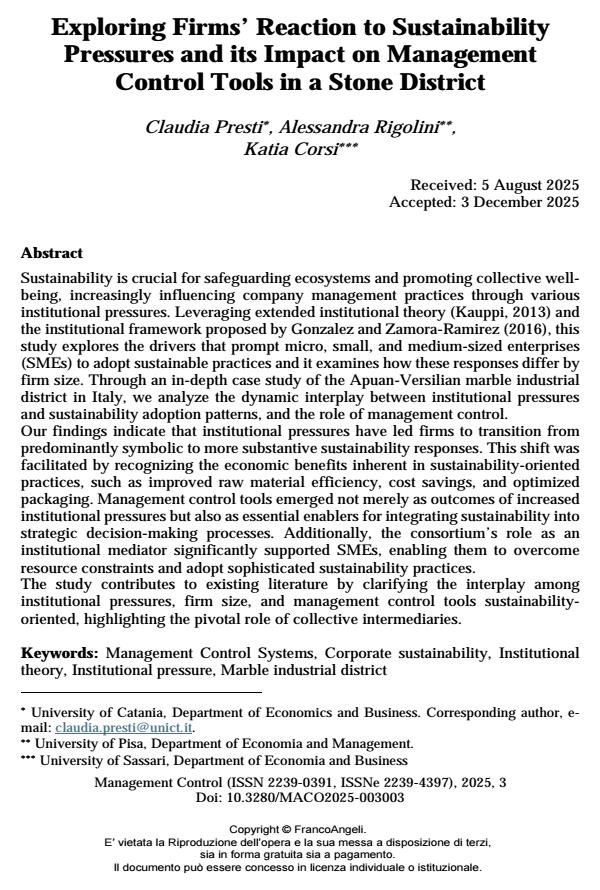
Sustainability is crucial for safeguarding ecosystems and promoting collective well-being, increasingly influencing company management practices through various institutional pressures. Leveraging extended institutional theory (Kauppi, 2013) and the institutional framework proposed by Gonzalez and Zamora-Ramirez (2016), this study explores the drivers that prompt micro, small, and medium-sized enterprises (SMEs) to adopt sustainable practices and it examines how these responses differ by firm size. Through an in-depth case study of the Apuan-Versilian marble industrial district in Italy, we analyze the dynamic interplay between institutional pressures and sustainability adoption patterns, and the role of management control. Our findings indicate that institutional pressures have led firms to transition from predominantly symbolic to more substantive sustainability responses. This shift was facilitated by recognizing the economic benefits inherent in sustainability-oriented practices, such as improved raw material efficiency, cost savings, and optimized packaging. Management control tools emerged not merely as outcomes of increased institutional pressures but also as essential enablers for integrating sustainability into strategic decision-making processes. Additionally, the consortium’s role as an institutional mediator significantly supported SMEs, enabling them to overcome resource constraints and adopt sophisticated sustainability practices. The study contributes to existing literature by clarifying the interplay among institutional pressures, firm size, and management control tools sustainability-oriented, highlighting the pivotal role of collective intermediaries.
Keywords: Management Control Systems, Corporate sustainability, Institutional theory, Institutional pressure, Marble industrial district
Claudia Presti, Alessandra Rigolini, katia Corsi, Exploring Firms’ Reaction to Sustainability Pressures and its Impact on Management Control Tools in a Stone District in "MANAGEMENT CONTROL" 3/2025, pp 39-64, DOI: 10.3280/MACO2025-003003