The plow and the peasant. Freud in Groddeck’s mirror
Journal title PSICOTERAPIA E SCIENZE UMANE
Author/s Riccardo Gramantieri
Publishing Year 2026 Issue 2026/1
Language Italian Pages 22 P. 65-86 File size 354 KB
DOI 10.3280/PU2026-001004
DOI is like a bar code for intellectual property: to have more infomation
click here
Below, you can see the article first page
If you want to buy this article in PDF format, you can do it, following the instructions to buy download credits
FrancoAngeli is member of Publishers International Linking Association, Inc (PILA), a not-for-profit association which run the CrossRef service enabling links to and from online scholarly content.
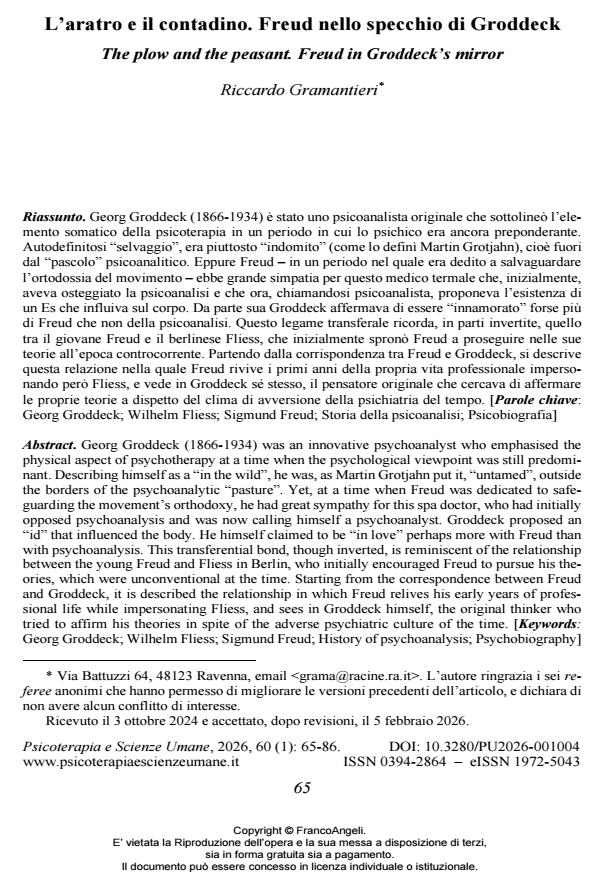
Georg Groddeck (1866-1934) was an innovative psychoanalyst who emphasised the physical aspect of psychotherapy at a time when the psychological viewpoint was still predominant. Describing himself as a “in the wild”, he was, as Martin Grotjahn put it, “untamed”, outside the borders of the psychoanalytic “pasture”. Yet, at a time when Freud was dedicated to safeguarding the movement’s orthodoxy, he had great sympathy for this spa doctor, who had initially opposed psychoanalysis and was now calling himself a psychoanalyst. Groddeck proposed an “id” that influenced the body. He himself claimed to be “in love” perhaps more with Freud than with psychoanalysis. This transferential bond, though inverted, is reminiscent of the relationship between the young Freud and Fliess in Berlin, who initially encouraged Freud to pursue his theories, which were unconventional at the time. Starting from the correspondence between Freud and Groddeck, it is described the relationship in which Freud relives his early years of professional life while impersonating Fliess, and sees in Groddeck himself, the original thinker who tried to affirm his theories in spite of the adverse psychiatric culture of the time.
Keywords: Georg Groddeck; Wilhelm Fliess; Sigmund Freud; History of psychoanalysis; Psychobiography
- Masson J.M. (1985). Introduzione del curatore. In: Freud, 1887-1904, pp. 19-32 trad. it.
- Nunberg H. & Federn E., editors (1962). Minutes of the Vienna Psychoanalytic Society, Vol. 1. 1906-1908. New York: International Universities Press (trad. it.: Dibattiti della Società Psicoanalitica di Vienna, 1906-1908. Torino: Boringhieri, 1973).
- Olivetti E., Cavagna D. & Oasi O. (2021). Georg Groddeck e la psicosomatica. In: Oasi O., Cavagna D. & Paolicelli S., a cura di, L’eredita` di Freud. Percorsi di sviluppo in psicologia dinamica. Milano: Edra, 2021, pp. 111-126.
- Perlini T. (2016). Il lato oscuro della psicoanalisi. Psicoterapia e Scienze Umane, 50, 4: 701-714. DOI: 10.3280/PU2016-004005
- Porge E. (1994). Vol d’idées? Wilhelm Fliess, son plagiat et Freud Suivi de Pour ma propre cause de Wilhelm Fliess. Paris: Denoël.
- Poster M.F. (2009). Ferenczi and Groddeck: Simpatico roots of a paradigm shift in psychoanalysis. American Journal of Psychoanalysis, 69, 3: 195-206.
- Poster M.F., Hristeva G. & Giefer M. (2016). Georg Groddeck: “The pinch of pepper” of psychoanalysis. American Journal of Psychoanalysis, 76, 2: 161-182.
- Rudnytsky P.L. (2022). Reading Psychoanalysis: Freud, Rank, Ferenczi, Groddeck. Ithaca, NY: Cornell University Press.
- Schreber D.P. (1903). Denkwürdigkeiten eines Nervenkranken. Leipzig: Oswald Mutze (trad. it.: Memorie di un malato di nervi. Milano: Adelphi, 1974).
- Schröter M. (2003). Fliess versus Weininger, Swoboda and Freud: The plagiarism conflict of 1906 assessed in the light of the documents. Psychoanalysis and History, 5, 2: 147-173.
- Schur M. (1972). Freud: Living and Dying. New York: International Universities Press (trad. it.: Il caso di Freud: biografia scritta dal suo medico. Torino: Boringhieri, 1976).
- Sobolewska A. (2022). Freud’s queer fellow: Georg Groddeck between psychoanalytic theory and literary modernism. Oxford German Studies, 51, 1: 45-76. DOI: 10.1080/00787191.2022.2066867
- Sulloway F.J. (1979). Freud, Biologist of the Mind. Beyond the Psychoanalytic Legend. New York: Basic Books (trad. it.: Freud biologo della psiche. Al di là della leggenda psicoanalitica. Milano: Feltrinelli, 1982).
- Swoboda H. (1904). Die Perioden des menschlichen Organismus in ihrer psychologischen und bio-logischen Bedeutung. Leipzig: Deuticke.
- Weininger O. (1903). Geschlecht und Charakter. Wien: Wilhelm Braumüller (trad. it.: Sesso e carattere. Torino: Bocca, 1912; Milano: Feltrinelli, 1978; Sesto San Giovanni [MI]; Mimesis, 2012).
- Weininger O. (1903). Geschlecht und Charakter. Wien: Wilhelm Braumüller (trad. it.: Sesso e carattere. Toirno: Bocca, 1912: Milano: Feltrinelli, 1978).
- Will H. (1994). Ferenczi und Groddeck. Eine Freundschaft. Psyche, 48, 8: 720-737.
- Martynkewicz W. (1997). Georg Groddeck: Eine Biographie. Frankfurt a.M.: Fischer (trad. it.: Georg Groddeck. Una vita. Milano: Il Saggiatore, 2005).
- Clark R. (1980). Freud, the Man and the Cause. London: Jonathan Cape (trad. it.: Freud. Milano: Rizzoli, 1983).
- Ferenczi S. (1924). Thalassa. Versuch einer Genitaltheorie. Wien: Internationaler Psychoanalytischer Verlag (trad. it.: Thalassa. Psicoanalisi delle origini della vita sessuale. Roma: Astrolabio, 1965; Thalassa. Saggio sulla teoria della genitalità. In: Opere, vol. III: 1919-1926. Milano: Raffaello Cortina, 1992, pp. 230-302).
- Ferenczi S. & Groddeck G. (1921-33 [1982]). Correspondance (1921-1933). Paris: Payot, 1982 (trad. it.: Corrispondenza, 1921-1933. Roma: Astrolabio, 1982).
- Fliess W. (1897). Die Beziehungen zwischen Nase und weiblichen Geschlechtsorganen. Leipzig: Deuticke.
- Fliess W. (1906). In eigener Sache: Gegen Otto Weininger und Hermann Swoboda. Berlin: Emil Goldschmidt.
- Fliess W. (1906). Der Ablauf des Lebens. Leipzig: Deuticke.
- Fortune C. (2002). Georg Groddeck’s influence on Sandor Ferenczi’s clinical practice as reflected in their correspondence 1921-1933. Psychoanalysis and History, 4, 1: 85-94.
- Freud S. (1887-1904 [1985]). The Complete Letters of Sigmund Freud to Wilhelm Fliess, 1887-1904 (Masson J.M., editor). Cambridge, MA: Belknap Press of Harvard University Press, 1985 (trad. it.: Lettere a Wilhelm Fliess, 1887-1904. Torino: Bollati Boringhieri, 1986).
- Freud S. (1899 [1900]). L’interpretazione dei sogni. Opere, 3. Torino: Boringhieri, 1966.
- Freud S. (1901a). Psicopatologia della vita quotidiana. Opere, 4: 51-297. Torino: Boringhieri, 1970.
- Freud S. (1901b [1905]). Frammento di un’analisi di isteria (Caso clinico di Dora). Opere, 4: 301-402. Torino: Boringhieri, 1970.
- Freud S. (1922 [1923]). L’Io e l’Es. Opere, 9: 471-520. Torino: Boringhieri, 1977.
- Freud S. (1910). Psicoanalisi “selvaggia”. Opere, 6: 325-331. Torino: Boringhieri, 1974.
- Freud S. (1910 [1911]). Osservazioni psicoanalitiche su un caso di paranoia (dementia paranoides) descritto autobiograficamente (Caso clinico del presidente Schreber). Opere, 6: 335-406. Torino: Boringhieri, 1974.
- Freud S. (1937). Analisi terminabile e interminabile. Opere, 11: 497-535. Torino: Boringhieri, 1979.
- Freud S. & Ferenczi S. (1920-33 [2000]). The Correspondence of Sigmund Freud and Sándor Ferenczi. Volume 3, 1920-1933. Edited by Ernst Falzeder & Eva Brabant with the collaboration of Patrizia Giampieri-Deutsch. Cambridge, MA: The Belknap Press of Harvard University Press, 2000.
- Freud S. & Jones E. (1908-1939 [1993]). The Complete Correspondence of Sigmund Freud and Ernest Jones 1908-1939. Cambridge, MA: Harvard University Press, 1993 (trad. it.: Corrispondenza 1908-1939. Torino: Bollati Boringhieri, 2001).
- Freud S. & Groddeck G. (1917-34 [1970]). Briefwechsel. Georg Groddeck, Sigmund Freud. Wiesbaden: Limes, 1970 (trad. it. Carteggio Freud-Groddeck. Milano: Adelphi, 1986).
- Garner S.N. (1989). Freud and Fliess: Homophobia and seduction. In: Hunter D., editor, Seduction and Theory. Chicago, IL: University of Illinois Press, 1989, pp. 86-109.
- Gay P. (1988). Freud: A Life for Our Time. London: J.M. Dent & Sons (trad. it.: Freud: una vita per i nostri tempi. Milano: Bompiani, 1988).
- Gramantieri R. (2015). Leonardo, Schreber e il “caso” Freud: un’ipotesi di identificazione. Psicoterapia e Scienze Umane, 49, 4: 573-588.
- Groddeck G. (1917). Psychische Bedingtheit und psychoanalytische Behandlung organischer Leiden. Leipzig: Hirzel (trad. it.: Condizionamento psichico e trattamento psicoanalitico delle affezioni organiche. In: Groddeck, 1917-33, pp. 5-38).
- Alt P.-A. (2016). Sigmund Freud. Der Arzt der Moderne. Eine Biographie. Monaco: C.H. Beck (trad. it.: Il medico dell’inconscio. Torino: Hoepli, 2022).
- Antonelli G. (1997). Il mare di Ferenczi: la storia, il pensiero, la tecnica di un maestro della psicoanalisi. Roma: Di Renzo.
- Anzieu D. (1988 [2000]). Vues nouvelles sur l’auto-analyse de Freud et la découverte de la psychanalyse (Vienne, 23 juillet 1988). Revue Française de Psychanalyse, 2000, 64, 4: 1201-1216.
- Ávila L.A. (2023). Friendship, creativity and dispute in the Freud-Fliess and Ferenczi-Groddeck letters. American Journal of Psychoanalysis 83, 2: 210-230.
- Azouri Ch. (1991). J’ai réussi là où le paranoïaque échoue. La théorie a-t-elle un père? Paris: Denoël.
- Baldoni F. (2010). La prospettiva psicosomatica: dalla teoria alla pratica clinica. Bologna: Il Mulino.
- Berman E. (2007). Call of the wild. American Journal of Psychoanalysis 67, 3: 211-220. DOI: 10.1057/9780230589629_5
- Bonomi C. (2015). The Cut and the Building of Psychoanalysis, Vol. I. Sigmund Freud and Emma Eckstein. New York: Routledge.
- Bonomi C. (2018). The Cut and the Building of Psychoanalysis: Volume II. Sigmund Freud and Sándor Ferenczi. New York: Routledge.
- Breger L. (2012). Freud: Darkness and Vision. Psychodynamic Psychiatry, 40, 2: 211-242.
- Chemouni J. (1984). Georg Groddeck, psychanalyste de l’imaginaire: psychanalyse freudienne et psychanalyse groddeckienne. Paris: Payot.
- Groddeck G. (1917-33 [1964]). Psychoanalytische Schriften zur Psychosomatik. Psychoanaly-tische Schriften zur Literatur und Kunst. Wiesbaden: Limes, 1964 (trad. it.: Il linguaggio dell’Es: saggi di psicosomatica e di psicoanalisi dell’arte e della letteratura. Milano: Bompiani, 1987).
- Groddeck G. (1902). Ein Frauenproblem. Leipzig: Naumann (trad. it.: Questione di donna. Milano: TEA, 1995).
- Groddeck G. (1919). Der Seelensucher. Ein psychoanalytischer Roman. Wien: Internationaler Psychoanalytischer Verlag (trad. it.: Lo scrutatore d’anime: un romanzo psicoanalitico. Milano: Adelphi, 1976).
- Groddeck G. (1923). Das Buch vom Es. Psychoanalytische Briefe an eine Freundin. Wien: Internationaler Psychoanalytischer Verlag (trad. it.: Il libro dell'Es. Lettere di psicoanalisi a un’amica. Milano: Adelphi, 1990).
- Groddeck G. (1931). Das Zwiegeschlecht des Menschen. Psychoanalytische Bewegung, 3, 2: 166-172 (trad. it.: Il doppio sesso dell’essere umano. In: Radovich E., a cura di, Bisessualità e differenza dei sessi. Milano: Savelli, 1980, pp. 41-50).
- Grotjahn M. (1966). Georg Groddeck. The untamed analyst. In: Alexander F., Eisenstein S. & Grotjahn M., editors, Psychoanalytic Pioneers. New York: Basic Books, 1966 (trad. it.: Georg Groddeck [1866-1934]. L’analista indomito. In: Alexander F., Eisenstein S. & Grotjahn M., a cura di, I pionieri della psicoanalisi. Milano: Feltrinelli, 1971, pp. 260-273).
- Guasto G. (2016). Ferenczi face à l’énigme Schreber: de l’“incident” de Palerme à la dé-couverte de l’intropression. Revue Canadienne de Psychoanalyse, 24, 2: 87-102 / Canadian Journal of Psychoanalysis, 2017, 25, 1: 87-102 (anche in: Le Coq-héron, 2021, 1, 244: 96-105.
- Haynal A., Falzeder E. & Roazen P. (2005). Dans les secrets de la psychanalyse et de son histoire. Paris: PUF (trad. it.: Nei segreti della psicoanalisi e della sua storia. Roma: Borla, 2008).
- Honda H. (2015). Utraquism and metapsychology: Ferenczi’s contributions to psychoanalysis epistemology. International Journal of Psychoanalysis (IJP) Open, 2: 15.
- Jones E. (1953). The Life and Work of Sigmund Freud. 1: The Formative Years and the Great Discoveries, 1856-1900. New York: Basic Books (tr. it. Vita e opere di Freud. 1. Gli anni della formazione e le grandi scoperte 1856-1900. Milano: Il Saggiatore, 1962-1995).
- Le Corre L. (2017). L’homosexualité de Freud. Paris: PUF.
- Lualdi M.M. (2022a). Georg Groddeck, Parte II: La fuga nella filosofia (Berlino, 1922). Il passo psicoanalitico, 12 gennaio 2022: https://ilpassopsicoanalitico.blogspot.com/2022/01/georg-groddeck-parte-ii-la-fuga-nella.html.
- Lualdi M.M. (2022b). Georg Groddeck Parte III: il VI Congresso psicoanalitico internazionale (L’Aia, 5-8 settembre 1920). Il passo psicoanalitico, 1° febbraio 2022: https://ilpassopsicoanalitico.blogspot.com/2022/02/georg-groddeck-parte-iii-il-vi.html.
- Lualdi M.M. (2022c). Georg Groddeck, Parte V: Sulla psicoanalisi dell’organico nell’uomo (1921). Il passo psicoanalitico, 14 febbraio 2022: https://ilpassopsicoanalitico.blogspot.com/2022/02/georg-groddeck-parte-v-sulla.html.
- Lualdi M.M. (2022d). Georg Groddeck, Parte VII: L’analista selvaggio. Il passo psicoanalitico, 24 febbraio 2022: https://ilpassopsicoanalitico.blogspot.com/2022/02/georg-groddeck-parte-vii-lanalista.html.
- Lualdi M.M. (2022e). Nota introduttiva al “Discorso al dessert durante la cena sociale del IX Congresso internazionale di psicoanalisi (Bad Homburg, 1925). Psicoterapia e Scienze Umane, 56, 3: 457-464. DOI: 10.3280/PU2022-003005
Riccardo Gramantieri, L’aratro e il contadino. Freud nello specchio di Groddeck in "PSICOTERAPIA E SCIENZE UMANE" 1/2026, pp 65-86, DOI: 10.3280/PU2026-001004