Unseen, uncounted, unprotected: the classification struggles of performing art workers in Italy
Journal title SOCIOLOGIA DEL LAVORO
Author/s Maria Dodaro, Francesco Eugenio Iannuzzi
Publishing Year 2026 Issue 2025/173
Language English Pages 23 P. 80-102 File size 262 KB
DOI 10.3280/SL2025-173005
DOI is like a bar code for intellectual property: to have more infomation
click here
Below, you can see the article first page
If you want to buy this article in PDF format, you can do it, following the instructions to buy download credits
FrancoAngeli is member of Publishers International Linking Association, Inc (PILA), a not-for-profit association which run the CrossRef service enabling links to and from online scholarly content.
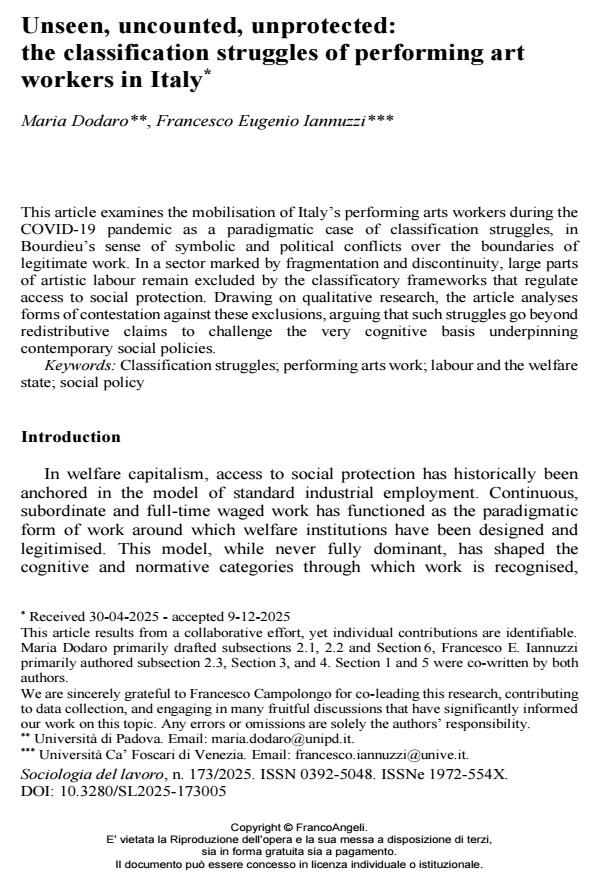
This article examines the mobilisation of Italy’s performing arts workers during the COVID-19 pandemic as a paradigmatic case of classification struggles, in Bourdieu’s sense of symbolic and political conflicts over the boundaries of legitimate work. In a sector marked by fragmentation and discontinuity, large parts of artistic labour remain excluded by the classificatory frameworks that regulate access to social protection. Drawing on qualitative research, the article analyses forms of contestation against these exclusions, arguing that such struggles go beyond redistributive claims to challenge the very cognitive basis underpinning contemporary social policies.
Keywords: Classification struggles; performing arts work; labour and the welfare state; social policy
- Armano E., Murgia A. (2017). Hybrid areas of work in Italy. Hypothesis to interpret the transformations of precariousness and subjectivity. In: Armano E., Bove A., Murgia A., (eds.), Mapping Precariousness, Labour Insecurity and Uncertain Livelihoods. Abingdon: Routledge.
- Barron P., Bory A., Chauvin S., Jounin N., and Tourette L. (2016). State categories and labour protest: Migrant workers and the fight for legal status in France. Work, employment and society, 30(4): 631-648. DOI: 10.1177/0950017016631451
- Borghi V., Rizza R. (2006). L’organizzazione sociale del lavoro. Milano: Mondadori. Bourdieu P. (2001). La distinzione. Critica sociale del gusto. Bologna: il Mulino. (Original Ed. La distinction, Paris: Les Éditions de Minuit, 1979)
- Bourdieu P. (2018). Classification Struggles: General Sociology, Volume 1. Cambridge: Polity Press.
- Bozzon R., Martinelli F., Murgia A. (2025). Is there a European ‘Great Resignation’? The case of technicians in the entertainment sector in Italy. Sociologia del lavoro, 171: 165-185. DOI: 10.3280/SL2025-171008
- Campolongo F., Iannuzzi F. E., (2023). Time, discipline and subjectivity: Performing arts worker mobilisations in Italy during the pandemic. Partecipazione e conflitto, 16(2): 268-286.
- Castel R. (2003). From Manual Workers to Wage Laborers: Transformation of the Social Question. New Brunswick: Transaction Publishers. (Orig. pub. Les Métamorphoses de la question sociale: une chronique du salariat, 1995, Paris: Fayard).
- Corsani A., Lazzarato M. (2008). Intermittents et précaires. Paris: Éditions Amsterdam. Crouch C. (1997) The globalized economy: An end to the age of industrial citizenship? In: Wilthagen, T. (ed.) Advanced Theory in Labour Law and Industrial Relations in a Global Context. Amsterdam: North-Holland.
- Di Nunzio D., Toscano E. (2018). L’azione sindacale nella frammentazione: Il caso dei lavoratori nello spettacolo dal vivo. Quaderni di Rassegna Sindacale, 1: 101-115.
- Di Sandro M., Sanguinetti A. (2024). «Remake the Globe!» Un’inchiesta sui lavoratori dello spettacolo durante la pandemia in Italia. Sociologia del lavoro, 169: 135-151. DOI: 10.3280/SL2024-169007
- Esping-Andersen G. (1999). Social Foundations of Postindustrial Economies. Oxford: Oxford University Press.
- Esping-Andersen G. (1990). The Three Worlds of Welfare Capitalism. Cambridge: Polity Press.
- Federcultura (2019). Impresa Cultura. Comunità, Territori, Sviluppo. Rome: Gangemi Editori.
- Fondazione Centro Studi Doc (FCSD) (2021). L’impatto del Covid-19 sulle industrie culturali e creative e sul mondo dello spettacolo. Retrieved from http://www.centrostudidoc.org/2021/03/08/spettacolo-nel-2020-il-covid-19-e-costato-circa-13-miliardi-di-euro/.
- Fondazione Symbola (2021). Io Sono Cultura, Rapporto annuale 2011-2021. Fondazione Symbola e Unioncamere.
- Gibson-Light M. (2017). Classification Struggles in Semi-Formal and Precarious Work: Lessons from Inmate Labor and Cultural Production. Research in the Sociology of Work, 31: 61-89. DOI: 10.1108/S0277-283320170000031002
- Gill R., Pratt A. (2008). In the Social Factory? Immaterial Labour, Precariousness and Cultural Work. Theory, Culture and Society, 25(7-8): 1-30. DOI: 10.1177/026327640809779
- Hesmondhalgh D., Baker S. (2011). Toward a political economy of labor in the media industries. In: J. Wasko, G. Murdock and H. Sousa (Eds.), The handbook of political economy of communications. Hoboken: John Wiley and Sons.
- INPS (2024). Osservatorio Gestione Lavoratori dello Spettacolo e Sportivi Professionisti – Anno 2023. Retrieved from: https://www.inps.it/it/it/inps-comunica/notizie/dettaglio-news-page.news.2024.05.osservatorio-lavoratori-dello-spettacolo-e-dello-sport-dati-del-2023.html.
- Istat (2019). Indagine conoscitiva in materia di lavoro e previdenza nel settore dello Spettacolo. Audizione parlamentare. Retrieved 5 May 2021 from: https://www.istat.it/it/files/2019/04/Istat-Audizione-lavoro-spettacolo.pdf.
- Loacker B. (2013). Becoming ‘culturpreneur’: How the ‘neoliberal regime of truth’ affects and redefines artistic subject positions. Culture and Organization, 19(2): 124-145. DOI: 10.1080/14759551.2011.644671
- Menger P. M. (2017). Contingent high-skilled work and flexible labor markets: Creative workers and independent contractors cycling between employment and unemployment. Swiss Journal of Sociology, 43(2): 253-384.
- Mingione E. (1991) Fragmented Societies. A Sociology of Economic Life beyond the Market Paradigm. Oxford: Blackwell.
- Morlicchio E. (2023). Il lavoro come maledizione e come salvezza. Costituzionalismo.it, 3: 18-39.
- Murgia A. (2025). Hybrid Labour: Measuring, Classifying, and Representing Workers at the Boundaries of Employment and Self-employment. Abingdon, New York: Routledge.
- Naclerio E. (2023). Self-entrepreneurship in uncertain futures: The case of performing artists in Italy. International Sociology, 38(1): 142-160.
- Orloff A.S. (1993). Gender and the Social Rights of Citizenship: The Comparative Analysis of Gender relations and Welfare State. American Sociological Review, 58: 303-328.
- Pulignano V., Domecka M. (2025). The Politics of Unpaid Labour. Oxford: Oxford University Press.
- Saraceno C. (2013). Il Welfare. Bologna: il Mulino
- Supiot A. (2001). Beyond Employment: Changes in Work and the Future of Labour Law in Europe. Oxford: Oxford University Press.
- Sylos Labini P. (1966). Problemi dell’economia siciliana. Milan: Feltrinelli.
- Turrini M., Chicchi F. (2013). Precarious subjectivities are not for sale: The loss of the measurability of labour for performing arts workers. Global Discourse, 3(3-4): 507-521. DOI: 10.1080/23269995.2014.885167
- Umney C., Kretsos L. (2014). Creative labour and collective interaction: The working lives of young jazz musicians in London. Work, Employment and Society, 28(4): 571-588. DOI: 10.1177/0950017013491452
- Umney C., Kretsos L. (2015). That’s the experience: Passion, work precarity, and life transitions among London jazz musicians. Work and Occupations, 42(3): 313-334. DOI: 10.1177/073088841557363
Maria Dodaro, Francesco Eugenio Iannuzzi, Unseen, uncounted, unprotected: the classification struggles of performing art workers in Italy in "SOCIOLOGIA DEL LAVORO " 173/2025, pp 80-102, DOI: 10.3280/SL2025-173005