La Medicina Narrativa, di casa nelle Medical Humanities
Journal title RIVISTA SPERIMENTALE DI FRENIATRIA
Author/s Sandro Spinsanti
Publishing Year 2026 Issue 2026/1
Language Italian Pages 15 P. 9-23 File size 732 KB
DOI 10.3280/RSF2026-001002
DOI is like a bar code for intellectual property: to have more infomation
click here
Below, you can see the article first page
If you want to buy this article in PDF format, you can do it, following the instructions to buy download credits
FrancoAngeli is member of Publishers International Linking Association, Inc (PILA), a not-for-profit association which run the CrossRef service enabling links to and from online scholarly content.
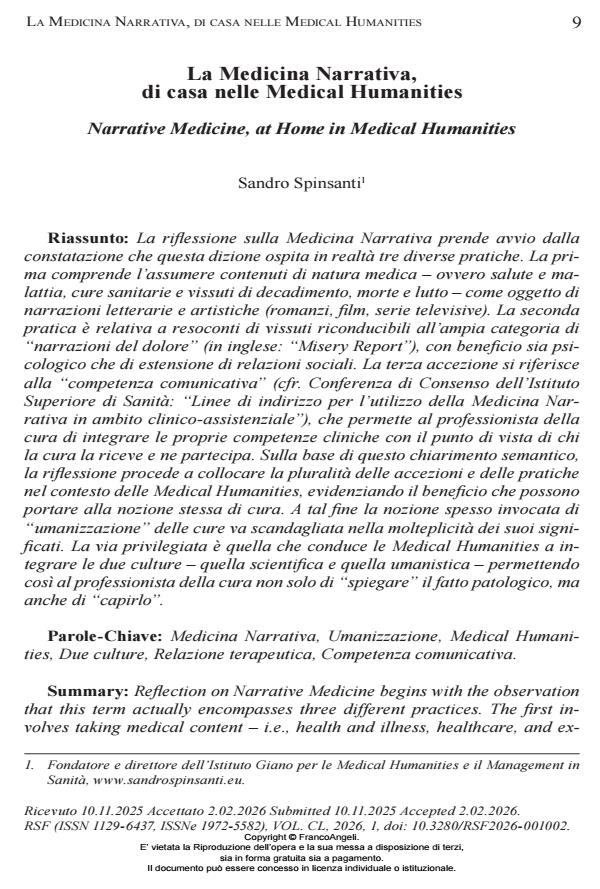
Reflection on Narrative Medicine begins with the observation that this term actually encompasses three different practices. The first in-volves taking medical content – i.e., health and illness, healthcare, and experiences of decline, death, and mourning – as the subject of literary and artistic narratives (novels, films, television series, etc.). The second practice concerns accounts of experiences that fall within the broad category of ‘mi-sery reports’, with both psychological benefits and the extension of social re-lationships. The third meaning refers to ‘communicative competence’ (see the consensus conference of the Italian National Institute of Health: ‘Guidelines for the use of Narrative Medicine in clinical care’), which enables healthcare professionals to integrate their clinical skills with the point of view of those who receive and participate in care. On the basis of this semantic clarification, the reflection proceeds to place the plurality of meanings and practices in the context of Medical Humanities, highlighting the benefit that they can respectively bring to the very notion of care. To this end, the often-invoked notion of the “humanisation” of care must be explored in the multiplicity of its meanings. The preferred path is one that leads Medical Humanities to integrate the two cultures – scientific and humanistic – thereby enabling healthcare professionals not only to “explain” pathological phenomena, but also to “understand” them.
Keywords: Narrative Medicine, Humanization, Medical Humanities, Two Cultures, Therapeutic Relationship, Communication Skills.
Sandro Spinsanti, La Medicina Narrativa, di casa nelle Medical Humanities in "RIVISTA SPERIMENTALE DI FRENIATRIA" 1/2026, pp 9-23, DOI: 10.3280/RSF2026-001002