Narrative Medicine in Mental Health: Theoretical Foundations, Empirical Evidence and Applied Perspectives
Journal title RIVISTA SPERIMENTALE DI FRENIATRIA
Author/s Antonio Lasalvia, Luca Bodini, Rodolfo D’Agostini, Maria Micaela Coppola
Publishing Year 2026 Issue 2026/1
Language Italian Pages 24 P. 25-48 File size 802 KB
DOI 10.3280/RSF2026-001003
DOI is like a bar code for intellectual property: to have more infomation
click here
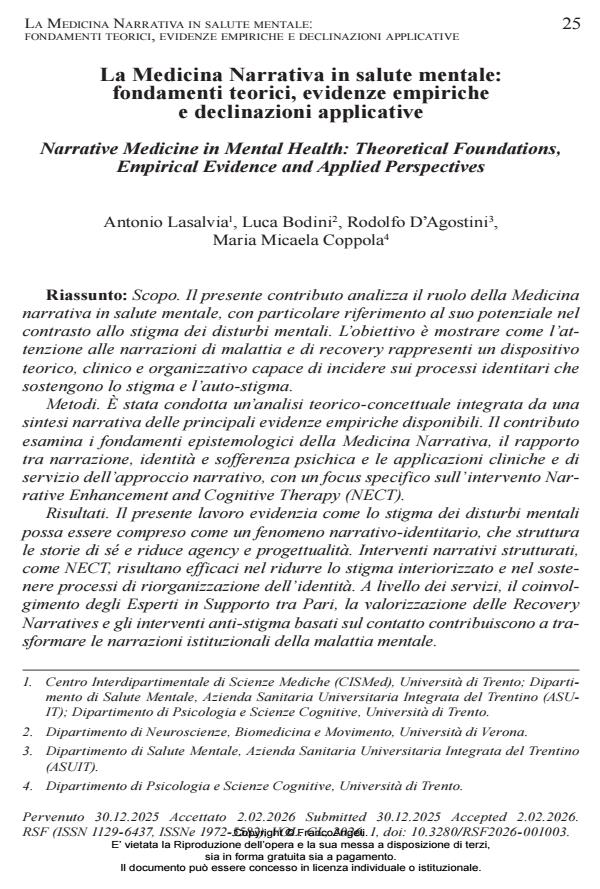
Below, you can see the article first page
If you want to buy this article in PDF format, you can do it, following the instructions to buy download credits
FrancoAngeli is member of Publishers International Linking Association, Inc (PILA), a not-for-profit association which run the CrossRef service enabling links to and from online scholarly content.
Objective. This paper examines the role of Narrative Medicine in mental health care, with a specific focus on its potential to address stigma related to mental disorders. The aim is to conceptualize narrative approaches as theoretical, clinical, and organizational tools capable of acting on identi-ty-related processes that underpin stigma and self-stigma. Methods. A theoretical-conceptual analysis was conducted, integrated with a narrative synthesis of relevant empirical evidence. The paper explores the epistemological foundations of Narrative Medicine, the relationship be-tween narration, identity, and mental suffering, and the main clinical and service-level applications of narrative approaches, with particular attention to the Narrative Enhancement and Cognitive Therapy (NECT) model. Results. Findings suggest that mental illness stigma can be understood as a narrative-identity phenomenon that shapes self-stories and constrains agency and future orientation. Structured narrative interventions such as NECT have shown effectiveness in reducing internalized stigma and support-ing identity reorganization. At the service level, peer support workers, re-covery narratives, and contact-based anti-stigma interventions contribute to transforming institutional narratives of mental illness. Conclusions. Narrative Medicine represents a key resource for recov-ery-oriented mental health care and stigma reduction. Embedding narrative practices within mental health services may foster changes not only in indi-vidual care pathways but also in professional cultures and organizational frameworks, promoting more inclusive and person-centered care systems.
Keywords: Narrative Medicine, Mental Health, Stigma, Narrative Iden-tity, Recovery, NECT.
- [1.] Charon R. What to do with stories: the sciences of narrative medicine. Canadian Family Physician 2007; 53: 1265-7.
- [2.] Charon R, DasGupta S, Hermann N, Irvine C, Marcus ER, Colón ER, Spencer D, Spiegel M, ed. The principles and practices of narrative medicine. New York: Oxford University Press; 2017.
- [3.] Frank AW. Letting stories breathe: a socio-narratology. Chicago, Lon-don: University of Chicago Press; 2010.
- [4.] Engel GL. The need for a new medical model: a challenge for biomedi-cine. Science 1977; 196: 129-36.
- [5.] Greenhalgh T, Hurwitz B. Narrative based medicine. London: BMJ Publications; 1999.
- [6.] Kleinman A. Patients and healers in the context of culture: an explora-tion of the borderland between anthropology, medicine, and psychiatry. Berkeley: University of California Press; 1980.
- [7.] Eisenberg L. Disease and illness: distinction between professional and popular ideas of sickness. Culture, Medicine and Psychiatry 1977; 1: 9-23. DOI: 10.1007/BF00114808
- [8.] Sontag S. Malattia come metafora e L’AIDS e le sue metafore [1978; 1988]. Milano: Nottetempo; 2020.
- [9.] Morris DB. Illness and culture in the postmodern age. Berkeley, Los Angeles, London: University of California Press; 1998.
- [10.] Lewis B. Narrative psychiatry. How stories shape clinical practice. Bal-timore: Johns Hopkins University Press; 2011.
- [11.] Coppola MM. Into the land of wonder: the narrative life of dying neu-ral cells in dementia stories. Other Modernities 2024; 32: 1-16. DOI: 10.13130/2035-7680/32.2024.1
- [12.] Roberts G, Holmes J, ed. Healing stories: narrative in psychiatry and psychotherapy. Oxford: Oxford University Press; 1998.
- [13.] Holmes J. Narrative in psychiatry and psychotherapy: the evidence? Journal of Medical Ethics: Medical Humanities 2000; 26: 92-6.
- [14.] Polkinghorne DE. Narrative knowing and the human sciences. New York: State University of New York Press; 1988.
- [15.] Bruner J. Actual minds, possible worlds. Cambridge, MA: Harvard University Press; 1986.
- [16.] Kleinman A, Eisenberg L, Good B. Culture, Illness and care. Clini-cal lessons from anthropologic and cross-cultural research. Annals of
- [17.] Mattingly C, Garro LC, ed. Narrative and the cultural construction of illness and healing. Berkeley, Los Angeles, London: University of Cal-ifornia Press; 2000.
- [18.] Brody H. Stories of sickness. Oxford, New York: Oxford University Press; 2003.
- [19.] Becker G. Disrupted lives: how people create meaning in a chaotic world. Berkeley, Los Angeles, London: University of California Press; 1999.
- [20.] Ricoeur P. Narrative identity, in Wood D, ed. On Paul Ricoeur. Narra-tive and Interpretation. London: Routledge; 1991. p 188-99.
- [21.] Lysaker PH, Lysaker JT. Narrative structure in psychosis: Schizophre-nia and disruptions in the dialogical self. Theory & Psychology 2002; 12, 207-20. DOI: 10.1177/0959354302012002630
- [22.] Frank AW. The wounded storyteller. Body, illness and ethics. Chicago, London: University of Chicago Press; 2013.
- [23.] Charon R. Narrative medicine: attention, representation, affiliation. Narrative 2005; 13: 261-70.
- [24.] Rudnytsky PL, Charon R, ed. Psychoanalysis and narrative medicine. Albany: State University of New York Press; 2008.
- [25.] Lambert MJ, ed. Bergin and Garfield’s handbook of psychotherapy and behavior change. New York: John Wiley & Sons; 2004.
- [26.] Beach MC, Inui T. Relationship-centered care. A constructive re-framing. Journal of General Internal Medicine 2006; 21: S3–S8.
- [27.] Shapiro J. Narrative medicine and the clinical encounter. Oxford Text-book of Communication in Oncology and Palliative Care 2012; 43-52.
- [28.] White M, Epston D. Narrative means to therapeutic ends. New York: WW Norton & Company; 1990.
- [29.] Elwyn G, Frosch D, Thomson R, Joseph-Williams N, Lloyd A, Kinner-sley P, Cording E, Tomson D, Dodd C, Rollnick S, Edwards A, Barry M. Shared decision making: a model for clinical practice. Journal of General Internal Medicine 2012; 27: 1361-67.
- [30.] Centro Nazionale Malattie Rare, Istituto Superiore di Sanità, ed. Con-sensus conference. Linee di indirizzo per l’utilizzo della medicina nar-rativa in ambito clinico-assistenziale, per le malattie rare e cronico-de-generative. Il Sole-24 Ore Sanità 2015, 7; 1-24.
- [31.] Virzì A, Dipasquale S, Salvatrice T, Monaco LO, Previti G, Ruta S. La medicina narrativa in psichiatria: un modo per curare e prendersi cura.
- [32.] Foa EB, Hembree E, Rothbaum B. Prolonged Exposure Therapy for PTSD: therapist guide. Oxford: Oxford University Press; 2007.
- [33.] Gross JJ. The emerging field of emotion regulation: An integra-tive review. Review of General Psychology 1998; 2: 271-99. DOI: 10.1037/1089-2680.2.3.271
- [34.] Kross E, Ayduk O. Making meaning out of negative experiences by self-distancing. Current Directions in Psychological Science 2011; 20: 187-91. DOI: 10.1177/0963721411408883
- [35.] Wilson TD, Gilbert DT. Explaining away: A model of affective adap-tation. Perspectives on Psychological Science 2008; 3: 370-86.
- [36.] Pennebaker JW, Beall SK. Confronting a traumatic event: Toward an understanding of inhibition and disease. Journal of Abnormal Psychol-ogy 1986; 95: 274-81. DOI: 10.1037/0021-843X.95.3.274
- [37.] Frattaroli J. Experimental disclosure and its moderators: A meta-analysis. Psychological Bulletin 2006; 132: 823-65. DOI: 10.1037/0033-2909.132.6.823
- [38.] Pennebaker JW, Seagal JD. Forming a story: the health benefits of nar-rative. Journal of Clinical Psychology 1999; 55: 1243-54.
- [39.] Lasalvia A. Lo stigma dei disturbi mentali. Guida agli interventi basati sulle evidenze. Roma: Giovanni Fioriti Editore; 2022.
- [40.] Yanos PT, Roe D, Lysaker PH. The impact of illness identity on recovery from severe mental illness. American Journal of Psychiatric Rehabilitation 2010; 13: 73-93. DOI: 10.1080/15487761003756820
- [41.] Yanos PT, Roe D, Lysaker PH. Rinforzo narrativo e terapia cognitiva per l’auto-stigma. Come lo sviluppo di una nuova narrazione di sé e la riformulazione di pensieri disfunzionali può contrastare l’auto-stigma nelle persone con malattia mentale (versione italiana a cura di Lasalvia A, Bodini L, Bonetto C). Roma: Giovanni Fioriti Editore; 2024.
- [42.] Slade M. Personal recovery and mental illness. Cambridge: Cambridge University Press; 2009.
- [43.] Leamy M, Bird V, Le Boutillier C, Williams J, Slade M. A conceptual framework for personal recovery in mental health: systematic review and narrative synthesis. British Journal of Psychiatry 2011; 199: 445-
- 52.
- [44.] Yanos PT, Roe D, West ML, Smith SM, Lysaker PH. Group-based treatment for internalized stigma among persons with severe mental illness: findings from a randomized controlled trial. Psychological Ser-vices 2012; 9: 248-58.
- [45.] Davidson L. Living outside mental illness: qualitative studies of recovery in schizophrenia. New York: NYU Press; 2003.
- [46.] Rennick-Egglestone S, Morgan K, Llewellyn-Beardsley J, Ramsay A, McGranahan R, Gillard S, et al. Mental health recovery narra-tives and their impact on recipients: Systematic review and narrative synthesis. Canadian Journal of Psychiatry 2019; 64: 669-79. DOI: 10.1177/0706743719846108
- [47.] Slade M, Rennick-Egglestone S, Elliott RA, Newby C, Robinson C, Gavan SP, et al. Effectiveness and cost-effectiveness of online recorded recovery narratives in improving quality of life for people with non-psy-chotic mental health problems: a pragmatic randomized controlled tri-al. World Psychiatry 2024; 23: 101-112.
- [48.] Woods A, Hart A, Spandler H. The recovery narrative: politics and possibilities of a genre. Culture, Medicine, and Psychiatry 2019; 46: 221-47.
- [49.] Thornicroft G, Sunkel C, Aliev AA, Baker S, Brohan E, el Chammay R, et al. The Lancet Commission on ending stigma and discrimina-tion in mental health. Lancet 2022; 400: 1438-80. DOI: 10.1016/S0140-6736(22)01470-2
- [50.] Charon R. The patient-physician relationship. Narrative medicine: a model for empathy, reflection, profession, and trust. Journal of the American Medical Association 2001; 286: 1897-902.
- [51.] [51] Link BG, Phelan JC. Conceptualizing stigma. Annual Review of Sociology 2001; 27: 363-85.
- [52.] Yanos PT, Roe D, Lysaker PH. Narrative enhancement and cognitive therapy: a new group-based treatment for internalized stigma among persons with severe mental illness. International Journal of Group Psy-chotherapy 2011; 61: 577-95.
- [53.] Corrigan PW, Rao D. On the self-stigma of mental illness: stages, disclosure, and strategies for change. Canadian Journal of Psychiatry 2012; 57: 464-9. DOI: 10.1177/070674371205700804
- [54.] Roe D, Hasson-Ohayon I, Mashiach-Eizenberg M, Derhy O, Lysaker PH, Yanos PT. Narrative enhancement and cognitive therapy (NECT) effectiveness: a quasi-experimental study. Journal of Clinical Psychol-ogy 2014; 70: 303-12.
- [55.] Lysaker PH, Lysaker JT, Lysaker JT. Schizophrenia and the collapse of the dialogical self: Recovery, narrative and psychotherapy. Psycho-therapy: Theory, Research, Practice, Training 2001; 38, 252-61. DOI: 10.1037/0033-3204.38.3.252
- [56.] Slade M, Amering M, Farkas M, Hamilton B, O’Hagan M, Panther G, et al. Uses and abuses of recovery: implementing recovery-oriented practices in mental health systems. World Psychiatry 2014; 13: 12-20.
- [57.] Lasalvia A, Bonetto C, Van Bortel T, Cristofalo D, Brouwers E, Lan-fredi M, et al. The impact of self-stigma on empowerment in major depressive disorder: The mediating role of self-esteem and the moder-ating effects of socioeconomic and cultural context in an internation-al multi-site study. Journal of Affective Disorders 2025; 390: 119802.
- [58.] Lasalvia A, Pillan S, Marzocco G, Ambrosini A, Veltro F, Pozzan T, et al. Development and validation of a new standardized measure for as-sessing experiences of discrimination within mental health services. A participatory research project. Epidemiology and Psychiatric Sciences 2023; 32: e54. DOI: 10.1017/S2045796023000733
Antonio Lasalvia, Luca Bodini, Rodolfo D’Agostini, Maria Micaela Coppola, La Medicina Narrativa in salute mentale: fondamenti teorici, evidenze empiriche e declinazioni applicative in "RIVISTA SPERIMENTALE DI FRENIATRIA" 1/2026, pp 25-48, DOI: 10.3280/RSF2026-001003