How Gender Role Influences the Illness Narrative and the Reconstruction of Patient Identity
Journal title RIVISTA SPERIMENTALE DI FRENIATRIA
Author/s Isabella Serafini, Francesco Ferrarello
Publishing Year 2026 Issue 2026/1
Language Italian Pages 23 P. 49-71 File size 802 KB
DOI 10.3280/RSF2026-001004
DOI is like a bar code for intellectual property: to have more infomation
click here
Below, you can see the article first page
If you want to buy this article in PDF format, you can do it, following the instructions to buy download credits
FrancoAngeli is member of Publishers International Linking Association, Inc (PILA), a not-for-profit association which run the CrossRef service enabling links to and from online scholarly content.
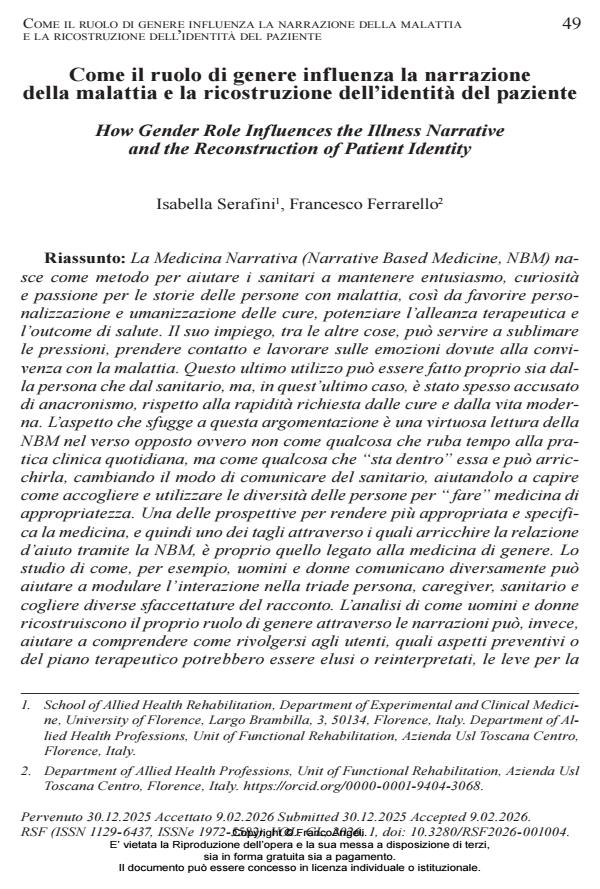
Narrative-based medicine (NBM) was developed to help healthcare professionals maintain their enthusiasm, curiosity and passion for patients’ stories, thereby promoting the personalisation and humanisation of care, strengthening the therapeutic alliance, and improving health outcomes. NBM can be useful for individuals and healthcare professionals, helping to alleviate stress, establish contact, and deal with the emotional impact of living with illness. However, NBM is often criticised for being anachronistic in the context of modern life and healthcare, where tight deadlines are the norm. This view fails to consider the idea that NBM can be a positive addition to daily clinical practice, rather than something that takes time away from it. It can enrich practice by changing the way healthcare professionals communicate and helping them understand how to embrace and utilise people’s diversity to provide appropriate care. One way in which NBM can enhance the therapeutic relationship is by ensuring that treatments are more appropriate and specific. Gender medicine is one area where this can be achieved. For example, studying differences in men and women communication can help to capture different perspectives and improve interactions within the person-caregiver- healthcare professional triad. Analysing how men and women reconstruct their gender roles through narratives can help us to understand how to address users, which aspects of prevention or treatment plans could be circumvented or reinterpreted, and what motivates them. In this article, we provide a brief summary of the literature on this topic.
Keywords: Gender, Femminility, Masculinity, Illness, Narrative, Storytelling.
- [20.] Xiao S, Yuan J, Lan H, Li Q, Cheng Y, Cao K, Zeng X. Investigation of clinical medicine undergraduates’ recognition of narrative medicine. BMC Medical Education 2024. 24.
- [1.] Greenhalgh T, Hurwitz B. Narrative based medicine: why study narra-tive?. BMJ 1999; 318 7175: 48-50. DOI: 10.1136/BMJ.318.7175.48
- [2.] Launer J. Narrative based medicine: a narrative approach to mental health in general practice. BMJ 1999. 318 7176, 117-9.
- [3.] Remei C, Childs E, Pasco J, Trinquart L, Flynn D, Wingerter et al. Content and outcomes of narrative medicine programmes: a systematic review of the literature through 2019. BMJ Open, 10.
- [4.] Gallagher A, Brown J, Caroll C, Perkins E, Van Dore, C & McEntegart
- A. The potential of narrative-based medicine interventions targeting hospital practitioner burnout: findings from a scoping review. Arts & health 2024; 1-24. DOI: 10.1080/17533015.2024.2403607
- [5.] Charon R. Narrative medicine. Honoring the stories of illness. New
- York: Oxford University Press; 2006.
- [6.] Charon R. Narrative Medicine: A Model for Empathy, Reflection, Profession, and Trust. JAMA 2001; 286(15): 1897-1902.
- [7.] Zannini L. Medical Humanities e medicina narrativa. Milano: Raffael-lo Cortina Editore; 2008.
- [8.] Covelli V. Medicina narrative e ricerca. Lecce: Youcanprint; 2008. [9.] Balint M. Medico, paziente e malattia. Milano: Feltrinelli; 1961.
- [10.] Schieppati A. Progettare la cura con la medicina narrativa. Perugia: Cultura e salute editore Perugia; 2024.
- [11.] https://www.medicinanarrativa.network/wp-Content/uploads/2021/03/ Quaderno_n._7_02_CONSENSUS-CON-FINALE_compressed.pdf.
- [12.] Kleinman A. Culture, illness and care: clinical lessons from anthropo-lologic and cross-cultural research. Annals of internal medicine 1978; 88(2): 251-258. DOI: 10.7326/0003-4819-88-2-251.PMID:626456
- [13.] Vermeire E, Hearnshaw H, Van Royen P, Denekens J. Patient adher-ence to treatment: three decades of research. A comprehensive review. J Clin Pharm Ther. 2001; Oct; 26(5): 331-42.
- [14.] Becker J, Dickerman M. Impact of Narrative Medicine Curriculum on Burnout in Pediatric Critical Care Trainees. Critical Care Medicine 2020; 951 (49) 473-473.
- [15.] Lee E, Jacobson A, Maalouf M. Addressing Burnout: A Narrative Medicine Curriculum for Millennial Medical Students. Journal of Psychology Research 2020; 10(12): 507-511. DOI: 10.17265/2159
- [16.] Edwards L, Kim Y, Stevenson M, Johnson T, Sharp N, Reisman A, Srinivasan M. When it’s needed most: a blueprint for resident creative writing workshops during inpatient rotations. BMC Medical Education 2021. Oct 20; 21(1): 535.
- [17.] Winkel A, Feldman N, Moss H, Jakalow H, Simon J, Blank S. Narra-tive Medicine Workshops for Obstetrics and Gynecology Residents and Association With Burnout Measures. Obstetrics & Gynecology 2016. 128, 27S-33S. DOI: 10.1097/AOG.0000000000001619
- [18.] Dutta R. The limitations of narrative medicine. Theoretical Medicine and Bioethics 2025. 46: 247-264.
- [19.] Fox D, Hauser J. Exploring perception and usage of narrative medicine by physician specialty: a qualitative analysis. Philosophy, Ethics, and Humanities in Medicine 2021. 16.
- [21.] Milota M, Van Thiel G, Van Delden J. Narrative medicine as a medical education tool: A systematic review. Medical Teacher 2019. 41. 802-810. DOI: 10.1080/0142159X.2019.1584274
- [22.] France EF, Hunt K, Dow C, Wyke S. Do men’s and women’s accounts of surviving a stroke conform to Frank’s narrative genres? Qual Health Res. 2013 Dec; 23(12): 1649-59.
- 2013 Oct 24. PMID: 24159003; PMCID: PMC3938143.
- [23.] Kagawa Y, Ishikawa H, Son D, Okuhara T, Okada H, Ueno H, Goto, E et al23). Using patient storytelling to improve medical students’ empa-thy in Japan: a pre-post study. BMC Medical Education 2023. Jan 27; 23(1): 67.
- [24.] Purkiss A. Power of patient storytelling. Archives of Disease in Child-hood 2022. 108: 815-816.
- [25.] Assad M. Gender, illness and narrative: a rhetorical study of the amer-ican heart association’s go red for women campaign. Unpublished doc-toral dissertation 2014. Ohio: Case Western Reserve University.
- [26.] Baum N. Once Upon a Time: Storytelling to Connect with Your Pa-tients. Physician Leadership Journal 2024. 11(6): 41-43.
- [27.] Getchell L, Reich M, Allu S, Woods C, Atkinson T, Beaucage M, Stal-ke, L, Sparkes D, Turner C, L’Espérance A, Burns K, Elliott M, Chiu H, Rosenblum N, Sapir-Pichhadze R. Storytelling for impact: the creation of a storytelling program for patient partners in research. Research In-volvement and Engagement 2023. 9.
- [28.] Gucciardi E, Jean-Pierre N, Karam G, Sidani S. Designing and deliver-ing facilitated storytelling interventions for chronic disease self-management: a scoping review. BMC Health Services Research 2016.
- [29.] Lipsey A, Waterman A, Wood E, Balliet W. Evaluation of first-person storytelling on changing health-related attitudes, knowledge, behav-iors, and outcomes: A scoping review. Patient education and counseling 2020.
- [30.] Roberts A. A Two-Phase Qualitative Enquiry Into Storytelling’s Potential to Support Palliative Care Patient-Led Change, Using a Systematic Re-view Approach.. Omega 2024. Jan 9. DOI: 10.1177/00302228231223270
- [31.] Rushforth A, Ladds E, Wieringa S, Taylor S, Husain L, Greenhalgh T. Long Covid - The illness narratives. Social science & medicine 2021. 286: 114326.
- [32.] Bury M. Chronic illness as biographical disruption. Sociol Health Illn. 1982 Jul; 4(2): 167-82.
- [33.] Tokatli M, Sisti L, Marziali E, Nachira L, Rossi M, Amantea C et al. Hormones and Sex-Specific Medicine in Human Physiopathology. Bio-molecules, 2022. Mar 7; 12(3): 41312.
- [34.] Mauvais-Jarvis F, Merz N, Barnes P, Brinton R, Carrero J, Demeo D, Vries G et al. Sex and gender: modifiers of health, disease, and med-icine. Lancet (London, England) 2020; 396: 565-582. DOI: 10.1016/S0140-6736(20)31561-0
- [35.] Oertelt-Prigione, S. Putting gender into sex- and gender-sensitive med-icine. EClinicalMedicine 2020; Mar 4; 20: 100305.20.
- [36.] Di Nuovo F. Il valore aggiunto della medicina di genere. Ital J Gen-der-Specific Med 2020; 20:34-35.
- [37.] De Fiore, L. Toward a gender-oriented scientific communication. Journal of Sex-and Gender-Specific Medicine 2017; 3(3), 124. DOI: 10.1723/2882.29063
- [38.] ARS Toscana. (2023). La salute di genere in Tscana. Documenti ARS Toscana, numero speciale maggio 2023.
- [39.] Bhaloo T, Juma M, Criscuolo-Higgins C. A solution-focused approach to understanding patient motivation in diabetes self-management: Gen-der differences and implications for primary care. Chronic Illness 2018; 14(4), 243-255. DOI: 10.1177/1742395317736372
- [40.] Bueno MV et al. Differences in Adverse Psychosocial Outcomes among Family Caregivers: A Systematic Review. West J Nurs Res. 2023 Jan; 45(1):78-92. DOI: 10.1177/01939459221099672
- [41.] Wittenberg Y et al. Informal caregivers’ judgements on sharing care with home care professionals from an intersectional perspective: the influence of personal and situational characteristics. Scand J Caring Sci. 2019. Dec; 33(4): 1006-1016.
- [42.] Lippi, D, Bianucci, R, & Donell, S. Gender medicine: its historical roots. Postgraduate Medical Journa 2020; 96, 480-486.
- [43.] Piani F, Baffoni L, Strocchi E, Borghi C. Gender-Specific Medicine in the European Society of Cardiology Guidelines from 2018 to 2023: Where Are We Going?. Journal of Clinical Medicine 2024; 13.
- [44.] Delgado-Herrera M, Aceves-Gómez AC, Reyes-Aguilar A. Relation-ship between gender roles, motherhood beliefs and mental health. PLoS One 2024 Mar 20; 19(3): e0298750.
- [45.] Ullrich R, Becker M, Scharf J. The Development of Gender Role At-titudes During Adolescence: Effects of Sex, Socioeconomic Back-ground, and Cognitive Abilities. Journal of Youth and Adolescence 2022; 51: 2114-2129.
- [46.] Yilmaz Z, Yilmaz T, Tokman E. Views of healthcare professionals on gender roles: A qualitative study. Heliyon 2023; 9.
- [47.] Appleton D, Robertson N, Lesley R.. The Effect of Gender Ideal Ad-herence on Carer Burden and Help-Seeking in Male Carers of People With Multiple Sclerosis.. International journal of MS care 2025; 27: 8-14. DOI: 10.7224/1537-2073.2023-073
- [48.] Lennon J, Hevey D, Kinsella L. Gender role conflict, emotional ap-proach coping, self-compassion, and distress in prostate cancer pa-tients: A model of direct and moderating effects. Psycho-Oncology 2018; 27: 2009-2015.
- [49.] Seldomridge A, Wang D, Dryjanska L, Schwartz J. Adherence to Gender Roles on PTSD Symptoms of Hurricane Harvey Sur-vivors. Journal of Loss and Trauma 2024; 29: 803-827. DOI: 10.1080/15325024.2024.2345071
- [50.] Ahlsen B, Bondevik H, Mengshoel AM, Solbrække K N. (Un)doing gender in a rehabilitation context: A narrative analysis of gender and self in stories of chronic muscle pain.Disability and Rehabilitation: An International, Multidis-ciplinary Journal 2014, 36(5), 359-366. DOI: 10.3109/09638288.2013.793750
- [51.] Riessman, C. K. (2003). Performing identities in illness narrative: Mas-culinity and multiple sclerosis. Qualitative research, 3(1), 5-33. DOI: 10.1177/1468794103003001766
- [52.] Le Henaff Y, Héas S, Joly P. Taking care of oneself and others: The emotion work of women suffering from a rare skin disease. Health. 2023; 27(5): 738-755. DOI: 10.1177/13634593211064127
- [53.] Thompson EH Jr, Futterman AM. Body talk and resilience: Aging men’s experiences with mastectomy and prostatectomy. J Aging Stud.
- [54.] Solimeo S. Sex and gender in older adults’ experience of Parkinson’s disease. J Gerontol B Psychol Sci Soc Sci. 2008 Jan; 63(1): S42-8.
- [55.] Moè A. La motivazione: Teorie e processi. Bologna: il Mulino; 2020. [56.] Tannen D. You just don’t understand. Women and men in conversation. New York: Balantine Books, 1992.
- [57.] Saccà F, Rosalba Belmonte R. Sopravvissute. La violenza narrata dalle donne. Roma: Castelvecchi, 2022.
- [58.] Quaglia V. Men, masculinities and diabetes: ‘doing gender’ in Italian men’s narratives of chronic illness. Sociol Health Illn 2020 Nov; 42(8): 1902-1917. DOI: 10.1111/1467-9566.13176
- [59.] Poli EF. Le emozioni che curano. Stare bene con la nuova medicina delle emozioni. Milano:Mondadori, 2019.
- [60.] Arcand M, Juster R, Lupien S, Marin, M. Gender roles in re-lation to symptoms of anxiety and depression among students and workers. Anxiety, Stress, & Coping 2020; 33: 661-674. DOI: 10.1080/10615806.2020.1774560
- [61.] Pedulla R, Glugosh J, Jeyaseelan N, Prevost B, Velez, E., Winnitoy, B et al. Associations of Gender Role and Pain in Musculoskeletal Disor-ders: A Mixed-Methods Systematic Review. The journal of pain 2024; 104644.
- [62.] Stalling I, Gruber M, Bammann K. Sex differences in physical func-tioning among older adults: cross-sectional results from the OUT-DOOR ACTIVE study. BMC Public Health. 2024 Jul 2; 24(1): 1766.
- [63.] Zeidan RS, McElroy T, Rathor L, Martenson MS, Lin Y, Mankowski R T. Sex differences in frailty among older adults. Experimental Geron-tology 2023, 184.
Isabella Serafini, Francesco Ferrarello, Come il ruolo di genere influenza la narrazione della malattia e la ricostruzione dell’identità del paziente in "RIVISTA SPERIMENTALE DI FRENIATRIA" 1/2026, pp 49-71, DOI: 10.3280/RSF2026-001004