The Narrated Mind: Narrative Medicine and Psychoneurology between Brain, Relationship, and Meaning
Journal title RIVISTA SPERIMENTALE DI FRENIATRIA
Author/s Francesca Sireci, Franco Valzania, Antonio Iudici, Sara Montepietra
Publishing Year 2026 Issue 2026/1
Language Italian Pages 27 P. 73-99 File size 822 KB
DOI 10.3280/RSF2026-001005
DOI is like a bar code for intellectual property: to have more infomation
click here
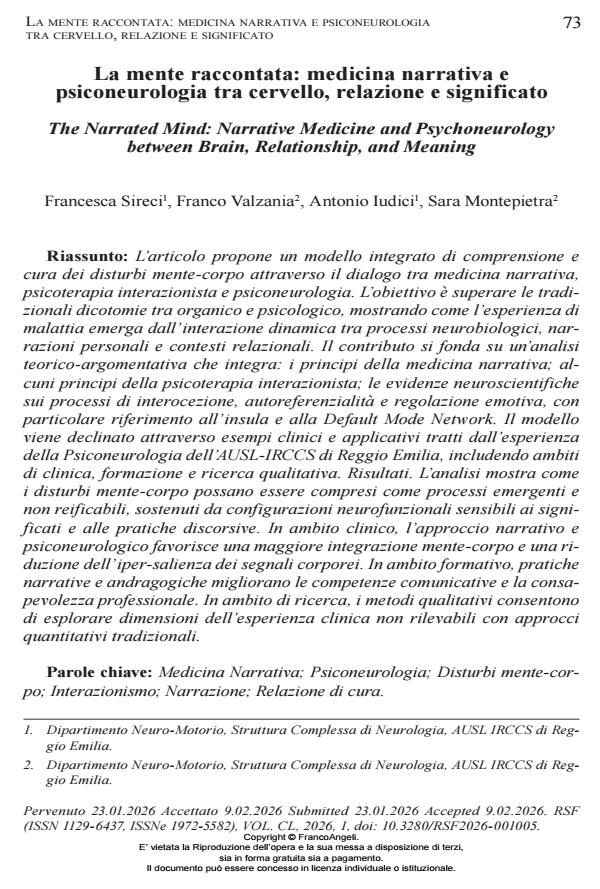
Below, you can see the article first page
If you want to buy this article in PDF format, you can do it, following the instructions to buy download credits
FrancoAngeli is member of Publishers International Linking Association, Inc (PILA), a not-for-profit association which run the CrossRef service enabling links to and from online scholarly content.
Objective. This article proposes an integrated framework for understanding and treating mind-body disorders through the dialogue be-tween Narrative Medicine, Interactionist Psychotherapy, and Psychoneurol-ogy. The aim is to overcome traditional dichotomies between the “organic” and the “psychological” by conceptualising illness as an emergent phenom-enon arising from the dynamic interaction among neurobiological processes, personal narratives, and relational contexts. Methods. The paper is based on a theoretical-argumentative analysis integrating: the principles of Narrative Medicine; Rom Harré’s Positioning Theory; and neuroscientific evidence on interoception, self-referential processing, and emotional regulation, with par-ticular reference to the insula and the Default Mode Network. The proposed model is illustrated through clinical, educational, and research applications drawn from the experience of the Psychoneurology Unit at AUSL-IRCCS of Reggio Emilia, including qualitative research approaches. Results. The analysis shows that mind-body disorders can be understood as emergent and non-reifiable processes, sustained by neurofunctional configurations that are sensitive to meaning-making and discursive practices. In clinical settings, the narrative-psychoneurological approach promotes greater mind-body inte-gration and a reduction of hyper-salience of bodily signals. In educational contexts, narrative and andragogical practices enhance clinicians’ commu-nicative skills and professional self-awareness. In research, qualitative meth-odologies enable the exploration of dimensions of clinical experience that cannot be adequately captured by traditional quantitative methods.
Keywords: Narrative Medicine; Psychoneurology; Mind-Body Disorders; Interactionist Approach; Narrative Processes; Therapeutic Relationship.
- [1.] Charon R. «Narrative medicine: A model for empathy, reflection, pro-fession, and trust», in Journal of the American Medical Association, 286(15); 2001, pp. 1897-1902.
- [2.] Charon R. Narrative Medicine: Honoring the Stories of Illness, Oxford: Oxford University Press; 2006.
- [3.] Harré R. The Singular Self: An Introduction to the Psychology of Per-sonhood. London: Sage; 1998.
- [4.] Harré R., van Langenhove, L. Positioning Theory: Moral Contexts of Intentional Action. Oxford: Blackwell; 1999.
- [5.] Damasio A. Self Comes to Mind: Constructing the Conscious Brain, New York: Pantheon; 2010.
- [6.] Northoff G. Neuropsychoanalysis in Practice: Brain, Self and Objects, Oxford: Oxford University Press; 2011.
- [7.] Cabeza R., Moscovitch M. «Memory systems, processing modes, and components: Functional neuroimaging evidence», in Trends in Cogni-tive Sciences, 2013, 17(12), pp. 611-621.
- [8.] Andrews-Hanna J. R., Smallwood J., Spreng R. N. «The default net-work and self-generated thought: Component processes, dynamic con-trol, and clinical relevance», in Nature Reviews Neuroscience, 2014, 15(8), pp. 483-495.
- [9.] Charmaz K. Constructing Grounded Theory (2nd ed.). London: Sage; 2014.
- [10.] Giorgi A. The Descriptive Phenomenological Method in Psychology, Pittsburgh: Duquesne University Press; 2009.
- [11.] Smith J. A., Flowers P., Larkin M. Interpretative Phenomenological Analysis: Theory, Method and Research. London: Sage; 2009.
- [12.] Siegel DJ, Drulis C. An interpersonal neurobiology perspective on the mind and mental health: personal, public, and planetary well-being. Ann Gen Psychiatry. 2023 Feb 3; 22(1): 5.
- 00434-5. PMID: 36737822; PMCID: PMC9897608.
- [13.] Schore A. N. The Science of the Art of Psychotherapy, New York: W. W. Norton; 2012.
- [14.] Brown R. J. «Psychogenic nonepileptic seizures: A cognitive model», in Cognitive and Behavioral Practice. 2016, 23(2), pp. 225-240.
- [15.] Brown RJ., Reuber M. Psychological and psychiatric aspects of psycho-genic non-epileptic seizures (PNES): A systematic review. Clin Psy-chol Rev. 2016 Apr; 45: 157-82.
- 2016 Mar 16. PMID: 27084446.
- [16.] Edwards M. J., Adams R. A., Brown H., Pareés I., Friston K. J. «A Bayesian account of hysteria», Brain, 2012. 135(11), pp. 3495-3512.
- [17.] Espay A. J., Aybek S., Carson A., Edwards M. J., Goldstein L. H., Hallett M., LaFaver K., Nicholson T., Nielsen G., Reuber M., Voon V., Stone, J. «Current concepts in diagnosis and treatment of Functional Neurological Disorder», JAMA Neurology, 2018: 75(9), pp. 1132-1141.
- [18.] LeDoux J. Anxious: The Modern Mind in the Age of Anxiety, New York: Viking; 2012.
- [19.] Varela FG, Maturana HR, Uribe R. Autopoiesis: the organization of living systems, its characterization and a model. Curr Mod Biol. 1974. DOI: 10.1016/0303-2647(74)90031-8.PMID:4407425
- [20.] Stone J, Carson A. Functional neurologic disorders. Continuum (Min-neap Minn). Behavioural Neurology and Neuropsychiatry, 2015 Jun, 21(3): 818-37. DOI: 10.1212/01.CON.0000466669.02477.45.PMID
- 26039857.
- [21.] Sireci F., Moretti V., Cavallieri F., Ferrari S., Minardi V., Ferrari F., Bal-estra G. L., Ghirotto L., Valzania F. «“Somewhere between an actual disease and a disease”: A Grounded Theory study on diagnosing Func-tional Neurological Disorders from a multi-informant perspective», Qualitative Health Research, 2024, 34(11), pp. 1069-1083.
- [22.] Sireci F., Bellei E., Torre G., Ferrari F., Minardi V., Ghirotto L., Valz-ania F. «Being a technician during COVID-19: a qualitative cross-sec-tional survey on the experiences of clinical neurophysiology techni-cians», Neurological Sciences, 2023: 44(2), pp. 429-436.
- [23.] Turchi G. P., Orrù L., Iudici A., Pinto E. «A contribution towards health», Journal of Evaluation in Clinical Practice, 2022: 28, pp. 717-720.
- [24.] Iudici A., Girolimetto R., Bacioccola E., Faccio E., Turchi G. P. «Impli-cations of involuntary psychiatric admission: Health, social, and clin-ical effects on patients», The Journal of Nervous and Mental Disease, 2022: 210(4), pp. 290-311.
- [25.] Kirmayer, L. J., & Gold, I. (2012). Re-socializing psychiatry: Critical neuroscience and the limits of reductionism. In S. Choudhury & J. Sla-by (Eds.), Critical neuroscience: A handbook of the social and cultural contexts of neuroscience (pp. 307-330). Wiley-Blackwell.
- [26.] Choudhury, S., & Slaby, J. (Eds.). (2012). Critical neuroscience: A hand-book of the social and cultural contexts of neuroscience. Wiley-Black-well.
- [27.] Borsboom, D., Cramer, A. O. J., & Kalis, A. (2019). Brain disorders? Not really: Why network structures block reductionism in psychopa-thology research. Behavioral and Brain Sciences, 42, e2.
- [28.] Iudici, A., Della Rocca, P. (2025). Ne’ di casi né di pazienti. Storie biografiche in ambito clinico. FrancoAngeli.
- [29.] Iudici A, Colombo L, Caravita SCS, Cottone P, Neri J. The Invisible Discrimination: Biases in the Clinical Approach Regarding Migrants: A Study to Help Ethnopsychology Services and Clinicians. Behav Sci (Basel). 2024 Feb 21; 14(3): 155.
Francesca Sireci, Franco Valzania, Antonio Iudici, Sara Montepietra, La mente raccontata: medicina narrativa e psiconeurologia tra cervello, relazione e significato in "RIVISTA SPERIMENTALE DI FRENIATRIA" 1/2026, pp 73-99, DOI: 10.3280/RSF2026-001005