Neurosyphilis and Narrative: The Case of Guy de Maupassant
Journal title RIVISTA SPERIMENTALE DI FRENIATRIA
Author/s Stefano Calabrese, Valentina Conti
Publishing Year 2026 Issue 2026/1
Language Italian Pages 25 P. 101-125 File size 804 KB
DOI 10.3280/RSF2026-001006
DOI is like a bar code for intellectual property: to have more infomation
click here
Below, you can see the article first page
If you want to buy this article in PDF format, you can do it, following the instructions to buy download credits
FrancoAngeli is member of Publishers International Linking Association, Inc (PILA), a not-for-profit association which run the CrossRef service enabling links to and from online scholarly content.
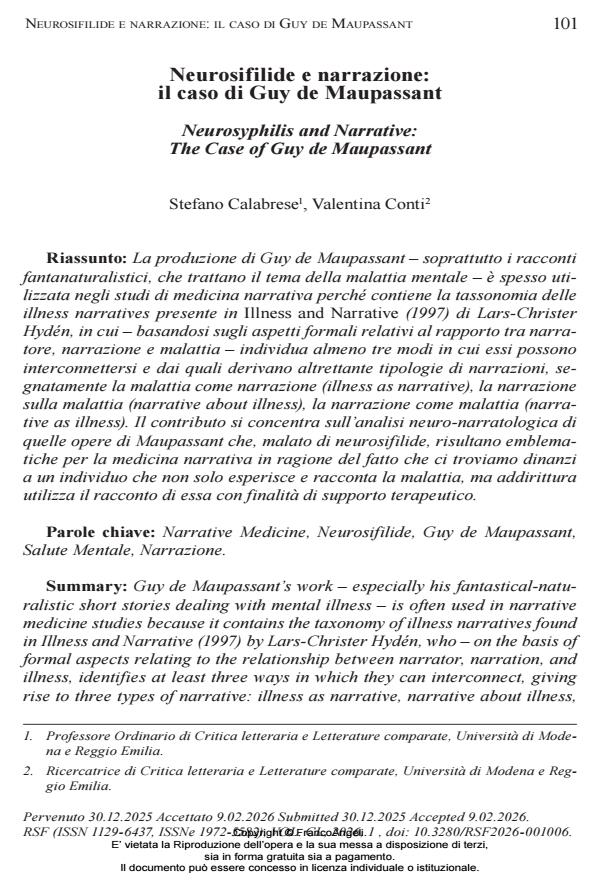
Guy de Maupassant’s work – especially his fantastical-natu-ralistic short stories dealing with mental illness – is often used in narrative medicine studies because it contains the taxonomy of illness narratives found in Illness and Narrative (1997) by Lars-Christer Hydén, who – on the basis of formal aspects relating to the relationship between narrator, narration, and illness, identifies at least three ways in which they can interconnect, giving rise to three types of narrative: illness as narrative, narrative about illness and narrative as illness. The article focuses on the neuro-narratological analysis of those works by Maupassant who, suffering from neurosyphilis, are emblematic for narrative medicine, since they present an individual who not only experiences and recounts illness but even uses its narration for ther-apeutic purposes.
Keywords: Narrative Medicine, Neurosyphilis, Guy de Maupassant, Mental Health.
- [1.] Charon R. Medicina narrativa. Onorare le storie dei pazienti, trad. it. Milano: Raffaello Cortina; 2019, p. 1.
- [2.] Spinsanti S. Le Medical Humanities: una cura per la medicina. Teoria, numero monografico su Critica della ragione medica 2011; 31(1): 23-38.
- [3.] Montgomery Hunter K. Doctor’s Stories. The Narrative Structure of Medical Knowledge. Princeton: Princeton University Press; 1991, p. 46 ss.
- [4.] Charon R et al. Literature and medicine: Contributions to clinical prac-tice. Annals of Internal Medicine 1995; 122: 599-606.
- [5.] Greenhalg T., Hurwitz B. Narrative Based Medicine: Dialogue and Discourse in Clinical Practice 1998.
- [6.] Charon R. Narrative medicine: a model for empathy, reflection, profes-sion, and trust. Jama 2001; 286(15): 1897-902.
- [7.] Charon R. Narrative Medicine: Form, Function, and Ethics. Annals of Internal Medicine. 2001; 134(1): 83-7.
- [8.] Charon R. Narrative Medicine: Honoring the Stories of Illness. New York: Oxford University Press; 2006.
- [9.] Bert G. Medicina narrativa. Storie e parole nella relazione di cura. Roma: Il Pensiero Scientifico; 2015.
- [10.] Conferenza di Consenso. Linee di indirizzo per l’utilizzo della Me-dicina Narrativa in ambito clinico-assistenziale, per le malattie rare e cronico-degenerative. Sole 24 Ore Sanità, Collana I Quaderni di Medi-cina, Allegato al n. 7, 24 febbraio - 2 marzo 2015: 15.
- [11.] Conferenza di Consenso. Linee di indirizzo per l’utilizzo della Me-dicina Narrativa in ambito clinico-assistenziale, per le malattie rare e cronico-degenerative. Sole 24 Ore Sanità, Collana I Quaderni di Medi-cina, Allegato al n. 7, 24 febbraio - 2 marzo 2015: 13-4.
- [12.] Conferenza di Consenso. Linee di indirizzo per l’utilizzo della Me-dicina Narrativa in ambito clinico-assistenziale, per le malattie rare e cronico-degenerative. Sole 24 Ore Sanità, Collana I Quaderni di Medi-cina, Allegato al n. 7, 24 febbraio - 2 marzo 2015: 14-6.
- [13.] Calabrese S, Conti V, Fioretti C. Che cos’è la medicina narrativa. Roma: Carocci; 2022.
- [14.] Bert G, Quadrino S. Parole di medici, parole di pazienti. Counselling e narrativa in medicina. Roma: Il Pensiero Scientifico; 2002.
- [15.] Garrino L. La medicina narrativa nei luoghi di formazione e di cura. Milano: Ermes divisione Centro Scientifico Editore; 2010.
- [16.] Polvani S, Sarti A. Medicina narrativa in terapia intensiva. Storie di malattia e di cura. Milano: FrancoAngeli; 2013.
- [17.] Virzì A. et al. Medicina narrativa: cos’è?. Medicina Narrativa 2011; 1: 9-13.
- [18.] Charon R. Medicina narrativa. Onorare le storie dei pazienti, trad. it. Milano: Raffaello Cortina; 2019, p. 167-70.
- [19.] Demetrio D. La scrittura clinica. Consulenza autobiografica e fragilità esistenziali. Milano: Cortina; 2008, p. 22 ss.
- [20.] Groleau D, Young A, Kirmayer LJ. The McGill Illness Narrative Interview (MINI): an interview schedule to elicit meanings and modes of reasoning related to illness experience. Transcult Psychiatry 2006; 43(4): 671-91.
- [21.] Hydén LC, Antelius E. Communicative disability and stories: Towards an embodied conception of narratives. Health 2010; 15(6): 588-603. [22.] Launer J. Narrative-based Primary Care. A practical guide. Abington: Radclife Medical Press; 2002.
- [23.] George DR, Stuckey HL, Whitead MM. How a creative storytelling intervention can improve medical student attitude toward a person with dementia: A mixed methods study. Dementia 2014, 13: 318-29.
- [24.] Kottler J. Stories We’ve Heard, Stories We’ve Told. Life-Changing Narratives in Therapy and Everyday Life. Oxford: Oxford University Press; 2025, p. 3.
- [25.] Kottler J. Stories We’ve Heard, Stories We’ve Told. Life-Changing Narratives in Therapy and Everyday Life. Oxford: Oxford University Press; 2025, p. 76-109.
- [26.] Calabrese S, Conti V, Fioretti C. Che cos’è la medicina narrativa. Roma: Carocci; 2022.
- [27.] Addamiano N. Guy de Maupassant. La vita e l’opera. Roma: Ausona; 1949, p. 3 ss.
- [28.] Johnston M. Guy de Maupassant. Fayard: Paris; 2012, p. 9-105.
- [29.] Longhi MG. Introduzione a Maupassant. Laterza: Roma; 1994, p. 4 ss. [30.] Savinio A. Maupassant e “l’Altro”. s.l. (edizione Kindle): Adelphi; 2019, p. 50.
- [31.] Longhi MG. Introduzione a Maupassant. Laterza: Roma; 1994, p. 19.
- [32.] Johnston M. Guy de Maupassant. Fayard: Paris; 2012, p. 782.
- [33.] Maupassant G de. Correspondance. Évreux: Le Cercle du bibliophile, vol. I; 1973, p. 300-3.
- [34.] Plaitano G. L’Androgyne et le Faune. Il travestimento tra Gisèle d’E-stoc e Guy de Maupassant. Itinera 2016; 11: 233-48.
- [35.] Maupassant G de. Correspondance. Évreux: Le Cercle du bibliophile, vol. I; 1973, p. 117.
- [36.] Friedrich F et al. Psychosis in neurosyphilis-clinical aspects and impli-cations. Psychopathology 2014; 47(1): 3-9.
- [37.] Charon R. Narrative Medicine: Honoring the Stories of Illness. New York: Oxford University Press; 2006.
- [38.] Hydén L-C. Illness and narrative. Sociology of Health & Illness 1997; 19(1): 48-69.
- [39.] Calabrese S, Conti V. Vivere di storie. Seminario su Maupassant e la neuronarratologia. Roma: Carocci; 2023.
- [40.] Maupassant G de. Correspondance. Évreux: Le Cercle du bibliophile, vol. I; 1973, p. 93-5.
- [41.] Addamiano N. Guy de Maupassant. La vita e l’opera. Roma: Ausona; 1949, p. 69-87.
- [42.] Maupassant G de. Correspondance. Évreux: Le Cercle du bibliophile, vol. I; 1973, p. 83-4.
- [43.] Bienvenu J. Maupassant inédit. Aix-en-Provence: Éditions Édisud; 1993, p. 96-8.
- [44.] Murat L. La casa del dottor Blanche. Storia di un luogo di cura e dei suoi ospiti, da Nerval a Maupassant, trad. it. Genova: Il Melangolo; 2007, p. 382.
- [45.] Bienvenu J. Maupassant inédit. Aix-en-Provence: Éditions Édisud; 1993, p. 100.
- [46.] Arago JE. Une maison de fous, in Paris ou le livre des cent-et-un. Paris: Ladvocat; 1832, vol. 4, p. 212.
- [47.] Senon JL, Sechter D, Richard D. Thérapeutique psychiatrique. Paris: Hermann; 1995, p. 1-18.
- [48.] Scuro G. Sulla follia di Maupassant: l’‘étude de cas’ de “Le Horla”. SigMa 2019; 3: 769-89.
- [49.] Maupassant G de. Correspondance. Évreux: Le Cercle du bibliophile, vol. III; 1973, p. 219-20.
- [50.] Maupassant G de. Correspondance. Évreux: Le Cercle du bibliophile, vol. III; 1973, p. 240.
- [51.] Maupassant G de. Correspondance. Évreux: Le Cercle du bibliophile, vol. III; 1973, p. 241-2.
- [52.] Conti V. Guy de Maupassant: lo spazio privato della follia. Comparati-smi 2024; 9: 78-95.
- [53.] Maupassant G de. Le Horla, trad. it. Milano: BUR; 2019, p. 73, 75, 77.
- [54.] Maupassant G de. Le Horla, trad. it. Milano: BUR; 2019, p. 77-9.
- [55.] Álvaro LC. Hallucinations and pathological visual perceptions in Mau-passant’s fantastical short stories - A neurological approach. Journal of the History of the Neurosciences 2005; 14(2): 100-15.
- [56.] Maupassant G de. Le Horla, trad. it. Milano: BUR; 2019, p. 82. [57.] Maupassant G de. Le Horla, trad. it. Milano: BUR; 2019, p. 83. [58.] Maupassant G de. Le Horla, trad. it. Milano: BUR; 2019, p. 118.
- [59.] Álvaro LC. Hallucinations and pathological visual perceptions in Mau-passant’s fantastical short stories - A neurological approach. Journal of the History of the Neurosciences 2005; 14(2): 100-15.
- [60.] Maupassant G de. Le Horla, trad. it. Milano: BUR; 2019, p. 119.
- [61.] Maupassant G de. Le Horla, trad. it. Milano: BUR; 2019, p. 135, 137.
- [62.] Maupassant G de. Le Horla, trad. it. Milano: BUR; 2019, p. 189. [63.] Maupassant G de. Le Horla, trad. it. Milano: BUR; 2019, p. 189. [64.] Maupassant G de. Le Horla, trad. it. Milano: BUR; 2019, p. 187, 189.
- [65.] Marzano P. Maupassant e «l’altro». Tre soprannomi e un nome misterioso: Horla o Gorla? Il nome nel testo 2002; 4: 97-124. [66.] Scuro G. Sulla follia di Maupassant: l’’étude de cas’ de “Le Horla”. SigMa 2019; 3: 770.
- [67.] Marquer B. Naissance du fantastique clinique. Paris: Hermann; 2014, p. 25-6.
- [68.] Lagriffe L, Voivenel P. Sous le signe de la P. G.: la folie de Guy de Mau-passant. Paris: La Renaissance du livre; 1929, p. 152.
Stefano Calabrese, Valentina Conti, Neurosifilide e narrazione: il caso di Guy de Maupassant in "RIVISTA SPERIMENTALE DI FRENIATRIA" 1/2026, pp 101-125, DOI: 10.3280/RSF2026-001006