Narrative Medicine and the Self-Care of Healthcare Professionals in Care Contexts
Journal title RIVISTA SPERIMENTALE DI FRENIATRIA
Author/s Micaela Castiglioni
Publishing Year 2026 Issue 2026/1
Language Italian Pages 19 P. 127-145 File size 757 KB
DOI 10.3280/RSF2026-001007
DOI is like a bar code for intellectual property: to have more infomation
click here
Below, you can see the article first page
If you want to buy this article in PDF format, you can do it, following the instructions to buy download credits
FrancoAngeli is member of Publishers International Linking Association, Inc (PILA), a not-for-profit association which run the CrossRef service enabling links to and from online scholarly content.
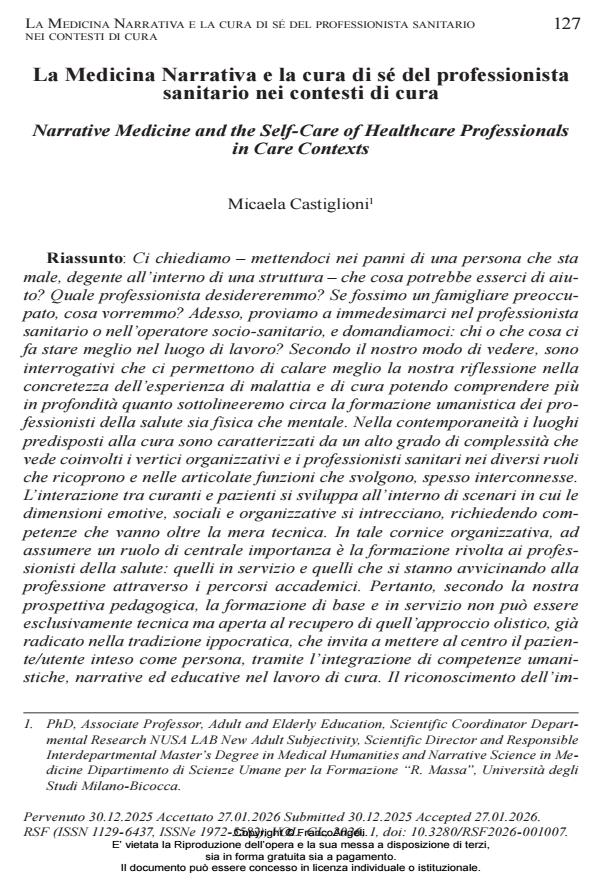
We ask ourselves – putting ourselves in the shoes of a sick person, a patient in a facility – what could help us? Which professional would we want? If we were a worried family member, what would we want? Now, let’s try to step into the shoes of the healthcare professional or social worker, and ask ourselves: who or what makes us feel better in the workplace? In our view, these are questions that allow us to ground our reflection more firmly in the concrete experience of illness and care, enabling a deeper understanding of what we will emphasise regarding the humanistic training of both physical and mental health professionals. Nowadays, healthcare settings are generally characterised by a high degree of complexity, involving both organisational leaders and healthcare professionals, in their various roles as well as the complex and multifaceted functions they perform, often interconnected. The interaction between healthcare professionals and patients, therefore, unfolds within scenarios in which emotional, social, and organisational dimensions intersect, requiring competences that go beyond purely technical skills. In this scenario, training aimed at healthcare professionals – both those already in practice and those who will become professionals (students who are approaching the profession through academic programmes), assumes a central role. Therefore, from our pedagogical perspective, basic and inservice training for healthcare professionals cannot be exclusively technical but must embrace a holistic approach, rooted in the Hippocratic tradition, which calls for placing the patient or service user at the centre as a person, through the integration of humanistic, narrative, and educational competences into care practice. Recognising the importance of this training approach requires legitimising the integration of EvidenceBased Medicine with BioPsychoSocial Medicine, in accordance with the principles of Medical Humanities and Narrative Medicine.
Keywords: Care, Complexity, Training, Healthcare Professionals, Medical Humanities, Narrative Medicine.
- [1.] Bertolini G. (a cura di). Diventare medici. Il problema della conoscenza in medicina e nella formazione del medico. Milano: Guerini e Associati; 1994.
- [2.] AA.VV., Consensus Conference “Linee di indirizzo per l’utilizzo della medicina narrativa in ambito clinicoassistenziale, per le malattie rare e cronicodegenerative”, 1113/6, 2014.
- [3.] Bracco C. Anche l’arte può aiutare i medici “sovraccaricati”. Il Corriere della Sera; 14.12.2025.
- [4.] Charon R. Medicina narrativa: onorare le storie dei pazienti. Milano: Raffaello Cortina Editore; 2919.
- [5.] Varchetta L. Le organizzazioni che curano, in L. Mori, G. Varchetta (a cura di) Cura e formazione. Le organizzazioni che curano. Milano: FrancoAngeli; 2012.
- [6.] Cosso A. Raccontarsela. Copioni di vita e storie organizzative: l’uso della narrazione per lo sviluppo individuale e d’impresa. Milano: Lupetti; 2013.
- [7.] Bert G. Medicina narrativa. Storie e parole nella relazione di cura. Roma: Il Pensiero Scientifico; 2009.
- [8.] Castiglioni M. Prendersi cura delle narrazioni per prendersi cura dei contesti di cura”, in V. Alastra (a cura di), Narrazioni che disegnano mondi. Vivere la complessità fare la differenza. Lecce: Pensa MultiMedia; 2019.
- [9.] Castiglioni M. Introduzione, in R. Charon, Medicina narrativa: onorare le storie dei pazienti. Milano: Raffaello Cortina Editore; 2019.
- [10.] Zannini L. Medical Humanities e Medicina Narrativa. Nuove prospettive nella formazione dei professionisti della cura. Milano: Raffaello Cortina Edizioni; 2008.
- [11.] Nussbaum M. Non per profitto. Perché le democrazie hanno bisogno della cultura umanistica. Bologna: il Mulino; 2014.
- [12.] Carmagnola F., Bonazzi, M. Il fantasma della libertà. Inconscio e politica al tempo di Berlusconi. Milano: Mimesis; 2011.
- [13.] www.mednarr Dipartimento di Scienze Umane per la formazione “R. Massa”, Università degli Studi MilanoBicocca.
- [14.] Sacks O. L’occhio della mente. Milano: Adelphi; 2016.
Micaela Castiglioni, La Medicina Narrativa e la cura di sé del professionista sanitario nei contesti di cura in "RIVISTA SPERIMENTALE DI FRENIATRIA" 1/2026, pp 127-145, DOI: 10.3280/RSF2026-001007