A Measured and Respectful Approach Engaging with Mental Health Narratives

Journal title RIVISTA SPERIMENTALE DI FRENIATRIA
Author/s Marco Bobbio, Massimiliano Marinelli, Paola Arcadi, Tania Milletti, Daniela Berardinelli
Publishing Year 2026 Issue 2026/1
Language Italian Pages 27 P. 147-173 File size 810 KB
DOI 10.3280/RSF2026-001008
DOI is like a bar code for intellectual property: to have more infomation click here

Below, you can see the article first page

If you want to buy this article in PDF format, you can do it, following the instructions to buy download credits
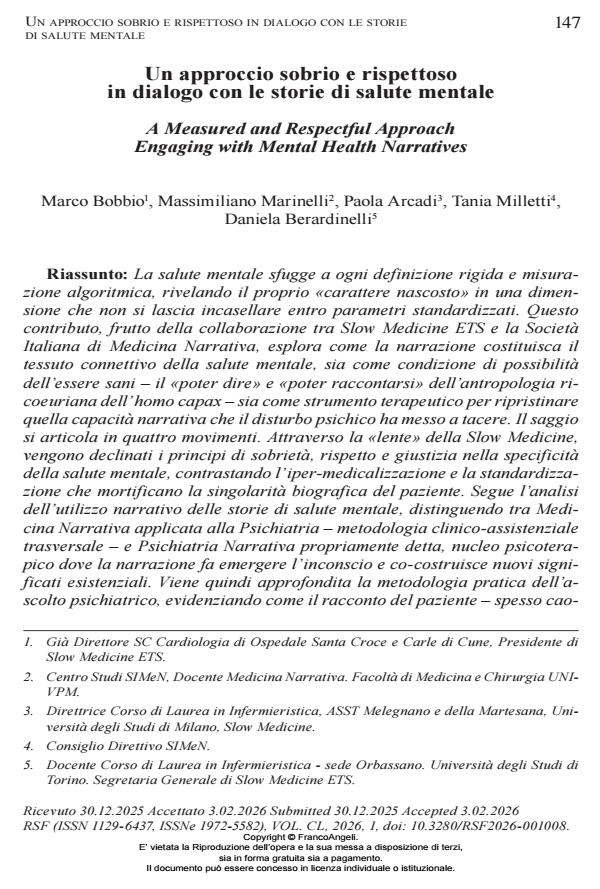
Article preview

FrancoAngeli is member of Publishers International Linking Association, Inc (PILA), a not-for-profit association which run the CrossRef service enabling links to and from online scholarly content.

Mental health eludes rigid definition and algorithmic measurement, revealing its “hidden character” in a dimension that cannot be confined within standardised parameters. This contribution, arising from collaboration between Slow Medicine ETS and the Italian Society of Narrative Medicine, explores how narrative constitutes the connective tissue of mental health, both as a condition of possibility for being healthy – the “ability to speak” and “ability to narrate oneself” of Ricoeur’s anthropology of homo capax – and as a therapeutic tool to restore the narrative capacity that psychic disturbance has silenced. The essay unfolds in four movements. Through the “lens” of Slow Medicine, the principles of sobriety, respect, and justice are articulated in the specificity of mental health, countering overmedicalisation and standardisation that diminish the patient’s biographical singularity. This is followed by an analysis of the narrative use of mental health stories, distinguishing between Narrative Medicine applied to psychiatry – a transversal clinicalcare methodology – and Narrative Psychiatry in the strict sense, the psychotherapeutic core in which narration brings forth the unconscious to light and coconstructs new existential meanings. The practical methodology of psychiatric listening is then examined, highlighting how the patient’s account – often chaotic, fragmented, marked by “narrative gaps” – requires a specific narrative stance capable of welcoming the other beyond diagnosis. The “Storie Slow” project finally demonstrates how these theoretical principles translate into concrete practice, through narratives that make visible the relational fabric of care and become formative tools for healthcare professionals. The training experience with nursing students shows how writing “through another’s lens” – recounting the same story from the perspectives of student, patient, and professional – becomes a powerful pedagogical device for developing empathy, reflexivity, and critical thinking.

Keywords: Slow Medicine, Narrative Medicine, Narrative Psychiatry, Nursing Education, Therapeutic relationship.

  1. [1.] Gadamer HG. Dove si nasconde la salute. Milano: Raffaello Cortina Editore; 1994. p. 117.
  2. [30.] Campos Velho JC. Un farmaco meglio di quattro https://www.slowmedicine.it/slow/wpcontent/uploads/2021/09/35CamposVelhoUnfarmacomegliodiquattro.pdf.
  3. [2.] Ministero della Salute. Rapporto sulla salute mentale. Analisi dei dati del Sistema Informativo per la Salute Mentale (SISM). Anno 2023. Roma: Ministero della Salute; 2024. p. 7.
  4. [3.] American Psychiatric Association. Diagnostic and Statistical Manual of Mental Disorders. 5th ed., Text Revision. Washington, DC: American Psychiatric Association; 2022.
  5. [4.] Ricoeur P. Percorsi del riconoscimento. Milano: Raffaello Cortina Editore; 2005. pp. 107126.
  6. [5.] Charon R. Narrative Medicine: Honoring the Stories of Illness” ed it Medicina narrativa. Onorare le storie dei pazienti. Castiglioni M, cur.; Delorenzo C, trad. Milano: Raffaello Cortina Editore; 2019. p. 1.
  7. [6.] Ricoeur P. Paul Ricoeur e la psicoanalisi. Testi scelti. Jervolino D, Mar tini G, cur. Milano: FrancoAngeli; 2007.
  8. [7.] https://www.slowmedicine.it/ilmanifestodislowmedicine/.
  9. [8.] Berwick DM, Hackbarth A. Eliminating waste in US health care. JAMA 2012; 307: 15136.
  10. [9.] Fisher ES, Bynum JP, Skinner JS. Slowing the growth of health care costs lessons from regional variation. N Engl J Med 2009; 360: 849 52.
  11. [10.] https://www.slowmedicine.it/choosingwisely/.
  12. [11.] Arcadi P, Chiarlo M, Bobbio M. Il tempo è la cura. Lo sguardo di Slow Medicine. L’infermiere 2021; 58: 6, 15. https://www.infermiereonline. org/2022/01/30/iltempodirelazioneetempodicuralosguardodislowmedicine/.
  13. [12.] https://www.slowmedicine.it/slow/wpcontent/uploads/2021/07/ 31SchiavoQuandoifarmaciammalano.pdf.
  14. [13.] Ioannidis JP. Evidencebased medicine has been hijacked: A report to David Sackett. Journal of Clinical Epidemiology 2016; 73: 8286.
  15. [14.] Bobbio M, Chiarlo M, Arcadi P, Kidd E. Practising Less is More: An Exploration of What it Means to See “This Patient” Not a “Patient Like This”. J Bioeth Inq 2025; 22: 131145.
  16. [15.] Freud, S., Casi clinici. Torino: Bollati Boringhieri; 2008.
  17. [16.] Benedetti G. Alienazione e personazione nella psicoterapia della malattia mentale. Torino: Einaudi; 1980.
  18. [17.] Trenta P. La postura narrativa. I modi di essere della cura. Roma: Castelvecchi; 2024.
  19. [18.] Giberti F., Rossi R., Marcenaro M. (a cura di), Manuale di Psichiatria, VII Edizione. Padova: Piccin Nuova Libraria; 2023.
  20. [19.] Ogden T. H., Riscoprire la psicoanalisi. Pensare e sognare, imparare e dimenticare.Milano: CIS Editore; 2009.
  21. [20.] Binswanger, L., Sogno ed esistenza, introduzione di M. Foucault,.Milano: SE; 1993.
  22. [21.] Borgna E., L’arcipelago delle emozioni. Milano: Feltrinelli;2001.
  23. [22.] Bruner, J. S., “La vita come narrazione”, in La ricerca del significato. Per una psicologia culturale. Torino: Bollati Boringhieri; 1992
  24. [23.] Sarbin, T. R. (1986). The narrative as a root metaphor for psychology. In T. R. Sarbin (Ed.), Narrative psychology: The storied nature of human conduct (pp. 321). Praeger Publishers/Greenwood Publishing Group.
  25. [24.] Gottschall, J. L’istinto di narrare. Come le storie ci hanno resi umani. Torino: Bollati Boringhieri; 2014.
  26. [25.] Baranzini, F, Psichiatria Narrativa: Origine, Definizione e Applicazioni.Varese: Independently Published; 2025.
  27. [26.] https://www.neuronews24.it/2025/07/26/certificatoperlapsichiatriamilano.
  28. [27.] https://psichiatraamilano.it/certificazioneperla2025afedericobaranzini/.
  29. [28.] https://www.certificazioneperla.it.
  30. [29.] https://www.slowmedicine.it/storieslow/.
  31. [31.] Testaverde P. Tempo di relazione è tempo di cura. https://www.slowmedicine.it/slow/wpcontent/uploads/2021/12/48TestaverdeTempodirelazioneetempodicura.pdf.
  32. [32.] Berardinelli D. Un ultimo bacio. Storie Slow [Internet]. 2022 [cited 2026 Jan 13]. https://www.slowmedicine.it/slow/wpcontent/uploads/2021/10/40BerardinelliUnultimobacio.pdf.
  33. [33.] Arcadi P, Bobbio M, Chiarlo M, Ploteger V, Spinsanti S, Vernero S, Zuppiroli A. I gatti della signora Augusta e altre storie slow di cura sobria e rispettosa. Il Pensiero Scientifico Editore. Roma 2023.
  34. [34.] Charon R. The patientphysician relationship. Narrative medicine: a model for empathy, reflection, profession, and trust. JAMA 2001 Oct 17; 286(15): 1897902.
  35. [35.] Yang N, Xiao H, Cao Y, Li S, Yan H, Wang Y. Does narrative medicine education improve nursing students’ empathic abilities and academic achievement? A randomised controlled trial. J Int Med Res. 2018; 46: 33063317. DOI: 10.1177/0300060518781476.
  36. [36.] Xue M, Sun H, Xue J, Zhou J, Qu J, Ji S, Bu Y, Liu Y. Narrative medicine as a teaching strategy for nursing students to developing professionalism, empathy and humanistic caring ability: a randomized controlled trial. BMC Med Educ. 2023; 23: 38.
  37. [37.] Darby M, Petersen MC, Stoltman A, Gilmore M. Storytelling as a Tool for Nurses and Nursing Students. Am J Nurs 2022; 122: 6062.

Marco Bobbio, Massimiliano Marinelli, Paola Arcadi, Tania Milletti, Daniela Berardinelli, Un approccio sobrio e rispettoso in dialogo con le storie di salute mentale in "RIVISTA SPERIMENTALE DI FRENIATRIA" 1/2026, pp 147-173, DOI: 10.3280/RSF2026-001008