The Moral Economies of Retribution and Restitution: Confiscations and Sequestrations in Hungary 1848-­1856

Journal title SOCIETÀ E STORIA
Author/s Heléna Tóth
Publishing Year 2026 Issue 2025/191
Language English Pages 24 P. 70-93 File size 220 KB
DOI 10.3280/SS2026-191005
DOI is like a bar code for intellectual property: to have more infomation click here

Below, you can see the article first page

If you want to buy this article in PDF format, you can do it, following the instructions to buy download credits
Article preview

FrancoAngeli is member of Publishers International Linking Association, Inc (PILA), a not-for-profit association which run the CrossRef service enabling links to and from online scholarly content.

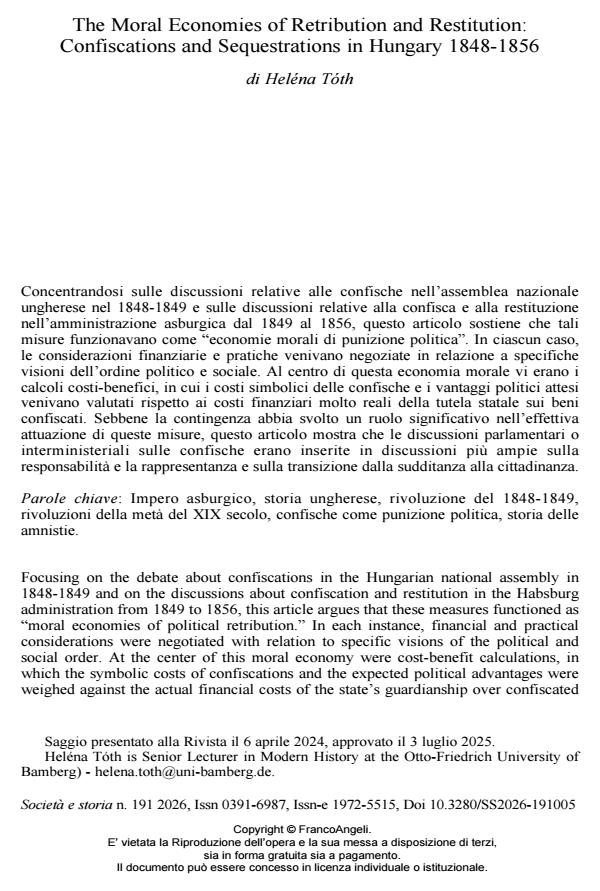
Focusing on the debate about confiscations in the Hungarian national assembly in 1848--1849 and on the discussions about confiscation and restitution in the Habsburg administration from 1849 to 1856, this article argues that these measures functioned as “moral economies of political retribution.” In each instance, financial and practical considerations were negotiated with relation to specific visions of the political and social order. At the center of this moral economy were costbenefit calculations, in which the symbolic costs of confiscations and the expected political advantages were weighed against the actual financial costs of the state’s guardianship over confiscated assets. While contingencies played a significant role in the implementation of these measures, this article shows that the parliamentary or interministerial discussions about confiscations were embedded in larger arguments about responsibility and representation, and the transition from subjection to citizenship.

Keywords: Habsburg Empire, Hungarian history, revolution of 1848--1849, mid--19th--century revolutions, confiscations as political punishment, history of amnesties.

  1. Hermann R. (2003), Kossuth, Parliamentary Dictator, in Lajos Kossuth Sent Word…, Papers delivered on the occasion of the bicentenary of Kossuth’s birth, edited by Péter L., Rady M. and Sherwood P, London, School of Slavonic and East European Studies, pp. 41--70.
  2. Hermann R. (2016), I. Ferenc József és a megtorlás, in «Magyar Tudomány», 12, pp. 1435--1446.
  3. Jókai M. (1850), A gyémántos miniszter in Forradalmi és csataképek 1848--1849--bol, edited by Jókai M., Pest, Heckenast
  4. Jelentés (1849) (without author), Jelentés a számoltató választmánytól gróf Zichy Ödön--féle ingóságok eránt. Debrecen, National Assembly.
  5. Judson P. (2016), The Habsburg Empire: A New History, Cambridge, The Belknap Press of Harvard.
  6. Jung T. (2023), Fragen an 1848/49. Ein Forschungsüberblick, in «Aus Politik und Zeitgeschichte», 7--9, pp. 17--23.
  7. Kazinczy G., Szerepem a forradalomban, in «Hazánk», vol. 1, Budapest, Aigner Lajos, pp. 83--105.
  8. Kletecka T. (ed.) (2002), Die Protokolle des österreichischen Ministerrates 1848--1867, II. Abteilung. Das Ministerium Schwarzenberg, vol. 1, Vienna, öbv & htp. Közlöny, Pest/Debrecen.
  9. Manifestumok (without editor) (1849), Gyüjteménye a‘ Magyarország számára kibocsátott legfelsobb manifestumok és szózatoknak, valamit a‘ cs. Kir. Hadsereg foparancsnokai által Magyarországban kiadott hirdetményeknek, Buda, Egyetemi Nyomda.
  10. Madarász J. (1883), Emlékirataim, 1831--1881, Budapest, Franklin--Társulat.
  11. Melkovics T. (2016), Vezérszerep helyett bitófa. Zichy Ödön gróf politikai metamorfózisa, in «Aetas», 31, 1, pp. 132--153.
  12. Monti A.M. (2012), La confiscation des biens dans les codes pénaux européens (XIXème--XXéme), in Le Code penal: Les metamorphoses d’un modéle 1810--2010, edited by Aboucaya C. and Martinage R., Lille, Centre d’histoire judiciaire, pp. 39--49.
  13. Osterkamp J. (2020), Vielfalt ordnen. Das föderale Europa der Habsburgermonarchie (Vormärz bis 1918), Göttingen, Vandenhoeck and Ruprecht.
  14. Ökröss B. (ed.) (1867), Törvények és hivatalos rendeletes gyujteménye, a nemzeti felelos kormány visszaállításától fogva, Pest, Heckenast.
  15. Ökröss B, ed. (1868), Jelentés az 1867. augusztus hó 10--én kiküldött országos küldöttségi alválasztmány eljárásáról, in Törvények és hivatalos rendeletek gyujteménye, a nemzeti felelos kormány visszaállításától fogva. Pest, Heckenast Gusztáv.
  16. Pap D. (ed.) (1870), A parlament Debrecenben. 1849. Leipzig, Köhler K.A. Somogyi É. (1981), Abszolutizmus és kiegyezés, 1849--1867, Budapest, Gondolat.
  17. Somogyi É. (1999), A honvéd nyugdíjak ügye a közös minisztertanácson in A pesti polgár. Tanulmányok Vörös Károly emlékére, edited by Gyáni G. and Pajkossy G., Debrecen, Csokonai, pp. 103.107.
  18. Spira Gy. (1979), Polgári forradalom (1848--1849) in Magyarország története, edited by Kovács E. and Katus L., vol. 6, I, Budapest, Akadémiai Kiadó.
  19. Tardy L. (1986), A Zichy--gyémántok titkának rejtélyes utóelete, in Kis magyar történetek, edited by Tardy L., Budapest, pp. 229--252.
  20. Tóth J. (2005), Az ikervári Batthyány--kastélypark 1850. évi növénylistája in «Vasi honismereti és helytörténeti közlemények», 1, Szombathely, Vas Megyei Levéltár. Tóth H. (2014), An Exiled Generation. German and Hungarian Refugees of
  21. Revolution, 1848--1871, New York, Cambridge University Press.
  22. Újházy L. (1849), Debrecen máczius 19--én 1849, in «Márczius Tizenötödike», 29, 19.03.1849, Debrecen, pp. 113--114.
  23. Brice C. and Caglioti D.L. (2021), Property rights in wartime. Sequestration, confiscation and restitution in twentieth--century Europe: Introduction, in «European Review of History», 28, 2, pp. 163--175.
  24. Cieger A. (2018), 1867 szimbolikus világa. Tanulmányok a kiegyezés koráról, Budapest, MTA Bölcsészettudományi Kutatóközpont.
  25. Clark C. (2023), Revolutionary Spring. Fighting for a New World, 1848--1849, London, Allen Lane.
  26. Deák Á. (2009), Polgári átalakulás és neoabszolutizmus (1849--1867), Budapest, Kossuth Kiadó.
  27. Deák I. (1979), The Lawful Revolution. Louis Kossuth and the Hungarians, 1848--1849, New York, Columbia University Press.
  28. Deák I. (1990), Beyond Nationalism. A Social and Political History of the Habsburg Officer Corps, 1848--1918, New York -- Oxford, Oxford University Press.
  29. Dessewffy E. (1849a), Letter to Bach, dated Vienna, 24.05.1849, in A nagybirtokos arisztokrácia ellenforradalmi szerepe, 1848--1849, edited by Andics E, vol III, Budapest, Akadémiai Kiadó, 1965, pp. 245--255.
  30. Dessewffy E. (1849b), Letter to Count Samu Jósika, dated Bratislava, 04.07.1849, in A nagybirtokos arisztokrácia ellenforradalmi szerepe, 1848--1849, edited by Andics E., vol III, Budapest, Akadémiai Kiadó, 1965, pp. 333--335.
  31. Faragó, M. (1911), A Kossuth--bankók kora. A szabadságharc pénzügyei, Budapest, Nyugat.
  32. Farkas K. (2015), “Névtelen félistenek” viszontagságai. Az 1848--49--es honvédek segélyezésének és nyugdíjának ügye a dualizmus korában, in «Hadtörténeti Közlemények» 128, 2, pp. 415--444.
  33. Fábiánné Kiss E. (1984), A Kossuth--bankók sorsa az osztrák uralom idején, in «Századok» 118, 2, pp. 273--303.
  34. Fábiánné Kiss E. (1994), A honárulók vagyonának lefoglalása és kezelése. Az 1848 1849--es pénzügyi adminisztráció egyik speciális feladata, in «Századok» 128, 1, pp. 46--90.
  35. Freifeld A. (2000), Nationalism and the Crowd in Liberal Hungary, 1848--1914, Washington D.C., Woodrow Wilson Center Press.
  36. Gosewinkel D. (2014), Introduction. Histoire et fonctions de la proprieté”, in «Revue d’histoire modern et contemporaine» 61, 1, pp-- 7--25.
  37. Irányi D. and Chassin C.L. (1860), Histoire politique de la révolution de Hongrie, 1847--1849, Paris, Pagnerre.
  38. Kosáry D. (2003) Hungary and International Politics in 1848--1849, New York, Columbia University Press, 2003.
  39. Gesetze und Verordnungen (1856), Sammlung der seit derm Regierungsantritte Sr. Majestät Kaiser Franz Joseph des Ersten bis zum Schlusse des Jahres 1856 erlassenen und noch in Kraft bestehenden Gesetze und Verordnungen im Justiz--Fache für das Kaiserthum Österreich, Vienna, Friedrich Manz. Vol. 1--10.
  40. Heindl W. (ed.) (1993), Die Protokolle des österreichischen Ministerrates, 1848--1867.
  41. III. Abteilung. Das Ministerium Buol--Schauenstein, vol. 5, Vienna, ÖVB Pädagogischer Verlag.
  42. Hermann R. (1994), A rendorminiszter és a Zichy--gyémántok, Székesfehérvár, Fejér Megyei Levéltár.
  43. Hermann R. (1995), Megtorlás Heves és Külso--Szolnok vármegyében, 1849--1851, in «Mátrai Tanulmányok», vol. 2 , Gyöngyös, Mátra Múzeum, pp. 121--160.
  44. Hermann, R. (1996), Az 1848--49--es forradalom és szabadságharc története, Budapest, Videopont.
  45. Hermann R. (1999), Az 1848--49--es forradalom és szabadságharc a magyar történetírásban, in «Aetas», 14, pp. 62--85.
  46. Varga J. (1964), A “gyémántos miniszter:” Madarász László, in «Élet és Tudomány», 19, 24, pp. 1107--1100;; 19, 25, pp. 1166--1169.
  47. Abafi L. (1884), Kazinczy Gábor hadi törvényszék elott, in «Hazánk», 1, pp. 160--276. Andics E. (1968), Kossuth harca az árulók és megalkuvók ellen a reformkorban és a forradalom idején, in 1848--1849. Tanulmányok, edited by Andics E., Budapest, Kossuth, pp. 7--107.
  48. Barna A. (2010) Törekvések a politikai büncselekmények rendezésére Magyarországon a 18. század végén, és az 1795. évi büntetotörvénykönyv tervezete, in «Jog--Állam--Politika» 2, pp. 29--67.
  49. Bató Sz. (2007), Megjegyzések a büntetojogi kodifikáció 1848 elotti történetéhez in «Jogelméleti szemle», 1, pp. 1--33;; available at the following URL: https://epa.oszk.hu/05200/05288/pdf/EPA05288_Jogelmeleti_szmele_2007_1001/00 29/pdf (11/02/2026).
  50. Beér J. and Csizmadia A. (eds.) (1954), Az 1848/49. évi népképviseleti országgyulés, Budapest, Akadémiai Kiadó.
  51. Bernstein B. (1906), A negyvennyolcas magyar szabadságharc és a zsidók, Budapest, Magyar Zsidó Könyvtár Kiadóvállalata.
  52. Bleyer A. (2022), Erfolgsgeschichte einer gescheiterten Revolution, Ditzingen, Philipp Reclam.
  53. Brettner--Messler H. (ed.) (1971), Die Protokolle des österreichischen Ministerrates, 1848--1867, VI. Abteilung, vol. 1, Vienna, Österreichischer Bundesverlag für Unterricht, Wissenschaft und Kunst.
  54. Brettner--Messler H. and Koch K. (eds.) (1986), Die Protokolle des österreichischen Ministerrates, 1848--1867, V. Abteilung. Band 4., Vienna, ÖBV.
  55. Brice C. (2026), La fabrique économique de l’étranger, in «Società e storia», 191, pp. 1--12.

Heléna Tóth, The Moral Economies of Retribution and Restitution: Confiscations and Sequestrations in Hungary 1848-­1856 in "SOCIETÀ E STORIA " 191/2025, pp 70-93, DOI: 10.3280/SS2026-191005