Rental subsidies: Bunching in Spanish personal income tax
Journal title ECONOMIA PUBBLICA
Author/s José Torres Remírez, María Concepción Parra Meroño
Publishing Year 2026 Issue 2026/1
Language English Pages 23 P. 37-59 File size 147 KB
DOI 10.3280/EP2026-001002
DOI is like a bar code for intellectual property: to have more infomation
click here
Below, you can see the article first page
If you want to buy this article in PDF format, you can do it, following the instructions to buy download credits
FrancoAngeli is member of Publishers International Linking Association, Inc (PILA), a not-for-profit association which run the CrossRef service enabling links to and from online scholarly content.
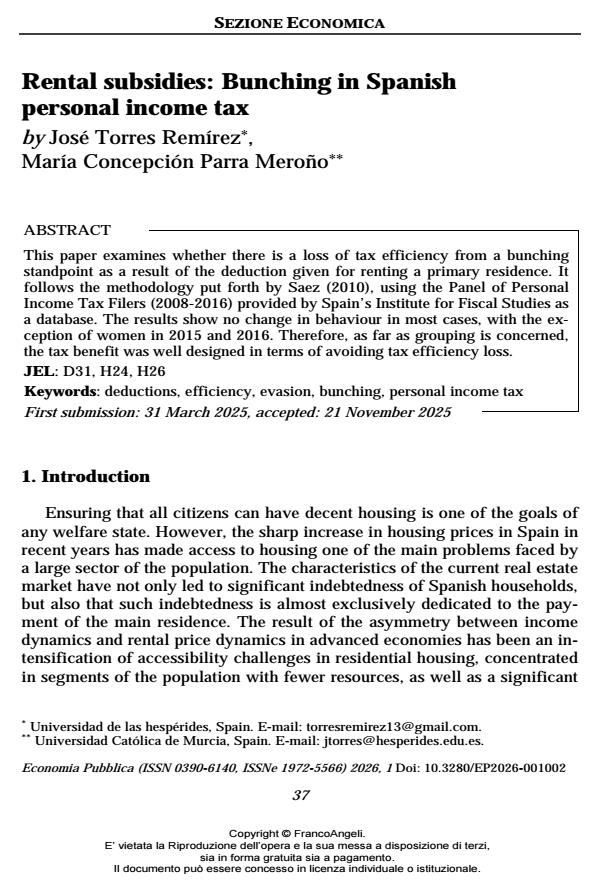
This paper examines whether there is a loss of tax efficiency from a bunching standpoint as a result of the deduction given for renting a primary residence. It follows the methodology put forth by Saez (2010), using the Panel of Personal Income Tax Filers (2008-2016) provided by Spain’s Institute for Fiscal Studies as a database. The results show no change in behaviour in most cases, with the exception of women in 2015 and 2016. Therefore, as far as grouping is concerned, the tax benefit was well designed in terms of avoiding tax efficiency loss
Jel codes: D31, H24, H26
- Aghion P., Akcigit U., Lequien M., Stantcheva S. (2023). Tax simplicity and heterogeneous learning. NBER Working Paper, 24049.
- Alstadsaeter A., Jacob M. (2015). Who participates in tax avoidance?. Working Paper, WHU-Otto Beisheim School of Management.
- Apps P., Rees R. (2014). Optimal Dual Income Taxation. Working Paper, 9th Norwegian-German Seminar on Public Economics, CES ifo.
- Alvaredo F., Londoño J. (2014). Altos Ingresos e impuesto de renta en Colombia, 1993-2010. Revista de Economía Institucional, 16(31): 157-194.
- Aronsson T., Jenderny K., Lanot G. (2018). Alternative parametric bunching estimators of the ETI. UMEA Economics Studies 956, UMEA University, Department of Economics.
- Bastani S., Selin H. (2013). Bunching and non-bunching at kink points of the Swedish tax schedule. Journal of Public Economics, 109: 36-49.
- Bergolo M., Burdin G., De Rosa M., Giaccobasso M., Leites M. (2021). Digging into the channels of Bunching: Evidence from the Uruguayan Income Tax. The Economic Journal, 131(639): 2726-2762.
- Blackorby C., Brett C., Cebreiro A. (2007). Nonlinear taxes for spatial mobile workers. International Journal of Economic Theory, 3: 57-74
- Blomquist S., Selin H. (2010). Hourly wage rate and taxable labor income responsiveness to changes in marginal tax rates. Journal of Public Economics, 94: 878-889.
- Blomquist S., Newey W., Kumar A., Liang C-Y. (2021). On bunching and identification of the taxable income elasticity. Journal of Political Economy, 129(8): 2320-2343.
- Blundell R., Hoynes H. (2004). Has In-work benefit reform helped the labour market?. En D. Card, R. Blundell y R. Freeman Seeking a premier economy: The economic effects of British economic reforms, 1980-2000. University of Chicago Press, pp. 411-458.
- Bohne A., Nimczik J. S. (2017). Learning Dynamics in Tax Bunching at the kink: Evidence from Ecuador. UNU-WIDER Public Economics for Development.
- Borgia Sorrosal S. (2008). Nuevas ayudas y ventajas fiscales destinadas a incentivar el Mercado del alquiler ¿Una solución al problema de la Vivienda?. Cronica Tributaria, 129: 9-34.
- Chapman B., Leigh A. (2009). Do very high tax rates induce bunching? Implications for the design of income-continent loan schemes. Economic Record, 85(270): 276-289.
- Chetty R., Friedman J. N., Olsen T., Pistaferri L. (2011). Adjustment costs, firm responses, and micro vs. macro labor supply elasticities: Evidence from Danish tax records. The Quarterly Journal of Economics, 162(2): 749-804.
- Chisholm A. H. (1971). A comparison of income averaging procedures for income tax purposes. Australian Journal of Agricultural Economics, 15(1): 36-50.
- Dombeck F. B. (2016). Bunching in the Norwegian Income Distribution. Master Thesis, University of Oslo.
- Fack G., Landais C. (2016). The effect of tax enforcement on tax elasticities: Evidence from charitable contributions in France. Journal of Public Economics, 133: 23-40.
- Gamarra Rondinel A., Arrazola M., Sánz Sánz J. F. (2022). The elasticity of taxable income of low-income earns: bunching evidene from Spain. Applied Economics, DOI: 10.1080/00036846.2022.2102576
- Goupille-Lebret J., Infante J. (2018). Behavioral responses to inheritance tax: evidence from notches in France. Journal of Public Economics, 168: 21-34.
- Hernandez M. (2022). Taxation, information, and withholding: evidence from Costa Rica. CEPR Discussion Paper, 17716.
- Kosonen T., Matikka T. (2019). Discrete earning response to tax incentives: empirical evidence and implications. Labour Institute for Economics Research Työpapereita Working Paper, 326.
- Le Maire D., Schjerning B. (2013). Tax Bunching, income shifting and self-employment. Journal of Public Economics, 107: 1-18.
- Lopez-Luzuriaga A. (2019). Less is more? Limits to itemized deductions and tax evasion. 122th Annual Conference on Taxation, NTA.
- López-Rodríguez D., Llanos Matea Mª. (2020). La intervención pública en el Mercado del alquiler de Vivienda: una revision de la experiencia internacional. Documentos Ocasionales, Banco de España, 2002.
- Mortenson J. A., Whitten A. (2020). Bunching to maximize Tax Credits: Evidence from Kinks in the U.S. Tax Schedule. American Economic Journal: Economic Policy, 12(3): 402-32.
- Ordoñez Olivo M. L., Lakner Z. (2023). Shaping the knowledge Base of Bioeconomy Sectors development in Latin American and Caribbean Countries: A bibliometric Analysis. Sustainability, 15(6), 5158.
- Saez E. (2010). Do taxpayer bunch at kink points?. American Economic Journal: Economic Policy, 2(3): 180-212.
- Schächtele S. (2016). The importance of deductions in response to the Personal Income Tax: Bunching evidence from Germany. Beiträge zur Jahrestagung des Vereins für Socialpolitik 2016: Demographischer Wandel – Session: Tax Responses, Nº E10-V2, ZBW, Deutsche Zentralbibliothek für Wirtschaftswissenschaften.
- Seade J. (1977). On the shape of optimal tax Schedule. Journal of Public Economics, 7(2): 203-235.
- Sommer E. (2017). Wealth transfer and tax planning: evidence for the German bequest tax. IZA Discussion Papers, nº 11120, Institute of Labor Economics.
- Torres-Remírez J. (2023). Bunching: una revisión. El Trimestre Económico, 90(360): 1141-1163.
- Torres-Remírez J. (Forthcoming). Bunching: Reducción de los rendimientos netos del trabajo en los contribuyentes de más de 65 años desde la perspectiva del agrupamiento. Cuadernos de Economía.
- Torres-Remírez J., López González E., Gómez Melero E. (Forthcoming). Bunching en España (1982-1998). Las rentas bajas frente a las modificaciones del tipo marginal. Hacienda Pública Española/Review of Public Economics, 2342.
- Vilá J. (2019). Respuestas en los ingresos frente a un programa de transferencias monetarias: evidencia de un notch a partir de registros administrativos de Uruguay. Serie Documentos de Trabajo; 07/19.
- Zaresani A. (2020). Adjustment cost and incentives to work: Evidence from a disability insurance program. Journal of Public Economics, 188, 104223.
José Torres Remírez, María Concepción Parra Meroño, Rental subsidies: Bunching in Spanish personal income tax in "ECONOMIA PUBBLICA " 1/2026, pp 37-59, DOI: 10.3280/EP2026-001002