The Reception of Bretton Woods Decisions through Unofficial Expertise: The Economist M. Goudi and the Greek Reconstruction

Journal title HISTORY OF ECONOMIC THOUGHT AND POLICY
Author/s Virginia Anastasia Fournari
Publishing Year 2026 Issue 2026/1
Language English Pages 25 P. 55-79 File size 134 KB
DOI 10.3280/SPE2026-001003
DOI is like a bar code for intellectual property: to have more infomation click here

Below, you can see the article first page

If you want to buy this article in PDF format, you can do it, following the instructions to buy download credits
Article preview

FrancoAngeli is member of Publishers International Linking Association, Inc (PILA), a not-for-profit association which run the CrossRef service enabling links to and from online scholarly content.

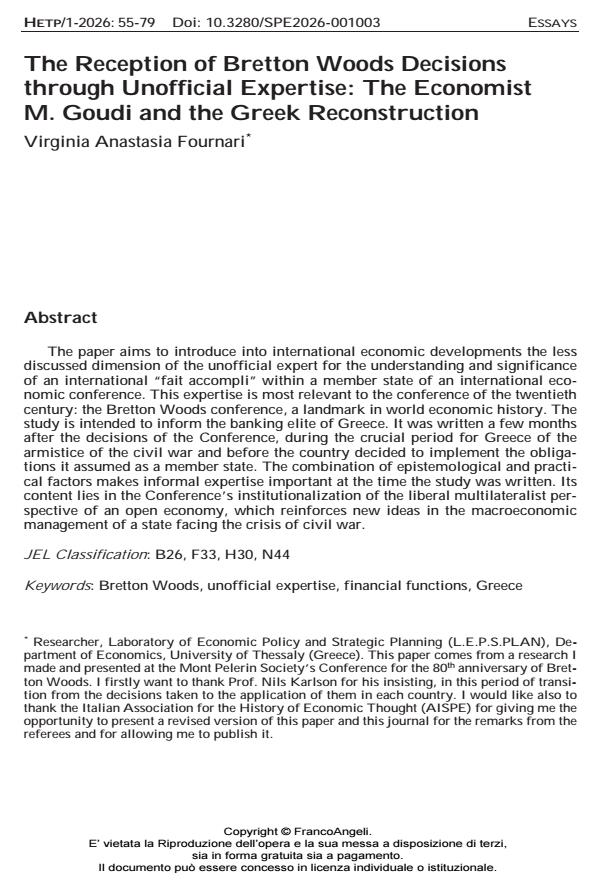
The paper aims to introduce into international economic developments the less discussed dimension of the unofficial expert for the understanding and significance of an international “fait accompli” within a member state of an international economic conference. This expertise is most relevant to the conference of the twentieth century: the Bretton Woods conference, a landmark in world economic history. The study is intended to inform the banking elite of Greece. It was written a few months after the decisions of the Conference, during the crucial period for Greece of the armistice of the civil war and before the country decided to implement the obligations it assumed as a member state. The combination of epistemological and practical factors makes informal expertise important at the time the study was written. Its content lies in the Conference’s institutionalization of the liberal multilateralist perspective of an open economy, which reinforces new ideas in the macroeconomic management of a state facing the crisis of civil war.

Keywords: Bretton Woods, unofficial expertise, financial functions, Greece

Jel codes: B26, F33, H30, N44

  1. Acemoglu D. and Robinson J.A. 2006. Economic origins of dictatorship and democracy. New York, Cambridge University Press.
  2. Alley J. 2021. Reassessing the public goods theory of alliances. Research & Politics, 8(1), DOI: 10.1177/20531680211005225
  3. Alogoskoufis G. 2021. Historical Cycles of the Economy of Modern Greece from 1821 to the Present. GreeSE Papers Hellenic Observatory Discussion Papers on Greece and Southeast Europe, available at: https://www.lse.ac.uk/HellenicObservatory/Assets/Documents/Publications/GreeSEPapers/GreeSENo158.pdf.
  4. Angelopoulos A. 1974. Economics: articles and studies 19461967. [Oikonomika: Arthra kai meletes 19461967.]. Athens, Papazisis, available at: http://dspace.lib.uom.gr/handle/2159/17588.
  5. Armitage D. 2018. Civil wars: a history in ideas. New Haven, Yale University Press. Assefa D.Z., Iona A. and Leonida L. 2024. Political competition and financial development: A test of two tales. Working Paper, 981, available at: https://hdl.handle.net/10419/306613.
  6. Beck S. 2015. The Problem of Expertise. European Journal of Pragmatism and American Philosophy, VII(1),
  7. Benati L. 2023. The monetary dynamics of hyperinflation reconsidered. University of Bern, Department of Economics, Discussion Papers, No. 2305, available at: https://www.econsto r.eu/bitstream/10419/278565/1/1853479187.pdf.
  8. Bordo M.D. 2019. The Operation and Demise of the Bretton Woods System, 19581971. In: Lamoreaux N. and Shapiro I. (eds.). 2019 The Bretton Woods Agreements: Together with Scholarly Commentaries and Essential Historical Documents. Yale University Press, 217235, DOI: 10.12987/9780300245578011
  9. Boughton J. 1998. Harry Dexter White and the International Monetary Fund. Finance and Development | F&D, 35(3), available at: https://www.imf.org/ external/pubs/ft/fandd/1998/09/boughton.htm.
  10. Cagan P. 1956. The Monetary Dynamics of Hyperinflation. In: Friedman M. 1956 (ed.). Studies in the Quantity Theory of Money. Chicago, The University of Chicago Press, 25117.
  11. Craig R.B. 2004. Treasonable doubt: the Harry Dexter White spy case. Lawrence, University Press of Kansas.
  12. de Vries M.G. and Horsefield J.K. (eds.). 1969. The International Monetary Fund, 19451965; twenty years of international monetary cooperation. Washington, International Monetary Fund.
  13. Delivanis I.D. 1946. Keynes’ plan. Economic and Political Science Review, B’C’. Gärtner H. 2001. Small States and Alliances. In: Reiter E. and Gärtner H. (eds.). 2001. Small States and Alliances. Physica Heidelberg.
  14. Goldberg R.A. 2006. Treasonable Doubt: The Harry Dexter White Spy Case (review). The Journal of Interdisciplinary History, 37(1), 156157,
  15. Goudi M. 1946. The cycles Keynes’s. Economic and Political Science Review, B’C’. Hayek F.A. 1937. Economics and Knowledge. Economica, 4(13), 3354, 07/2548786.
  16. Helleiner E. 2019. How the Bretton Woods Negotiations Helped to Pioneer International Development. In: Lamoreaux N.R. and Shapiro I. (eds.). 2019. The Bretton Woods Agreements. New Haven, Yale University Press.
  17. Historical Archive of the Bank of Greece (HA.BoG): Varvaressos K. [43:] Bretton Woods International Conference. 1944; Members of the 1944, Greek delegation to the InterAllied Monetary Conference (Bretton Woods International Conference) and the conference results; Zolotas X., Proposal of the Advisory Committee on the appropriate Monetary and Economic Policy, 20 Sep. 1945; Goudi M.N. The decisions of the Bretton Woods Conference in relation to the Keynes, White and other plans submitted to the Conference, March 1945 [Historical Archives of the Bank of Greece]; Governors and Deputy Governors of the Bank of Greece, https://www.bankofgreece.gr/RelatedDocuments/Governors25102019.pdf.
  18. Heywood A. 2011. Global Politics. New York, Palgrave Macmillan.
  19. Judt T. 2011. Past Imperfect: French Intellectuals, 19441956. New York, New York University Press.
  20. Kakridis A. 2017. Kyriakos Varvaressos: Biography as economic history [Kyriakos Varvaresos: I viographia os oikonomiki istoria]. Athens, Papazisis.
  21. Lamoreaux N.R. and Shapiro I. (eds.). 2019. The Bretton Woods agreements: together with scholarly commentaries and essential historical documents. New Haven, Yale University Press.
  22. Makinen G.E., Bomberger W.A., Woodward G.T., Anderson R.B. and Babcock J.M. 2014. Studies in Hyperinflation and Stabilization. Center for Financial Stability. Pamuk Z. 2023. Politics and Expertise. How to Use Science in a Democratic Society [I politiki kai oi eidimones. I epistimi sti dimokratiki koinonia]. Heraklion, Publications of the University of Crete.
  23. Prontzas E. 2011. The economy of the occupation period [I oikonomia tis katohikis periodou]. In: Kalafatis T. and Prontzas E. (eds.). 2011. Economic History of the Greek State. Athens, Piraeus Bank Group Cultural Foundation, 408417.
  24. Psalidopoulos M. 2004. Mariana Goudi. In: Dimand R.W., Dimand M.A. and Forget
  25. E.L. (eds.). 2004. A Biographical Dictionary of Women Economists. Edward Elgar Publishing.
  26. Psalidopoulos M. 2010. Preface. In: Giannakopoulos N., Giannitsis A., DendrinouLouri E., Donatos G. and Kimourtzis P. (eds.). 2010. Marina Goudi. Woman, Academian and Researcher [Marina Goudi. Ginaika, Panepistimiakos kai Erevnitria]. Athens, Metamesonikties Ekdoseis.
  27. Rajan R.G. and Zingales L. 2001. The Great Reversals: The Politics of Financial Development in the 20th Century. NBER Working Paper No. 8178,
  28. Robbins L. 1971. Autobiography of an Economist. London, Macmillan.
  29. Schild G. 1995. Bretton Woods and Dumbarton Oaks: American economic and political postwar planning in the summer of 1944. New York, St. Martin’s Press.
  30. Schuler K. and Bernkopf M. 2014. Who Was at Bretton Woods? New York: Center for Financial Stability, available at: https://www.centerforfinancialstability.org/ bw/Who_Was_at_Bretto n_Woods.pdf.
  31. ScottSmith G. and Rofe J.S. (eds.). 2017. Global perspectives on the Bretton Woods Conference and the PostWar World Order. Palgrave Macmillan.
  32. Stathakis G. 2004. The Truman Doctrine and the Marshall Plan [To Dogma Truman kai to Shedio Marshall]. Athens, Vivliorama.
  33. Steil B. 2013. The Battle of Bretton Woods: John Maynard Keynes, Harry Dexter White, and the Making of a New World Order. Princeton, Princeton University Press.
  34. Sum A.B. 2015. The History, Impact and Limits of Economic Expertise. Institute for Advanced Sustainability Studies (IASS) – Working paper.
  35. Topolski J. 1976. Methodology of history [Metodologia historii]. Translated by O. Wojtasiewicz. Boston, Reidel.
  36. Van Hook J.C. 2005. Treasonable Doubt: The Harry Dexter White Spy Case. Intelligence in Recent Public Literature By R. Bruce Craig. Lawrence, University of Kansas Press, 2004. 422 pages. Studies in Intelligence, 49(1), https://www.cia. gov/resources/csi/static/ReviewTreasonableDoubt.pdf.
  37. Voss J.F. and Wiley J. 2006. Expertise in History. In: Ericsson K.A., Charness N., Feltovich P.J. and Hoffman R.R. (eds.). 2006. The Cambridge handbook of expertise and expert performance. Cambridge University Press, 569584.
  38. Wolin S.S. 1981. Max Weber: Legitimation, Method, and the Politics of Theory. Political Theory, 9(3), 401424, DOI: 10.1177/00905917810090030

Virginia Anastasia Fournari, The Reception of Bretton Woods Decisions through Unofficial Expertise: The Economist M. Goudi and the Greek Reconstruction in "HISTORY OF ECONOMIC THOUGHT AND POLICY" 1/2026, pp 55-79, DOI: 10.3280/SPE2026-001003