Marx, Keynes, Technological Progress and Labor: A Backward-looking Perspective on Artificial Intelligence and Time-use

Journal title HISTORY OF ECONOMIC THOUGHT AND POLICY
Author/s Gabriele Guzzi, Eleonora Sanfilippo
Publishing Year 2026 Issue 2026/1
Language English Pages 33 P. 81-113 File size 145 KB
DOI 10.3280/SPE2026-001004
DOI is like a bar code for intellectual property: to have more infomation click here

Below, you can see the article first page

If you want to buy this article in PDF format, you can do it, following the instructions to buy download credits
Article preview

FrancoAngeli is member of Publishers International Linking Association, Inc (PILA), a not-for-profit association which run the CrossRef service enabling links to and from online scholarly content.

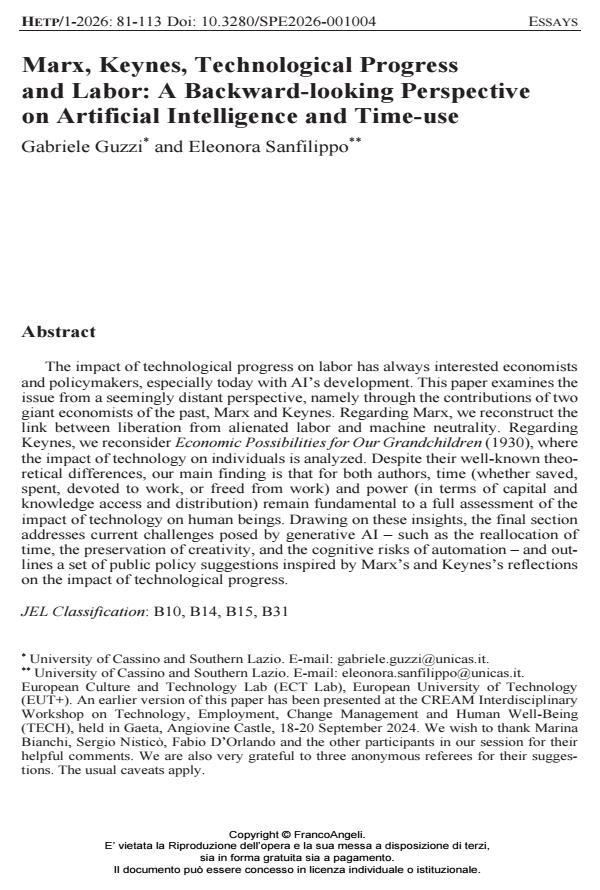
The impact of technological progress on labor has always interested economists and policymakers, especially today with AI’s development. This paper examines the issue from a seemingly distant perspective, namely through the contributions of two giant economists of the past, Marx and Keynes. Regarding Marx, we reconstruct the link between liberation from alienated labor and machine neutrality. Regarding Keynes, we reconsider Economic Possibilities for Our Grandchildren (1930), where the impact of technology on individuals is analyzed. Despite their wellknown theoretical differences, our main finding is that for both authors, time (whether saved, spent, devoted to work, or freed from work) and power (in terms of capital and knowledge access and distribution) remain fundamental to a full assessment of the impact of technology on human beings. Drawing on these insights, the final section addresses current challenges posed by generative AI - such as the reallocation of time, the preservation of creativity, and the cognitive risks of automation - and outlines a set of public policy suggestions inspired by Marx’s and Keynes’s reflections on the impact of technological progress.

Keywords: Marx, Keynes, technology, Artificial Intelligence, time-use

Jel codes: B10, B14, B15, B31

  1. Costa G. (ed.) 1978. Keynes, Antologia di scritti economicopolitici. Bologna, il Mulino
  2. Cotgrove S. 1972. Alienation and automation. The British Journal of Sociology, 23(4), 437451, DOI: 10.2307/588323
  3. Cristiano C., Marcuzzo M. C. and Sanfilippo E. 2018. Taming the Great Depression: Keynes’s personal investments in the US stock market, 19311939. Economia Politica, 35, 1340,
  4. Acemoglu D. 2002. Technical change, inequality, and the labor market. Journal of Economic Literature, 40(1), 772,
  5. Acemoglu D. and Restrepo P. 2018. Artificial intelligence, automation, and work. NBER Working Paper, 24196, National Bureau of Economic Research,
  6. Acemoglu D. and Restrepo P. 2020. Robots and jobs: Evidence from US labor markets. Journal of Political Economy, 128(6), 21882244, DOI: 10.1086/705716
  7. Aghion P., Jones B. F. and Jones C. I. 2017. Artificial intelligence and economic growth. NBER Working Paper, 23928.
  8. Anders G. 1956. Die Antiquiertheit des Menschen. Munich, C. H. Beck.
  9. Barclays and IBM 2024. AI Revolution: Productivity boom and beyond. Barclays Research and IBM Institute for Business Value, Impact Series 12, 121, 11 Jan 2024.
  10. Bariletti A. and Sanfilippo E. 2017. At the origin of the notion of ‘creative’ goods in economics: Scitovsky and Hawtrey. History of Economic Thought and Policy, 1, 534, DOI: 10.3280/SPE2017001001
  11. Bellofiore R. and Tomba M. 2014. The ‘Fragment on Machines’ and the Grundrisse: The Workerist Reading in Question. In van Der Linden M. and Roth K. H. (eds.) Beyond Marx. Theorising the Global Labor Relations of the TwentyFirst Century. Leiden, Brill, 345367.
  12. Bibow J. 2024. Economic Possibilities for our Grandchildren: 90 years later. Levy Economic Institute Working Paper, 1038, 139.
  13. Braverman H. 1974. Labor and Monopoly Capital: The Degradation of Work in the Twentieth Century. New York, Monthly Review Press.
  14. Brynjolfsson E., Mitchell T. and Rock D. 2018. What can machines learn, and what does it mean for occupations and the economy? AEA Papers and Proceedings, 108, 4347,
  15. Brittan S. 2006. Keynes’s political philosophy. In Backhouse R. and Bateman B. W. (eds.) The Cambridge Companion to Keynes. Cambridge, Cambridge University Press, 180198.
  16. Budhwar P., Chowdhury S., Wood G., Aguinis H., Bamber G.J., Beltran J., Boselie P., LeeCooke F., Decker S., DeNisi A., Dey P., Guest D., Knoblich A., Malik A., Paauwe J., Papagiannidis S., Patel C., Pereira V., Ren S., Rogelberg S., Saunders M. N. K., Tung R. L., and Varma A. 2023. Human resource management in the age of generative Artificial Intelligence: Perspectives and research directions on ChatGPT. Human Resource Management Journal, 33(3), 606659, DOI: 10.1111/17488583.12524
  17. Burns T. 2024. Marx, automation and the politics of recognition within social institutions. Critique, 52(23), 357378, DOI: 10.1080/03017605.2024.2391619
  18. Carabelli A. 2021. Keynes on uncertainty and tragic happiness: Complexity and expectations. London, Palgrave Macmillan.
  19. Castoriadis C. 1975. L’Institution Imaginaire de la Société. Paris, Seuil.
  20. Chambers D. and Dimson E. 2013. John Maynard Keynes, investment innovator. Journal of Economic Perspectives, 27, 213228,
  21. Chambers D. and Kabiri A. 2016. Keynes and Wall Street. Business History Review, 90, 301328, DOI: 10.1017/S0007680516000362
  22. Dergaa I., Chamari K., Zmijewski P. and Ben Saad H. 2023. From human writing to artificial intelligence generated text: examining the prospects and potential threats of ChatGPT in academic writing. Biology of Sport, 40(2), 615622,
  23. Deloitte 2024. State of Generative AI in the Enterprise, Q4 2024. Deloitte Insights. Engels F. and Marx K. [1845] 1975. The Holy Family. In Hobsbawm E., Hoffman J., Foner P. S., Jackson J. E., Semyonov Y. V. and Goldman L. I. (eds.) The Collected Works of Karl Marx and Frederick Engels, Vol. 4. New York, Inter national Publishers.
  24. Engels F. and Marx K. [1932] 1976. Theses on Feuerbach, The German Ideology and Related Manuscripts (18451847). In: Hobsbawm E., Hoffman J., Foner P. S., Jackson J. E., Semyonov Y. V. and Goldman L. I. (eds.). The Collected Works of Karl Marx and Frederick Engels, Vol. 5. New York, International Publishers.
  25. Felten E. W., Raj M. and Seamans R. 2019. The occupational impact of artificial intelligence: labor, skills, and polarization. NYU Stern School of Business.
  26. Felten E. W., Raj M. and Seamans R. 2023. How will language modelers like ChatGPT affect occupations and industries? Available as preprint,
  27. Folgieri R. 2016. Technology, artificial intelligence and Keynes’ utopia: a realized prediction? In: Bait M., Brambilla M.M. and Crestani V. (eds.) Utopian Discourses across Cultures. Frankfurt am Main and New York, Peter Lang, 7386.
  28. Frey C.B. and Michael A. Osborne, M.A. 2017. The future of employment: How susceptible are jobs to computerisation?, Technological Forecasting and Social Change, 114, 254280,
  29. Fuchs C. 2014. Digital Labor and Karl Marx. New York, Routledge.
  30. Fuchs C. 2019. Karl Marx in the age of big data capitalism. In Chandler D. and Fuchs
  31. C. (eds.) Digital Objects, Digital Subjects: Interdisciplinary Perspectives on Capitalism, Labor and Politics in the Age of Big Data. London, University of Westminster Press, 5371.
  32. FuiHoon Nah F., Zheng R., Cai J., Siau K. and Chen L. 2023. Generative AI and ChatGPT: Applications, challenges, and AIhuman collaboration. Journal of Information Technology Case and Application Research, 25(3), 277304, DOI: 10.1080/15228053.2023.2233814
  33. Garcia M. B. 2024. The paradox of artificial creativity: Challenges and opportunities of generative AI artistry. Creativity Research Journal, 36(3), 114, DOI: 10.1080/10400419.2024.2354622
  34. Gehlen A. [1957] 1980. Man in the Age of Technology. New York, Columbia University Press.
  35. GeorgescuRoegen N. 1971. The Entropy Law and the Economic Process. Cambridge (MA), Harvard University Press.
  36. Gmyrek P., Berg J. and Bescond D. 2023. Generative AI and jobs: A global analysis of potential effects on job quantity and quality. ILO Working Paper, 96, Geneva,
  37. Hardt M. and Negri A. 2000. Empire. Cambridge (MA), Harvard University Press. Hawtrey R. 1925. The Economic Problem. London, Longmans, Green and Co.
  38. Heidegger M. 1954. Vorträge und Aufsätze. Pfullingen, Verlag Günther Neske. Heilbroner R. L. 1967. Do machines make history? Technology and Culture, 8(3), 335345, DOI: 10.2307/3101719
  39. Heinrich M. 2013. The ‘Fragment on Machines’: A Marxian misconception in the Grundrisse and its overcoming in Capital. In: Bellofiore R., Starosta G. and Thomas P. D. (eds.) In Marx’s Laboratory: Critical Interpretations of the Grundrisse. Leiden, Haymarket Books, 195212.
  40. Heinrich M. [1991] 2022. Die Wissenschaft vom Wert. Die Marxsche Kritik der politischen Ökonomie zwischen wissenschaftlicher Revolution und klassischer Tradition. Munich, Westfälisches Dampfboot.
  41. Hughes C. and Southern A. 2019. The world of work and the crisis of capitalism: Marx and the Fourth Industrial Revolution. Journal of Classical Sociology, 19(1), 5971, DOI: 10.1177/1468795X18810577
  42. International Labour Organization 2024. Mind the AI Divide: Shaping a Global Perspective on the Future of Work. Geneva, ILO Publications.
  43. International Labour Organization 2025. Generative AI and Jobs: A Refined Global Index of Occupational Exposure. ILO Working Paper, 140, Geneva.
  44. International Monetary Fund 2025. AI Adoption and Inequality. IMF Working Paper, WP/25/68, Washington DC.
  45. Jaffe S. 2024. When workers decide what to make. The Progressive, 88, 2021. Kaplan S.A, Aitken J.A., Allan B.A., Alliger G.M., Ballard T. and Zacher H. 2025.
  46. Revisiting Keynes’ predictions about work and leisure: A discussion of fundamental questions about the nature of modern work. Industrial and Organizational Psychology, 18, 122,
  47. Keynes J.M. 1921. A Treatise on Probability. London, Macmillan.
  48. Keynes J.M. [1925] 1931. Am I a liberal? The Nation and Athenaeum, 6 and 15 August, reprinted in Essays in Persuasion, London, Macmillan, 323338.
  49. Keynes J.M. [1926] 1931. The end of laissezfaire. Reprinted in Essays in Persuasion, London, Macmillan, 312322.
  50. Keynes J.M. 1930. Economic possibilities for our grandchildren. The Nation and Athenaeum, 11 and 18 October, reprinted in Essays in Persuasion, London, Macmillan, 358373.
  51. Keynes J.M. 1931. Essays in Persuasion. London, Macmillan.
  52. Keynes J.M. 1931a. Preface. In Essays in Persuasion, London, Macmillan, vix. Keynes J.M. 1936. The General Theory of Employment, Interest and Money. London, Macmillan.
  53. Keynes J.M. 1937. The general theory of employment. Quarterly Journal of Economics, 51, 209223, DOI: 10.2307/1882087
  54. Keynes J.M. 19711989. The Collected Writings of John Maynard Keynes (CWK), vols. IXXX, edited by Johnson E. and Moggridge D. London, Macmillan.
  55. Keynes J.M. 19711989 CWK Volume XII, Economic Articles and Correspondence, Investment and Editorial.
  56. Kosar A. 2024. Marx, automation and the future of work. Global Labor Journal, 15(2), 8396,
  57. Kosmyna N. et al. 2025. Your brain on ChatGPT: Accumulation of cognitive debt when using an AI assistant for essay writing task. arXiv preprint, arXiv, 2506.08872.
  58. La Malfa G. 2019. Saggezza nuova per una nuova era. In Keynes J. M. Teoria generale dell’occupazione, dell’interesse e della moneta e altri scritti. Milan, Mondadori, “I Meridiani”
  59. La Malfa G. 2022. Keynes l’eretico. Milano, Mondadori.
  60. Lee H.K. 2022. Rethinking creativity: Creative industries, AI and everyday creativity. Media, Culture & Society, 44(3), 601612, DOI: 10.1177/01634437221077009
  61. Löwith K. 1949. Meaning in History: The Theological Implications of the Philosophy of History. ChicagoLondon, University of Chicago Press.
  62. Mackay R. and Avanessian A. 2015. #Accelerate: The Accelerationist Reader. Falmouth, Urbanomic.
  63. MacKenzie D. 1984. Marx and the machine. Technology and Culture, 25(3), 473502, DOI: 10.2307/3104202
  64. Marcuse H. 1955. Eros and Civilization: A Philosophical Inquiry into Freud. Boston, Beacon Press.
  65. Marcuse H. 1964. OneDimensional Man: Studies in the Ideology of Advanced Industrial Society. Boston, Beacon Press.
  66. McKinsey 2024b. Gen AI’s Next Inflection Point: From Employee Experimentation to Organizational Transformation. QuantumBlack, AI by McKinsey, August 2024.
  67. Marcuzzo M. C. 2008. Keynes and persuasion. In Forstater M. and Wray L. R. (eds.) Keynes for the TwentyFirst Century: The Continuing Relevance of the General Theory. Basingstoke and New York, Palgrave Macmillan, 2340.
  68. Marcuzzo M. C. and Sanfilippo E. 2022. Keynes’s personal investments in the London Stock Exchange and his views on the transformation of the British economy. Structural Change and Economic Dynamics, 61, 512526,
  69. Marcuzzo M. C. and Sanfilippo E. 2025. Why was Keynes keen to invest in American but not in British Investment Trusts? Journal of the History of Economic Thought, 47(1), 92115. DOI: 10.1017/S1053837224000063
  70. Marrone R., Cropley D. and Medeiros K. 2024. How does narrow AI impact human creativity? Creativity Research Journal, 36(2), 111, DOI: 10.1080/10400419.2024.2378264
  71. Marshall A. 1907. The social possibilities of economic chivalry. Economic Journal, 17(65), 729, DOI: 10.2307/2220775
  72. Marx K. [1844] 1975. On the Jewish question. In Hobsbawm E., Hoffman J., Foner
  73. P. S., Jackson J. E., Semyonov Y. V. and Goldman L. I. (eds.) The Collected Works of Karl Marx and Frederick Engels, Vol. 3. New York, International Publishers.
  74. Marx K. [1847] 1976. The Poverty of Philosophy. In: Hobsbawm E., Hoffman J., Foner P. S., Jackson J. E., Semyonov Y. V. and Goldman L. I. (eds.). The Collected Works of Karl Marx and Frederick Engels, Vol. 6. New York, International Publishers.
  75. Marx K. [1859] 1987. A Contribution to the Critique of Political Economy. In Hobsbawm E., Hoffman J., Foner P. S., Jackson J. E., Semyonov Y. V. and Goldman L. I. (eds.). The Collected Works of Karl Marx and Frederick Engels, Vol. 29. New York, International Publishers.
  76. Marx K. [1867] 1996. Capital, Vol. I. In Hobsbawm E., Hoffman J., Foner P. S., Jackson J. E., Semyonov Y. V. and Goldman L. I. (eds.). The Collected Works of Karl Marx and Frederick Engels, Vol. 35. New York, International Publishers.
  77. Marx K. [1894] 1998. Capital, Vol. III. In Hobsbawm E., Hoffman J., Foner P. S., Jackson J. E., Semyonov Y. V. and Goldman L. I. (eds.). The Collected Works of Karl Marx and Frederick Engels, Vol. 37. New York, International Publishers.
  78. Marx K. [1932] 1975. Economic and Philosophic Manuscripts of 1844. In Hobsbawm E., Hoffman J., Foner P. S., Jackson J. E., Semyonov Y. V. and Goldman L. I. (eds.). The Collected Works of Karl Marx and Frederick Engels, Vol. 3. New York, International Publishers.
  79. Marx K. [19391941] 1986. Grundrisse: Outlines of the Critique of Political Economy, first installment. In: Hobsbawm E., Hoffman J., Diskin L., Foner P. S., Avelichev A. K. and Fedoseyev P. N. (eds.). The Collected Works of Karl Marx and Frederick Engels, Vol. 28. New York, International Publishers.
  80. Marx K. [19391941] 1987. Grundrisse: Outlines of the Critique of Political Economy, second installment. In: Hobsbawm E., Hoffman J., Diskin L., Foner P. S., Avelichev A. K. and Fedoseyev P. N. (eds.). The Collected Works of Karl Marx and Frederick Engels, Vol. 29. New York, International Publishers.
  81. Masera R. S. 2023. Economics and money: Political and epistemological perspectives of connecting and fault lines. In Savona P. and Masera R. S. (eds.). Monetary Policy Normalization: One Hundred Years after Keynes’ Tract on Monetary Reform. Cham, Springer, 1352.
  82. Maslow A. 1954. Motivation and Personality. New York, Harper.
  83. McKinsey 2024a. The State of AI in Early 2024: Generative AI Adoption Spikes and Starts to Generate Value. QuantumBlack, AI by McKinsey, May 2024.
  84. Mill J. S. 1848. Principles of Political Economy with Some of Their Applications to Social Philosophy. 2 vols. London, John W. Parker.
  85. Mirowski P. 2001. Machine Dreams: Economics Becomes a Cyborg Science. Cambridge, Cambridge University Press.
  86. Mishra P. and Hill G. L. 2025. The AI revolution and the future of work hours: Reevaluating Keynes’ prediction. Industrial and Organizational Psychology, 18(1), 7579,
  87. Moggridge D. 1983. Keynes as an investor. Editorial introduction to Vol. XII of The Collected Writings of J. M. Keynes, 1113. London, Macmillan.
  88. Moggridge D. E. 1992. Maynard Keynes: An Economist’s Biography. London, Routledge.
  89. Mokyr J. 2018. The past and the future of innovation: Lessons from economic history. Explorations in Economic History, 69, 1326,
  90. Napoleoni C. [1972] 2024. Lezioni sul Capitolo sesto inedito di Marx, edited by Guzzi G. Rome, Rogas.
  91. Negri A. [1979] 1998. Marx oltre Marx: Quaderno di lavoro sui “Grundrisse”. Rome, Manifestolibri.
  92. Noble D. F. 1984. Forces of Production: A Social History of Industrial Automation. New York, Oxford University Press.
  93. O’Donnell R. M. 1989. Keynes: Philosophy, Economics and Politics. London, Palgrave Macmillan.
  94. OECD 2023. OECD Employment Outlook 2023: Artificial Intelligence and the Labor Market. Paris, OECD Publishing.
  95. OECD 2025. Early Divides in the Transition to Artificial Intelligence. Paris, OECD Publishing.
  96. Panzieri R. [1964] 1994. Plusvalore e pianificazione. In Panzieri R. Spontaneità e organizzazione. Pisa, Edizioni BFSSerantini.
  97. Pecchi L. and Piga G. 2008. Revisiting Keynes: Economic Possibilities for Our Grandchildren. Cambridge (MA), MIT Press.
  98. PricewaterhouseCoopers 2024. PwC’s 2024 AI Jobs Barometer. London, PwC. Available at: https://www.pwc.com/gx/en/issues/artificialintelligence/aijobsbarometer.html.
  99. PricewaterhouseCoopers 2025. 28th Annual Global CEO Survey. London, PwC. Robbins L. 1932. An Essay on the Nature and Significance of Economic Science. London, Macmillan.
  100. Romer P. M. 1990. Endogenous technological change. Journal of Political Economy, 98(5, Part 2), S71S102, DOI: 10.1086/261725
  101. Rosenberg N. 1974. Karl Marx on the economic role of science. Journal of Political Economy, 82(4), 713728, DOI: 10.1086/260230
  102. Rosenberg N. 1982. Inside the Black Box: Technology and Economics. Cambridge, Cambridge University Press.
  103. Sanfilippo E. 2021. Keynes’s trading on Wall Street: Did he follow the same behaviour when investing for himself and for King’s? Financial History Review, 28(1), 125, DOI: 10.1017/S0968565020000256
  104. Sanfilippo E. 2024. Keynes’s “practical acquaintance” with financial markets and his investment principles, Monetary Policy Institute Blog, December, 4th, at https://medium.com/@monetarypolicyinstitute/keynesspracticalacquaintancewithfinancialmarketsandhisinvestmentprinciples346ab27c6118.
  105. Scitovsky T. 1972. What’s wrong with the arts is what’s wrong with society. Reprinted in Human Desires and Economic Satisfaction: Essays on the Frontiers of Economics. Brighton, Wheatsheaf Books, 1986, 3746.
  106. Scitovsky T. 1992. The Joyless Economy, revised edition. Oxford, Oxford University Press.
  107. Sharma P., Mishra K. K., Priya S. and Pant P. 2023. Artificial intelligence and its impact on employment: A perspective in context of Keynesian employment theory. In Proceedings of the 2023 International Conference on New Frontiers in Communication, Automation, Management and Security (ICCAMS), Vol. 1, 17. IEEE.
  108. Skidelsky R. 1992. John Maynard Keynes: The Economist as Saviour, 19201937. London, Macmillan.
  109. Smith T. 2013. The ‘general intellect’ in the Grundrisse and beyond. In: Bellofiore R., Starosta G. and Thomas P. D. (eds.). In Marx’s Laboratory: Critical Interpretations of the Grundrisse. Leiden, Haymarket Books, 213232.
  110. Smith R. E. 2016. Idealizations of uncertainty, and lessons from artificial intelligence. Economics: The OpenAccess, OpenAssessment eJournal, 10(201617), 140,
  111. Solow R. M. 1957. Technical change and the aggregate production function. Review of Economics and Statistics, 39(3), 312320, DOI: 10.2307/1926047
  112. Spencer D. A. 2023. Technology and work: Past lessons and future directions. Technology in Society, 74,
  113. Srnicek N. and Williams A. 2015. Inventing the Future: Postcapitalism and a World Without Work. London, Verso Books.
  114. Starosta G. 2013. The system of machinery and determinations of revolutionary subjectivity in the Grundrisse and Capital. In: Bellofiore R., Starosta G. and Thomas
  115. P. D. (eds.). In Marx’s Laboratory: Critical Interpretations of the Grundrisse. Leiden, Haymarket Books, 233264.
  116. SzabóSzentgróti G., Végvári B. and Varga J. 2021. Impact of Industry 4.0 and digitization on labor market for 2030: Verification of Keynes’ prediction. Sustainability, 13, 7703, 119,
  117. Vercellone C. 2007. From formal subsumption to general intellect: Elements for a Marxist reading of the thesis of cognitive capitalism. Historical Materialism, 15(1), 1336, DOI: 10.1163/156920607X171681
  118. Wach D., Stephan U., Pindek S. and Thatcher S. M. B. 2023. The dark side of generative artificial intelligence: A critical analysis of controversies and risks of ChatGPT. Entrepreneurial Business and Economics Review, 11(2), 730, DOI: 10.15678/EBER.2023.110201
  119. Walton N. and Nayak B. S. 2021. Rethinking Marxist perspectives on big data, artificial intelligence (AI) and capitalist economic development. Technological Forecasting and Social Change, 166, 120576,
  120. Wang P. 2019. On defining artificial intelligence. Journal of Artificial General Intelligence, 10(2), 137,
  121. Wendling A. 2009. Karl Marx on Technology and Alienation. London, Palgrave Macmillan.
  122. World Economic Forum 2023. The Future of Jobs Report 2023. Geneva, World Economic Forum.
  123. Wu Z., Ji D., Yu K., Zeng X., Wu D. and Shidujaman M. 2021. AI creativity and the human – AI cocreation model. In: Kurosu M. (ed.) HumanComputer Interaction: Theory, Methods and Tools (HCII 2021). Cham, Springer, 123139.
  124. Zarifhonarvar A. 2024. Economics of ChatGPT: A labor market view on the occupational impact of artificial intelligence. Journal of Electronics Business and Digital Economics, 3(2), 100116, DOI: 10.1108/JEBDE102023002

Gabriele Guzzi, Eleonora Sanfilippo, Marx, Keynes, Technological Progress and Labor: A Backward-looking Perspective on Artificial Intelligence and Time-use in "HISTORY OF ECONOMIC THOUGHT AND POLICY" 1/2026, pp 81-113, DOI: 10.3280/SPE2026-001004