Stakeholder engagement in the development of sustainability standards: Evidence from EFRAG and ISSB comment letters
Journal title FINANCIAL REPORTING
Author/s Alessandro Sura, Emanuele Di Ventura
Publishing Year 2026 Issue 2026/1
Language Italian Pages 26 P. 85-110 File size 235 KB
DOI 10.3280/fr202620909
DOI is like a bar code for intellectual property: to have more infomation
click here
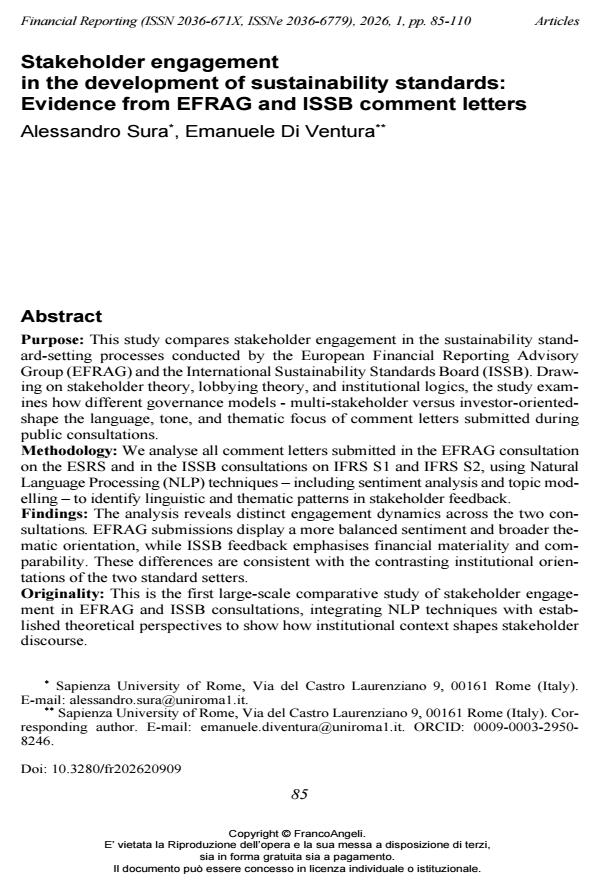
Below, you can see the article first page
If you want to buy this article in PDF format, you can do it, following the instructions to buy download credits
FrancoAngeli is member of Publishers International Linking Association, Inc (PILA), a not-for-profit association which run the CrossRef service enabling links to and from online scholarly content.
Purpose: This study compares stakeholder engagement in the sustainability standard-setting processes conducted by the European Financial Reporting Advisory Group (EFRAG) and the International Sustainability Standards Board (ISSB). Drawing on stakeholder theory, lobbying theory, and institutional logics, the study examines how different governance models - multi-stakeholder versus investor-oriented-shape the language, tone, and thematic focus of comment letters submitted during public consultations. Methodology: We analyse all comment letters submitted in the EFRAG consultation on the ESRS and in the ISSB consultations on IFRS S1 and IFRS S2, using Natural Language Processing (NLP) techniques – including sentiment analysis and topic modelling – to identify linguistic and thematic patterns in stakeholder feedback. Findings: The analysis reveals distinct engagement dynamics across the two consultations. EFRAG submissions display a more balanced sentiment and broader thematic orientation, while ISSB feedback emphasises financial materiality and comparability. These differences are consistent with the contrasting institutional orientations of the two standard setters. Originality: This is the first large-scale comparative study of stakeholder engagement in EFRAG and ISSB consultations, integrating NLP techniques with established theoretical perspectives to show how institutional context shapes stakeholder discourse. Practical implications: The findings suggest that differences in institutional orientation influence the type of stakeholder input received during standard-setting processes. These insights are relevant to ongoing debates on interoperability between EFRAG and the ISSB, as understanding how institutional contexts shape stakeholder discourse may inform future coordination efforts.
Keywords: sustainability reporting, stakeholder engagement, EFRAG, ISSB, NLP, ESG standards
Jel codes: M41, G34, Q56
- Agostini, M., Costantini, A., & Marcon, C. (2025). Constituent participation in the public consultation on EU CSRD: Who was the most active stakeholder?. Sustainability Accounting, Management and Policy Journal, 16(7), 289-325. DOI: 10.1108/SAMPJ-08-2024-0921
- Alexenko, A. (2024). Stakeholder Engagement in the Development of the Sustainability Reporting Standards of the Global Reporting Initiative (GRI) and of the International Sustainability Standards Board (ISSB). In C. Obádovics & Z. Széles (eds.). Fenntarthatósági átmenet: Kihívások és innovatív megoldások: Nemzetközi tudományos konferencia a Magyar Tudomány Ünnepe alkalmából (pp. 329-341). Soproni Egyetem Kiadó.
- Arun, R., Suresh, V., Veni Madhavan, C. E., & Narasimha Murthy, M. N. (2010). On Finding the Natural Number of Topics with Latent Dirichlet Allocation: Some Observations. In M. J. Zaki, J. X. Yu, B. Ravindran & V. Pudi (eds.). Advances in Knowledge Discovery and Data Mining (Vol. 6118, pp. 391-402). Springer Berlin Heidelberg. DOI: 10.1007/978-3-642-13657-3_43
- Balzarova, M. A., & Castka, P. (2012). Stakeholders’ Influence and Contribution to Social Standards Development: The Case of Multiple Stakeholder Approach to ISO 26000 Development. Journal of Business Ethics, 111(2), 265-279.
- Bird, S., Klein, E., & Loper, E. (2009). Natural language processing with Python. O’Reilly Media.
- Botzem, S., & Quack, S. (2009). (No) Limits to Anglo-American accounting? Reconstructing the history of the International Accounting Standards Committee: A review article. Accounting, Organizations and Society, 34(8), 988-998.
- Bozzolan, S., Fabrizi, M., Mallin, C. A., & Michelon, G. (2015). Corporate Social Responsibility and Earnings Quality: International Evidence. The International Journal of Accounting, 50(4), 361-396.
- Brown, P. R. (1981). A Descriptive Analysis of Select Input Bases of the Financial Accounting Standards Board. Journal of Accounting Research, 19(1), 232. DOI: 10.2307/2490971
- Brown, P., & Tarca, A. (2005). A commentary on issues relating to the enforcement of International Financial Reporting Standards in the EU. European Accounting Review, 14(1), 181-212. DOI: 10.1080/0963818042000338997
- Carini, C., Rocca, L., Veneziani, M., & Teodori, C. (2023). Exploring the accounting community perspective on the «Consultation Paper on Sustainability Reporting». Financial Reporting, 1, 67-96. DOI: 10.3280/FR2023-001003
- Christensen, H. B., Hail, L., & Leuz, C. (2021). Mandatory CSR and sustainability reporting: Economic analysis and literature review. Review of Accounting Studies, 26(3), 1176-1248.
- Clark, G. L., Feiner, A., & Viehs, M. (2014). From the Stockholder to the Stakeholder: How Sustainability Can Drive Financial Outperformance. SSRN Electronic Journal.
- David M. Blei, Andrew Y. Ng, & Michael I. Jordan (2003). Latent Dirichlet allocation. Journal of Machine Learning Research, 3, 993-1022.
- Deegan, C., Morris, R., & Stokes, D. (1990). Audit Firm Lobbying on Proposed Disclosure Requirements. Australian Journal of Management, 15(2), 261-280. DOI: 10.1177/031289629001500203
- Deveaud, R., SanJuan, E., & Bellot, P. (2014). Accurate and effective latent concept modeling for ad hoc information retrieval. Document numérique, 17(1), 61-84.
- Dhaliwal, D. S., Li, O. Z., Tsang, A., & Yang, Y. G. (2011). Voluntary Nonfinancial Disclosure and the Cost of Equity Capital: The Initiation of Corporate Social Responsibility Reporting. The Accounting Review, 86(1), 59-100.
- Elkins, H., & Entwistle, G. (2023). A Canadian Response to the Pursuit of Global Sustainability Reporting Standards*. Accounting Perspectives, 22(1), 7-54. DOI: 10.1111/1911-3838.12297
- European Commission (2024, March 13). Competitiveness and simplification at the Heart of the new “Omnibus” package [Press release]. europa.eu.
- Feldman, R. (2013). Techniques and applications for sentiment analysis. Communications of the ACM, 56(4), 82-89. DOI: 10.1145/2436256.2436274
- Francioli, F., Lardo, A., & Fiume, R. (2023). Dialogue with standard setters. The creation of the International Sustainability Standards Board: Evidence from the steps undertaken by the IFRS Foundation for Sustainability Reporting. Financial Reporting, 2, 123-136. DOI: 10.3280/FR2023-002005
- Francis, J. R. (1987). Lobbying against proposed accounting standards: The case of employers’ pension accounting. Journal of Accounting and Public Policy, 6(1), 35-57. DOI: 10.1016/0278-4254(87)90004-4
- Freeman, R. E., Phillips, R., & Sisodia, R. (2020). Tensions in Stakeholder Theory. Business & Society, 59(2), 213-231. DOI: 10.1177/0007650318773750
- Freeman, R. E., Wicks, A. C., & Parmar, B. (2004). Stakeholder Theory and “The Corporate Objective Revisited”. Organization Science, 15(3), 364-369.
- Freeman, R. E. (2010). Strategic management: A stakeholder approach. Cambridge University Press.
- Freeman, R. E., Harrison, J. S., Wicks, A. C., Parmar, B. L., & De Colle, S. (2010). Stakeholder theory: The state of the art. Cambridge University Press.
- Fusco, F., Pavone, P., & Ricci, P. (2024). Strengthening accountability and sustainability reporting: Does stakeholder engagement really work? Evidence from the judicial sector. Social Responsibility Journal, 20(5), 1015-1039. DOI: 10.1108/SRJ-05-2023-0248
- Greenwood, M. (2007). Stakeholder Engagement: Beyond the Myth of Corporate Responsibility. Journal of Business Ethics, 74(4), 315-327.
- Griffiths, T. L., & Steyvers, M. (2004). Finding scientific topics. Proceedings of the National Academy of Sciences, 101(suppl_1), 5228-5235.
- Hillman, A. J., Keim, G. D., & Schuler, D. (2004). Corporate Political Activity: A Review and Research Agenda. Journal of Management, 30(6), 837-857.
- Hirschman, A. O. (1964). The paternity of an index. The American Economic Review, 54(5), 761.
- Hoque, A., Clarke, A., & Huang, L. (2016). Lack of Stakeholder Influence on Pollution Prevention: A Developing Country Perspective. Organization & Environment, 29(3), 367-385. DOI: 10.1177/1086026615623057
- Johnson, S. B., & Solomons, D. (1984). Institutional legitimacy and the FASB. Journal of Accounting and Public Policy, 3(3), 165-183. DOI: 10.1016/0278-4254(84)90015-2
- Jurafsky, D., & Martin, J. H. (2023). Speech and language processing: An introduction to natural language processing, computational linguistics, and speech recognition with language models (3rd ed., draft). -- https://web.stanford.edu/~jurafsky/slp3/.
- Krivogorsky, V. (2024). Sustainability reporting with two different voices: The European Union and the International Sustainability Standards Board. Journal of International Accounting, Auditing and Taxation, 56, 100635.
- Kulik, A. (2026). Initial Evidence on Stakeholder Participation in EFRAG’s Sustainability Reporting Standard-Setting Process. Social and Environmental Accountability Journal, 46(1), 59-87. DOI: 10.1080/0969160X.2025.2588597
- Kulik, A., & Dobler, M. (2023). Stakeholder participation in the ISSB’s standard-setting process: The consultations on the first exposure drafts on sustainability reporting. Sustainability Accounting, Management and Policy Journal, 14(7), 349-380. DOI: 10.1108/SAMPJ-05-2023-0314
- Larson, R. K. (2007). Constituent Participation and the IASB’s International Financial Reporting Interpretations Committee. Accounting in Europe, 4(2), 207-254. DOI: 10.1080/17449480701727981
- Larson, R. K., & Herz, P. J. (2013). A Multi-Issue/Multi-Period Analysis of the Geographic Diversity of IASB Comment Letter Participation. Accounting in Europe, 10(1), 99-151. DOI: 10.1080/17449480.2013.772716
- Li, F. (2010). Textual analysis of corporate disclosures: A survey of the literature. University of Michigan, Ross School of Business.
- Liu, B. (2022). Sentiment analysis and opinion mining. Springer Nature. DOI: 10.1007/978-3-031-02145-9
- Loughran, T., & Mcdonald, B. (2011). When Is a Liability Not a Liability? Textual Analysis, Dictionaries, and 10-Ks. The Journal of Finance, 66(1), 35-65.
- MacArthur, J. B. (1988). Some Implications of Auditor and Client Lobbying Activities: A Comparative Analysis. Accounting and Business Research, 19(73), 56-64. DOI: 10.1080/00014788.1988.9728836
- Macarthur, J. B., & Groves, R. E. V. (1993). An empirical investigation into the impact of profit sharing schemes of executives on the content of corporate submissions on proposed accounting standards. Journal of Business Finance & Accounting, 20(5), 623-638.
- Mandas, M., Lahmar, O., Piras, L., & De Lisa, R. (2023). ESG in the financial industry: What matters for rating analysts?. Research in International Business and Finance, 66, 102045.
- Manning, C. D., Raghavan, P., & Schütze, H. (2008). Introduction to Information Retrieval. Cambridge University Press.
- Mian, S. L., & Smith, C. W. (1990). Incentives associated with changes in consolidated reporting requirements. Journal of Accounting and Economics, 13(3), 249-266. DOI: 10.1016/0165-4101(90)90033-Z
- Millar, J., & Slack, R. (2024). Global investor responses to the International Sustainability Standards Board draft sustainability and climate-change standards: Sites of dissonance or consensus. Sustainability Accounting, Management and Policy Journal, 15(3), 573-604. DOI: 10.1108/SAMPJ-03-2023-0128
- Mohammad, S. M., & Turney, P. D. (2013). Crowdsourcing a word-emotion association lexicon. Computational Intelligence, 29(3), 436-465.
- Ni, J., Bingler, J., Colesanti-Senni, C., Kraus, M., Gostlow, G., Schimanski, T., Stammbach, D., Vaghefi, S. A., Wang, Q., Webersinke, N., Wekhof, T., Yu, T., & Leippold, M. (2023). Paradigm Shift in Sustainability Disclosure Analysis: Empowering Stakeholders with CHATREPORT, a Language Model-Based Tool (Versione 2). arXiv. DOI: 10.48550/ARXIV.2306.15518
- Nielsen, F. Å. (2011). A new ANEW: Evaluation of a word list for sentiment analysis in microblogs. DOI: 10.48550/ARXIV.1103.2903
- Parmar, B. L., Freeman, R. E., Harrison, J. S., Wicks, A. C., Purnell, L., & De Colle, S. (2010). Stakeholder Theory: The State of the Art. Academy of Management Annals, 4(1), 403-445. Doi. 10.5465/19416520.2010.495581.
- Ponte, S. (2014). ‘Roundtabling’ sustainability: Lessons from the biofuel industry. Geoforum, 54, 261-271.
- Puroila, J., & Mäkelä, H. (2019). Matter of opinion: Exploring the socio-political nature of materiality disclosures in sustainability reporting. Accounting, Auditing & Accountability Journal, 32(4), 1043-1072. DOI: 10.1108/AAAJ-11-2016-2788
- Rawhouser, H., Cummings, M. E., & Marcus, A. (2018). Sustainability Standards and Stakeholder Engagement: Lessons From Carbon Markets. Organization & Environment, 31(3), 263-282. DOI: 10.1177/1086026617718434
- Salton, G. (1971). The SMART retrieval system - Experiments in automatic document processing. Prentice-Hall.
- Scharpf, F. (1999). Governing in Europe: Effective and Democratic?. Oxford University Press.
- Shannon, C. E. (1948). A Mathematical Theory of Communication. Bell System Technical Journal, 27(3), 379-423.
- Tandy, P. R., & Wilburn, N. L. (1992). Constituent participation in standard-setting: The FASB’s first 100 statements. Accounting Horizons, 6(2), 47-58.
- Zeff, S. A. (1978). The Rise of Economic Consequences. Journal of Accountancy, 56-63.
Alessandro Sura, Emanuele Di Ventura, Stakeholder engagement in the development of sustainability standards: Evidence from EFRAG and ISSB comment letters in "FINANCIAL REPORTING" 1/2026, pp 85-110, DOI: 10.3280/fr202620909