Parental influence and sibling conflicts within family context in Southeast Nigeria: Implication for conflict management and social policy
Journal title PSICOLOGIA DELLA SALUTE
Author/s Onyedikachi C. Nnamchi, Favour Udemba, Samuel O. Okafor, Uchenna B. Nwokoma, Florence I. Onuoha, Innocent A. Ngene, Precious O. Oti, Andrew N. Ogbochie
Publishing Year 2026 Issue 2026/2
Language English Pages 18 P. 113-130 File size 164 KB
DOI 10.3280/PDS2026-002007
DOI is like a bar code for intellectual property: to have more infomation
click here
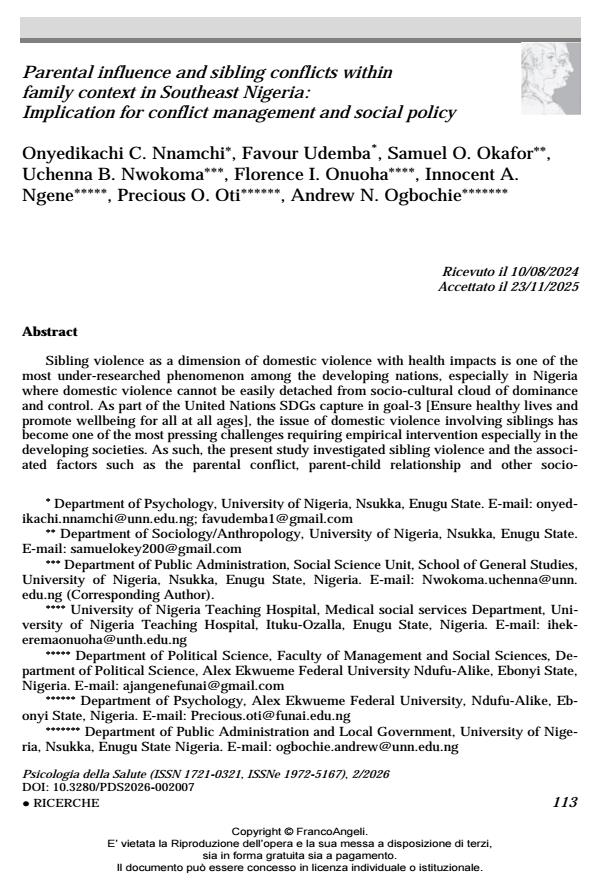
Below, you can see the article first page
If you want to buy this article in PDF format, you can do it, following the instructions to buy download credits
FrancoAngeli is member of Publishers International Linking Association, Inc (PILA), a not-for-profit association which run the CrossRef service enabling links to and from online scholarly content.
Sibling violence as a dimension of domestic violence with health impacts is one of the most under-researched phenomenon among the developing nations, especially in Nigeria where domestic violence cannot be easily detached from socio-cultural cloud of dominance and control. As part of the United Nations SDGs capture in goal-3 [Ensure healthy lives and promote wellbeing for all at all ages], the issue of domestic violence involving siblings has become one of the most pressing challenges requiring empirical intervention especially in the developing societies. As such, the present study investigated sibling violence and the associated factors such as the parental conflict, parent-child relationship and other socio-demographic factors in the family context in southeast Nigeria. The study involved 359 youths (18+) from different institutions of higher learning in the region, while a total of three scales [Parent Adult-Child Relationship Questionnaire (PACQ) (Peisah et al., 1999); Children Perception of Inter-parental Conflict (CPIC) (Grych et al., 1992); and Conflict Tactics Scale (CTS) (Straus, 1979)] were applied in collecting data from the respondents. Pearson’s correlation and Hierarchical multiple linear regressions were used to test for the relationship among the variables included in the study. According to the findings of the study, parental conflict was positively correlated with parent-child relationship (r = 0.20, p < 0.001), sibling violence (r = 0.19, p < 0.001) and also a significant positive predictor of sibling violence (ß = 0.19, p < 0.001); parent-child-relationship was not significantly related with sibling violence (r = 0.10, p > 0.05), while being male was associated with higher parent-child relationship (r = -0.17, p < 0.01).
Keywords: Sibling violence, domestic violence, family conflict, parent-child relationship, sustainable development.
Onyedikachi C. Nnamchi, Favour Udemba, Samuel O. Okafor, Uchenna B. Nwokoma, Florence I. Onuoha, Innocent A. Ngene, Precious O. Oti, Andrew N. Ogbochie, Parental influence and sibling conflicts within family context in Southeast Nigeria: Implication for conflict management and social policy in "PSICOLOGIA DELLA SALUTE" 2/2026, pp 113-130, DOI: 10.3280/PDS2026-002007