Algorithms in Employment Matchmaking: bridging Public and Private Sectors Approaches
Journal title STUDI ORGANIZZATIVI
Author/s Francesco Seghezzi, Diletta Porcheddu, Alessandra Della Vecchia
Publishing Year 2026 Issue 2026/1
Language English Pages 27 P. 149-175 File size 182 KB
DOI 10.3280/SO2026-001006
DOI is like a bar code for intellectual property: to have more infomation
click here
Below, you can see the article first page
If you want to buy this article in PDF format, you can do it, following the instructions to buy download credits
FrancoAngeli is member of Publishers International Linking Association, Inc (PILA), a not-for-profit association which run the CrossRef service enabling links to and from online scholarly content.
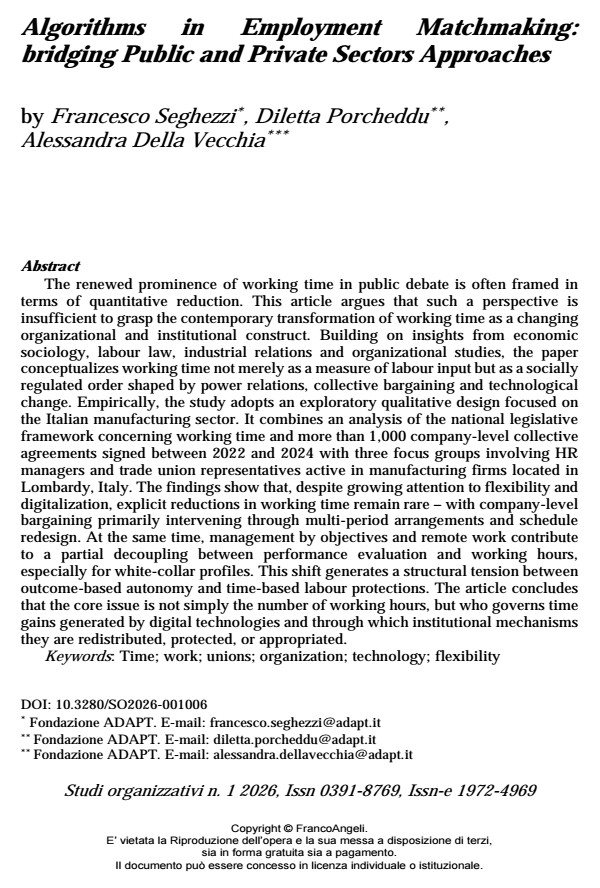
The renewed prominence of working time in public debate is often framed in terms of quantitative reduction. This article argues that such a perspective is insufficient to grasp the contemporary transformation of working time as a changing organizational and institutional construct. Building on insights from economic sociology, labour law, industrial relations and organizational studies, the paper conceptualizes working time not merely as a measure of labour input but as a socially regulated order shaped by power relations, collective bargaining and technological change. Empirically, the study adopts an exploratory qualitative design focused on the Italian manufacturing sector. It combines an analysis of the national legislative framework concerning working time and more than 1,000 company-level collective agreements signed between 2022 and 2024 with three focus groups involving HR managers and trade union representatives active in manufacturing firms located in Lombardy, Italy. The findings show that, despite growing attention to flexibility and digitalization, explicit reductions in working time remain rare – with company-level bargaining primarily intervening through multi-period arrangements and schedule redesign. At the same time, management by objectives and remote work contribute to a partial decoupling between performance evaluation and working hours, especially for white-collar profiles. This shift generates a structural tension between outcome-based autonomy and time-based labour protections. The article concludes that the core issue is not simply the number of working hours, but who governs time gains generated by digital technologies and through which institutional mechanisms they are redistributed, protected, or appropriated.
Keywords: Time; work; unions; organization; technology; flexibility
- Anttila, T., Oinas, T., Tammelin, M., Nätti, J. (2015), “Working-Time Regimes and Work-Life Balance in Europe”, European Sociological Review, 31 : 713–724,
- Acemoglu, D., Restrepo, P. (2019) “Automation and New Tasks: How Technology Displaces and Reinstates Labor”, Journal of Economic Perspectives, 33 : 3-33,
- ADAPT (2023), La contrattazione collettiva in Italia (2022). IX Rapporto ADAPT, ADAPT University Press.
- ADAPT (2024), La contrattazione collettiva in Italia (2023). X Rapporto ADAPT, ADAPT University Press.
- ADAPT (2025), La contrattazione collettiva in Italia (2024). XI Rapporto ADAPT, ADAPT University Press.
- Bartezzaghi, E., Della Rocca, G., Pero, L., Ponzellini, A.M. (eds.) (2022), Organizzazione e lavoro in un’epoca di incertezze, Torino, Centro Einaudi, Quaderni di Biblioteca della libertà, Collana del Tassello Mancante.
- Burchell, B., Deakin, S., Rubery, J., Spencer, D. (2024), “The future of work and working time: Introduction to special issue”, Cambridge Journal of Economics, 48,
- Carinci, M. T., & Ingrao, A. (2021). Il lavoro agile: criticità emergenti e proposte per una riforma. LLI, 7(2).
- Cipriani, A., Gramolati, A., Mari, G. (2018), Il lavoro 4.0. La Quarta Rivoluzione industriale e le trasformazioni delle attività lavorative, Florence, Firenze University Press.
- Coser, L. (1974), Greedy Institutions: Patterns of Undivided Commitment, New York, NY: Free Press.
- Doellgast, V., Lillie, N., Pulignano, V. (eds.) (2018), Reconstructing Solidarity: Labour Unions, Precarious Work, and the Politics of Institutional Change in Europe, Oxford, Oxford University Press,
- Durkheim, E. (1902), De la division du travail social, Paris, Alcan.
- Eurofound and the International Labour Office (2017), Working anytime, anywhere: The effects on the world of work, Luxembourg, Publications Office of the European Union, Geneva, International Labour Office.
- Fagan, C., Lyonette, C., Smith, M., Saldaña-Tejeda, A. (2012), The influence of working time arrangements on work-life integration or ‘balance’: A review of the international evidence, Geneva, International Labour Organization,
- Freidson, E. (2001), Professionalism, the third logic: on the practice of knowledge, Bibliovault OAI Repository, the University of Chicago Press.
- Gorz, A. (1992) Metamorfosi del lavoro. Critica della ragione economica, Bollati Boringhieri.
- Green, F. (2001) “It’s Been A Hard Day’s Night: The Concentration and Intensification of Work in Late Twentieth-Century Britain”, British Journal of Industrial Relations, 39(1) : 53-80.
- Hermann, C. (2014), Capitalism and the Political Economy of Work Time, London, Routledge. DOI: 10.4324/9781315745770
- Holt, R., Johnsen, R. (2019), “Time and Organization Studies”, Organization Studies, 40(10) : 1557-1572, DOI: 10.1177/0170840619844292
- Howcroft, D., Taylor, P. (2024), “Experiences of working time intensification and extensification: examining the influence of logics of production in IT work”, Cambridge Journal of Economics, 48(1) : 69-88,
- Ingold, T. (1995), “Work, Time and Industry”, Time & Society, 4(1) : 5-28, DOI: 10.1177/0961463X95004001001
- Kalleberg, A.L., Epstein, C.F. (2001), “Introduction: Temporal Dimensions of Employment Relations: Temporal Dimensions of Employment Relations”, American Behavioral Scientist, 44(7) : 1064-1075, DOI: 10.1177/00027640121956656
- Keynes, J.M. (1930), “Economic Possibilities for our Grandchildren”, in Keynes, J.M. Essays in Persuasion, New York, W.W. Norton & Co: 358-373.
- Leccese, V. (2022), “La misurazione dell’orario di lavoro e le sue sfide”, in LLI, (1).
- Lu, Z. (2023), “Can Work Time Fragmentation Influence Workers’ Subjective Time Pressure? The Roles of Gender and Parenthood”, Sociology, 58(1) : 194-212. DOI: 10.1177/00380385231166893
- Messenger, J. (2018), “Working time and the future of work”, ILO Future of Work Research Paper Series, Geneva, International Labour Organization.
- Mullens, F., Glorieux, I. (2023), “Reducing weekly working hours: Temporal strategies and changes in the organization and experiences of work - Results from a qualitative study of a 30-hour workweek experiment”, Time & Society, 32 : 1-23, DOI: 10.1177/0961463X231156948
- Mumford, L. (1967), The Myth of the Machine, Harcourt Brace Jovanovich.
- Piasna, A. (2024) Job quality and digitalisation, ETUI Working Paper 2024.01, Brussels, European Trade Union Institute.
- Rubery, J., Grimshaw, D., Keizer, A., Johnson, M. (2018), “Challenges and contradictions in the ‘normalising’ of precarious work”, Work, Employment and Society, 32 : 509–527, DOI: 10.1177/0950017017751790
- Rubery, J., Ward, K., Grimshaw, D., Beynon, H. (2005), “Working Time, Industrial Relations and the Employment Relationship”, Time & Society, 14(1) : 89-111, DOI: 10.1177/0961463X05050300
- Standing, G. (2013), The Precariat: The New Dangerous Class, London, Bloomsbury Academic.
- Supiot, A. (2001), Beyond Employment: Changes in Work and the Future of Labour Law in Europe, Oxford, Oxford University Press.
- Thompson, J.D. (1967), Organizations in Action: Social Science Bases of Administrative Theory, New Jersey, Transaction Publishers.
- Tiraboschi, M. (2003) “La riforma dell'orario di lavoro: quale ruolo per la contrattazione collettiva?” Contratti e Contrattazione Collettiva, n. 5, 72, ISSN 1592-4556.
- Trentin, B. (1997), La città del lavoro. Sinistra e crisi del fordismo, Feltrinelli.
- Trentin, B. (2014), La città del lavoro. Sinistra e crisi della sinistra (1997), new edition by Ariemma, I. (eds.), Florence, Firenze University Press.
Francesco Seghezzi, Diletta Porcheddu, Alessandra Della Vecchia, Algorithms in Employment Matchmaking: bridging Public and Private Sectors Approaches in "STUDI ORGANIZZATIVI " 1/2026, pp 149-175, DOI: 10.3280/SO2026-001006