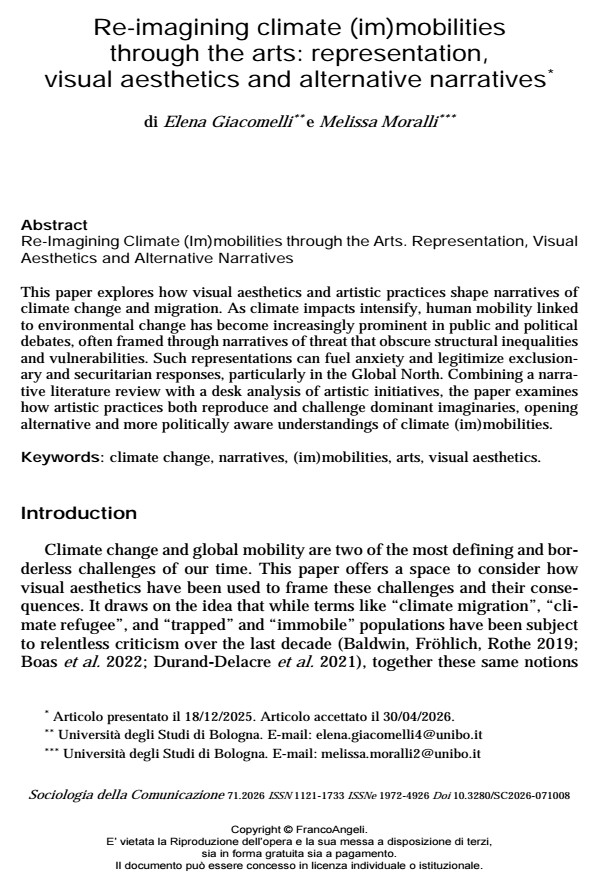
Re-Imagining Climate (Im)mobilities through the Arts. Representation, Visual Aesthetics and Alternative Narratives
Journal title SOCIOLOGIA DELLA COMUNICAZIONE
Author/s Elena Giacomelli, Melissa Moralli
Publishing Year 2026 Issue 2026/71
Language English Pages 19 P. 145-163 File size 149 KB
DOI 10.3280/SC2026-071008
DOI is like a bar code for intellectual property: to have more infomation
click here
Below, you can see the article first page
If you want to buy this article in PDF format, you can do it, following the instructions to buy download credits
FrancoAngeli is member of Publishers International Linking Association, Inc (PILA), a not-for-profit association which run the CrossRef service enabling links to and from online scholarly content.
This paper explores how visual aesthetics and artistic practices shape narratives of climate change and migration. As climate impacts intensify, human mobility linked to environmental change has become increasingly prominent in public and political debates, often framed through narratives of threat that obscure structural inequalities and vulnerabilities. Such representations can fuel anxiety and legitimize exclusionary and securitarian responses, particularly in the Global North. Combining a narrative literature review with a desk analysis of artistic initiatives, the paper examines how artistic practices both reproduce and challenge dominant imaginaries, opening alternative and more politically aware understandings of climate (im)mobilities.
Keywords: climate change, narratives, (im)mobilities, arts, visual aesthetics.
- Baldwin W.A. (2013), Racialisation and the Figure of the Climate-Change Migrant, in «Environment and Planning A», 45(6), pp. 1474-1490.
- Baldwin W.A. (2022), The Other of Climate Change: Racial Futurism, Migration, Humanism, Rowman & Littlefield, Lanham.
- Baldwin W.A., Bettini G. (eds.) (2017), Life adrift: climate change, migration, critique. Geopolitical bodies, material worlds, Rowman & Littlefield International, New York.
- Baldwin W.A., Fröhlich C., Rothe D. (2019), From Climate Migration to Anthropocene Mobilities: Shifting the Debate, in «Mobilities», 14(3), pp. 289-297.
- Boas I., Farbotko C.A., Adams H., Sterly H., Bush S., van der Geest K., Wiegel H., Ashraf H., Baldwin A., Bettini G., Blondin S., de Bruijn M., Durand-Delacre D., Frölich C., Gioli G., Guaita L., Hut E., Jarawura F.X., Lamers M., Lietaer S., Nash S.L., Piguet E., Rothe D., Sakdapolrak P., Smith L., Tripathy Furlong B., Turhan E., Warner J., Zickgraf C., Black R., Hulme M. (2019). Climate migration myths, in «Nature Climate Change», 9(11), pp. 901-903.
- Boas I., Wiegel H., Farbotko C., Warner J., Sheller M. (2022), Climate mobilities: migration, im/mobilities and mobility regimes in a changing climate, in «Journal of Ethnic and Migration Studies», 48(14), 3365-3379. DOI: 10.1080/1369183X.2022.2066264.
- Brown A.D. (2006), A Narrative Approach to Collective Identities, in «Journal of Management Studies», 43(4), pp. 731-753.
- Cappi V. (2023), Immaginare l’altrove nell’epoca dell’Antropocene. Media, confini e cambiamenti climatici, FrancoAngeli, Milano.
- Castoriadis C. (1998), The Imaginary Institution of Society, The MIT Press, Cambridge.
- Chouliaraki L. (2013), The ironic spectator: Solidarity in the age of post-humanitarianism, Polity Press, Cambridge.
- - (2024), Wronged: The Weaponization of Victimhood, Columbia University Press, New York.
- Davis J.E. (2002), Stories of Change. Narrative and Social Movements, State University of New York Press, Albany.
- De Fina A., Georgakopoulou A. (2008), Introduction: Narrative analysis in the shift from texts to practices, in «Text and Talk», 28, pp. 275-281. DOI: 10.1177/1468794106093634
- Demos T.J. (2023), Radical Futurisms. Ecologies of Collapse, Chronopolitics, and Justice-to-Come, StenbergPress, London.
- Dogramaci B., Mersmann B. (eds.) (2019), Handbook of Art and Global Migration: Theories, practices, and challenges, Walter de Gruyter GmbH & Co KG, Berlin.
- Durand G. (2015), L’imagination symbolique, PUF, Paris.
- Durand-Delacre D. (2023), Climate-related Mobility Mostly Occurs within Borders: Disentangling Factual Truth from a Convenient Narrative, Researching Internal Displacement. Available at: https://researchinginternaldisplacement.org/short_pieces/climate-related-mobility-mostly-occurs-within-borders-disentangling-factual-truth-from-a-convenient-narrative/
- Durand-Delacre D., Böhm S., Sullivan S. (2021), Climate Migration Is about People, Not Numbers, in Böhm S., Sullivan S. (eds.), Negotiating Climate Change in Crisis, Open Book Publishers, Cambridge, pp. 63-82.
- Fassin D., Pandolfi M. (eds.) (2010), Contemporary states of emergency: the politics of military and humanitarian interventions, Zone Books, New York.
- Ford J.D., Ford L.W. (1995), The role of conversations in producing intentional change in organizations, in «Academy of Management Review», 19, pp. 756-85.
- Giacomelli E. (2023), Panicocene. Narrazioni su cambiamenti climatici, regimi di mobilità e migrazioni ambientali, FrancoAngeli, Milano.
- Giacomelli E., Musarò P. (2025), Climate Mobility Justice. Narratives and Visual Politics of the Panicocene, Palgrave, Cham.
- Giacomelli E., Musarò P., Peca S., Parmiggiani P. (2025), Imaginary Wor(l)ds: A Creative Methodology to Explore Future Imaginaries of Climate Change-Induced (Im)mobilities, in «Migraciones», pp. 1-23,
- Hinchman L.P., Hinchman S.K. (eds.) (1997), Memory, Identity, Community: The Idea of Narrative in the Human Sciences, SUNY Press, New York.
- International Organization for Migration (2019), Glossary on Migration. Available at: https://environmentalmigration.iom.int/sites/g/files/tmzbdl1411/files/iml_34_glossary.pdf.
- Ionesco D., Mokhnacheva D., Gemenne F. (2017), The atlas of environmental migration, Routledge, New York.
- Jedlowski P. (2005), Un giorno dopo l’altro. La vita quotidiana fra esperienza e routine, il Mulino, Bologna.
- Macleod K. (ed.) (2013), Thinking through art: Reflections on art as research, Routledge, London.
- Mazzara F. (2019), Reframing Migration: Lampedusa, Border Spectacle and the Aesthetics of Subversion, Peter Lang, Berna.
- McKee Y. (2011), On ‘Climate Refugees’: Biopolitics, Aesthetics, and Critical Climate Change, in «Qui Parle», 19(2), pp. 309-325.
- McLeman R. (2018), Thresholds in climate migration, in «Population and Environment», 39(4), pp. 319–338.
- Methmann Y., Rothe D. (2014), Tracing the spectre that haunts Europe: the visual construction of climate-induced migration in the MENA region, in «Critical Security Studies», 2(2), pp. 162-179.
- Mirzoeff N. (2015), How to See the World, Pelican, London.
- Moralli M. (2023), Research as care: Positionality and reflexivity in qualitative migration research, in «Qualitative Research», 23(24), pp. 751–770. DOI: 10.1177/14687941231176946
- - (2024), Arts-Based Methods in Migration Research. A Methodological Analysis on Participatory Visual Methods and Their Transformative Potentials and Limits in Studying Human Mobility, in «International Journal of Qualitative Methods», 23, pp. 1-19. DOI: 10.1177/16094069241254008
- - (2025), The right to the discourse: Grassroots artistic production as a space for reconstructing aesthetic structures on migration in the city of Marseille, in «City, Culture and Society», 45, 100708.
- Moralli M., Musarò P., Paltrinieri R., Parmiggiani P. (2021), Creative resistance. Cultural practices, artistic activism and counter-hegemonic narratives on diversity, in «Studi Culturali», 2, pp. 163-181.
- Musarò P. (2017), Mare Nostrum: the visual politics of a military-humanitarian operation in the Mediterranean Sea, in «Media, Culture & Society», 39(1), pp. 11-28. DOI: 10.1177/0163443716672296
- Musarò P., Papastergiadis N., Peja L. (2022), Reimagining Narratives on Migration. The Role of Media, Arts, and Culture in Promoting Transcultural Dialogue, in «Comunicazioni Sociali», 1, pp. 3-16.
- Musarò P., Parmiggiani P. (2022), Ospitalità mediatica. Le migrazioni nel discorso pubblico, FrancoAngeli, Milano.
- Oso L., Ribas-Mateos N., Moralli M. (2025), Elgar Encyclopedia of Global Migration: New Mobilities and Artivism, Elgar, Cheltenham.
- Papastergiadis N. (2013), Cosmopolitanism and culture, John Wiley & Sons, London.
- Piguet E. (2013), From “Primitive Migration” to “Climate Refugees”: The Curious Fate of the Natural Environment in Migration Studies, in «Annals of the Association of American Geographers», 103(1), pp. 148-162. DOI: 10.1080/00045608.2012.696233
- Piguet E. (2022), Linking climate change, environmental degradation, and migration: An update after 10 years, in «WIREs Climate Change», 13(1).
- Ransan-Cooper H., Farbotko C., McNamara K.E., Thornton F., Chevalier E. (2015). Being(s) framed: The means and ends of framing environmental migrants, in «Global Environmental Change», 35, pp. 106–115.
- Said E.W. (1979), Orientalism, Vintage Books, London.
- Sakellari M. (2023), Communicating climate change induced migration: the role of NGOs, in «Open Research Europe», 3(163), pp. 1-11.
- Salzbrunn M. (2019), Artivisme, Anthropen, Laval.
- Scott M. (2023), Adapting to Climate-Related Human Mobility into Europe: Between the Protection Agenda and the Deterrence Paradigm, or Beyond?, in «EJML», 25(1), pp. 54-82. DOI: 10.1163/15718166-12340144
- Sheller M. (2018), Mobility Justice: The Politics of Movement in an Age of Extremes, Verso Books, New York.
- Sheller M. (2023), Theorizing mobility justice in contexts of climate mobilities, in Jacobsen K., Majidi N. (eds.), Handbook on Forced Migration, Elgar, Worcester, pp. 227-233.
- Sultana F. (2022), The unbearable heaviness of climate coloniality in «Political Geography», 99, 102638.
- Vinke K., Bergmann J., Blocher J., Upadhyay H., Hoffmann R. (2020), Migration as Adaptation?, in «Migration Studies», 8(4), pp. 626–634.
Elena Giacomelli, Melissa Moralli, Re-imagining climate (im)mobilities through the arts: representation, visual aesthetics and alternative narratives in "SOCIOLOGIA DELLA COMUNICAZIONE " 71/2026, pp 145-163, DOI: 10.3280/SC2026-071008