A new Technocratic Politics. Hypotheses on the Far-Right, Big Tech and new forms of legitimation
Journal title PRISMA Economia - Società - Lavoro
Author/s Francesco Antonelli
Publishing Year 2026 Issue 2026/1
Language Italian Pages 14 P. 76-89 File size 116 KB
DOI 10.3280/PRI2026-001006
DOI is like a bar code for intellectual property: to have more infomation
click here
Below, you can see the article first page
If you want to buy this article in PDF format, you can do it, following the instructions to buy download credits
FrancoAngeli is member of Publishers International Linking Association, Inc (PILA), a not-for-profit association which run the CrossRef service enabling links to and from online scholarly content.
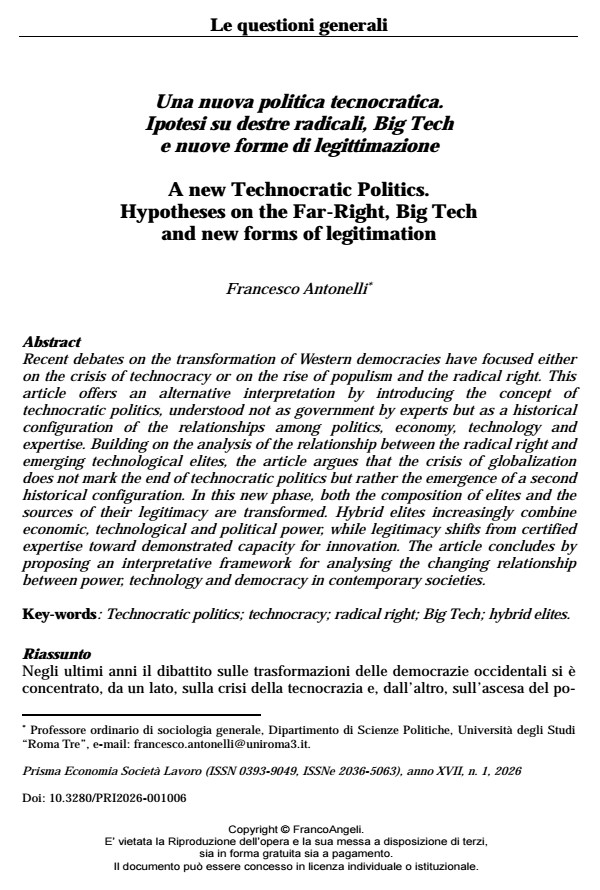
Recent debates on the transformation of Western democracies have focused either on the crisis of technocracy or on the rise of populism and the radical right. This article offers an alternative interpretation by introducing the concept of technocratic politics, understood not as government by experts but as a historical configuration of the relationships among politics, economy, technology and expertise. Building on the analysis of the relationship between the radical right and emerging technological elites, the article argues that the crisis of globalization does not mark the end of technocratic politics but rather the emergence of a second historical configuration. In this new phase, both the composition of elites and the sources of their legitimacy are transformed. Hybrid elites increasingly combine economic, technological and political power, while legitimacy shifts from certified expertise toward demonstrated capacity for innovation. The article concludes by proposing an interpretative framework for analysing the changing relationship between power, technology and democracy in contemporary societies.
Keywords: Technocratic politics; technocracy; radical right; Big Tech; hybrid elites.
- Antonelli F. (2022), Technocratic Politics. Beyond Democratic Society?, London, Routledge.
- Antonelli F. (2026), “From technocracy to technocratic politics: a new conceptual model for analysing the relation between technoscience and politics” in L.W. Garry Robson (eds.), Rise of the Digital Technocracy, Northampton, Massachusetts, Edward Elgar Publishing.
- Bell D. (1973), The Coming of Post-Industrial Society. A Venture in Social Forecasting, New York, Basic Books, trad. it. di G. Guizzardi, L’avvento della società post-industriale (1978), Milano, Edizioni di Comunità.
- Bickerton C. J., Invernizzi Accetti C. (2021), Technopopulism. The New Logic of Democratic Politics, Oxford, Oxford University Press.
- Centeno M. A. (1993), “The New Leviathan: The Dynamics and Limits of Technocracy”, Theory and Society, 22(3), pp. 307-335.
- Crouch C. (2004), Post-Democracy, Cambridge, Polity Press, trad. it. di C. Fusini, Postdemocrazia (2003), Roma-Bari, Laterza.
- Eatwell R., Goodwin M. (2018), National Populism. The Revolt Against Liberal Democracy, London, Pelican Books.
- Fischer F. (1990), Technocracy and the Politics of Expertise, Newbury Park (CA), Sage.
- Habermas J. (2022), Ein neuer Strukturwandel der Öffentlichkeit und die deliberative Politik, Berlin, Suhrkamp Verlag, trad. it. di L. Ceppa, Nuovo mutamento strutturale della sfera pubblica e politica deliberativa (2023), Milano, Raffaello Cortina Editore.
- Majone G. (1996), Regulating Europe, London, Routledge.
- McDonald K. (2022), “Drivers of Far-Right Extremism”, in The Routledge International Handbook of New Digital Practices and Radicalization, London, Routledge.
- Miller-Idriss C. (2020), Hate in the Homeland. The New Global Far Right, Princeton (NJ), Princeton University Press.
- Mudde C. (2007), Populist Radical Right Parties in Europe, Cambridge, Cambridge University Press.
- Mudde C., Rovira Kaltwasser C. (2017), Populism. A Very Short Introduction, Oxford, Oxford University Press.
- Norris P., Inglehart R. (2019), Cultural Backlash. Trump, Brexit, and Authoritarian Populism, Cambridge, Cambridge University Press.
- Pareto V. (1916), Trattato di sociologia generale, Firenze, G. Barbèra.
- Schmidt V. A. (2020), Europe’s Crisis of Legitimacy. Governing by Rules and Ruling by Numbers in the Eurozone, Oxford, Oxford University Press.
- Scott H. (1933), Introduction to Technocracy, New York, Technocracy Inc.
- Srnicek N. (2017), Platform Capitalism, Cambridge, Polity Press, trad. it. di F. Peri, Capitalismo digitale. Google, Facebook, Amazon e la nuova economia del web (2017), Roma, Luiss University Press.
- Touraine A. (1969), La société post-industrielle. Naissance d'une société, Paris, Denoël-Gonthier, trad. it. di G. Bogliolo, La società post-industriale (1970), Bologna, il Mulino.
- Weber M. (1922), Wirtschaft und Gesellschaft, Tübingen, Mohr Siebeck, trad. it. di P. Rossi, Economia e società (1961), Milano, Edizioni di Comunità.
- Zuboff S. (2019), The Age of Surveillance Capitalism. The Fight for a Human Future at the New Frontier of Power, New York, PublicAffairs, trad. it. di P. Bassotti, Il capitalismo della sorveglianza. Il futuro dell’umanità nell’era dei nuovi poteri (2019), Roma, Luiss University Press.
Francesco Antonelli, Una nuova politica tecnocratica. Ipotesi su destre radicali, Big Tech e nuove forme di legittimazione in "PRISMA Economia - Società - Lavoro" 1/2026, pp 76-89, DOI: 10.3280/PRI2026-001006