Political Participation and Gender Representation in the Marche Region: Recent Trends and Perspectives
Journal title PRISMA Economia - Società - Lavoro
Author/s Angela Cossiri, Selena Grimaldi
Publishing Year 2026 Issue 2026/1
Language Italian Pages 10 P. 94-103 File size 93 KB
DOI 10.3280/PRI2026-001008
DOI is like a bar code for intellectual property: to have more infomation
click here
Below, you can see the article first page
If you want to buy this article in PDF format, you can do it, following the instructions to buy download credits
FrancoAngeli is member of Publishers International Linking Association, Inc (PILA), a not-for-profit association which run the CrossRef service enabling links to and from online scholarly content.
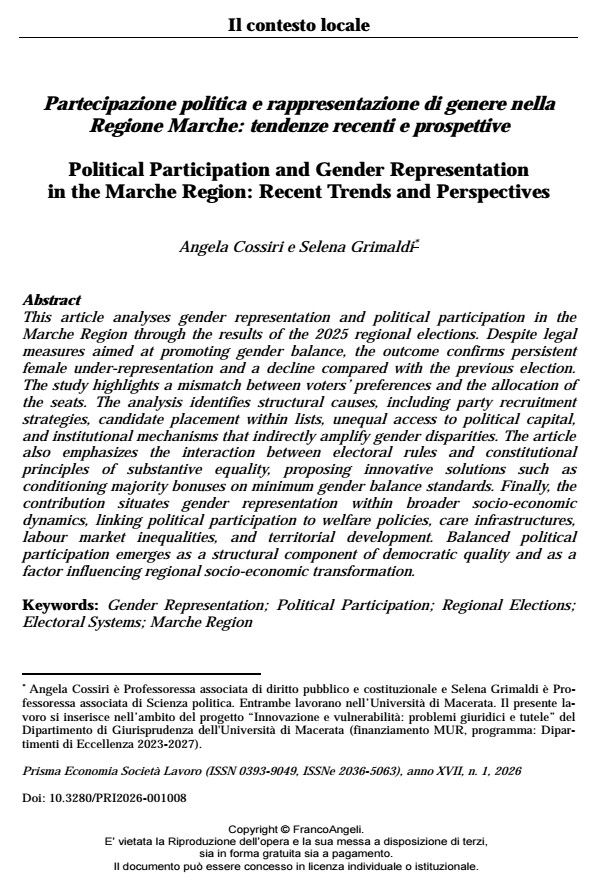
This article analyses gender representation and political participation in the Marche Region through the results of the 2025 regional elections. Despite legal measures aimed at promoting gender balance, the outcome confirms persistent female under-representation and a decline compared with the previous election. The study highlights a mismatch between voters’ preferences and the allocation of the seats. The analysis identifies structural causes, including party recruitment strategies, candidate placement within lists, unequal access to political capital, and institutional mechanisms that indirectly amplify gender disparities. The article also emphasizes the interaction between electoral rules and constitutional principles of substantive equality, proposing innovative solutions such as conditioning majority bonuses on minimum gender balance standards. Finally, the contribution situates gender representation within broader socio-economic dynamics, linking political participation to welfare policies, care infrastructures, labour market inequalities, and territorial development. Balanced political participation emerges as a structural component of democratic quality and as a factor influencing regional socio-economic transformation.
Keywords: Gender Representation; Political Participation; Regional Elections; Electoral Systems; Marche Region
- Apostoli A. (2016), La rappresentanza di genere nel campo “minato” della rappresentanza politica, Rivista AIC, 4, p. 41.
- Califano L. (2011), Eguaglianza, diritti e partecipazione femminile alla vita democratica: la parità dei sessi nella rappresentanza politica: riforme costituzionali e “quote di genere”, in A. Falcone (a cura di), Verso una democrazia paritaria: modelli e percorsi per la piena partecipazione delle donne alla vita politica e istituzionale, Milano, Giuffrè, pp. 71-85.
- Califano L. (2021), Parità dei diritti e discriminazioni di genere, Federalismi.it, 7, spec. p. 28 ss.
- Cerioni M. (2020), Riforma della legge elettorale e dello Statuto delle Marche in tema di parità di genere e forma di governo, Federalismi.it, 21.
- Coman E., Shair-Rosenfield S. (2025), Women on the ballot and women at the polls: how women’s representation shapes voter turnout in local elections, in Political Science Research and Methods, 13(4), pp. 1008-1024.
- Devroe R., Wauters B. (2020), Does High on the Ballot Means Highly Competent? Explaining the Ballot Position Effect in List-PR Systems, Acta Politica, 55(3), pp. 454-471.
- Di Cosimo G. (2015), Quando la politica si autolimita: realtà e finzione nel caso della legge elettorale della Regione Marche, Le Regioni, 43(3), pp. 683-692.
- Lawless J. L., Fox R. L. (2025), It Takes More Than a Candidate: Why Women Don’t Run for Office, III ed., Cambridge, Cambridge University Press.
- Norris P., Lovenduski J. (1995), Political Recruitment, Cambridge, Cambridge University Press.
- Pezzini B., Lorenzetti A. (2019) (a cura di), 70 anni dopo tra uguaglianza e differenza. Una riflessione sull’impatto del genere nella Costituzione e nel costituzionalismo, Torino, Giappichelli.
- Pitkin H. (2017), Il concetto di rappresentanza, Soveria Mannelli, Rubbettino.
- Regalia M. (2021), Una democrazia dimezzata. Autoselezione, Selezione ed Elezione delle Donne in Italia, Milano, Egea.
- Schwindt-Bayer L. A. (2009), Making Quota Work: The Effect of Gender Quota Laws on Election of Women, Legislative Studies Quarterly, 34(1), pp. 5-28.
- Waylen G. (1994), Women and Democratization: Conceptualizing Gender Relations in Transition Politics, World Politics, 46(3), pp. 327-354.
- UN Women, Facts and Figures: Women’s Leadership and Political Participation, ultimo aggiornamento 15 settembre 2025, disponibile in: https://www.unwomen.org/en/articles/facts-and-figures/facts-and-figures-womens-leadership-and-political-participation.
- Parlamento europeo, Review of European and National Elections 2024, European Parliament, Bruxelles, settembre 2024, disponibile in: https://www.europarl.europa.eu/at-your-service/files/be-heard/eurobarometer/2024/review-of-european-and-national-elections-september-2024.pdf.
- European Institute for Gender Equality (EIGE), Gender Equality Index 2024, Lussemburgo, Publications Office of the European Union, 2024.
- European Parliamentary Research Service (EPRS), Women in politics in the EU: State of play 2024, European Parliament, Brussels, 2024, disponibile in: https://www.europarl.europa.eu/RegData/etudes/BRIE/2024/760348/EPRS_BRI(2024)760348_EN.pdf.
Angela Cossiri, Selena Grimaldi, Partecipazione politica e rappresentazione di genere nella Regione Marche: tendenze recenti e prospettive in "PRISMA Economia - Società - Lavoro" 1/2026, pp 94-103, DOI: 10.3280/PRI2026-001008