La gestione delle informazioni di sostenibilità nella catena di fornitura: un caso studio nel settore agroalimentare

Titolo Rivista MANAGEMENT CONTROL
Autori/Curatori Vincenzo Riso, Silvia Cantele, Le Thanh Arianna Truong
Anno di pubblicazione 2026 Fascicolo 2025/3
Lingua Italiano Numero pagine 21 P. 89-109 Dimensione file 337 KB
DOI 10.3280/MACO2025-003005
Il DOI è il codice a barre della proprietà intellettuale: per saperne di più clicca qui

Qui sotto puoi vedere in anteprima la prima pagina di questo articolo.

Se questo articolo ti interessa, lo puoi acquistare (e scaricare in formato pdf) seguendo le facili indicazioni per acquistare il download credit. Acquista Download Credits per scaricare questo Articolo in formato PDF
Anteprima articolo

FrancoAngeli è membro della Publishers International Linking Association, Inc (PILA)associazione indipendente e non profit per facilitare (attraverso i servizi tecnologici implementati da CrossRef.org) l’accesso degli studiosi ai contenuti digitali nelle pubblicazioni professionali e scientifiche

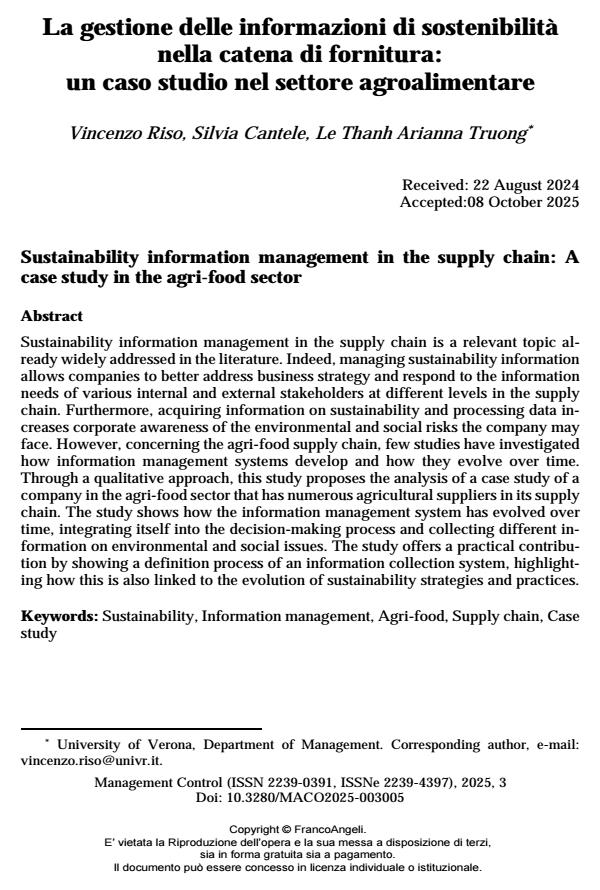
Sustainability information management in the supply chain is a relevant topic already widely addressed in the literature. Indeed, managing sustainability information allows companies to better address business strategy and respond to the information needs of various internal and external stakeholders at different levels in the supply chain. Furthermore, acquiring information on sustainability and processing data increases corporate awareness of the environmental and social risks the company may face. However, concerning the agri-food supply chain, few studies have investigated how information management systems develop and how they evolve over time. Through a qualitative approach, this study proposes the analysis of a case study of a company in the agri-food sector that has numerous agricultural suppliers in its supply chain. The study shows how the information management system has evolved over time, integrating itself into the decision-making process and collecting different information on environmental and social issues. The study offers a practical contribution by showing a definition process of an information collection system, highlighting how this is also linked to the evolution of sustainability strategies and practices.

Parole chiave:Sustainability, Information management, Agri-food, Supply chain, Case study

  1. Arcese G., Fortuna F., Pasca M.G. (2023), The sustainability assessments of the supply chain of agri-food products: the integration of socio-economic metrics, Current Opinion in Green and Sustainable Chemistry, 40, 100782.
  2. Ashby A., Leat M., Hudson-Smith M. (2012), Making connections: a review of supply chain management and sustainability literature, Supply chain management: an international journal, 17(5), pp. 497-516. DOI: 10.1108/13598541211258573
  3. Astill J., Dara R.A., Campbell M., Farber J.M., Fraser E.D., Sharif S., Yada R.Y. (2019), Transparency in food supply chains: A review of enabling technology solutions, Trends in Food Science & Technology, 91, pp. 240-247.
  4. Barrett C.B., Reardon T., Swinnen J., Zilberman D. (2022), Agri-food value chain revolutions in low-and middle-income countries, Journal of Economic Literature, 60(4), pp. 1316-1377.
  5. Bastian J., Zentes J. (2013), Supply chain transparency as a key prerequisite for sustainable agri-food supply chain management, The International Review of Retail, Distribution and Consumer Research, 23(5), pp. 553-570. DOI: 10.1080/09593969.2013.834836.
  6. Beske P., Seuring S. (2014), Putting sustainability into supply chain management, Supply Chain Management: an international journal, 19(3), pp. 322-331. DOI: 10.1108/SCM-12-2013-0432
  7. Carter C.R., Liane Easton P. (2011), Sustainable supply chain management: evolution and future directions, International journal of physical distribution & logistics management, 41(1), pp. 46-62. DOI: 10.1108/09600031111101420.
  8. Das A., Bocken N. (2024), Regenerative business strategies: A database and typology to inspire business experimentation towards sustainability, Sustainable Production and Consumption, 49, pp. 529-544.
  9. Davila T. (2000), An empirical study on the drivers of management control systems’ design in new product development, Accounting, organizations and society, 25(4-5), pp. 383-409. DOI: 10.1016/S0361-3682(99)00034-3
  10. de Mattos C.A., Barbin Laurindo F.J. (2015), Collaborative platforms for supply chain integration: trajectory, assimilation of platforms and results, Journal of technology management & innovation, 10(2), pp. 79-92. DOI: 10.4067/S0718-2724201500020000
  11. Gioia D.A., Corley K.G., Hamilton A.L. (2013), Seeking qualitative rigor in inductive research: Notes on the Gioia methodology, Organizational Research Methods, 16(1), pp. 15-31. DOI: 10.1177/1094428112452151
  12. Hofmann F., Jaeger-Erben M. (2020), Organizational transition management of circular business model innovations, Business strategy and the environment, 29(6), pp. 2770-2788.
  13. Iakovou E., Bochtis D., Vlachos D., Aidonis D. (2015), Sustainable agrifood supply chain management, Supply chain management for sustainable food networks, pp. 1-39.
  14. Joshi S., Singh R.K., Sharma M. (2023), Sustainable agri-food supply chain practices: Few empirical evidences from a developing economy, Global Business Review, 24(3), pp. 451-474. DOI: 10.1177/0972150920907014
  15. Konietzko J., Das A., Bocken N. (2023), Towards regenerative business models: A necessary shift?, Sustainable Production and Consumption, 38, pp. 372-388.
  16. Kunz N., Chesney T., Trautrims A., Gold S. (2023), Adoption and transferability of joint interventions to fight modern slavery in food supply chains, International Journal of Production Economics, 258, 108809.
  17. Maloni M.J., Brown M.E. (2006), Corporate social responsibility in the supply chain: an application in the food industry, Journal of business ethics, 68, pp. 35-52.
  18. Mangla S.K., Luthra S., Rich N., Kumar D., Rana N.P., Dwivedi Y.K. (2018), Enablers to implement sustainable initiatives in agri-food supply chains, International Journal of Production Economics, 203, pp. 379-393.
  19. McDougall N., Wagner B., MacBryde J. (2016), Exploring dynamic natural-resource-based capabilities for sustainable agri-food chains, In: Sustainable Design and Manufacturing 2016 (pp. 455-465), Springer International Publishing. DOI: 10.1007/978-3-319-32098-4_39
  20. Meemken E.M., Barrett C.B., Michelson H.C., Qaim M., Reardon T., Sellare J. (2021), Sustainability standards in global agrifood supply chains, Nature Food, 2(10), pp. 758-765.
  21. Menon S., Jain K. (2021), Blockchain technology for transparency in agri-food supply chain: Use cases, limitations, and future directions, IEEE Transactions on Engineering Management, 71, pp. 106-120. DOI: 10.1109/TEM.2021.3110903
  22. Miranda B.V., Monteiro G.F.A., Rodrigues V. P. (2021), Circular agri-food systems: A governance perspective for the analysis of sustainable agri-food value chains, Technological Forecasting and Social Change, 170, 120878.
  23. Montresor S., Vezzani A. (2023), Digital technologies and eco-innovation. Evidence of the twin transition from Italian firms, Industry and Innovation, 30(7), pp. 766-800. DOI: 10.1080/13662716.2023.2213179
  24. Myshko A., Checchinato F., Colapinto C., Finotto V., Mauracher C. (2024), Towards twin transition in the agri-food sector? Framing the current debate on sustainability and digitalisation, Journal of Cleaner Production, 142063.
  25. O'Dwyer B., Unerman J. (2020), Shifting the focus of sustainability accounting from impacts to risks and dependencies: Researching the transformative potential of TCFD reporting, Accounting, Auditing & Accountability Journal, 33(5), pp. 1113-1141. DOI: 10.1108/AAAJ-02-2020-4445
  26. Pérez-Mesa J.C., Piedra-Muñoz L., Galdeano-Gómez E., Giagnocavo C. (2021), Management strategies and collaborative relationships for sustainability in the agrifood supply chain, Sustainability, 13(2), 749.
  27. Pramatari K. (2007), Collaborative supply chain practices and evolving technological approaches, Supply chain management: an International Journal, 12(3), pp. 210-220. DOI: 10.1108/13598540710742527
  28. Raynolds L.T. (2014), Fairtrade, certification, and labor: global and local tensions in improving conditions for agricultural workers, Agriculture and human values, 31, pp. 499-511.
  29. Rajeev A., Pati R.K., Padhi S.S., Govindan K. (2017), Evolution of sustainability in supply chain management: A literature review, Journal of cleaner production, 162, pp. 299-314.
  30. Rueda X., Garrett R.D., Lambin E.F. (2017), Corporate investments in supply chain sustainability: Selecting instruments in the agri-food industry, Journal of cleaner production, 142, pp. 2480-2492.
  31. Schaltegger S., Burritt R. (2014), Measuring and managing sustainability performance of supply chains: Review and sustainability supply chain management framework, Supply Chain Management: An International Journal, 19(3), pp. 232-241. DOI: 10.1108/SCM-02-2014-0061
  32. Schaltegger S., Hansen E.G., Lüdeke-Freund F. (2016), Business models for sustainability: Origins, present research, and future avenues, Organization & environment, 29(1), pp. 3-10. DOI: 10.1177/1086026615599806
  33. Seuring S., Müller M. (2008), From a literature review to a conceptual framework for sustainable supply chain management, Journal of cleaner production, 16(15), pp. 1699-1710.
  34. Wongprawmas R., Canavari M., Waisarayutt C. (2015), A multi-stakeholder perspective on the adoption of good agricultural practices in the Thai fresh produce industry, British Food Journal, 117(9), pp. 2234-2249. DOI: 10.1108/BFJ-08-2014-0300
  35. Yin R.K. (2012), Case study methods. In APA handbook of research methods in psychology: Research designs: Quantitative, qualitative, neuropsychological, and biological 2, pp. 141–155. Springer. DOI: 10.1037/13620-009
  36. Zhao G., Liu S., Lopez C., Chen H., Lu H., Mangla S.K., Elgueta S. (2020), Risk analysis of the agri-food supply chain: A multi-method approach, International Journal of Production Research, 58(16), pp. 4851-4876. DOI: 10.1080/00207543.2020.1725684

Vincenzo Riso, Silvia Cantele, Le Thanh Arianna Truong, La gestione delle informazioni di sostenibilità nella catena di fornitura: un caso studio nel settore agroalimentare in "MANAGEMENT CONTROL" 3/2025, pp 89-109, DOI: 10.3280/MACO2025-003005