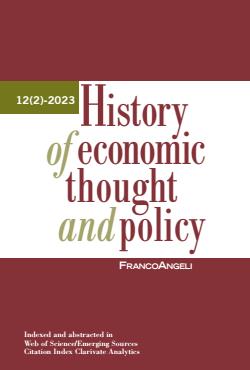
HISTORY OF ECONOMIC THOUGHT AND POLICY

HISTORY OF ECONOMIC THOUGHT AND POLICY

2 fascicoli all'anno, ISSN 2240-9971 , ISSNe 2280-188X

Prezzo fascicolo (inclusi arretrati): € 78,50

Prezzo fascicolo e-book (inclusi arretrati): € 67,50

La rivista pubblica anche in Online First

Canoni 2026

Biblioteche, Enti, Società

Atenei

Riviste online (con arretrati, accesso perpetuo, formula plus)

Abbonamento Privati

History of Economic Thought and Policy is a new professional journal that continues the tradition established by the "newsletter of the history of economic thought" which was founded in Florence (Italy) in 1972 by Piero Barucci, Francesca Duchini and Umberto Meoli. In 2004 the newsletter began a "new series" of biannual issues, published by FrancoAngeli, which ceased publication in 2010.
History of Economic Thought and Policy accepts original papers across the full spectrum of scientific approaches within the history of economic thought. However, HETP has a special interest in analyzing the relationship between economic theories and public policy in different historical phases and national contexts. It is interested in exploring the role played by economists in advising and implementing policy measures and in taking active part in the life of major institutions, both economic or non-economic. On occasion, HETP may accept to publish monographic issues or launch a "call for papers" on specific topics. It will also be open to the publication of archival sources of major importance regarding the role of economists in policy decisions or debates.

History of Economic Thought and Policy is meant to be accessible to readers from a great variety of intellectual backgrounds: historians of economic thought, economists, economic historians, as well as social scientists.
History of Economic Thought and Policy is structured into four main sections: a) Essays; b) Short articles - Economist’s Archive - Review Articles; c) Book reviews; d) Features.
History of Economic Thought and Policy is a peer-reviewed journal: once a paper passed a preliminary screening by the editors, external referees will be invited to submit reports in line with internationally accepted best practices. The editors will try to select referees who will provide timely, impartial and informative reports. The list of referees as well as other relevant information on the editorial policy (rejection rates, average time of acceptance and publication of articles etc.) will be published regularly.
Although founded and edited in Italy, History of Economic Thought and Policy has an international vocation. All essays are published in English, with contributors from all over the world.

A 15% discount is available for Aispe, Eshet and Storep members.

Editor
Fabio Masini (University of Roma Tre)

Editor-in-chief
Stefano Solari (University of Padua)

Founding editors
Piero Bini (University of Florence); Pier Francesco Asso (University of Palermo)

Editorial board
Michele Alacevich (University of Bologna); Katia Caldari (University of Padua); Carlo Cristiano (University of Pisa); Antonio Magliulo (University of Florence); Giovanni Michelagnoli (Independent researcher); Manuela Mosca (University of Salento); Albertina Nania (Roma 3 University); Sebastiano Nerozzi (Catholic University, Milan); Daniela Parisi (Catholic University, Milan); Monika Poettinger (University of Milan, Bocconi); Antonella Rancan (University of Molise); Luca Sandonà (Independent researcher); Claudia Sunna (University of Salento); Gianfranco Tusset (University of Padua)

Advisory board
Massimo Augello (University of Pisa); Roger Backhouse (University of Birmingham); Bradley Bateman (Randolph College); Daniele Besomi (Independent researcher); Fabrizio Bienintesi (University of Pisa); Annie Cot (University of Paris I, Sorbonne); Marco Dardi (University of Florence); Alfredo Gigliobianco (Bank of Italy); Gabriella Gioli (University of Florence); Harald Hagemann (University of Hohenheim); Wade Hands (University of Puget Sound); Robert Leeson (Stanford University); Ivo Maes (Catholic University of Leuven); M. Cristina Marcuzzo (University of Rome, La Sapienza); Michael McLure (University of Western Australia); Steven Medema (Duke University); Tamotsu Nishizawa (Teikyo University, Tokyo); Jean-Pierre Potier (University of Lyon 2); Malcolm Rutherford (University of Victoria); Richard Whatmore (University of Sussex)

Redazione
Fabio Masini
Via Reims, 6
50126 Firenze
Email: fabio.masini@uniroma3.it

Norme Redazionali
Accordo per la pubblicazione di un articolo

Article Processing Charges & Fees

La pubblicazione dei singoli articoli non è vincolata al pagamento di alcun contributo.

Gli articoli riguardanti persone fisiche o contenenti informazioni personali che rendano identificabile un soggetto devono essere conformi agli standard internazionali stabiliti dalla Dichiarazione di Helsinki, sviluppata dalla World Medical Association (WMA) e aggiornata nel 2013.

Per maggiori informazioni sulla condotta etica della rivista, si rimanda al documento di seguito riportato:
Codice Etico

FrancoAngeli è consapevole dell’importanza - per accrescere visibilità e impatto delle proprie pubblicazioni - di assicurare la conservazione nel tempo dei contenuti digitali. A tal fine siamo membri delle due associazioni internazionali di editori e biblioteche - Clockss e Portico - nate per garantire la conservazione delle pubblicazioni accademiche elettroniche e l’accesso futuro nel caso in cui venissero a mancare le condizioni per accedere al contenuto tramite altre forme.

Sono repository certificati che offrono agli autori e alle biblioteche anche la garanzia dell’aggiornamento tecnologico e di formati per permettere di fruire in perpetuo e nel modo più completo possibile dei full text.

Per saperne di più: Home - CLOCKSS ; Publishers – Portico.

ANVUR. Scientific journal for the competition areas:
• Area 13 – Scienze economiche e statistiche;
• Area 14 – Scienze politiche e sociali.

Scimago chart and data

SCImago Journal & Country Rank

La diffusione della rivista mira a valorizzarne l’impatto presso la comunità accademica.

Fascicolo 1/2026

Essays

Features

Obituary

Book review