E-Methods e rapporto intervistato/intervistatore
Titolo Rivista SALUTE E SOCIETÀ
Autori/Curatori Alessio Valastro, Costantino Cipolla, Mauro Niero, Charlie Barnao, Adriano Passerini
Anno di pubblicazione 2014 Fascicolo 2014/3
Lingua Italiano Numero pagine 12 P. 91-102 Dimensione file 513 KB
DOI 10.3280/SES2014-003007
Il DOI è il codice a barre della proprietà intellettuale: per saperne di più
clicca qui
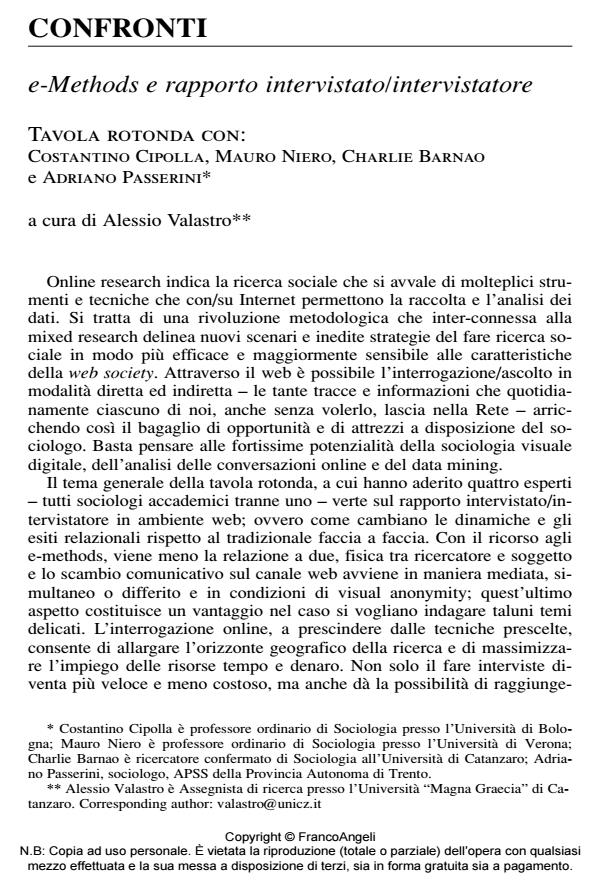
Qui sotto puoi vedere in anteprima la prima pagina di questo articolo.
Se questo articolo ti interessa, lo puoi acquistare (e scaricare in formato pdf) seguendo le facili indicazioni per acquistare il download credit. Acquista Download Credits per scaricare questo Articolo in formato PDF
FrancoAngeli è membro della Publishers International Linking Association, Inc (PILA), associazione indipendente e non profit per facilitare (attraverso i servizi tecnologici implementati da CrossRef.org) l’accesso degli studiosi ai contenuti digitali nelle pubblicazioni professionali e scientifiche.
- Barnao C. (2013). Nightclub e prostituzione. Tra conservazione e sperimentazione culturale. Etnografia e ricerca qualitativa, 3: 385-406, DOI: 10.3240/75031CipollaC.(2014).Oltreil“peccatooriginale”dellaselezionenaturale.Alcuneproposteteorichenellasocietàdigitale.Milano:FrancoAngel
- Cipolla C. (2013). Perché non possiamo non essere eclettici. Il sapere sociale nella web society. Milano: FrancoAngeli
- Cipolla C., de Lillo A. e Ruspini E., a cura di (2012). Il sociologo, le sirene e gli avatar. Milano: FrancoAngeli
- Cipriani R., Cipolla C. e Losacco G., a cura di (2013). La ricerca qualitativa fra tecniche tradizionali ed e-methods. Milano: FrancoAngeli
- Corposanto C., a cura di (2004). Metodologia e tecniche non intrusive nella ricerca sociale. Milano: FrancoAngeli
- Corposanto C., Valastro A., a cura di (2014). Blog, Fb & Tw. Fare ricerca qualiquantitativa online. Milano: Giuffrè
- Di Fraia G., a cura di (2004). e-Research. Internet per la ricerca sociale e di mercato. Bari-Roma: Laterza
- Dillman D.A. (2007). Mail and Internet surveys. The tailored design method. New Jersey: John Wiley & Sons
- Fielding N., Lee R.M. and Blank G., a cura di (2008). The Sage Handbook of Online Research Methods. London: Sage
- Hewson C., Yule P., Laurent D., Vogel C. (2003). Internet Research Methods. A Practical Guide for the Social and Behavioural Sciences. London: Sage Hine C. (2005). Virtual Methods: Issues in social research on the Internet. Oxford: Berg
- Hooley T., Marriott J., Wellens J. (2012). What is Online Research?. London: Bloomsbury Academic
- Johns M.D., Chen S.L. and Hall G.J., a cura di (2004). Online Social Research: Methods, Issues & Ethics. New York: Peter Lang
- Lee R.M., a cura di (2000). Unobtrusive Methods in Social Research. Philadelphia: Open University Press
- Lozar Manfreda K., Bosnjak M., Berzelak J., Haas I., Vehovar V. (2008). Web surveys vs other survey modes: a meta-analysis comparing response rates. International Journal of Market Research, 50: 79-104, DOI: 10.2501/S147078530820025
- Niero M. (2008). Il mix fra qualità e quantità nella ricerca sociale. Lo studio dei casi e altre proposte applicative. Verona: QuiEdit
- Rogers R. (2009). The end of the virtual: digital methods. Amsterdam: Vossiuspers UvA
- Savage M., Burrows R. (2007). The coming crisis of empirical sociology. Sociology, 41: 885-899. DOI: 10.1177/003803850708044
- Serres M. (2013). Non è un mondo per vecchi. Perché i ragazzi rivoluzionano il sapere. Torino: Bollati Boringhieri
- Sheehan K.B. (2002). Online Research Methodology: Reflections and Speculations. Journal of Interactive Advertising, 3: 1-6, DOI: 10.1080/15252019.2002.1072206
Alessio Valastro, Costantino Cipolla, Mauro Niero, Charlie Barnao, Adriano Passerini, E-Methods e rapporto intervistato/intervistatore in "SALUTE E SOCIETÀ" 3/2014, pp 91-102, DOI: 10.3280/SES2014-003007