Il fenomeno del Dating Aggression: aspetti evolutivi e contestuali
Titolo Rivista MALTRATTAMENTO E ABUSO ALL’INFANZIA
Autori/Curatori Annalaura Nocentini
Anno di pubblicazione 2014 Fascicolo 2014/3
Lingua Italiano Numero pagine 15 P. 13-27 Dimensione file 100 KB
DOI 10.3280/MAL2014-003002
Il DOI è il codice a barre della proprietà intellettuale: per saperne di più
clicca qui
Qui sotto puoi vedere in anteprima la prima pagina di questo articolo.
Se questo articolo ti interessa, lo puoi acquistare (e scaricare in formato pdf) seguendo le facili indicazioni per acquistare il download credit. Acquista Download Credits per scaricare questo Articolo in formato PDF
FrancoAngeli è membro della Publishers International Linking Association, Inc (PILA), associazione indipendente e non profit per facilitare (attraverso i servizi tecnologici implementati da CrossRef.org) l’accesso degli studiosi ai contenuti digitali nelle pubblicazioni professionali e scientifiche.
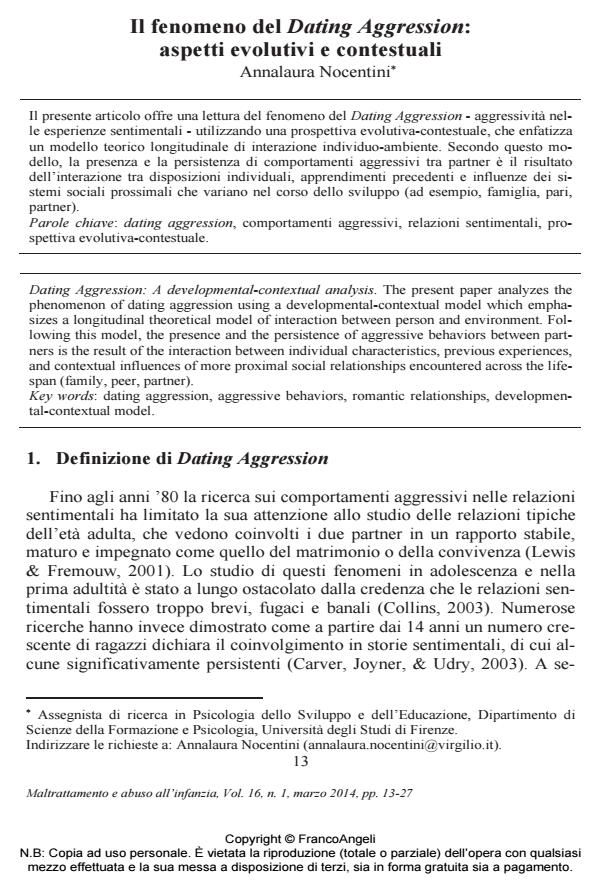
Il presente articolo offre una lettura del fenomeno del Dating Aggression - aggressività nelle esperienze sentimentali - utilizzando una prospettiva evolutiva-contestuale, che enfatizza un modello teorico longitudinale di interazione individuo-ambiente. Secondo questo modello, la presenza e la persistenza di comportamenti aggressivi tra partner è il risultato dell’interazione tra disposizioni individuali, apprendimenti precedenti e influenze dei sistemi sociali prossimali che variano nel corso dello sviluppo (ad esempio, famiglia, pari, partner).
Parole chiave:Dating aggression, comportamenti aggressivi, relazioni sentimentali, prospettiva evolutiva-contestuale.
- Menesini, E., Nocentini, A., & Calussi, P. (2011). Valori, comportamenti e relazioni sociali in adolescenza. In G. V.Caprara, E. Scabini & P. Steca (Eds.). I
- valori nell’Italia contemporanea (pp. 116-133). Milano: FrancoAngeli. Menesini, E., Nocentini, A., Ortega-Rivera, F. J, Sánchez, V., & Ortega, R. (2011).
- Reciprocal involvement in adolescent Dating Aggression: An Italian-Spanish study. European Journal of Developmental Psychology, 8, 4, 437-451, DOI: 10.1080/17405629.2010.549011
- Moffitt, T. E., & Caspi, A. (1998). Violence between intimate partners: Implications for child psychologists and psychiatrists. Journal of Child Psychology & Psychiatry, 39, 137-144, DOI: 10.1111/1469-7610.00308
- Moffitt, T. E., Caspi, A., Rutter, M., & Silva, P.A. (2002). Sex differences in antisocial behaviour: conduct disorder, delinquency and violence in the Dunedin Longitudinal Study. Cambridge, UK: Cambridge University Press, DOI: 10.1017/s0033291702216670
- Nocentini, A., Menesini, E., & Pastorelli, C. (2010). Physical Dating Aggression Growth during adolescence. Journal of Abnormal Child Psychology, 38, 3, 353-365, DOI: 10.1007/s10802-009-9371-8
- Nocentini, A., Menesini, E., Pastorelli, C., Connolly, J., Pepler, D., & Craig, W. (2011). Physical Dating Aggression in adolescence: Cultural and gender invariance. European Psychologist, 16, 4, 278-287, DOI: 10.1027/1016-9040/a000045
- Nocentini, A., Pastorelli, C., & Menesini, E. (2013). Self-efficacy in anger management and dating aggression in italian young adults. International Journal of Conflict and Violence, 7, 2, 274-285 (disponibile online: http://www.ijcv.org/index.php/ijcv/article/view/306/pdf_91).
- O’Keefe, M. (2005). Teen dating violence: A review of risk factors and prevention efforts. Harrisburg, PA: National Resource Center on Domestic Violence.
- O’Leary, K. D. (1999). Developmental and affective issues in assessing and treating partner aggression. Clinical Psychology: Science and Practice, 6, 400-414, DOI: 10.1093/clipsy.6.4.400
- Orpinas, P., Hsieh, H. L., Song, X., Holland, K., & Nahapetyan, L. (2013). Trajectories of physical dating violence from middle to high school: Association with relationship quality and acceptability of aggression. Journal of Youth & Adolescence, 42, 4, 551-565, DOI: 10.1007/s10964-012-9881-5
- Patterson, G. R., Forgatch, M. S., Yoerger, K. L., & Stoolmiller, M. (1998). Variables that initiate and maintain an early-onset trajectory for juvenile offending. Development and Psychopathology, 10, 531-547, DOI: 10.1017/s0954579498001734
- Poitras, M., & Lavoie, F. (1995). A study of the prevalence of sexual coercion in adolescent heterosexual dating relationships in a Quebec sample. Violence and Victims, 10, 299-313.
- Seiffge-Krenke, I., & Connolly, J. (2010). Adolescent romantic relationships across the globe: Involvement, conflict management, and linkages to parents and peer relationships. International Journal of Behavioral Development, 34, 97, DOI: 10.1177/0165025409360289.Silverman,J.G.,Raj,A.,Mucci,L.A.,&Hathaway,J.E.(2001).Datingviolenceagainstadolescentgirlsandassociatedsubstanceuse,unhealthyweightcontrol,sexualriskbehavior,pregnancy,andsuicidality.JournaloftheAmericanMedicalAssociation,286,372-379,doi:10.1001/jama.286.5.572
- Simonelli, C. J., Mullis, T., Elliott, A. N., & Pierce, T. W. (2002). Abuse by siblings and subsequent experiences of violence within the dating relationship. Journal of Interpersonal Violence, 17, 103-121, DOI: 10.1177/0886260502017002001
- Straus, M. A. (1979). Measuring intrafamily conflict and violence: The Conflict mTactics (CT) Scales. Journal of Marriage and the Family, 41, 75-88, DOI: 10.2307/351733
- Archer, J. (2000). Sex differences in aggression between heterosexual partners: A meta-analytic review. Psychological Bulletin, 126, 651-680,
- Bonechi, A., & Tani, F. (2011). Italian adaptation of the multidimensional measure of emotional abuse (MMEA). TPM -Testing, Psychometrics, Methodology in Applied Psychology, 18, 2, 65-86.
- Bouchey, H. A., & Furman, W. (2003). Dating and romantic experiences in adolescence. In G. R. Adams & M. Berzonsky (Eds.), The Blackwell Handbook of Adolescence (pp. 313-329). Oxford, UK: Blackwell Publishers, DOI: 10.1002/9780470756607.ch15.Brendgen,M.,Vitaro,F.,Tremblay,R.E.,&Wanner,B.(2002).Parentandpeereffectsondelinquency-relatedviolenceanddatingviolence:Atestoftwomediationalmodels.SocialDevelopment,11,2,225-244,doi:10.1111/1467-9507.00196
- Capaldi, D. M., & Crosby, L. (1997). Observed and reported psychological and physical aggression in young, at-risk couples. Social Development, 6, 2, 184-206, DOI: 10.1111/j.1467-9507.1997.tb00101.x
- Capaldi, D. M., & Gorman-Smith, D. (2003). The development of aggression in young male/female couples. In P. Florsheim (Ed.), Adolescent romantic relations and sexual behavior: Theory, research, and practical implications (pp. 243-278). Mahwah, NJ: Lawrence Erlbaum Associates, DOI: 10.1016/s0140-1971(04)00026-0
- Capaldi, D. M., Kim, H. K., & Shortt, J. W. (2004). Women’s involvement in aggression in young adult romantic relationships: A developmental systems model.
- Furman, W., & Shaffer, L. (2003). The role of romantic relationships in adolescent development. In P. Florsheim (Ed.), Adolescent romantic relations and sexual behavior: Theory, research, and practical implications (pp. 3-22). Mahwah, NJ: Lawrence Erlbaum Associates, DOI: 10.4324/9781410607782
- Gray, H. M., & Foshee, V. (1997). Adolescent dating violence. Journal of Interpersonal Violence, 12, 126-142, DOI: 10.1177/088626097012001008
- Hendy, H. M., Weiner, K., Bakerofskie, J., Eggen, D., Gustitus, C., & McLeod, K. C. (2003). Comparison of six models for violent romantic relationships in college men and women. Journal of Interpersonal Violence, 18, 645-665, DOI: 10.1177/0886260503251180
- Hird, M. J. (2000). An empirical study of adolescent dating aggression in the UK. Journal of Adolescence, 23, 69-78, DOI: 10.1006/jado.1999.0292
- Jackson, S. M. (1999). Issues in the dating violence research: A review of the literature. Aggression and Violent Behavior, 4, 2, 233-247, DOI: 10.1016/s1359-1789(97)00049-9.Jackson,S.M.,Cram,F.,&Seymour,F.W.(2000).Violenceandsexualcoercioninhighschoolstudents’datingrelationships.JournalofFamilyViolence,15,23-36,doi:10.1023/a:1007545302987
- Kim, H. K., Laurent, H. K., Capaldi, D. M., & Feingold, A. (2008). Men’s aggression toward women: A 10-year panel study. Journal of Marriage and Family, 70, 1169-1187, DOI: 10.1111/j.1741-3737.2008.00558.x
- Lewis, S., & Fremouw, W. J. (2001). Dating violence: A critical review of the literature. Clinical Psychology Review, 21, 105-127, DOI: 10.1016/s0272-7358(99)00042-2
- Linder, J. R., Crick, N. R. & Collins, W. A. (2002). Relational aggression and victimization in young adult’s romantic relationships: Associations with perceptions of parent, peer, and romantic relationship quality. Social Development, 11, 69-86, DOI: 10.1111/1467-9507.00187
- Luthra, R., & Gidycz, C. A. (2006). Dating violence among college men and women: Evaluation of a theoretical model. Journal of Interpersonal Violence, 21, 717-731, DOI: 10.1177/0886260506287312
- Malik, S., Sorenson, S. B., & Aneshensel, C. S. (1997). Community and dating violence among adolescents: Perpetration and victimization. Journal of Adolescent Health, 21, 291-302, DOI: 10.1016/s1054-139x(97)00143-2
- McHugh, M. C. (2005). Understanding gender and intimate partner abuse. Sex Roles, 52, 11/12, 717-724, DOI: 10.1007/s11199-005-4194-8
- McHugh, M. C., & Bartoszek, T. A. (2002). Intimate violence. In M. Biaggio & M. Hersen (Eds.), Issues in the psychology of women (pp. 115-142), New York: Plenum, DOI: 10.1007/0-306-47185-x_7
- McHugh, M. C., Livingston, N. A., & Ford, A. (2005). A postmodern approach to women’s use of violence: Developing multiple and complex conceptualizations. Psychology of Women Quarterly, 29, 323-336, DOI: 10.1111/j.1471-6402.2005.00226.x
- McLaughlin, I. G., Leonard, K. E., & Senchak, M. (1992). Prevalence and distribution of premarital aggression among couples applying for a marriage license. Journal of Family Violence, 7, 309-319, DOI: 10.1007/bf00994621
- Menesini, E., & Nocentini, A. (2007). Bulli da grandi. Amore, sessualità e violenza tra gli adolescenti. Minori Giustizia, 4, 176-181.
- Menesini, E., & Nocentini, A. (2008). Comportamenti aggressivi nelle prime esperienze sentimentali in adolescenza. Giornale Italiano di Psicologia, 2, 405-430, DOI: 10.1421/27217
- Menesini, E., & Nocentini, A. (2009). Comportamenti aggressivi nel gruppo dei pari e nelle relazioni sentimentali: quali continuità? Psicologia Clinica dello Sviluppo, 1, 65-81, DOI: 10.1449/29220
- Straus, M. A., & Gelles, R. J. (1986). Societal change and change in family violence from 1975 to 1985 as revealed by two national surveys. Journal of Marriage and the Family, 48, 465-479, DOI: 10.2307/352033
- Straus, M. A., & Gelles, R. J. (1990). Physical violence in American families: Risk factors and adaptations to violence in 8.145 families. New Brunswick, NJ: Transaction, DOI: 10.2307/584883
- Swart, L., Seedat, M., Stevens, G., & Ricardo, I. (2002). Violence in adolescents’ romantic relationships: Findings from a survey amongst school-going youth in a South African community. Journal of Adolescence, 25, 4, 385-395, DOI: 10.1006/jado.2002.0483
- Walker, L. E. (1989). Psychology and violence against women. American Psychologist, 44, 695-702, DOI: 10.1037//0003-066x.44.4.695
- Wekerle, C., & Wolfe, D. A. (1999). Dating violence in mid-adolescence: Theory, significance, and emerging prevention initiatives. Clinical Psychology Review, 19, 435-456, DOI: 10.1016/s0272-7358(98)00091-9
- Wekerle, C., & Avgoustis, E. (2003). Child maltreatment, adolescent dating, and adolescent dating violence. In P. Florsheim (Ed.), Adolescent romantic relations and sexual behavior: Theory, research and practical implications (pp. 213-241). Hillsdale, NJ: Erlbaum.
- Wolf, K. A., & Foshee, V. A. (2003). Family violence, anger expression styles, and adolescent dating violence. Journal of Family Violence, 18, 6, 309-316. DOI: 10.1023/a:1026237914406
- Wolfe, D. A., Scott, K., & Crooks, C. V (2005). Dating and relationship violence among adolescent girls. In D. Bell-Dolan, E. J. Mash & S. Foster (Eds.). Handbook of emotional and behavioral problems in girls (pp. 381-414). New York: Kluwer Academic.
- Wood, M. D., & Sher, K. J. (2002). Sexual assault and relationship violence among college students: Examining the role of alcohol and other drugs. In C. Wekerle & A-M. Wall (Eds.), The violence and addiction equation: Theoretical and clinical issues in substance abuse and relationship violence (pp. 169-193).
- Philadelphia, PA: Bunner/Mazel, DOI: 10.4324/9780203306895.Zimmer-Gembeck,M.J.,&Petherick,J.(2006).Dating,relationshipsatisfaction,andthelifetasksofidentityandintimacyduringadolescenceandemergingadulthood,InternationalJournalofBehavioralDevelopment,30,189-199,doi:10.1177/016502540606363
- In M. Putallez & K. L. Bierman (Ed.), Aggression, antisocial behavior, and violence among girls: A developmental perspective (pp. 223-241). New York: Guilford Press.
- Capaldi, D. M., Shortt, J. W., & Kim, H. K. (2005). A life span developmental systems perspective on aggression toward a partner. In W. M. Pinsof & J. Lebow (Eds.), Family psychology: The art of the science (pp. 141-167). New York: Oxford University Press, DOI: 10.1037/e522022006-014
- Capaldi, D. M., & Patterson, G. R. (1994). Interrelated influences of contextual factors on antisocial behavior in childhood and adolescence for males. In D. Fowles, P. Sutker, & S. H. Goodman (Eds.), Experimental personality and psychopathy research (pp. 165-198). New York: Springer.
- Carver, K., Joyner, K., & Udry, J. R. (2003). National estimates of adolescent romantic relationships. In P. Florsheim (Ed.), Adolescent romantic relations and sexual behavior: Theory, research, and practical implications (pp. 23-56).
- Mahwah, NJ: Lawrence Erlbaum Associates, DOI: 10.4324/9781410607782.Chase,K.A.,Treboux,D.,O’Leary,K.D.,&Strassberg,Z.(1998).Specificityofdatingaggressionanditsjustificationamonghigh-riskadolescents.JournalofAbnormalChildPsychology,26,6,467-473,doi:10.1023/a:1022651818834
- Collins, A. W. (2003). More than myth: The developmental significance of romantic relationships during adolescence, Journal of Research on Adolescence, 13, 1, 1-24, DOI: 10.1111/1532-7795.1301001
- Connolly, J. A., Pepler, D., Craig, W., & Taradash, A. (2000). Dating experiences of bullies in early adolescence. Child Maltreatment: Journal of the American Professional Society on the Abuse of Children, 5, 299-311, DOI: 10.1177/1077559500005004002
- Connolly, J. A., Nocentini, A., Menesini, E., Pepler, D., Craig, W., & Williams, T., (2010). Adolescent Dating Aggression in Canada and Italy: A cross-national
- comparison. International Journal of Behavioral Development, 34, 2, 98-105, DOI: 10.1177/0165025409360291.Dobash,R.E.,&Dobash,R.P.(1992).Women,violenceandsocialchange.LondonandNewYork:Routledge,doi:10.4324/9780203450734
- Draucker, C. B., & Martsolf, D. S. M. (2010). The role of electronic communication technology in adolescent dating violence, Journal of Child and Adolescent Psychiatric Nursing, 23, 3, 133-142, DOI: 10.1111/j.1744-6171.2010.00235.x
- Ely, G., Dulmus, C. N., & Wodarski, J. S. (2002). Adolescent dating violence. In L. A. Rapp-Paglicci & J. S. Wodarski (Eds.), Handbook of violence (pp. 34-49). New York: John Wiley & Sons.
- Feld, S. L., & Straus, M. A. (1989). Escalation and desistance of wife assault in marriage. Criminology, 27, 1, 141-161, DOI: 10.1111/j.1745-9125.1989.tb00866.x
- Foshee, V. A., Karriker-Jaffe, K. J., Reyes, H. L. M., Ennett, S. T., Suchindran, C.,
- Bauman, K. E., & Benefield, T. S. (2008).What accounts for demographic differences
- in trajectories of adolescent dating violence? An examination of intrapersonal and contextual mediators. Journal of Adolescent Health, 42, 596-604, DOI: 10.1016/j.jadohealth.2007.11.005
- Foshee, V. A., Benefield, T., Suchindran, C., Ennett, S. T., Bauman, K. E., Karriker-
- Jaffe, K. J., Reyes, H. L. M., & Mathias, J. (2009). The development of four types of adolescent dating abuse and selected demographic correlates. Journal of Research on Adolescence, 19, 3, 380-400, DOI: 10.1111/j.1532-7795.2009.00593.x
- Foshee, V. A., Benefield, T. S., Ennett, S. T., Bauman, K. E., & Suchindran, S. (2004). Longitudinal predictors of serious physical and sexual dating violence victimization during adolescence. Preventive Medicine, 39, 1007-1016, DOI: 10.2105/ajph.94.4.619
- Frieze, I. H. (2000). Violence in close relationships - Development of a research area: Comment on Archer (2000), Psychological Bullettin, 126, 5, 681-684, DOI: 10.1037//0033-2909.126.5.681
- Teen Dating Violence: lo psicologo scolastico alla frontiera tra prevenzione e interventi di presa in carico territoriale ed interistituzionale Roberta Di Pasquale, Andrea Rivolta, Lina Vita Losacco, in PSICOLOGIA DELLA SALUTE 3/2025 pp.29
DOI: 10.3280/PDS2025-003004 - Il minore reo sessuale tra pena e trattamento: una ricerca nell'area milanese Paolo Giulini, Federica de Gregorio, in MALTRATTAMENTO E ABUSO ALL'INFANZIA 3/2017 pp.53
DOI: 10.3280/MAL2016-003004 - Stile genitoriale autoritario, giustificazione della violenza e messa in atto di comportamenti di Dating Aggression Maria Giulia Olivari, Gaia Cuccì, Emanuela Confalonieri, in MALTRATTAMENTO E ABUSO ALL'INFANZIA 3/2017 pp.13
DOI: 10.3280/MAL2017-003002 - Teen dating violence e fattori post-migratori: una disamina della letteratura psicosociale Cristina Giuliani, in MALTRATTAMENTO E ABUSO ALL'INFANZIA 3/2017 pp.31
DOI: 10.3280/MAL2017-003003 - La Dating violence negli adolescenti e nei giovani adulti: fattori di rischio e di protezione nella ricerca in ambito nazionale e internazionale Emanuela Confalonieri, in MALTRATTAMENTO E ABUSO ALL'INFANZIA 3/2017 pp.7
DOI: 10.3280/MAL2017-003001
Annalaura Nocentini, Il fenomeno del Dating Aggression: aspetti evolutivi e contestuali in "MALTRATTAMENTO E ABUSO ALL’INFANZIA" 3/2014, pp 13-27, DOI: 10.3280/MAL2014-003002