Analisti genitori e pazienti bambini? Un’indagine retrospettiva
Titolo Rivista RICERCA PSICOANALITICA
Autori/Curatori Joyce Slochower
Anno di pubblicazione 2015 Fascicolo 2015/1
Lingua Italiano Numero pagine 24 P. 9-32 Dimensione file 127 KB
DOI 10.3280/RPR2015-001002
Il DOI è il codice a barre della proprietà intellettuale: per saperne di più
clicca qui
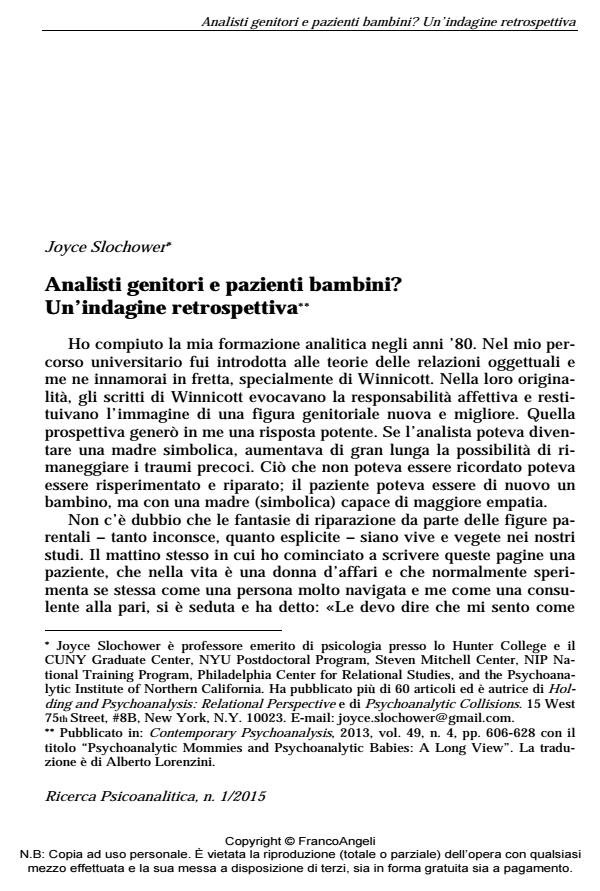
Qui sotto puoi vedere in anteprima la prima pagina di questo articolo.
Se questo articolo ti interessa, lo puoi acquistare (e scaricare in formato pdf) seguendo le facili indicazioni per acquistare il download credit. Acquista Download Credits per scaricare questo Articolo in formato PDF
FrancoAngeli è membro della Publishers International Linking Association, Inc (PILA), associazione indipendente e non profit per facilitare (attraverso i servizi tecnologici implementati da CrossRef.org) l’accesso degli studiosi ai contenuti digitali nelle pubblicazioni professionali e scientifiche.
L’articolo presenta una rassegna retrospettiva dell’uso della metafora dello sviluppo infantile nel pensiero relazionale. Le prime critiche relazionali al modello del deragliamento evolutivo e l’accanimento delle autrici femministe contro il concetto di holding nel lavoro clinico spinsero i relazionali verso una raffigurazione del paziente come necessariamente adulto e del dialogo analitico come intersoggettivo per definizione. Nella mia prospettiva winnicottiana/relazionale ho ampliato il concetto di holding e ho proposto delle mediazioni che rendessero possibile la coesistenza fra holding e pensiero relazionale, esplorando in che modo la partecipazione dell’analista renda possibile l’esperienza dell’holding. Nel passare in rassegna e aggiornare i termini della polemica, l’autrice offre nuove idee sulla funzione clinica dell’holding nel tamponare il senso di vergogna.
Parole chiave:Deragliamento evolutivo, Winnicott, teoria relazionale, holding, intersoggettività, il paziente come bambino
- Davies J. M. (1994). Love in the afternoon: A relational reconsideration of desire and dread in the countertransference. Psychoanalytic Dialogues, 4: 153-170. DOI: 10.1080/10481889409539011.DaviesJ.M.(2004).Whosebadobjectsareweanyway?Repetitionandourelusiveloveaffairwithevil.PsychoanalyticDialogues,14:711-732.doi:10.1080/1048188140-9348802
- Davies J. M., & Frawley M. G. (1994). Treating adult survivor of childhood sexual abuse: A psychoanalytical perspective. New York, NY: Basic Books.
- Dimen M. (1991). Deconstructing difference: Gender splitting and transitional space. Psychoanalytic Dialogues: 1, 335-353. DOI: 10.1080/10481889109538904
- Dinnerstein D. (1976). The mermaid and the minotaur: Sexual arrangements and human malaise. New York, NY: Harper & Row.
- Epstein L. (1987). The problem of the bad-analyst-feeling. Modern Psychoanalysis, 12 (1): 35-45.
- Fast I. (1984). Gender identity: A differentiation model. Hillsdale, NJ: Analytic Press.
- Ferenczi S. (1988). The clinical diary of Sándor Ferenczi. (Ed. J. Dupont; trans. M. Balint & N. Jackson). Cambridge, MA: Harvard University Press. (Originally published 1932.)
- Gerson S. (2009). When the third is dead: Memory, mourning, and witnessing in the aftermath of the Holocaust. International Journal of Psycho-Analysis, 90 (6): 1341-1357. DOI: 10.1111/j.1745-8315.2009.00214.x
- Goldner V. (1991). Toward a critical relational theory of gender. Psychoanalytic Dialogues, 1: 249-272. DOI: 10.1080/10481889109538898
- Grand S. (2000). The reproduction of evil: A clinical and cultural perspective. Hillsdale, NJ: Analytic Press.
- Grand S. (2010). The hero in the mirror: From fear to fortitude. New York, NY: Routledge.
- Greenberg J., & Mitchell S. (1983). Object relations in psychoanalytic theory. Cambridge, MA: Harvard University Press.
- Harris A. (1991). Gender as contradiction. Psychoanalytic Dialogues, 1: 197-224. Doi org/10.1080/10481889109538893.
- Harris A. (1997). Beyond/outside gender dichotomies. Psychoanalytic Dialogues, 7: 363-366. DOI: 10.1080/10481889709539190
- Harris A. (2009). You must remember this. Psychoanalytic Dialogues: 19, 2-21. DOI: 10.1080/10481880802634537
- Harris A., & Botticelli S. (2010). First, do no harm: The paradoxical encounters of psychoanalysis, warmaking, and resistance. New York, NY: Routledge.
- Hesse E., & Main M. (2000) Disorganized infant, child, and adult attachment: Collapse in behavioral and attentional strategies. Journal of American Psychoanalytical Association, 48 (4): 1097-1128. DOI: 10.1177/00030651000480041101
- Hoffman I. Z. (1991). Discussion: Toward a social‑constructivist view of the psychoanalytic situation. Psychoanalytic Dialogues: 1: 74-105. DOI: 10.1080/1048188910953-8886
- Hoffman I. Z. (2008). Forging difference out of similarity: The multiplicity of corrective experience. Psychoanalytic Quarterly, 75: 715-751.
- Hoffman I. Z. (2009). Therapeutic passion in the countertransference. Psychoanalytic Dialogues, 19: 617-637. DOI: 10.1080/10481880903340141
- Kraemer S. (1996). “Betwixt the dark and the daylight” of maternal subjectivity: Meditations on the threshold. Psychoanalytic Dialogues, 6: 765-791. DOI: 10.1080/104-81889609539152
- Laub D. (1992). Bearing witness: Or the vicissitudes of listening. In S. Felman & D. Laub (Eds.), Testimony: Crises of witnessing in literature, psychoanalysis, and history (pp. 57-74). New York, NY: Routledge. Laub D., & Auerhahn N. C. (1993). Knowing and not knowing massive psichi trauma. Forms of traumatic memory. International Journal of Psycho-Analysis, 74 (2): 287-302.
- Ainsworth M. D. S. (1969). Object relations, dependency and attachment: A theoretical overview of the infant-mother relationship. Child Development, 40 (4): 969-1025. DOI: 10.2307/1127008
- Alexander F. (1950). Analysis of the therapeutic factors in psychoanalytic treatment. Psychoanalytic Quarterly, 19 (4): 482-500.
- Bass A. (1996). Holding, holding back, and holding on. Commentary on paper by Joyce Slochower. Psychoanalytic Dialogues, 6 (3): 361-378. DOI: 10.1080/104818896095-39125
- Bassin D. (1997). Beyond the he and she: Postoedipal transcendence of gender polarities. Journal of the American Psychoanalytic Association, 44 (Special Supplement): 157-190.
- Bassin D. (1999). Female sexuality: Contemporary engagements. Northvale, NJ: Jason Aronson.
- Bassin D., Honey, M., & Kaplan, M. M. (Eds.) (1994). Representations of motherhood. New Haven, CT: Yale University Press.
- Beebe B., & Lachmann F. (1994). Representation and internalization in infancy: Three principles of salience. Psychoanalytic Psychology, 11 (2): 127-165. DOI: 10.1037/h0-079530
- Beebe B., Lachmann F., Markese S. & Bahrick L. (2012). On the origins of disorganized attachment and internal working models: Paper 1. A dyadic systems approach. Psychoanalytic Dialogues, 22: 253-272. DOI: 10.1080/10481885.2012.666147
- Benjamin J. (1986). A desire of one’s own: Psychoanalytic feminism and intersubjective space. In: de Lauretis T. (Ed.), Feminist studies/Critical studies (pp. 78-101). Bloomington, IN: Indiana University Press.
- Benjamin J. (1988). The bonds of love: Psychoanalysis, feminism and the problem of domination. New York, NY: Pantheon.
- Benjamin J. (1995). Like subjects, love objects. New Haven, CT: Yale University Press.
- Bion W. R. (1962). Learning from experience London: Heinemann.
- Boulanger G. (2008). Witness to reality: Working psychodynamically with survivors of terror. Psychoanalytic Dialogues, 18: 638-657. DOI: 10.1080/10481880802297673
- Bromberg P. M. (1991). On knowing one’s patient inside out: The aesthetics of unconscious communication. Psychoanalytic Dialogues, 1: 399-422. DOI: 10.1080/10481-889109538911
- Bromberg P. M. (1998). Standing in the spaces. Essays on clinical process, trauma and dissociation. Hillsdale, NJ: Analytic Press.
- Bromberg P. M. (2010). Minding the dissociative gap. Contemporary Psychoanalysis, 46, 19-31. DOI: 10.1080/00107530.2010.10746037
- Chodorow N. (1978). The reproduction of mothering: Psychoanalysis and the sociology of gender. Berkeley & Los Angeles, CA: University of California Press.
- Cooper S. H. (2007). Alexander’s corrective emotional experience: An objectivist turn in psychoanalytic authority and technique. Psychoanalytic Quarterly, 76 (4): 1085-1102. DOI: 10.1002/j.2167-4086.2007.tb00294.x
- Corbett K. (2008). Gender now. Psychoanalytic Dialogues, 18: 838-856. DOI: 10.1080/10481880802473381
- Laub D., & Podell D. (1995). Art and trauma. International Journal of Psycho-Analysis, 76 (5): 995-1005.
- Layton L. (1998). Who’s that girl? Who’s that boy? Clinical practice meets postmodern gender theory. New York, NY: Routledge.
- Mitchell S. (1984). Object relations theories and the developmental tilt. Contemporary Psychoanalysis, 20: 473-499. DOI: 10.1080/00107530.1984.10745749
- Mitchell S. (1988). Relational concepts in psychoanalysis: An integration. Cambridge, MA: Harvard University Press.
- Mitchell S. (1993). Hope and dread in psychoanalysis. New York, NY: Basic Books.
- Mitchell S. (2003). Relationality: From attachment to intersubjectivity. (Relational perspective book series). Hillsdale, NJ: Analytic Press.
- Morrison A (1989). Shame: The underside of narcissism. Hillsdale, NJ: Analytic Press.
- Ogden T. H. (1986). The matrix of the mind: Object relations and the psychoanalytic dialogue. New York, NY: Jason Aronson.
- Ogden T. H. (1989). The primitive edge of experience. New York, NY: Jason Aronson.
- Ogden T. H. (1994). Subjects of analysis. London: Karnac Books.
- Orange D. M. (2008). Whose shame is it anyway? Lifeworlds of humiliation and systems of restoration (or “The analyst’s shame”). Contemporary Psychoanalysis, 44: 83-100. DOI: 10.1080/00107530.2008.10745952
- Pizer S. A. (1998). Building bridges: The negotiation of paradox in psychoanalysis. Hillsdale, NJ: Analytic Press.
- Renik O. (1993). Analytic interaction: Conceptualizing technique in light of the analyst’s irreducible subjectivity. Psychoanalytic Quarterly, 62 (4): 553-571.
- Rosenblum R. (2009). Postponing trauma: The dangers of telling. International Journal of Psycho-Analysis, 90: 1319-1340. DOI: 10.1111/j.1745-8315.2009.00171.x
- Sandler J. (1960) The background of safety. International Journal of Psycho-Analysis, 41 (1): 352-356.
- Seligman S. (2003). The developmental perspective in relational psychoanalysis. Contemporary Psychoanalysis, 39: 477-508. DOI: 10.1080/00107530.2003.10747216
- Slochower J. (1991). Variations in the analytic holding environment. International Journal of Psycho-Analysis, 72 (4): 709-718.
- Slochower J. (1992). A hateful borderline patient and the holding environment. Contemporary Psychoanalysis, 28: 72-88. DOI: 10.1080/00107530.1992.10746738
- Slochower J. (1993). Mourning and the holding function of shiva. Contemporary Psychoanalysis, 30: 135-151. DOI: 10.1080/00107530.1994.10746846
- Slochower J. (1994). The evolution of object usage and the holding environment. Contemporary Psychoanalysis, 30: 135-151. DOI: 10.1080/00107530.1994.10746846
- Slochower J. (1996a). Holding and psychoanalysis: A relational perspective. Hillsdale, NJ: Analytic Press.
- Slochower J. (1996b). Holding and the evolving maternal metaphor. Psychoanalytic Review, 83 (2): 195-218.
- Slochower J. (1996c). The holding environment and the fate of the analyst’s subjectivity. Psychoanalytic Dialogues, 6: 323-353. DOI: 10.1080/10481889609539123
- Slochower J. (1999). Interior experience in analytic process. Psychoanalytic Dialogues, 9: 789-809. DOI: 10.1080/10481889909539362
- Slochower J. (2004). But what do you want? The location of emotional experience. Contemporary Psychoanalysis, 40: 577-602. DOI: 10.1080/00107530.2004.10747245SlochowerJ.(2006).Psychoanalyticcollisions,Hillsdale,NJ:AnalyticPress
- Slochower J. (in press). Holding and psychoanalysis: A relational perspective (2nd ed.). New York, NY: Routledge.
- Spezzano C. (1998). Listening and interpreting: How relational analysts kill time between disclosures and enactments. Comm. on papers by Bromberg and by Greenberg. Psychoanalytic Dialogues, 8: 237-246. DOI: 10.1080/10481889809539245
- Stein R. (1997). Chapter 8: The shame experiences of the analyst. Progress in Self Psychology, 13: 109-123.
- Stern D. (1992). Commentary on constructivism in clinical psychoanalysis. Psychoanalytic Dialogues, 3: 331-364. DOI: 10.1080/10481889209538937
- Stern D. (1997). Unformulated experience: From dissociation to imagination in psychoanalysis. Hillsdale, NJ: Analytic Press.
- Stern D. (2009). Partners in thought: Working with unformulated experience, dissociation, and enactment. New York, NY: Routledge.
- Stern S. (1994). Needed relationships and repeated relationships: An integrated relational perspective. Psychoanalytic Dialogues, 4: 317-346. DOI: 10.1080/10481889409539-020
- Stolorow R. D. (1997). Dynamic, dyadic, intersubjective systems: An evolving paradigm for psychoanalysis. Psychoanalytic Psychology, 14: 337-346. DOI: 10.1037/h0079-729
- Warshaw S. C. (1992). Mutative factors in child psychoanalysis: A comparison of diverse relational perspectives. In: Skolnick N. & Warshaw S. C. (Eds.), Relational perspectives in psychoanalysis (pp. 147-171). Hillsdale, NJ: Analytic Press.
- Winnicott D. W. (1971). Playing and reality. New York, NY: Basic Books.
Joyce Slochower, Analisti genitori e pazienti bambini? Un’indagine retrospettiva in "RICERCA PSICOANALITICA" 1/2015, pp 9-32, DOI: 10.3280/RPR2015-001002