Social innovation e politiche di welfare
Titolo Rivista SALUTE E SOCIETÀ
Autori/Curatori Giovanni Bertin
Anno di pubblicazione 2015 Fascicolo 2015/1
Lingua Italiano Numero pagine 14 P. 37-50 Dimensione file 53 KB
DOI 10.3280/SES2015-001004
Il DOI è il codice a barre della proprietà intellettuale: per saperne di più
clicca qui
Qui sotto puoi vedere in anteprima la prima pagina di questo articolo.
Se questo articolo ti interessa, lo puoi acquistare (e scaricare in formato pdf) seguendo le facili indicazioni per acquistare il download credit. Acquista Download Credits per scaricare questo Articolo in formato PDF
FrancoAngeli è membro della Publishers International Linking Association, Inc (PILA), associazione indipendente e non profit per facilitare (attraverso i servizi tecnologici implementati da CrossRef.org) l’accesso degli studiosi ai contenuti digitali nelle pubblicazioni professionali e scientifiche.
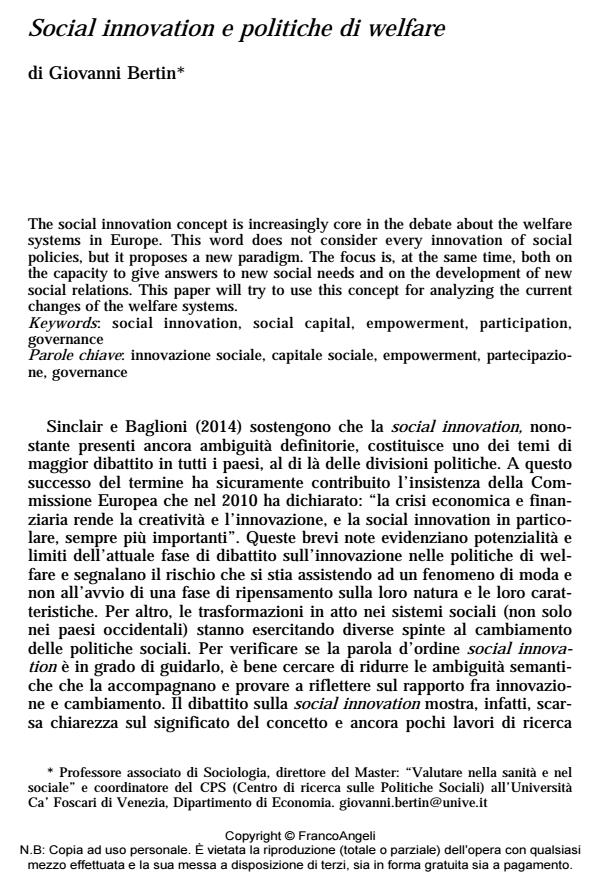
The social innovation concept is increasingly core in the debate about the welfare systems in Europe. This word does not consider every innovation of social policies, but it proposes a new paradigm. The focus is, at the same time, both on the capacity to give answers to new social needs and on the development of new social relations. This paper will try to use this concept for analyzing the current changes of the welfare systems.
Parole chiave:Innovazione sociale, capitale sociale, empowerment, partecipazione, governance
- Griffiths F., Cave J., Boardman F., Ren J., Pawlikowska T., Ball R., Clarke A., Cohen A. (2012). Social networks – the future for health care delivery. Social Science & Medicine, 75: 2233-2241. DOI 10.1016/j.socscimed.2012.08.023
- Hall P. (1993). Policy paradigms, social learning and the state. Comparative Politics, 25: 275-96. DOI: 10.1177/00027162025820010
- Harslof I. (2014). European Policy and Social Innovation. In: Bertin G., Campostrini S., a cura di, Equiwelfare and social innovation. Milano: FrancoAngeli
- Heiscala R. (2007). Social Innovations: structural and power perspectives. In: Hamalainen T.J., Heiscala R., a cura di, Social Innovations, Institutional Change and Economic Performance. Cheltenham: Edward Elgar
- Howaldt J., Schwarz M. (2010). Social Innovation: Concepts, Research Fields and International Trends, IMO, www.internationalmonitoring.com/ (Ultimo accesso 05/09/2014)
- Katzepov J., a cura di (2010). Rescaling social polizie: towards multilevel governance in Europe. Vienna: European Centre Laratta R. (2010). From welfare state to welfare society: toward a viable system of welfare in Japan and England. International Journal of Social Welfare, 19: 131-141. DOI: 10.1111/j.1468-2397.2009.00657
- Legh-Jones H., Moore S. (2012). Network social capital, social participation, and physical inactivity in an urban adult population. Social Science & Medicine, 74: 1362-1367. DOI: 10.1016/j.socscimed.2012.01.00
- Luhmann N. (2007). Conoscenza come costruzione. Roma: Armando
- March J.G. (1998). Prendere decisioni. Bologna: il Mulino
- Martignani L. (2014). De-commodification as re-configuration: an historical and epistemic necessity for the understanding of new welfare. In: Bertin G., Campostrini S., a cura di, Equiwelfare and social innovation. Milano: FrancoAngeli
- McLoughlin I., Preece D. (2010). Last Orders at the rural cyber pub: a failure of social learning? International Journal of Technological Management, 51: 75-91. DOI: 10.1504/IJTM.2010.03312
- Moro G. (2014). De-familization in commoditized welfare. In: Bertin G., Campostrini S., a cura di, Equiwelfare and social innovation. Milano: FrancoAngeli
- OECD LEED Forum on Social Innovations (2000). www.oecd.org/document/(Ultimo accesso 10/09/2014)
- Pierce J.L., Delbecq A.L. (1977). Organization structure, individual attitudes and Innovation. Academic Management Review, 2: 27-37. DOI: 10.5465/AMR.1977.440915
- Pierson P., a cura di (2001). The New Politics of the Welfare State. Oxford: Oxford University Press Rein.
- Pol E., Ville S. (2009). Social Innovation: Buzz word or enduring term. The Journal of Socio-Economics, 38: 878-885. DOI: 10.1016/j.socec.2009.02.01
- Sinclair S., Baglioni S. (2014). Social innovation and social policy-promises and risks. Social policy and Society, 13(3): 469-476. DOI: 10.1017/S147474641400008
- Slappendel C. (1996). Perspectives on innovation in organizations. Organization Studies, 17: 107-129. DOI: 10.1177/01708406960170010
- Rogers E.M. (1983). Diffusion of innovations. New York: Free Press
- Rothgang H., Obinger H., Leibfried S. (2006). The State and the Welfare State: How do Welfare State Changes Affect the Make-up of the Nation-State? Social Policy & Administration, 40(3): 250-266. DOI: 10.1111/j.1467-9515.2006.00488
- Tarde G. (1890). Les lois de l’imitation. Paris: Editions Kimé
- Toews D. (2013). Tarde’s sociology of difference: Its classical roots and contemporary meanings. Journal of Classical Sociology, 13(3): 393-401. DOI: 10.1177/1468795X1348067
- Andersen J.G. (2007). Conceptualizing welfare state change. CCWS: Aalborg University
- Bertin G. (2012). Sistemi regionali di welfare in Italia. Venezia: Edizioni Ca’ Foscari, Digital Press
- Bertin G. (2014). Evoluzione o cambiamento dei sistemi sanitari: verso un nuovo paradigma. In: Bertin G., a cura di, Community care e medicina specialistica. Venezia: Edizioni Ca’ Foscari, Digital Publishing
- Bertin G., Campostrini S. (2014). De-stratificazion, health inequality and welfare regimes. In: Bertin G., Campostrini S., a cura di, Equiwelfare and social innovation. Milano: FrancoAngeli
- Bertin G., Cipolla C., a cura di (2013). Verso differenti sistemi sanitari regionali. Venezia: Edizioni Ca’ Foscari, Digital Publishing
- Bonoli G. (2007). Time matter, post industrialisation, new social risk, and welfare state adaptation in advanced industrial democracies. Comparative Political Studies, 40: 495-520. DOI: 10.1177/001041400528575
- Cajaiba-Santana G. (2014). Social Innovation: Moving the field forward. A conceptual framework. Technological Forcasting & Social Change, 82: 42-51.
- DOI: 10.1016/j.techfore.2013.05.008CalltorpJ.(2012).Howcanourhealthsystemsbere-engineeredtomeetthefutur
- challenges? The Swedish experience. Social Science & Medicine, 74: 677-679. DOI: 10.1016/j.socscimed.2011.12.00
- Caulier-Grice J., Davies A., Patrick R., Norman W. (2012). Defining social innovation: a deliverable of the project. The Theoretical, Empirical and Policy Foundations for Building Social Innovation in Europe. Brussels: European Commission, DG Research Centre for Social Innovation (2008). http://socialinnovation.ca/about/social-innovation (Ultimo accesso 05/09/2014)
- Cipolla C. (2013). Perché non possiamo non essere eclettici. Il sapere sociale nella web society. Milano: FrancoAngeli
- Cresson E., Bangemann M. (1995). Green Paper on Innovation. Brussels: European Commission
- Crozier M., Friedberg E. (1978). Attore sociale e sistema. Milano: Etas Libri
- Di Nicola P. (2013). Il lavoro di cura tra defamiliarizzazione e mercificazione. Sociologia e Politiche Sociali, 16(1): 49-62. DOI: 10.3280/SP2013-00100
- Donati P. (2011). Sociologia della riflessività. Bologna: il Mulino
- Donati P. (2014). Beyond the Welfare State: Trajectories Towards the Relational State. In: Bertin G., Campostrini S., a cura di, Equiwelfare and social innovation. Milano: FrancoAngeli
- Eikemo T.A., Bambra C., Judge K., Ringdal K. (2008). Welfare state regimes and differences in self-perceived health in Europe: a multilevel analysis. Social Science & Medicine, 66: 2281-2295. DOI 10.1016/j.socscimed.2008.01.022
- European Commission (2010). Europe 2020 flagship initiative innovation union, SEC (2010) 1161, European Commission, Brussels
- Geels F.W., Schot J. (2007). Typology of sociotechnical transition pathways. Research Policy, 36: 399-417. DOI: 10.1016/j.techsoc.2007.08.00
- Gerometta J., Haussermann H., Longo G. (2005). Social Innovation and civil society in urban governance: strategies for an inclusive city. Urban Studies, 42(11): 2007-21. DOI: 10.1080/0042098050027985
- Giordano G.N., Björk J., Lindström M. (2012). Social capital and self-rated health – A study of temporal (causal) relationships. Social Science & Medicine, 75: 340-348. DOI: 10.1016/j.socscimed.2012.03.01
- Trade unions and employers associations: a new welfare model Daniele Cattaneo, Filippo Monge, in SOCIOLOGIA DEL LAVORO 147/2017 pp.220
DOI: 10.3280/SL2017-147012
Giovanni Bertin, Social innovation e politiche di welfare in "SALUTE E SOCIETÀ" 1/2015, pp 37-50, DOI: 10.3280/SES2015-001004