Leadership, Resistenza e Innovazione
Titolo Rivista SALUTE E SOCIETÀ
Autori/Curatori Mervyn Conroy
Anno di pubblicazione 2015 Fascicolo 2015/1
Lingua Italiano Numero pagine 22 P. 80-101 Dimensione file 102 KB
DOI 10.3280/SES2015-001007
Il DOI è il codice a barre della proprietà intellettuale: per saperne di più
clicca qui
Qui sotto puoi vedere in anteprima la prima pagina di questo articolo.
Se questo articolo ti interessa, lo puoi acquistare (e scaricare in formato pdf) seguendo le facili indicazioni per acquistare il download credit. Acquista Download Credits per scaricare questo Articolo in formato PDF
FrancoAngeli è membro della Publishers International Linking Association, Inc (PILA), associazione indipendente e non profit per facilitare (attraverso i servizi tecnologici implementati da CrossRef.org) l’accesso degli studiosi ai contenuti digitali nelle pubblicazioni professionali e scientifiche.
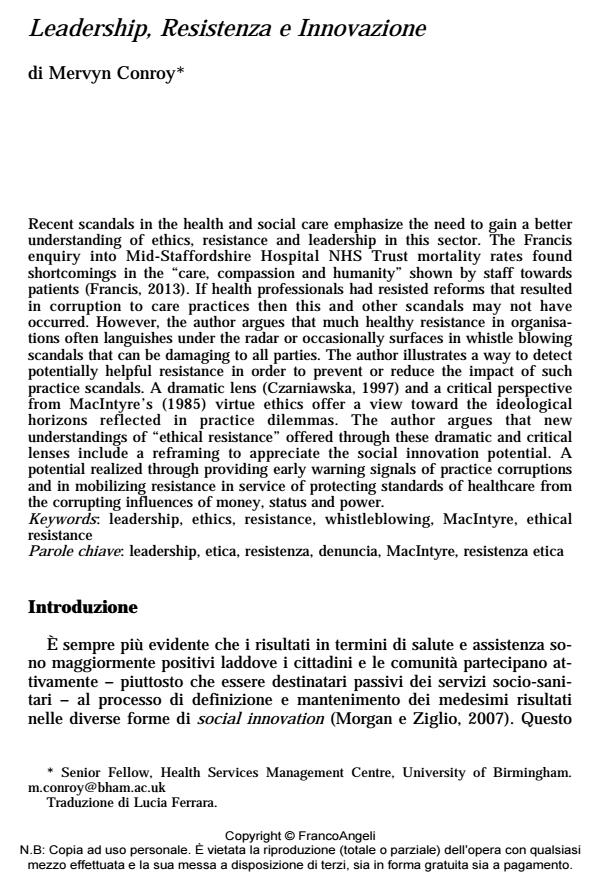
Recent scandals in the health and social care emphasize the need to gain a better understanding of ethics, resistance and leadership in this sector. The Francis enquiry into Mid-Staffordshire Hospital NHS Trust mortality rates found shortcomings in the “care, compassion and humanity” shown by staff towards patients (Francis, 2013). If health professionals had resisted reforms that resulted in corruption to care practices then this and other scandals may not have occurred. However, the author argues that much healthy resistance in organisations often languishes under the radar or occasionally surfaces in whistle blowing scandals that can be damaging to all parties. The author illustrates a way to detect potentially helpful resistance in order to prevent or reduce the impact of such practice scandals. A dramatic lens (Czarniawska, 1997) and a critical perspective from MacIntyre’s (1985) virtue ethics offer a view toward the ideological horizons reflected in practice dilemmas. The author argues that new understandings of "ethical resistance" offered through these dramatic and critical lenses include a reframing to appreciate the social innovation potential. A potential realized through providing early warning signals of practice corruptions and in mobilizing resistance in service of protecting standards of healthcare from the corrupting influences of money, status and power.
Parole chiave:Leadership, etica, resistenza, denuncia, MacIntyre, resistenza etica
- Ford J.D. (1999). Organisational change as shifting conversations. Journal of Organisational Change Management, 12: 480-500 Francis R. (2013). The Mid Staffordshire Foundation Trust Enquiry. London: The Stationary Office
- Gabriel Y. (2000). Storytelling in Organisations: Facts, Fictions and Fantasies. London: OUP
- Griffiths R., a cura di (1983). NHS Management Inquiry. London: HMSO. Disponibile al sito: www.sochealth.co.uk/history/griffiths.htm (Ultimo accesso 10/10/14)
- Iles V., Cranfield S. (2004). Managing Change in the NHS: Developing Change Management Skills - A Resource for Health Care Professionals and Managers. Literature Review Sponsored and Distributed by NHS SDO. London: LSHTM
- Iles V., Sutherland K. (2001). Managing Change in the NHS: Organisational Change - A Review for Health Care Managers, Professionals and Researchers. Literature Review produced by Cambridge University Judge Institute for the NHS SDO. London: LSHTM
- Kallio J., Saarinen T., Tinnila M. (2002). Efficient Change Strategies: Matching drivers and tracers in Change. Business Process Management Journal, 8(1): 80-92
- Kennedy I. (2001). The Bristol Royal Infirmary Inquiry. London: Department of Health Publication
- Kotter J.P., Schlesinger L.A. (1979). Choosing Strategies for change. Harvard Business Review, march: 106-114
- Kretzmann J.P., McKnight J.L. (1993). Building communities from the inside out: A path toward finding and mobilizing a community’s assets. Evanston, IL: Kretzmann and McKnight
- Kunda G. (1992). Engineering Culture: Control and Commitment in a High-Tech Corporation. Philadelphia: Temple University Press
- Learmonth M. (2003). Making health services management research critical: a review and a suggestion. Sociology of Health & Illness, 25(1): 93-119. DOI: 10.1111/1467-9566.0032
- Lewin K. (1948). Resolving social conflicts; selected papers on group dynamics.In: Gertrude W. Lewin a cura di. New York: Harper and Row
- Lewin K. (1951). Field Theory in Social Science. London: Tavistock Publications
- MacIntyre A. (1985). After Virtue: a study in moral theory. London: Duckworth
- MacIntyre A. (2009). God, Philosophy, Universities: A Selective History of the Catholic Philosophical Tradition. Lanham, MD: Rowman & Littlefield
- McCann D., Brownsberger M.L. (1990). Management as a Social Practice: Rethinking Business Ethics after MacIntyre. The Annual of the Society of Christian Ethics: 223-45
- Moore G. (2008). Re-Imagining The Morality of Management. Business Ethics Quarterly, 18(4): 483-511. DOI: 10.5840/beq20081843
- Moore G., Beadle R. (2006). In search of organisational virtue in business: agents, goods, practices, institutions and environments. Organisation Studies, 27(3): 369-389. DOI: 10.1177/017084060606242
- Morgan A., Ziglio E. (2007). Revitalising the evidence base for public health: An assets model. International Journal of Health Promotion and Education, Supplement 2: 17-22. DOI: 10.1177/10253823070140020701
- Murray R., Caulier-Grice J., Mulgan G. (2010). The Open Book of Social Innovation. London: The Young Foundation
- Øvretveit J. (2009). Leading evidence informed value improvement in health care. Chichester: Kingsham Press Passmore J. (1962). John Anderson and Twentieth-Century Philosophy. In: Passmore J., a cura di, Studies in Empirical Philosophy. Sydney: Angus and Robertson
- Pettigrew A.M. et al. (2001). Studying Organisational Change and Development: Challenges for Future Research. Academy of Management Journal, 44(4): 697. DOI: 10.2307/306941
- Anand V., Ashforth B.E., Joshi M. (2004). Business as usual: The acceptance and perpetuation of corruption in organizations. Academy of Management Executive, 18(2): 39-53. DOI: 10.5465/AME.2004.1383743
- Bate P., Robert G., Bevan H. (2004). The Next Phase of Healthcare Improvement: What Can We Learn from Social Movements? Quality and Safety in Healthcare, 13(1): 62-66. DOI: 10.1136/qshc.2003.00696
- Berger P.L., Luckmann T. (1967). The social construction of reality: a treatise in the sociology of knowledge. Allen Lane
- Boje D.M. (1995). Stories of the storytelling organisation: a postmodern analysis of Disney as “Tamara-Land”. Academy of Management Journal, 38(4): 997-1035. DOI: 10.2307/25661
- Bruner J. (1991). The narrative construction of reality. Critical Inquiry, 18: 1-21. DOI: 10.1086/44861
- Burrell G., Morgan G. (1979). Sociological Paradigms and Organisational Analysis. London: Heinmann
- Cameron M., Cranfield S., Iles V. et al. (2001). Managing Change in the NHS: Making Informed Decisions on Change: Key points for health care managers and professionals. Booklet produced by NHS NCCSDO. London: LSHTM
- Casey C. (1999). “Come, Join Our Family”: Discipline and Integration in Corporate Organizational Culture. Human Relations, 52(2): 155-178. DOI: 10.1023/A:101698060203
- Conroy M. (2010). An Ethical Approach to Leading Change: An Alternative and Sustainable Application. Basingstoke: Palgrave Macmillan
- Czarniawska B. (1997). Narrating the Organisation: Dramas of Institutional Identity. Chicago: UCP
- Czarniawska B. (1998). A Narrative Approach to Organisation Studies. London: Sage
- Daft R.L., Weick K. (1984). Towards a Model of Organisations as Interpretation Systems. Academy of Management Review, 9(2): 284-95
- Dawson P. (2003). Organisational Change Stories and Management Research: Facts or Fiction. Journal of the Australian and New Zealand Academy of Management, 9(3): 37-49
- Dawson S. (1999). Managing, Organising and Performing in Health Care: what do we know and how can we learn. In: Mark A.L., Dopson S., a cura di, Organisational Behaviour in Health Care: The Research Agenda. London: Macmillan
- Downing S.J. (1997). Learning the plot: emotional momentum in search of dramatic logic. Management Learning, 28(1): 27-44. DOI: 10.1177/135050769728100
- du Gay P. (2003). The Tyranny of the Epochal: Change, Epochalism and Organizational Reform. Organization, 10(4): 663-684. DOI: 10.1177/1350508403010400
- Fleming P., Spicer A. (2003). Working at a cynical distance: implications for power, subjectivity and resistance. Organisation, 10(1): 157-79
- Pettigrew A.M. (1992). Shaping strategic change: making changes in large organisations: the case of the National Health Service. London: Sage
- Piccone P. (1978). The Crisis of One-Dimensionality. Telos, 35: 43-54. DOI: 10.3817/037803504
- Propp V. (1928). Morphology of the Folktale. Austin: University of Texas Press
- Riley P. (1988). The merger of macro and micro levels of leadership. In: Hunt J.G., Baglia B.R., Dachler H.P., Schriesheim C.A., a cura di, Emerging leadership vistas. Lexington, MA: Lexington Books
- Royal Liverpool Children’s Inquiry Report (2001). London: The Stationery Office
- Schein E.H. (1985). Organisational Culture and Leadership. London: Jossey-Bass
- Skoldberg K. (1994). Tales of change: public administration reform and narrative mode. Organisational Science, 5(2): 219-238. DOI: 10.1287/orsc.5.2.21
- Smith J., Walshe K., Hunter D.J. (2001). The ‘redisorganisation’ of the NHS. British Medical Journal, 323(7324): 1263-1264
- Sturdy A., Grey C. (2003). Beneath and beyond organizational change management: exploring alternatives. Organization, 10(4): 651-662. DOI: 10.1177/1350508403010400
- The Shipman Enquiry: fouth report. 2003 & 2004. London: The Stationery Office
- Tushman M.L., Newman W.H., Romanelli E. (1986). Convergence and upheaval: managing the unsteady pace of organisational evolution. Californian Management Review, 29: 29-44
- Walker R., Ivanhoe P. (2007). Working Virtue: virtue ethics and contemporary moral problems. Oxford: Clarendon Press
- Watson T.J. (1982). Group Ideologies and Organisational Change. Journal of Management Studies, 19(3): 259-275
- Weick K.E. (1979). The social psychology of organizing (2nd edition). Reading, Mass.: Addison-Wesley Pub. Co
- West M., Borrill C.S., Dawson J.F., Brodbeck F., Shapiro D.A., Haward B. (2003). Leadership clarity and team innovation in health care. The Leadership Quarterly, 14(4-5): 393-410. DOI: 10.1016/S1048-9843(03)00044-
- White H. (1985). The value of narrativity in the representation of reality. In: Mitchell W.J.T., a cura di, On Narrative. Chicago: Chicago University Press
- Willmott H. (1993). Strength is ignorance; slavery is freedom: managing cultures in modern organizations. Journal of Management Studies, 30(4): 515-552. DOI: 10.1111/j.1467-6486.1993.tb00315
- Zizek S. (1989). Sublime Object of Ideology. London: Verso
- Zoller H., Fairhurst G.T. (2007). Dissent as Leadership: Discourse, Power, and Resistance. Human Relations, 60: 1331-1360
Mervyn Conroy, Leadership, Resistenza e Innovazione in "SALUTE E SOCIETÀ" 1/2015, pp 80-101, DOI: 10.3280/SES2015-001007