User-generated video parodies in social media
Titolo Rivista MERCATI E COMPETITIVITÀ
Autori/Curatori Francesca Negri
Anno di pubblicazione 2015 Fascicolo 2015/1
Lingua Italiano Numero pagine 21 P. 75-95 Dimensione file 114 KB
DOI 10.3280/MC2015-001005
Il DOI è il codice a barre della proprietà intellettuale: per saperne di più
clicca qui
Qui sotto puoi vedere in anteprima la prima pagina di questo articolo.
Se questo articolo ti interessa, lo puoi acquistare (e scaricare in formato pdf) seguendo le facili indicazioni per acquistare il download credit. Acquista Download Credits per scaricare questo Articolo in formato PDF
FrancoAngeli è membro della Publishers International Linking Association, Inc (PILA), associazione indipendente e non profit per facilitare (attraverso i servizi tecnologici implementati da CrossRef.org) l’accesso degli studiosi ai contenuti digitali nelle pubblicazioni professionali e scientifiche.
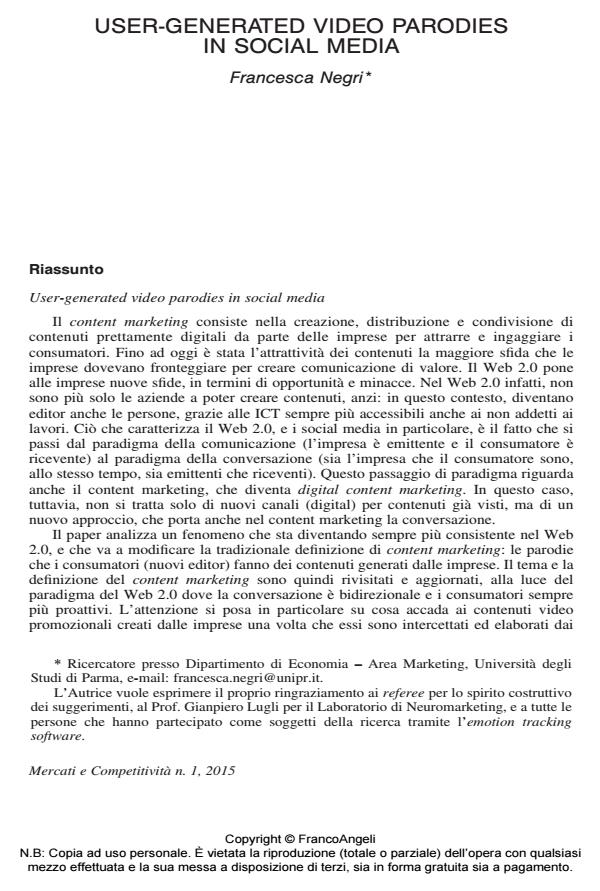
Il content marketing consiste nella creazione, distribuzione e condivisione di contenuti prettamente digitali da parte delle imprese per attrarre e ingaggiare i consumatori. Fino ad oggi è stata l’attrattività dei contenuti la maggiore sfida che le imprese dovevano fronteggiare per creare comunicazione di valore. Il Web 2.0 pone alle imprese nuove sfide, in termini di opportunità e minacce. Nel Web 2.0 infatti, non sono più solo le aziende a poter creare contenuti, anzi: in questo contesto, diventano editor anche le persone, grazie alle ICT sempre più accessibili anche ai non addetti ai lavori. Ciò che caratterizza il Web 2.0, e i social media in particolare, è il fatto che si passi dal paradigma della comunicazione (l’impresa è emittente e il consumatore è ricevente) al paradigma della conversazione (sia l’impresa che il consumatore sono, allo stesso tempo, sia emittenti che riceventi). Questo passaggio di paradigma riguarda anche il content marketing, che diventa digital content marketing. In questo caso, tuttavia, non si tratta solo di nuovi canali (digital) per contenuti già visti, ma di un nuovo approccio, che porta anche nel content marketing la conversazione. Il paper analizza un fenomeno che sta diventando sempre più consistente nel Web 2.0, e che va a modificare la tradizionale definizione di content marketing: le parodie che i consumatori (nuovi editor) fanno dei contenuti generati dalle imprese. Il tema e la definizione del content marketing sono quindi rivisitati e aggiornati, alla luce del paradigma del Web 2.0 dove la conversazione è bidirezionale e i consumatori sempre più proattivi. L’attenzione si posa in particolare su cosa accada ai contenuti video promozionali creati dalle imprese una volta che essi sono intercettati ed elaborati dai fan, in particolare nella forma della video parodia condivisa sulla piattaforma YouTube. Le analisi condotte, attraverso il calcolo dell’Engagement Rate, una content analysis seguita dalla sentiment e un esperimento di emotion tracking tramite un software di face reading, dimostrano che le video parodie prodotte dai consumatori (User-Generated Video Parodies) sono effettivamente in grado di creare valore addizionale (in termini di percezione più positiva della comunicazione originale, opportunità di viralità e, infine, di costruzione di una relazione con il consumatore) rispetto a quello generato dagli sforzi editoriali e creativi delle sole imprese che investono nel content marketing.
Parole chiave:Digital content marketing, social media, User Generated Content, parodia, video, YouTube.
- AdvertisingAge (2014). Content Marketing 2014. www.adage.com.
- Belck W.R. (2006). Handbook of Qualitative Research Methods in Marketing. Cheltnham, UK: Edward Elgar P.L., DOI: 10.1108/13522750610689069
- Boyle E. (2007). A process model of brand co-creation: brand management and research implications. Journal of Product & Brand Management, 16(2): 122-31, DOI: 10.1108/10610420710739991
- Branthwaite A., Patterson S. (2011). The power of qualitative research in the era of social media. Qualitative Market Research: An International Journal, 14(4): 430-440, DOI: 10.1108/1352275111116324
- Burgess J., Green J. (2013). YouTube. Milano: Egea.
- Ceron A., Curini L., and Iacus A.M. (2014). Social Media e Sentiment Analysis. Milano: Springer, DOI: 10.1007/978-88-470-5532-2
- Chatzopoulou G., Sheng C., and Faloutsos M. (2010), A first step towards understanding popularity in YouTube. INFOCOM IEEE Conference on Computer Communications, Workshops – San Diego, CA, pp. 1-6.
- Chung H., Zhao X. (2003). Humour effect on memory and attitude: moderating role of product involvement. International Journal of Advertising, 22(1): 117-144.
- Cisco (2014). Cisco Visual Networking Index: Forecast and Methodology, 2013-2018. www.cisco.com.
- Cova B., Dalli D. (2009). Working consumers: the next step in marketing theory?. Marketing Theory, 9(3): 315-339, DOI: 10.1177/147059310933814
- Desai D. (2009). Role of Relationship Management and Value Co-Creation in Social Marketing. Social Marketing Quarterly, 15(112): 112-125, DOI: 10.1080/1524500090330461
- De Wever B., Schellens T., Valcke M., and Van Keer H. (2006). Content analysis schemes to analyse transcripts of online asynchronous discussion groups: A review.
- Computers & Education, 46(1): 6-28, DOI: 10.1016/j.compedu.2005.04.005
- Duncan T., Moriarty S.E. (1998). A Communication-Based Marketing Model for Managing Relationship. Journal of Marketing, 62(April): 1-13, DOI: 10.2307/1252157
- Ekman P. (1970). Universal facial expressions of emotion. California Mental Health Research Digest, 8: 151-158.
- Ertimur B., Gilly M.C. (2012). So Whaddya Think? Consumers Create Ads and Other Consumers Critique Them. Journal of Interactive Marketing, 26: 115-130, DOI: 10.1016/j.intmar.2011.10.002
- Glaser B.G., Strauss A.L. (1967). The discovery of grounded theory: Strategies for qualitative research. Chicago, IL: Aldine Publishing Company.
- Hautz J., Fuller J., Hutter K., and Thurridl, C. (2014). Let Users Generate Your Video
- Ads? The Impact of Video Source and Quality on Consumers’ Perceptions and Intended Behaviors. Journal of Interactive Marketing, 28: 1-15, DOI: 10.1016/j.intmar.2013.06.003
- Hoffman D.L., Fodor M. (2010). Can You Measure the ROI of Your Social Media Marketing?. MIT Sloan Management Review, 52(1): 41-49.
- Huang J., Su S., Zhou L., and Liu X. (2013). Attitude Toward the Viral Ad: Expanding Traditional Advertising Models to Interactive Advertising. Journal of Interactive Marketing, 27: 36-46, DOI: 10.1016/j.intmar.2012.06.001
- Jean S. (2011). Brand parody: a communication strategy to attack a competitor. Journal of Consumer Marketing, 28(1): 19-26, DOI: 10.1108/07363761111101912KassarjianH.H.(1977).ContentAnalysisinConsumerResearch.TheJournalofConsumerResearch,4(1):8-18,doi:10.1086/208674
- Knautz K., Stock W.G. (2011). Collective indexing of emotions in videos. Journal of Documentation, 67(6): 975-994, DOI: 10.1108/00220411111183555
- Kramer A.D.I., Guillory J.E., and Hancock J.T. (2014). Experimental evidence of massive-scale emotional contagion through social networks. PNAS, June 17, 111(24): 8788-8790, DOI: 10.1073/pnas.1320040111
- Lasswell H.D. (1948). The structure and function of communication in society. In The Communication of Ideas, L. Bryson, ed. New York: Harper.
- Lee Y.J., Shim J.M., Cho H.G. and Woo G. (2010), Detecting and visualizing the dispute structure of the replying comments in the internet forum sites. International Conference on Cyber-enabled Distributed Computing and Knowledge Discovery-Huangshan, China, pp. 456-463, DOI: 10.1109/CyberC.2010.90
- Lugli G. (2014). Emotions tracking. Come rispondiamo agli stimoli di marketing. Milano: Apogeo.
- Madden A., Ruthven I., and McMenemy D. (2013). A classification scheme for content analyses of YouTube video comments. Journal of Documentation, 69(5): 693-714, DOI: 10.1108/JD-06-2012-0078
- Mayan M. J. (2009). Essentials of Qualitative Inquiry. Left Coast Press, Incorporated.
- Negri F. (2013). NetworkCracy. Social Media Marketing per la Distribuzione. Torino: Giappichelli Editore.
- Nielsen (2014). The Data-Driven Future of Video Advertising. www.nielsen.com.
- O’Reilly T. (2006). Web 2.0 Principles and Best Practices. http://oreilly.com/catalog/web2report/chapter/web20_report_excerpt.pdf.
- Pace S. (2008). YouTube: an opportunity for consumer narrative analysis?. Qualitative Market Research: An International Journal, 11(2): 213-226, DOI: 10.1108/13522750810864459
- Paolillo J.C. (2008). “Structure and network in the YouTube core”, Proceedings of the 41st Annual International Conference on System Sciences – Waikoloa, Hawaii, pp. 156-165.
- Papadatos C. (2006). The art of storytelling: how loyalty marketers can build emotional connections to their brands. Journal of Consumer Marketing, 23(7): 382-384, DOI: 10.1108/07363760610712902
- Petty R.D. (2009). Brand parody products: is the harm worth the howl?. Journal of Consumer marketing, 26(2): 64-65, DOI: 10.1108/07363760910955351
- Pornpitakpan C. (2004). The persuasiveness of source credibility: a critical review of five decades of evidence. Journal of Applied Social Psychology, 34(2): 243-281, DOI: 10.1111/j.1559-1816.2004.tb02547.x
- Potthast M., Stein B. and Becker S. (2010), “Towards comment-based cross-media retrieval”, 19th International Conference on World Wide Web – Raleigh, NC, DOI: 10.1145/1772690.1772858
- Prahalad C.K., Ramaswamy V. (2004). Co-creation experiences: the next practice in value creation. Journal of Interactive Marketing, 18(3): 5-14, DOI: 10.1002/dir.20015
- Rowley J. (2008). Understanding digital content marketing. Journal of Marketing Management, 24(5-6): 517-540, DOI: 10.1362/026725708X325977
- Speck P.S. (1991). The humorous message taxonomy: a framework. Current Issues and Research in Advertising, 13(1): 1-44, DOI: 10.1080/01633392.1991.10504957
- Stephen A.T., Galak J. (2012). The effects of traditional and social earned media on sales: A study of a microlending marketplace. Journal of Marketing Research, 49(5): 624-639. dx.doi.org/10.1509/jmr.09.0401. Thelwall M., Sud P. and Vis F. (2011). Commenting on YouTube videos: from Guatemalan Rock to El Big Bang. Journal of the American Society for Information Science and Technology, 6 (3): 616-629.
- Tuten T., Solomon M. (2014). Social Media Marketing. Edinburgh: Pearson.
- Vanden Bergh B.G. (2003). “Ad parodies”, in Groth, G. & Sadowski, G. (eds) Will Elder, The Mad Playboy of Art. Seattle, WA: Fantagraphics Books, pp. 207-215.
- Vanden Bergh B.G., Lee, M., Quilliam E.T., and Hove T. (2011). The multidimensional nature and brand impact of user-generated ad parodies in social media. International Journal of Advertising, 30(1): 103-131, DOI: 10.2501/IJA-30-1-103-131
- Viola P., Jones M.J. (2001). Robust Real-time Object Detection. International Journal of Computer Vision, 57(2): 137-154, DOI: 10.1023/B:VISI.0000013087.49260.fb
- Zhang Y., Zinkhan G.M. (2006). Responses to humorous ads: does audience involvement matter?. Journal of Advertising, 35(4): 113-127, DOI: 10.2753/JOA0091-3367350408
- Zinkhan G.M., Johnson M. (1994). The use of parody in advertising. Journal of Advertising, 23(3): III-VIII, DOI: 10.1080/00913367.1994.10673444
- Exploring the palm oil crisis through the lens of different social media: an analysis of facebook, youtube and twitter contents Matteo Corciolani, Giacomo Gistri, Stefano Pace, in MERCATI & COMPETITIVITÀ 4/2016 pp.43
DOI: 10.3280/MC2016-004004
Francesca Negri, User-generated video parodies in social media in "MERCATI E COMPETITIVITÀ" 1/2015, pp 75-95, DOI: 10.3280/MC2015-001005