La riabilitazione motoria nel morbo di parkinson: nuovi interventi e prospettive future
Titolo Rivista RICERCHE DI PSICOLOGIA
Autori/Curatori Chiara Di Nuzzo
Anno di pubblicazione 2015 Fascicolo 2014/4
Lingua Italiano Numero pagine 26 P. 545-570 Dimensione file 254 KB
DOI 10.3280/RIP2014-004002
Il DOI è il codice a barre della proprietà intellettuale: per saperne di più
clicca qui
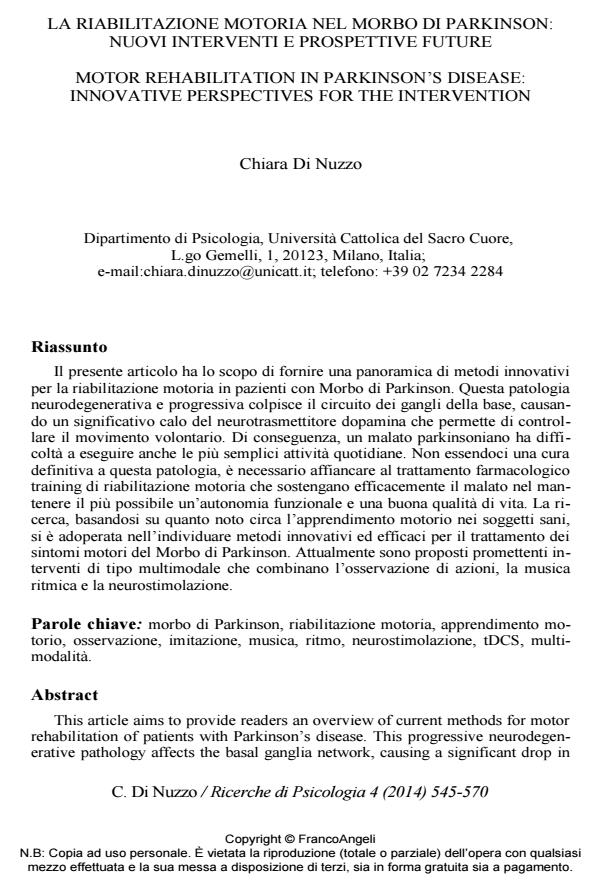
Qui sotto puoi vedere in anteprima la prima pagina di questo articolo.
Se questo articolo ti interessa, lo puoi acquistare (e scaricare in formato pdf) seguendo le facili indicazioni per acquistare il download credit. Acquista Download Credits per scaricare questo Articolo in formato PDF
FrancoAngeli è membro della Publishers International Linking Association, Inc (PILA), associazione indipendente e non profit per facilitare (attraverso i servizi tecnologici implementati da CrossRef.org) l’accesso degli studiosi ai contenuti digitali nelle pubblicazioni professionali e scientifiche.
Il presente articolo ha lo scopo di fornire una panoramica di metodi innovativi per la riabilitazione motoria in pazienti con Morbo di Parkinson. Questa patologia neurodegenerativa e progressiva colpisce il circuito dei gangli della base, causando un significativo calo del neurotrasmettitore dopamina che permette di controllare il movimento volontario. Di conseguenza, un malato parkinsoniano ha difficoltà a eseguire anche le più semplici attività quotidiane. Non essendoci una cura definitiva a questa patologia, è necessario affiancare al trattamento farmacologico training di riabilitazione motoria che sostengano efficacemente il malato nel mantenere il più possibile un’autonomia funzionale e una buona qualità di vita. La ricerca, basandosi su quanto noto circa l’apprendimento motorio nei soggetti sani, si è adoperata nell’individuare metodi innovativi ed efficaci per il trattamento dei sintomi motori del Morbo di Parkinson. Attualmente sono proposti promettenti interventi di tipo multimodale che combinano l’osservazione di azioni, la musica ritmica e la neurostimolazione.
Parole chiave:Morbo di Parkinson, riabilitazione motoria, apprendimento motorio, osservazione, imitazione, musica, ritmo, neurostimolazione, tDCS, multimodalità
- Alegre, M., Rodriguez-Oroz, M., Valencia, M., Guridi, J., Iriarte, J., Obeso, J., & Artieda, J. (2010). Changes in subthalamic activity during movement observation in Parkinson’s disease: is the mirror system mirrored in the basal ganglia? Clinical Neurophysiology, 121, 414-425. DOI: 10.1016/j.clinph.2009.11.013
- Alexander, G.E. & Crutcher, M.D. (1990). Functional architecture of basal ganglia circuits: Neural substrates of parallel processing. Trends Neuroscience, 13, 266-271.
- Antonietti, A. (2006). Significati musicali. Come la mente pensa i suoni. Milano: Quaderni di psicologia cognitiva, ISU.
- Bäckman, L., Nyberg, L., Lindenberger, U., Li, S.C., & Farde, L. (2006). The correlative triad among aging,dopamine,and cognition: current status and future prospects. Neuroscience & Biobehavioral Reviews, 30, 791-807. DOI: 10.1016/j.neubiorev.2006.06.005
- Bangert, M., Peschel, T., Schlaug, G., Rotte, M., Drescher, D., & Hinrichs, H. (2006). Shared Professional, networks for auditory and motor processing in pianists: evidence from fMRI conjunction. Neuroimage, 30, 917-926. DOI: 10.1016/j.neuroimage.2005.10.044
- Bellelli, G., Buccino, G., Bernardini, B., Padovani, A., & Trabucchi, M. (2010). Action observation treatment improves recovery of postsurgical orthopedic patients: evidence for a top-down effect? Archives of Physical Medicine and Rehabilitation, 91, 1489-1494. DOI: 10.1016/j.apmr.2010.07.01
- Benitez-Temino, B., Obeso, J.A., Rodri, M.C., Rodriguez, M., Blesa, F.J., & Guridi, J. (2008). Functional Organization of the Basal Ganglia: Therapeutic Implications for Parkinson’s Disease. Movement Disorders, 23(Suppl.3), 548-559. DOI: 10.1002/mds.22062
- Bennett, I.J., Howard, J.H., & Howard, D. (2007). Age-related differences in implicit learning of subtle third-order sequential structure. The Journal of Gerontology, 62, P98-P103. DOI: 10.1093/geronb/62.2.p98
- Bennett, I.J., Madden, D.J., Vaidya, C.J., Howard, J.H., & Howard, D.V. (2011). White matter integrity correlates of implicit sequence learning in healthy aging. Neurobiology Aging, 32, 2317e1–2317e12. DOI: 10.1016/j.neurobiolaging.2010.03.017
- Benoit, C., Dalla Bella, S., Farrugia, N., Obrig, H., Mainka, S., & Kotz, S. A. (2014). Musically cued gait-training improves both perceptual and motor timing in Parkinson’s disease. Frontiers in Human Neuroscience, 8(July), 1-11. DOI: 10.3389/fnhum.2014.00494
- Blandini, F. (2001). The role of the subthalamic nucleus in the pathophysiology of Parkinson’s disease. Functional Neurology, 16(Suppl. 4), 99–106.
- Blandini, F., & Greenamyre, J. (1995). Effect of subthalamic nucleus lesion on mitochondrial enzyme activity in rat basal ganglia. Brain Research, 669, 59-66. DOI: 10.1016/0006-8993(94)01233-8
- Bonini, L., Ferrari, P.F., & Fogassi, L. (2013). Neurophysiological bases underlying the organization of intentional actions and the understanding of others’ intention. Consciousness and Cognition, 3, 1095-104. DOI: 10.1016/j.concog.2013.03.001
- Boucai, L., Cerquetti, D., & Merello, M. (2004). Functional surgery for Parkinson’s disease treatment: a structured analysis of a decade of published literature. British Journal of Neurosurgery, 18, 213-222.
- DOI: 10.1080/02688690410001732625
- Brass, M., Bekkering, H., Wohlschlager, A., & Prinz, W. (2000). Compatibility between observed and executed finger movements: comparing symbolic, spatial, and imitative cues. Brain Cognition, 44, 124-143. DOI: 10.1006/brcg.2000.1225
- Brown, L.A., de Bruin, N. De, Doan, J.B., & Suchowersky, O. (2009). Novel challenges to gait in Parkinson’s disease: the effect of concurrent music in single-and dual-task contexts. Archives of Physical Medicine and Rehabilitation,
- 90(9), 1578-1583. DOI: 10.1016/j.apmr.2009.03.009
- Buccino, G. (2014). Action observation treatment: a novel tool in neurorehabilitation Action observation treatment: a novel tool in neurorehabilitation. Philosophical Transactions Royal Society, 369 (April), 1-8. DOI: 10.1098/rstb.2013.0185
- Buccino, G., Arisi, D., Gough, P., Aprile, D., Ferri, C., Serotti, L., & Fazzi, E. (2012). Improving upper limb motor functions through action observation treatment: a pilot study in children with cerebral palsy. Developmental Medicine & Child Neurology, 54, 822-828. DOI: 10.1111/j.1469-8749.2012.04334.x
- Buccino, G., Binkofski, F., & Riggio, L. (2004). The mirror neuron system and action recognition. Brain and Language, 89, 370-376. DOI: 10.1016/S0093-934X(03)00356-0
- Buccino, G., Gatti, R., Giusti, M.C., Negrotti, A., Rossi, A., Calzetti, S., & Cappa, S.F. (2011). Action observation treatment improves autonomy in daily activities in Parkinson’s disease patients: results from a pilot study. Movement Disorders, 26, 1963-1964. DOI: 10.1002/mds.23745
- Buccino, G., & Riggio, L. (2006). The role of the mirror neuron system in motor learning. Kinesiology, 38(1), 5-15.
- Calvo-Merino, B., Gre, J., Glaser, D.E., Passingham, R.E., & Haggard, P. (2006). Report seeing or doing ? influence of visual and motor familiarity in action observation. Current Biology, 16, 1905-1910. DOI 10.1016/j.cub.2006.07.065.
- Celnik, P., Webster, B., Glasser, D.M., & Cohen, L.G. (2008). Effects of action observation on physical training after stroke. Stroke, 39, 1814-1820. DOI: 10.1161/STROKEAHA.107.508184
- Chen, J.L., Penhune, V.B., & Zatorre, R.J. (2008). Listening to musical rhythms recruits motor regions of the brain. Cerebral Cortex, 18(12), 2844-2854. DOI: 10.1093/cercor/bhn042
- Cross, E.S., Hamilton, A.F.D.C., & Grafton, S.T. (2006). Building a motor simulation de novo: Observation of dance by dancers. NeuroImage, 31, 1257–1267. DOI: 10.1016/j.neuroimage.2006.01.033
- Curran, T. (1997). Effects of aging on implicit sequence learning: accounting for sequence structure and explicit knowledge. Psychological Research, 60, 24-41. DOI: 10.1007/BF00419678
- D’Ausilio, A. (2007). The role of the mirror system in mapping complex sounds into actions. The Journal of Neuroscience: The Official Journal of the Society for Neuroscience, 27(22), 5847-8. DOI: 10.1523/JNEUROSCI.0979-07.2007
- DeBruin, N., Doan, J. B., Turnbull, G., Suchowersky, O., Bonfield, S., & Hu, B. (2010). Walking with music is a safe and viable tool for gait training in Parkinson’s disease: the effect of a 13-week feasibility study on single and dual task walking. Parkinsons Disease, July, 1-9. DOI: 10.4061/2010/483530
- Delong, M.R., & Wichmann, T. (2007). Circuits disorders of the basal ganglia. Archives of Neurology, 64(1), 20e24. DOI: 10.1001/archneur.64.1.20
- Di Nuzzo, C. (2015). Motor learning in healthy and Parkinsonian adults. The combined effects of multimodality and neurostimulation. Lambert Academic Publishing, Saarbrücken, Germany. Di Nuzzo, C., Antonietti, A., & Colombo, B. (2014). Il ruolo della musica nella fase di encoding nell’apprendimento motorio: uno studio di neuro stimolazione. Atti del Convegno: XX Congresso della Sezione di Psicologia sperimentale AIP, Pavia, Italia.
- Double, K.L. (2012). Parkinsonism and related disorders neuronal vulnerability in Parkinson’s disease. Parkinsonism and Realted Disorders, 18, S52-S54. DOI: 10.1016/S1353-8020(11)70018-9
- Doyon, J., Bellec, P., Amsel, R., Penhune, V., Monchi, O., Carrier, J., & Benali, H. (2009). Contribution of the basal ganglia and functionally related brain structures to motor learning. Brain Research, 199, 61-75. DOI: 10.1016/j.bbr.2008.11.012
- Doyon, J., & Benali, H. (2005). Reorganization and plasticity in the adult brain during learning of motor skills. Current Opinion in Neurobiology, 15, 161–167. DOI: 10.1016/j.conb.2005.03.004
- Doyon, J., Penhune,V., & Ungerleider, L. (2003). Distinct contribution of the cortico-striatal and cortico-cerebellar systems to motor skill learning. Neuropsychologia, 41, 252-262. DOI: 10.1016/s0028-3932(02)00158-6
- Ertelt, D., Small, S., Solodkin, A., Dettmers, C., Mcnamara, A., Binkofski, F., & Buccino, G. (2007). Action observation has a positive impact on rehabilitation of motor deficits after stroke. NeuroImage, 36(Suppl.2), T164-173. DOI: 10.1016/j.neuroimage.2007.03.043
- Fadiga, L., Craighero, L., & D’Ausilio, A. (2009). Broca’s area in language, action, and music. Ann N Y Acad Sci, 1169, 448-458. DOI: 10.1111/j.1749-6632.2009.04582.x
- Fahn, S. (1982). Fluctuations of disability in Parkinson’s disease: pathophysiological aspects. In C.D. Marsden & S. Fahn (Eds.), Movement Disorders (pp.123-145). Butterworth Scientific, London.
- Fahn, S. (1995). The freezing phenomenon in parkinsonism. Advances in neurology, 67:53-63.
- Fitts, P. & Posner, M. (1967). Human performance. Belmont, CA:Brooks/Cole. Flament, D., Vaillancourt, D., Kempf, T., Shannon, K., & Corcos, D. (2003).
- EMG remains fractionated in Parkinson’s disease, despite practice-related improvements in performance. Clinical Neurophysiology, 114, 2385-96. DOI: 10.1016/S1388-2457(03)00254-2
- Fraix, V., Castrioto, A., Moro, E. & Krack, P. (2015). Trattamento chirurgico della malattia di Parkinson. EMC-Neurologia, 15(1), 1-14. DOI: 10.1016/s1634-7072(14)69825-1
- Fregni, F., Boggio, P.S., Santos, M.C., Lima, M., Vieira, A.L., Rigonatti, S.P., & Pascual-Leone, A. (2006). Noninvasive cortical stimulation with transcranial direct current stimulation in Parkinson’s disease. Movement Disorders, 21(10), 1693-1702. DOI: 10.1002/mds.21012
- Fregni, F., Santos, C.M., Myczkowski, M.L., Rigolino, R., Gallucci-Neto, J., Barbosa, E.R., & Marcolin, M.A. (2004). Repetitive transcranial magnetic stimulation is as effective as fluoxetine in the treatment of depression in patients with Parkinson’s disease. Journal of Neurology, Neurosurgery & Psychiatry, 75, 1171-1174. DOI: 10.1136/jnnp.2003.027060
- Fogassi, L., Ferrari, P.F., Gesierich, B., Rozzi, S., Chersi, F., & Rizzolatti, G. (2005). Parietal lobe: From action organization to intention understanding. Science, 302, 662-667. DOI: 10.1126/science.1106138
- Fritsch, B., Reis, J., Martinowich, K., Schambra, H., & Ji, Y. (2010). Direct current stimulation promotes BDNF-dependent synaptic plasticity: potential implications for motor learning. Neuron, 66, 198-204.
- 10.1016/j.neuron.2010.03.035.
- Giladi, N., McMahon, D., Przedborski, S., Flaster, E., Guillory, S., Kostic, V. & Fahn, S. (1992). Motor blocks in Parkinson’s disease. Neurology, 42, 333-9.
- Giladi, N., Shabtai, H., Simon, E., Biran, S., Tal, J., & Al, E. (2000). Construction of freezing of gait questionnaire for patients with Parkinsonism. Parkinsonism Relateted Disorders, 6, 165170. DOI: 10.1016/S1353-8020(99)00062-0
- Grahn, J.A., & Brett, M. (2007). Rhythm and beat perception in motor areas of the brain. Journal of Cognitive Neuroscience, 19(5), 893-906. DOI: 10.1162/jocn.2007.19.5.893
- Grahn, J.A. (2012). Neural mechanisms of rhythm perception: current findings and future perspectives. Topics in Cognitive Science, 4, 585-606. DOI: 10.1111/j.1756-8765.2012.01213.x
- Hebert, L., Bienias, J., McCann, J., Scherr, P., Wilson, R., & Evans, D. (2010). Upper and lower extremity motor performance and functional impairment in Alzheimer’s disease. American Journal of Alzheimer’s disease and Other Dementias, 25, 425-31. DOI: 10.1177/1533317510367636
- Herholz, S.C., Halpern, A., & Zatorre, R.J. (2012). Neuronal correlates of perception, imagery, and memory for familiar tunes. Journal of Cognitive Neuroscience, 24, 1382-1397. DOI: 10.1162/jocn_a_00216
- Hess, C.W., Vaillancourt, D.E., & Okun, M.S. (2013). The temporal pattern of stimulation may be important to the mechanism of deep brain stimulation. Experimental Neurology., 247, 296-302. DOI: 10.1016/j.expneurol.2013.02.001
- Howard, D.V., & Howard, J. (2001). When it does hurt to try: adult age differences in the effects of instructions on implicit pattern learning. Psychonomic Bulletin and Review, 8, 798-805. DOI: 10.3758/BF03196220
- Hummel, F., Celnik, P., Giraux, P., Floel, A., & Wu, W. (2005). Effects of noninvasive cortical stimulation on skilled motor function in chronic stroke. Brain, 128, 490-499. DOI: 10.1093/brain/awh369
- Hummel, F.C., Voller, B., Celnik, P., Floel, A., & Giraux, P. (2006). Effects of brain polarization on reaction times and pinch force in chronic stroke. BMC Neuroscience, 7, 73. DOI: 10.1186/1471-2202-7-73
- Iacoboni, M., Molnar-Szakacs, I., Gallese, V., Buccino, G., Mazziotta, J., & Rizzolatti, G. (2005). Grasping the intentions of others with one’s owns mirror neuron system. PLOS Biology, 3, 529-535. DOI: 10.1371/journal.pbio.0030079
- Janata, P., & Grafton, S.T. (2003). Swinging in the brain: shared neural substrates for behaviors related to sequencing and music. Nature Neuroscience, 6, 682-687. DOI: 10.1038/nn1081
- Jeong, S., & Kim, M. (2007). Effects of a theory-driven music and movement program for stroke survivors in a community setting. Applied Nursing Research, 20, 125-131. DOI: 10.1016/j.apnr.2007.04.005
- Jessop, R., Horowicz, C., & Dibble, L. (2006). Motor learning and Parkinson disease: refinement of movement velocity and endpoint excursion in a limits of stability balance task. Neurorehabil Neural Repair, 20(4), 459-67. DOI: 10.1177/1545968306287107
- Jobges, M., Heuschkel, G., Pretzel, C., Illhardt, C., Renner, C., & Hummelsheim, H. (2004). Repetitive training of compensatory steps: a therapeutic approach for postural instability in Parkinson’s disease, Journal of Neurology, Neurosurgery and Psychiatry, 75, 1682-1687. DOI: 10.1136/jnnp.2003.016550
- Kang, E., & Paik, N. (2011). Effect of a tDCS electrode montage on implicit motor sequence learning in healthy subjects. Experimental & Translational Stroke Medicine, 3, 4. DOI: 10.1186/2040-7378-3-4
- Karlsen, K., Larsen, J., Tandberg, E., & Maeland, J. (1999). Influence of clinical and demographic variables on quality of life in patients with Parkinson’s disease. Journal of Neurology, Neurosurgery and Psychiatry, 66, 431e5. DOI: 10.1136/jnnp.66.4.43
- Kaski, D., Allumc, J.H., Bronsteina, A.M., & Dominguez, R.O. (2014). Applying anodal tDCS during tango dancing in a patient with Parkinson’s disease. Neuroscience Letters, 568, 34-43. DOI: 10.1016/j.neulet.2014.03.043
- Kennedy, K.M., & Raz, N. (2005). Age, sex and regional brain volume spredict perceptual-motor skill acquisition. Cortex, 41, 560-569. DOI: 10.1037/a0033844
- Kidgell, D.J., Goodwill, A.M., Frazer, A.K., & Daly, R.M. (2013). Induction of cortical plasticity and improved motor performance following unilateral and bilateral transcranial direct current stimulation of the primary motor cortex. BMC Neuroscience, 14(1), 64. DOI: 10.1186/1471-2202-14-64
- King, L.A., Salarian, A., Mancini, M., Priest, K.C., Nutt, J., Serdar, A., & Road, P. (2013). Exploring outcome measures for exercise intervention in people with Parkinson’s disease. Parkinson’s Disease, 2013, 1-9. DOI: 10.1155/2013/572134
- Kotz, S.A., & Schwartze, M. (2011). Differential input of the supplementary motor area to a dedicated temporal processing network: functional and clinical implications. Frontiers in Integrative Neuroscience, 5, 86. DOI: 10.3389/fnint.2011.00086
- Kotz, S. A., Schwartze, M., & Schmidt-Kassow, M. (2009). Non-motor basal ganglia functions: are view and proposal for a model of sensory predictability in auditory language perception? Cortex, 45, 982-990. DOI: 10.1016/j.cortex.2009.02.010
- Lefaucheur, J.P., Drouot, X., Von Raison, F., Menard-Lefaucheur, I., Cesaro, P., & Nguyen, J.P. (2004). Improvement of motor performance and modulation of cortical excitability by repetitive transcranial magnetic stimulation of the motor cortex in Parkinson’s disease. Clinical Neurophysiology, 115, 2530-2541. DOI: 10.1016/j.clinph.2004.05.025
- Lehericy, S., Benali, H., Vande Moortele, P. F., Pelegrini-Issac, M., Waechter, T., Ugurbil, K., & Al, E. (2005). Distinct basal ganglia territories are engaged in early and advanced motor sequence learning. Proceedings of the National Academy of Science of the United States of America, 102, 12566-12571. DOI: 10.1073/pnas.0502762102
- Liebetanz, D., Koch, R., Mayenfels, S., König, F., Paulus, W., & Nitsche, M. (2009). Safety limits of cathodal transcranial direct current stimulation in rats. Neurophysiology, 120(6), 1161-1167. DOI: 10.1016/j.clinph.2009.01.022
- Lim, I., van Wegen, E., de Goede, C., & Al., E. (2005). Effects of external rhythmical cueing on gait in patients with Parkinson’s disease: a systematic review. Clinical Rehabilitation, 19, 695-713. DOI: 10.1191/0269215505cr906oa
- Lim, Y. (2002). Effects of movement/exercise on physical and emotional functioning in elders with cognitive impairments. Journal of Korea Gerontological Society, 21, 197-211. DOI: 10.4040/jkan.2009.39.6.829
- Mak, M.K., & Hui-Chan, C.W. (2008). Cued task-specific training is better than exercise in improving sit-to-stand in patients with Parkinson’s disease: a randomized controlled trial. Movement Disorders, 23(4), 501-509. DOI: 10.1002/mds.21509
- Majsak, M.J., Kaminski, T., Gentile, A.M., & Glanagan, J.R. (1998). The reaching movements of patients with Parkinson’s disease under self-determined maximal speed and visually cued conditions. Brain, 121, 755-766. DOI: 10.1093/brain/121.4.755
- Maranesi, M., Livi, A., Fogassi, L., Rizzolatti, G., & Bonini, L. (2014). Mirror neuron activation prior to action observation in a predictable context. Journal of Neuroscience, 34(45), 14827-32. DOI: 10.1523/JNEUROSCI.2705-14.2014
- Marchese, R., Bove, M., & Abbruzzese, G. (2003). Effect of cognitive and motor tasks on postural stability in Parkinson’s disease: A posturographic study. Movement Disorders, 18(Jun 6), 652-8. DOI: 10.1002/mds.10418
- Martinez-Martin, P. (2011). The importance of non-motor disturbances to quality of life in Parkinson ’ s disease. Journal of the Neurological Sciences, 310(1-2), 12-16. DOI: 10.1016/j.jns.2011.05.006
- McIntosh, G., Brown, S., Rice, R., & Thaut, M. (1997). Rhythmic auditorymotor facilitation of gait patterns in patients with Parkinson’s disease. Journal of Neurology, Neurosurgery and Psychiatry, 62, 22-26.
- 10.1136/jnnp.62.1.22. Michel, J., Benninger, D., Dietz, & van Hedel, H. (2009). Obstacle stepping in patients with Parkinson’s disease. Journal of Neurology, 256, 457-63. DOI: 10.1007/s00415-009-0114-0
- Molnar-Szakacs, I., & Overy, K. (2006). Music and mirror neurons: from motion to “e”motion. Scan, 1, 235-241. DOI: 10.1093/scan/nsl029
- Morris, M.E., Iansek, R., Matyas, T., & Summers, J.L. (1994). The pathogenesis of gait hypokinesia in Parkinson’s disease. Brain, 117, 1169-11821. DOI: 10.1093/brain/117.5.1169
- Morris, M.E., Iansek, R., Matyas, T., & Summers, J.L. (1996). Stride length regulation in Parkinson’s disease: normalization strategies and underlying mechanisms. Brain, 119, 551-568. DOI: 10.1093/brain/119.2.551
- Morris, M.E., & Iansek, R. (1996). Characteristics of motor disturbance in Parkinson’s disease and strategies for movement rehabilitation. Human Movement Science, 15, 649-669. DOI: 10.1016/0167-9457(96)00020-6
- Morris, M.E. (2000). Movement disorders in people with Parkinson disease: a model for physical therapy. Physical Therapy, 80, 578-597.
- Moussard, A., Bigand, E., Belleville, S., & Peretz, I. (2014). Music as a Mnemonic to Learn Gesture. Frontiers in Human Neuroscience, 8, 294. DOI: 10.3389/fnhum.2014.00294
- Muellbacher, W., Ziemann, U., Wissel, J., Dang, N., & Kofler, M. (2002). Early consolidation in human primary motor cortex. Nature, 415, 640-644. DOI: 10.1038/nature712
- Muenter, M.D. & Tyce, G.M. (1971). L-dopa therapy of Parkinson’s disease: plasma L-dopa concentration, therapeutic response, and side effects. Mayo Clinic Proceedings, 46, 231-239.
- Nemeth, D., Janacsek, K., Londe, Z., Ullman, M.T., Howard, J.H., & Howard, D.V. (2010). Sleep has no critical role in implicit motor sequence learning in young and old adults. Experimental Brain Research, 201, 351-358. DOI: 10.1007/s00221-009-2024-x
- Nieuwboer, A., Rochester, L., Muncks, L., & Swinnen, S.P. (2009). Motor learning inParkinson’s disease: limitations and potential for rehabilitation. Parkinsonism Related Disorders, 15(Suppl 3), S53-S58. DOI: 10.1016/S1353-8020(09)70781-3
- Nieuwboer, A., Kwakkel, G., Rochester, L., Jones, D., VanWegen, E., & Willems, A. M. (2007). Cueing training in the home improves gait-related mobility in Parkinson’s disease: the RESCUE trial. Journal of Neurology, Neurosurgery and Psychiatry, 78, 134-140. DOI: 10.1136/jnnp.200X.097923
- Nitsche, M.A., & Paulus, W. (2000). Excitability changes induced in the human motor cortex by weak transcranial direct current stimulation. Journal of Physiology, 527(3), 633-639. DOI: 10.1111/j.1469-7793.2000.t01-1-00633.x
- Nombela, C., Hughes, L.E., Owen, A.M., & Grahn, J.A. (2013). Into the groove: Can rhythm influence Parkinson’s disease? Neuroscience and Biobehavioral Reviews, 37(10), 2564-2570. DOI: 10.1016/j.neubiorev.2013.08.003.Onla-or,S.,&Winstein,C.(2008).DeterminingtheoptimalchallengepointformotorskilllearninginadultswithmoderatelysevereParkinson’sdisease
- Neurorehabilitation and Neural Repair, 22(4), 385-95. DOI: 10.1177/1545968307313508
- Oouchida, Y., & Izumi, S. (2014). The mirror neuron system in motor and sensory rehabilitation. Brain Nerve, 66(6), 655-63.
- Oouchida, Y., Suzuki, E., Aizu, N., Takeuchi, N., & Izumi, S. (2013). Applications of Observational Learning in Neurorehabilitation. International Journal of Physical Medicine and Rehabilitation, 1(146), 1-5. DOI: 10.4172/2329-9096.1000146
- Pau, S., Jahnb, G., Sakreidac, K., Domina, M., & Lotze, M. (2013). Encoding and recall of finger sequences in experienced pianists compared with musically naïve controls: A combined behavioral and functional imaging study. NeuroImage, 64, 379-387. DOI: 10.1016/j.neuroimage.2012.09.012
- Pelosin, E., Avanzino, A., Bove, M., Stramesi, P., Nieuwboer, A., & Abbruzzese, G. (2010). Action observation improves freezing of gait in patients with Parkinson’s disease. Neurorehabilitation and Neural Repair, 24, 746-752. DOI: 10.1177/1545968310368685
- Penhune,V.B., & Doyon, J. (2002). Dynamic cortical and subcortical networks in learning and delayed recall of timed motor sequences. Journal of Neuroscience, 22, 1397-1406.
- Porro, C.A., Facchin, P., Fusi, S., Dri, G., & Fadiga, L. (2007). Enhancement of force after action observation behavioural and neurophysiological studies. Neuropsychologia, 45, 3114-3121. DOI: 10.1016/j.neuropsychologia.2007.06.016
- Priori, A., Berardelli, A., Rona, S., Accornero, N., & Manfredi, M. (1998). Polarization of the human motor cortex through the scalp. Neuroreport, 9, 2257-60. DOI: 10.1097/00001756-199807130-00020
- Priori, A. (2003). Brain polarization in humans: a reappraisal of an old tool for prolonged non-invasive modulation of brain excitability. Clinical Neurophysiology, 114, 589-595. DOI: 10.1016/S1388-2457(02)00437-6
- Priori, A., e Lefaucheur, J. P. (2007). Chronic epidural motor cortical stimulation for movement disorders. The Lancet Neurology, 6, 279-286. DOI: 10.1016/S1474-4422(07)70056-X
- Puttemans, V., Wenderoth, N., & Swinnen, S. (2005). Changes in brain activation during the acquisition of a multifrequency bimanual coordination task: from the cognitive stage to advanced levels of automaticity. Journal of Neuroscience, 25(17), 4270-8. DOI: 10.1523/JNEUROSCI.3866-04.2005
- Reis, J., Schambra, H. M., Cohen, L. G., Buch, E. R., Fritsch, B., & Zarahn, E. (2009). Non invasive cortical stimulation enhances motor skill acquisition over multiple days through an effect on consolidation. Proceedings of the National Academy of Science of the United States of America, 106, 1590-1595.
- DOI: 10.1073/pnas.0805413106.Ridding,M.C.,&Ziemann,U.(2010).Determinantsoftheinductionofcorticalplasticitybynon-invasivebrainstimulationinhealthysubjects.JournalofPhysiology,588(13),2291-304.DOI:10.1113/jphysiol.2010.190314
- Rieckmann, A., & Bäckman, L. (2009). Implicit earning in aging: extant patterns and new directions. Neuropsychological Review, 19, 490-503. DOI: 10.1007/s11065-009-9117-y
- Rizzolatti, G., Fadiga, L., Gallese, V., & Fogassi, L. (1996). Premotor cortex and recognition of motor actions. Cognitive Brain Research, 3, 131-141. DOI: 10.1016/0926-6410(95)00038-0
- Rizzolatti, G., & Fogassi, L. (2014). The mirror mechanism: recent findings and perspectives. Philosophical Transactions of the Royal Society B, 369, 1-12. DOI: 10.1098/rstb.2013.0420
- Rizzolatti, G., & Sinigaglia, C. (2006). So quel che fai. Raffaello Cortina Editore, Milano.
- Rizzolatti, G. & Craighero, L. (2004). The mirror neuron system. Annual Review of Neuroscience, 27, 169-192. DOI: 10.1146/annurev.neuro.27.070203.144230
- Romano, J.C., Howard, J.H.A., & Howard, D. (2010). One-year retention of general and sequence-specific skills in a probabilistic, serial reaction time task. Memory, 18, 427-441. DOI: 10.1080/09658211003742680
- Rowe, J., Stephan, K., Friston, K., Frackowiak, R., Lees, A., & Passingham, R. (2002). Attention to action in Parkinson’s disease. Impaired effective connectivity among frontal cortical regions. Brain, 125, 276-289. DOI: 10.1093/brain/awf036
- Salthouse, T.A. (1996). The processing- speed theory of adult age differences in cognition. Psychological Review, 103, 403-428. DOI: 10.1037/0033-295X.103.3.403
- Sammler, D., Novembre, G., Koelsch, S., & Keller, P. E. (2013). Syntax in a pianist’s hand: ERP signatures of “embodied” syntax processing in music. Cortex, 49(5), 1325-39. DOI: 10.1016/j.cortex.2012.06.007
- Schaefer, R.S. (2014). Images of time: temporal aspects of auditory and movement imagination. Frontiers in Psychology, 5(August), 877. DOI: 10.3389/fpsyg.2014.00877
- Schrag, A., Jahanshahi, M., & Quinn, N. (2000). What contributes to quality of life in patients with Parkinson’s disease? Journal of Neurology, Neurosurgery and Psychiatry, 69, 308-12. DOI: 10.1136/jnnp.69.3.308
- Shanahan, J., Morris, M.E., Bhriain, O.N., Saunders, J. & Clifford, A.M. (2015). Dance for People With Parkinson Disease: What Is the Evidence Telling Us? Archives of Physical Medicine and Rehabilitation, 96(1), 141-153. DOI: 10.1016/j.apmr.2014.08.017
- Shmuelof, L., & Krakauer, J.W. (2011). Are we ready for a natural history of motor learning? Neuron, 72, 469-476. DOI: 10.1016/j.neuron.2011.10.017.Shoulson,I.,Glaubiger,G.A.&Chase,T.N.(1975).On-offresponse.Clinicalandbiochemicalcorrelationsduringoralandintravenouslevodopaadministrationinparkinsonianpatients.Neurology,25,1144-1148.DOI:10.1212/wnl.25.12.1144
- Siebner, H.R., Mentschel, C., Auer, C., & Conrad, B. (1999). Repetitive transcranial magnetic stimulation has a beneficial effect on bradykinesia in Parkinson’s disease. Neuroreport, 10, 589-594. DOI: 10.1097/00001756-199902250-00027
- Wu, A.D., Fregni, F., Simon, D.K., Deblieck, C., & Pascual-Leone, A. (2008). Noninvasive brain stimulation for Parkinson’s disease and dystonia. Neurotherapeutics, 5, 345-361. DOI: 10.1016/j.nurt.2008.02.002
- Wulf, G., Shea, C., & Lewthwaite, R. (2010). Motor skill learning and performance: a review of influential factors. Medical education, 44, 75-84. DOI: 10.1111/j.1365-2923.2009.03421.x
- Yutaka, O. (2013). Applications of Observational Learning in Neurorehabilitation. International Journal of Physical Medicine & Rehabilitation, 1(5), 1-6. DOI: 10.4172/2329-9096.1000146
- Simon, J.R., Stollstorff, M., Westbay, L.C., Vaidya, C.J., Howard, J.H., & Howard, D. (2011). Dopamine transporter genotype predicts implicit sequence learning. Behavioral Brain Research, 216, 452-457. DOI: 10.1016/j.bbr.2010.08.043
- Smiley-Oyen, A., Lowry, K., & Emerson, Q. (2006). Learning and retention of movement sequences in Parkinson’s disease. Movement Disorders, 21(8), 1078-87. DOI: 10.1002/mds.20906
- Steele, C.J., & Penhune, V.B. (2010). Specific increases within global decreases: a functional magnetic resonance imagingin vestigation of five days of motor
- sequence learning. J. Neurosci., 30, 8332-8341. DOI: 10.1523/jneurosci.5569-09.2010
- Starr, P.A., Vitek, J.L. & Bakay, R. (1998). Ablative Surgery and Deep Brain Stimulation for Parkinson’s Disease. Neurosurgery, 43(5),989-1013. DOI: 10.1097/00006123-199811000-00001
- Swinnen, S., Steyvers, M., Van Den Bergh, L., & Stelmach, G. (2000). Motor learning and Parkinson’s disease: refinement of within-limb and between-limb coordination as a result of practice. Behavioural Brain Research, 111, 45-9. DOI: 10.1016/s0166-4328(00)00144-3
- Thaut, M. (2014). Auditory Cognitive neuroscience neurobiological foundations of neurologic music therapy: rhythmic entrainment and the motor system. Frontiers in Psychology, 5, 1185. DOI: 10.3389/fpsyg.2014.01185
- Thaut, M.H., & Hoemberg, V. (2014). Oxford handbook of Neurologic Music Therapy. Oxford University Press, Oxford.
- Thaut, M.H., McIntosh, G.C., Rice, R.R., Miller, R.A., Rathbun, J., & Brault, J.M. (1996). Rhythmic auditory stimulation in gait training for Parkinson’s disease patients. Movement Disorders, 11, 193-200. DOI: 10.1002/mds.870110213
- Tia, B., Mourey, F., Ballay, Y., Sirandré, C., Pozzo, T., & Paizis, C. (2010). Improvement of motor performance by observational training in elderly people. Neuroscience Letters, 480(2), 138-142. DOI: 10.1016/j.neulet.2010.06.026
- Tecumseh, F.W., & Mauricio, D.M. (2014). Hierarchical processing in music, language, and action: Lashley revised. Annals of the New York Academy of Sciences, 1316, 87-104. DOI: 10.1111/nyas.12406
- Tillmann, B., Janata, P., & Bharucha, J.J. (2003). Activation of the Inferior Frontal Cortex in Musical Priming. Annals of the New York Academy of Sciences, 999, 9-11. DOI: 10.1196/annals.1284.031.Topper,A.K.,Maki,B.E.,&Holliday,P.J.(1993).Areactivities-basedassessmentsofbalanceandgaitintheelderlypredictiveofriskoffallingand/ortypeoffall?JournaloftheAmericanGeriatricsSociety,41,479-487
- Tzagournissakis, M., Dermon, C., & Savaki, H. (1994). Functional metabolic mapping of the rat brain during unilateral electrical stimulation of the subthalamic nucleus. Journal of cerebral blood flow and metabolism, 14, 132-144. DOI: 10.1038/jcbfm.1994.18
- Verschueren, S., Swinnen, S., Dom, R., & Weerdt, D. (1997). Interlimb coordination in patients with Parkinson’s disease: motor learning deficits and the importance of augmented information feedback. Experimental Brain Research, 113, 497-508. DOI: 10.1007/pl00005602
- Willis, A.W., Schootman, M., Kung, N., Wang, X-Y., Perlmutter, J.S., & Racette, B.A. (2014). Disparities in deep brain stimulation surgery among insured elders with Parkinson disease. Neurology, 82(2), 163-171. DOI: 10.1212/WNL.0000000000000017
- Wilson, J.K., Baran, B., Pace-Schott, E.F., Ivry, R.B., & Spencer, R.M.C. (2012). Sleep modulates word-pair learning but not motor sequence learning in healthy older adults. Neurobiology of Aging, 33, 991-1000. DOI: 10.1016/j.neurobiolaging.2011.06.029
Chiara Di Nuzzo, La riabilitazione motoria nel morbo di parkinson: nuovi interventi e prospettive future in "RICERCHE DI PSICOLOGIA " 4/2014, pp 545-570, DOI: 10.3280/RIP2014-004002