Il discorso dello "sviluppo sostenibile": critica di una fantasia ideologica
Titolo Rivista SOCIOLOGIA URBANA E RURALE
Autori/Curatori Alice Dal Gobbo
Anno di pubblicazione 2016 Fascicolo 2016/109
Lingua Italiano Numero pagine 15 P. 61-75 Dimensione file 76 KB
DOI 10.3280/SUR2016-109005
Il DOI è il codice a barre della proprietà intellettuale: per saperne di più
clicca qui
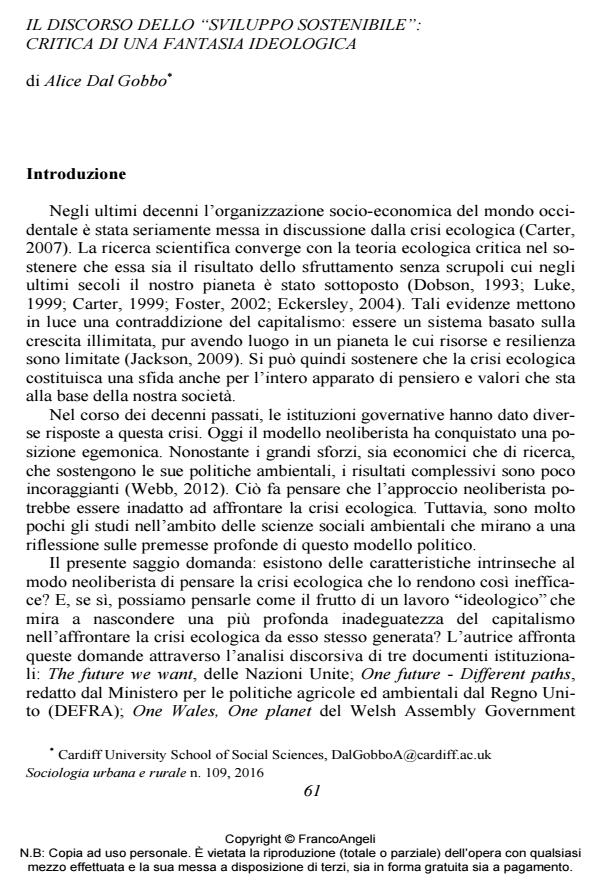
Qui sotto puoi vedere in anteprima la prima pagina di questo articolo.
Se questo articolo ti interessa, lo puoi acquistare (e scaricare in formato pdf) seguendo le facili indicazioni per acquistare il download credit. Acquista Download Credits per scaricare questo Articolo in formato PDF
FrancoAngeli è membro della Publishers International Linking Association, Inc (PILA), associazione indipendente e non profit per facilitare (attraverso i servizi tecnologici implementati da CrossRef.org) l’accesso degli studiosi ai contenuti digitali nelle pubblicazioni professionali e scientifiche.
La crisi ecologica mette in discussione i sistemi economico, sociale e politico occidentali. Le politiche neoliberiste oggi egemoni non sembrano capaci di implementare misure adeguate alla sua portata. L’autrice delinea i punti salienti di uno studio critico portato avanti tramite il metodo della Lacanian Discourse Analysis su tre documenti di politica ambientale. Propone che lo “sviluppo sostenibile” abbia funzione di fantasia ideologica: oscura le contraddizioni del sistema per perpetuarlo.
Parole chiave:Crisi ecologica, politiche ambientali, critica, neoliberismo, sviluppo sostenibile, fantasia ideologica
- Barr S., Gilg A., Shaw G. (2011). Citizens, consumers and sustainability: (Re)framing environmental practice in an age of climate change. Global Environmental Change, 21. DOI: 10.1016/j.gloenvcha.2011.07.00
- Bellamy R., Greenaway J. (1995). The New Right conception of citizenship and the Citizen’s Charter. Government and Opposition, 4.
- Berglund C., Matti S. (2006). Citizen and consumer: the dual role of individuals in environmental policy. Environmental Politics, 4. DOI: 10.1080/0964401060078517
- Boyd R., Krutilla K., Vicusi W.K. (1995). Energy taxation as a policy instrument to reduce CO2 emissions: A net benefit analysis. Journal of Environmental Economics and Management, 29. DOI: 10.1006/jeem.1995.102
- Bullard N. (2011). It’s too late for sustainability. What we need is system change. Development, 2. DOI: 10.1057/dev.2011.2
- Butler C. (2010). Morality and climate change: Is leaving your TV on standby a risky behaviour? Environmental Values, 2. DOI: 10.3197/096327110X1269942022055
- Carter A. (1999). A Radical Green Political Theory. London: Routledge.
- Carter N. (2007). The Politics of the Environment: Ideas, Activism, Policy. Cambridge: Cambridge University Press. DOI: 10.1017/CBO978051181917
- Cortella L. (1996). La teoria critica dalla dialettica alla dialogica. Fenomenologia e Società, 1-2.
- Daiello V. (2010). (K)not an impasse: working through Lacanian theory as a research methodology. Visual Arts Research, 2. DOI: 10.1353/var.2010.001
- Department for Environment, Food and Rural Affairs (2005). One future - Different paths. The UK’s shared framework for sustainable development. London: DEFRA Publications.
- Dobson A. (1993). Critical Theory and Green Politics. In Dobson A., Lucardie P. (a cura di). The Politics of Nature: Explorations in Green Political Theory. London: Routledge.
- Doubleday R. (2004). Institutionalising non-governmental organisation dialogue at Unilever: framing the public as ‘consumer-citizens’. Science and Public Policy, 2. DOI: 10.3152/14715430478178010
- Eckersley R. (2004). The Green State: Rethinking Democracy and Sovereignty. Cambridge MA: MIT Press.
- Feindt P.H., Oels A. (2006). Does discourse matter? Discourse analysis in environmental policy making. Journal of Environmental Policy & Planning, 3. DOI: 10.1080/1523908050033963
- Fink B. (1995). The Lacanian Subject: Between Language and Jouissance. Princeton: Princeton University Press.
- Fink B. (2013). Against Understanding, vol. 1: Commentary, Cases and Critiques in a Lacanian Key. London: Routledge.
- Flick U. (2013). An Introduction to Qualitative Research. London: SAGE Publisher.
- Foster J. B. (2002). Ecology Against Capitalism. New York: Monthly Review Press.
- Foucault M., Gordon C. (a cura di). (1980). Power/Knowledge: Selected Interviews and Other Writings 1972-1977. Harlow: Pearson Education Limited.
- Geller H., Harrington P., Rosenfeld A.H., Tanishima S., Unander, F. (2006). Polices for increasing energy efficiency: Thirty years of experience in OECD countries. Energy Policy, 34. DOI: 10.1016/j.enpol.2005.11.01
- Hajer M.A. (1995). The Politics of Environmental Discourse: Ecological Modernization and the Policy Process. London: Oxford University Press.
- Hajer M.A., Versteeg W. (2006). A decade of discourse analysis of environmental politics: Achievements, challenges, perspectives. Journal of Environmental Policy & Planning, 3. DOI: 10.1080/1523908050033964
- Hargreaves T. (2011). Practice-ing behaviour change: Applying social practice theory to pro-environmental behaviour change. Journal of Consumer Culture, 1. DOI: 10.1177/146954051039050
- Helm D. (2008). Climate-change policy: why so little has been achieved? Oxford Review of Economic Policy, 2. DOI: 10.1093/oxrep/grn01
- Honneth A. (2009). Pathologies of Reason: On the Legacy of Critical Theory. New York: Columbia University Press.
- Hook D. (2003). Language and the flesh: psychoanalysis and the limits of discourse. Pretexts: Literary & Cultural Studies, 1.
- Horowitz G. (1987). The Foucaultian impasse: No sex, no self, no revolution. Political Theory, 1. DOI: 10.1177/009059178701500100
- Jackson T. (2009). Prosperity without Growth: Economics for a Finite Planet. London: Earthscan.
- Jaeggi R. (2008). Per una critica dell’ideologia. Iride, 55. DOI: 10.1414/2896
- Longhi S. (2013). Individual pro-environmental behaviour in the household context. ISER Working Papers Series, 21.
- Luke T.W. (1995). On environmentality: Geo-power and eco-knowledge in the discourses of contemporary environmentalism. Cultural Critique, 31. DOI: 10.2307/135444
- Luke T.W. (1999). Ecocritique: Contesting the Politics of Nature, Economy, and Culture. Minneapolis: University of Minnesota Press.
- Marx K. (2013). Il Capitale, vol. 1. Torino: UTET.
- Nye M., Hargreaves T. (2009). Exploring the social dynamics of proenvironmental behavior change. Journal of Industrial Ecology, 1. DOI: 10.1111/j.1530-9290.2009.00193
- Oels A. (2006). Rendering climate change governable: From biopower to advanced liberal government? Journal of Environmental Policy & Planning, 3. DOI: 10.1080/1523908050033966
- Parker I. (2005). Lacanian Discourse Analysis in psychology: Seven theoretical elements. Theory Psychology, 15. DOI: 10.1177/095935430505136
- Parker I. (2007). Lacanian psychoanalysis and revolutionary Marxism. Lacanian Ink, 29.
- Pavon-Cuéllar D. (2010). From the Conscious Interior to an Exterior Unconscious: Lacan, Discourse Analysis and Social Psychology. London: Karnak Books.
- Pavon-Cuéllar D., Parker I. (2013). Introduction: Lacanian theory, discourse analysis and the question of the ‘event’. In Parker I., Pavon-Cuéllar D. (a cura di). Lacan, Discourse, Event: New Psychoanalytic Approaches to Textual Indeterminacy. London: Routledge.
- Sharp L., Richardson T. (2001). Reflections on Foucauldian Discourse Analysis in planning and environmental policy research. Journal of Environmental Policy & Planning, 3. DOI: 10.1002/jepp.8
- Shove E. (2010). Beyond the ABC: Climate change policy and theories of social change. Environment and Planning. A., 6. DOI: 10.1068/a4228
- Slocum R. (2004). Consumer citizens and the Cities for Climate Protection campaign. Environment and Planning A, 5. DOI: 10.1068/a3613
- Stern P.C. (1986). Blind spots in policy analysis: What economics doesn't say about energy use. Journal of Policy Analysis and Management, 2. DOI: 10.2307/332354
- Stern P.C. (2000). Toward a coherent theory of environmentally significant behaviour. Journal of Social Issues, 3. DOI: 10.1111/0022-4537.0017
- Tews K., Busch P.O., Jörgens H. (2003). The diffusion of new environmental policy instruments. European Journal of Political Research, 4. DOI: 10.1111/1475-6765.0009
- United Nations General Assembly (2012). The future we want. Resolution, 66, 288.
- Vighi F., Feldner H. (2007). Ideology critique or discourse analysis? Žižek against Foucault. European Journal of Political Theory, 2. DOI: 10.1177/147488510707434
- Webb J. (2012). Climate change and society: The chimera of behaviour change technologies.m Sociology, 1. DOI: 10.1177/003803851141919
- Welsh Assembly Government (2009). One Wales: One planet. The Sustainable Development scheme of the Welsh Assembly Government.
- http://wales.gov.uk/topics/sustainabledevelopment/publications/onewalesoneplanet/?lang=en.
- Whitebook J. (2002). Michel Foucault: A Marcusean in structuralist clothing. Thesis Eleven, 71. DOI: 10.1177/072551360207101100
- Žižek S. (2009). In Defense of Lost Causes. London: Verso.
- Economic Systems and Human Rights Margherita Ciervo, pp.211 (ISBN:978-3-031-72865-5)
Alice Dal Gobbo, Il discorso dello "sviluppo sostenibile": critica di una fantasia ideologica in "SOCIOLOGIA URBANA E RURALE" 109/2016, pp 61-75, DOI: 10.3280/SUR2016-109005