Urban Air Mobility. Un nuovo campo di ricerca sociologica
Titolo Rivista SOCIOLOGIA URBANA E RURALE
Autori/Curatori Carolina Mudan Marelli
Anno di pubblicazione 2024 Fascicolo 2024/135
Lingua Italiano Numero pagine 25 P. 123-147 Dimensione file 201 KB
DOI 10.3280/SUR2024-135007
Il DOI è il codice a barre della proprietà intellettuale: per saperne di più
clicca qui
Qui sotto puoi vedere in anteprima la prima pagina di questo articolo.
Se questo articolo ti interessa, lo puoi acquistare (e scaricare in formato pdf) seguendo le facili indicazioni per acquistare il download credit. Acquista Download Credits per scaricare questo Articolo in formato PDF
FrancoAngeli è membro della Publishers International Linking Association, Inc (PILA), associazione indipendente e non profit per facilitare (attraverso i servizi tecnologici implementati da CrossRef.org) l’accesso degli studiosi ai contenuti digitali nelle pubblicazioni professionali e scientifiche.
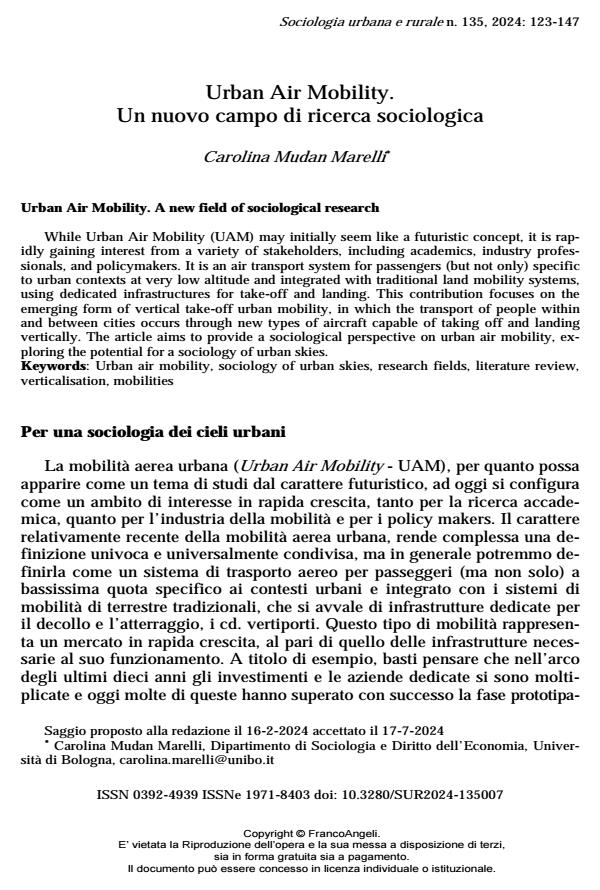
While Urban Air Mobility (UAM) may initially seem like a futuristic concept, it is rapidly gaining interest from a variety of stakeholders, including academics, industry professionals, and policymakers. It is an air transport system for passengers (but not only) specific to urban contexts at very low altitude and integrated with traditional land mobility systems, using dedicated infrastructures for take-off and landing. This contribution focuses on the emerging form of vertical take-off urban mobility, in which the transport of people within and between cities occurs through new types of aircraft capable of taking off and landing vertically. The article aims to provide a sociological perspective on urban air mobility, exploring the potential for a sociology of urban skies.
Parole chiave:Urban air mobility, sociology of urban skies, research fields, literature review, verticalisation, mobilities
- Adelstein B.D., Toscano W.B., Espinosa F.A., Cowings P. S. (2022). Passenger Experience of Simulated Urban Air Mobility Ride Quality: Responses to Large-Scale Motion. IFAC-PapersOnLine, 55(29): 138-143.
- Adler P. S. (1988). Automation, skill and the future of capitalism. Berkeley Journal of Sociology, 33: 1-36.
- Al Haddad C., Chaniotakis E., Straubinger A., Plötner K., Antoniou C. (2020). Factors affecting the adoption and use of urban air mobility. Transportation research part A: policy and practice, 132: 696-712.
- Ale-Ahmad H., Mahmassani H.S. (2021). Capacitated location-allocation-routing problem with time windows for on-demand urban air taxi operation. Transportation Research Record, 2675(10): 1092-1114. DOI: 10.1177/036119812110148
- Ariante G., Ponte S., Papa U., Del Core G. (2021). Safe landing area determination (slad) for unmanned aircraft systems by using rotary lidar. In 2021 IEEE 8th international workshop on metrology for AeroSpace (MetroAeroSpace): 110-115.
- Bacqué M.H., Fol S. (2007). L’inégalité face à la mobilité: du constat à l’injonction. Revue suisse de sociologie, 33(1): 89-104.
- Barra F., Scanavino M., Guglieri G. (2020). A methodology for multirotor aircraft power budget analysis. Aircraft Engineering and Aerospace Technology, 92(6): 909-916. DOI: 10.1108/AEAT-09-2019-0183
- Battiste V., Strybel T.Z. (2023). Development of Urban Air Mobility (UAM) Vehicles for Ease of Operation. In Duffy V.G., Krömker H., Streitz A., Konomi S. (eds.). HCI International 2023 Late Breaking Papers. Lecture Notes in Computer Science. Vol 14057. Springer, Cham. DOI: 10.1007/978-3-031-48047-8_14
- Boddupalli S.S., Garrow L.A., German B.J., Newman J.P. (2024). Mode choice modeling for an electric vertical takeoff and landing (eVTOL) air taxi commuting service. Transportation Research Part A: Policy and Practice, 181: 1-19.
- Bonin T., Jones J., Enea G., Levitt I., Phojanamongkolkij N. (2023). Development of a Weather Capability for the Urban Air Mobility Airspace Research Roadmap. 2023 Integrated Communication, Navigation and Surveillance Conference, IEEE: 1-11.
- Braverman H. (1982). The degradation of work in the twentieth century. Monthly Review New York, 34(1): 1-13.
- Braverman H. (1998). Labor and monopoly capital: The degradation of work in the twentieth century. New York: New York University Press.
- Bridgelall R. (2022). Perspectives on Securing the Transportation System. Vehicles, 4(4): 1332-1343.
- Burte H. (2024). Mumbai’s differential verticalisation: The dialectic of sovereign and technical planning rationalities. Urban Studies, 61(4): 706-725. DOI: 10.1177/00420980231192
- Castagna C. (2020). 30 Years After ANCA: Can Airports Live with New Community-Imposed Noise Restrictions? AviationPros. Testo disponibile al sito: https://www.aviationpros.com/airports/article/21126774/30-years-after-anca-can-airports- live-withnew-communityimposed-noise-restrictions
- Cerroni A., Carradore R. (2021). Comunicazione e incertezza scientifica nella società della conoscenza: teoria e casi studio di sociologia del rischio. Milano: FrancoAngeli.
- Chang Z., Zheng L., Yang T., Long F. (2022). High-speed rail, new town development, and the spatial mismatch of land leases in China. Land Use Policy, 115(106014): 1-12.
- Chen Y.C., Dobra A. (2020). Measuring human activity spaces from GPS data with density ranking and summary curves. The Annals of Applied. Statistics, 14(1): 409-432. DOI: 10.1214/19-AOAS1311
- Cho G., Choi J., Bae G., Oh H. (2022). Autonomous ship deck landing of a quadrotor UAV using feed-forward image-based visual servoing. Aerospace Science and Technology, 130 (107869): 1-17.
- Chrit M., Majdi M. (2022). Improving wind speed forecasting for urban air mobility using coupled simulations. Advances in Meteorology, 1: 1-14. DOI: 10.1155/2022/2629432
- Cohen A.P., Shaheen S.A., Farrar E.M. (2021). Urban air mobility: History, ecosystem, market potential, and challenges. IEEE Transactions on Intelligent Transportation Systems, 22(9): 6074-6087.
- Colleoni M., Gwiazdzinski L., Daconto L. (2017). L’accessibilità spaziale potenziale alle opportunità urbane: un’analisi comparata tra la città metropolitana di Milano e la metropoli di Lione. Archivio di studi urbani e regionali, 119(2): 73-91. DOI: 10.3280/ASUR2017119005
- Colleoni M., Pucci P., (2016). Understanding mobilities for designing contemporary cities. Berlino: Springer International Publishing.
- Daconto L. (2015). Mobilità precaria. L’accesso alla città delle persone in situazione di precarietà legata al lavoro a Milano e Lione. Tesi di dottorato discussa a MilanoBicocca. Testo disponibile al sito: https://boa.unimib.it/handle/10281/83189.
- Elias N. (2019). Sulla sociogenesi della sociologia. Cambio: rivista sulle trasformazioni sociali, 17(1): 75-93.
- Ge D., Topcu U. (2019). Hierarchical path planning for urban on-demand air mobility. In 2019 IEEE Conference on Control Technology and Applications (CCTA) IEEE: 894899. DOI: 10.1109/CCTA.2019.8920446
- Goyal R., Cohen A. (2022). Advanced air mobility: Opportunities and challenges deploying eVTOLs for air ambulance service. Applied Sciences, 12(3): 1-15.
- Goyal R., Reiche C., Fernando C., Serrao J., Kimmel S., Cohen A., Shaheen S. (2018). Urban air mobility (UAM) market study. NASA Market study.
- Graham S., Hewitt L. (2013). Getting off the ground: On the politics of urban verticality. Progress in Human Geography, 37(1): 72-92.
- Harris A. (2015). Vertical urbanisms: Opening up geographies of the three-dimensional city. Progress in Human Geography, 39(5): 601-620. DOI: 10.1177/0309132514554323
- Harvey D. (1998). L’esperienza urbana. Metropoli e trasformazioni sociali. Milano: Il Saggiatore.
- Haupt S.E., Rauber R.M., Carmichael B.J., Knievel C., Cogan J.L. (2018). 100 Years of Progress in Applied Meteorology. Part III: Additional Applications. Meteorological Monographs, 59: 24.1-24.35. DOI: 10.1175/AMSMONOGRAPHS-D-18-0012.1
- Järv O., Masso A., Silm S., Ahas R. (2021). The link between ethnic segregation and socioeconomic status: an activity space approach. Tijdschrift voor economische en sociale geografie, 112(3): 319-335.
- Johnson R.A., Miller E.E., Conrad S. (2022). Technology Adoption and Acceptance of Urban Air Mobility Systems: Identifying Public Perceptions and Integration Factors. The International Journal of Aerospace Psychology, 32(4): 240-253. DOI: 10.1080/24721840.2022.2100394
- Kaufmann V., Bergman M.M., Joye D. (2004). Motility: Mobility as capital. International journal of urban and regional research, 28(4): 745-756.
- Kelly L.C., Nicholson J.H., Scott O.R., Wright M.J. (2022). XTAL VR System Use in a Novel AAM Research Cockpit. IFAC-PapersOnLine, 55(29): 150-153.
- Lascara B, Spencer T., DeGarmo M., Lacher A., Maroney D., Guterres M. (2018). Urban Air Mobility Landscape Report. MITRE.
- Lefebvre H. (2000). La production de l’espace. Parigi: Anthropos.
- Lenormand M., Ramasco J.J. (2016). Towards a better understanding of cities using mobility data. Built Environment, 42(3): 356-364.
- Lim E., Hwang H. (2019). The selection of vertiport location for on-demand mobility and its application to Seoul metro area. International Journal of Aeronautical and Space Sciences, 20: 260-272.
- Lombard J. (2006). Enjeux privés dans le transport public d’Abidjan et de Dakar. Géocarrefour, 81(2): 167-174.
- Lucini-Paioni A., Busicchia F., Rossi-Lamastra C. (2024). What do people want? An analysis of citizens’ willingness to use Advanced Air Mobility in Italy. Applied Economics Letters, 31(6): 489-496. DOI: 10.1080/13504851.2022.2138815
- Merleau-Ponty M. (2003). Fenomenologia della percezione. Milano: Bompiani.
- Muñoz-Esparza D., Shin H.H., Sauer J.A., Steiner M., Hawbecker P., Boehnert J., Pinto J.O., Kosovic B., Sharman, R.D. (2021). Efficient graphics processing unit modeling of street-scale weather effects in support of aerial operations in the urban environment.
- AGU Advances, 2: 1-19. DOI: 10.1029/2021AV000432
- Naville P. (1972). Temps et technique: les structures de la vie de travail. Ginevra: Librairie Droz.
- Nehk N., Tiberius V., Kraus S. (2021). Urban air mobility: projections for air taxis. International Journal of Innovation and Technology Management, 18(07). DOI: 10.1142/S0219877021500334
- Noble D. (2017). Forces of production: A social history of industrial automation. Londra/New York: Routledge.
- Oppenchaim N., (2011). Mobilité quotidienne, socialisation et ségrégation: une analyse à partir des manières d'habiter des adolescents de zones urbaines sensibles. Tesi di dottorato discussa all’Università Paris-Est. -- Testo disponibile al sito: https://pastel.hal.science/pastel-00715300/.
- Park B.T., Kim H., Kim S.H. (2022). Vertiport performance analysis for on-demand Urban air mobility operation in Seoul metropolitan area. International Journal of Aeronautical and Space Sciences, 23(5): 1065-1078.
- Patches M. (2015). The long, weird history of the flying car. Popular Mechanics. -- Testo disponibile al sito: https://www.popularmechanics.com/technology/infrastructure/g2021/history-of-flying-car. Patterson M.D., Antcliff K.R., Kohlman L.W. (2018). A proposed approach to studying urban air mobility missions including an initial exploration of mission requirements. Annual Forum and Technology Display (NASA Technical Reports Server). Testo disponibile al sito: https://ntrs.nasa.gov/citations/20190000991.
- Possony S.T., Rosenzweig L. (1955). The Geography of the Air. The Annals of the American Academy of Political and Social Science, 299(1): 1-11. DOI: 10.1177/000271625529900102
- Privitera W. (2017). I compiti di una sociologia intesa come teoria della società. In Santambrogio A. (a cura di). Sociologia e sfide contemporanee. Napoli. Orthotes.
- Ravalet E. (2009). Ségrégation urbaine et mobilité quotidienne, une perspective internationale. Tesi di dottorato discussa presso l’Institut National de la Recherche Scientifique (Canada). -- Testo disponibile al sito: https://espace.inrs.ca/id/eprint/100/
- Reiche C., Cohen A.P., Fernando C. (2021). An initial assessment of the potential weather barriers of urban air mobility. IEEE Transactions on Intelligent Transportation Systems, 22(9): 6018-6027. DOI: 10.1109/TITS.2020.3048364
- Ripoll F., Veschambre V. (2005). Sur la dimension spatiale des inégalités: contribution aux débats sur la “mobilité” et le “capital spatial”. In Yves J., Arlaud S. (eds). Rural-Urbain. Nouveaux liens, nouvelles frontières, Rennes: PUR.
- Roseau N. (2012). Aerocity: quand l’avion fait la ville. Marsiglia: Parenthèses.
- Roseau N., Thébaud-Sorger M. (2013). L’emprise du vol: de l’invention à la massification: histoire d’une culture moderne. Ginevra: Métis Press.
- Rungskunroch P., Yang Y., Kaewunruen S. (2020). Does high-speed rail influence urban dynamics and land pricing? Sustainability, 12(7): 1-18.
- Sampson R.J., Levy B.L. (2022). The enduring neighborhood effect, everyday urban mobility, and violence in Chicago. The University of Chicago Law Review, 89(2): 323-348.
- Schweiger K., Schmitz R., Knabe F. (2023). Impact of wind on eVTOL operations and implications for vertiport airside traffic flows: A case study of Hamburg and Munich. Drones, 7(7): 1-29.
- Secchi B. (2011). La nuova questione urbana: ambiente, mobilità e disuguaglianze sociali. Crios, 1(1): 83-92. DOI: 10.7373/70210
- Shaheen S., Cohen A., Farrar E. (2018). The potential societal barriers of urban air mobility (UAM). In Goyal R., Reiche C., Fernando C., Serrao J., Kimmel S., Cohen A., Shaheen
- S. (eds). Urban air mobility (UAM) market study. Nasa. -- Testo disponibile al sito: https://ntrs.nasa.gov/api/citations/20190002046/downloads/20190002046.pdf.
- Sheller M., Urry J. (2006). The new mobilities paradigm. Environment and planning A, 38(2): 207-226.
- Steiner M. (2019). Urban air mobility: Opportunities for the weather community. Bulletin of the American Meteorological Society, 100(11): 2131-2133. DOI: 10.1175/BAMS-D-190148.1
- Stith J.L., Baumgardner D., Haggerty J., Hardesty R.M., Lee W.C., Lenschow D., Vömel H. (2018). 100 years of progress in atmospheric observing systems. Meteorological monographs, 59: 2.1-2.55. DOI: 10.1175/AMSMONOGRAPHS-D-18-0006.1
- Straubinger A., Rothfeld R., Shamiyeh M., Büchter K.D., Kaiser J., Plötner K.O. (2020). An overview of current research and developments in urban air mobility. Setting the scene for UAM introduction. Journal of Air Transport Management, 87: 1-12.
- Vempati L., Myers P., Winter S.R. (2023). The Technology Readiness and Acceptance Model as a Predictor of Pilots’ Willingness to Operate in UAM Integrated Airspace. The International Journal of Aerospace Psychology, 33(4): 288-306. DOI: 10.1080/24721840.2023.2242397
- Wang R., Zhang X., Li N. (2022). Zooming into mobility to understand cities: A review of mobility-driven urban studies. Cities, 130: 1-17.
- Yedavalli P., Mooberry J. (2019). An assessment of public perception of urban air mobility (UAM). Airbus UTM: Defining Future Skies. -- Testo disponibile al sito: https://www.airbus.com/sites/g/files/jlcbta136/files/2022-07/Airbus-UTM-public- perception-study%20-urban-air-mobility.pdf.
Carolina Mudan Marelli, Urban Air Mobility. Un nuovo campo di ricerca sociologica in "SOCIOLOGIA URBANA E RURALE" 135/2024, pp 123-147, DOI: 10.3280/SUR2024-135007