Why not? Perché i Musei e gli Ecomusei possono contribuire alla sostenibilità della food governance
Titolo Rivista SOCIOLOGIA URBANA E RURALE
Autori/Curatori Nunzia Borrelli, Giulia Mura, Lisa N.R. Pigozzi
Anno di pubblicazione 2025 Fascicolo 2025/137
Lingua Italiano Numero pagine 19 P. 43-61 Dimensione file 176 KB
DOI 10.3280/SUR2025-137003
Il DOI è il codice a barre della proprietà intellettuale: per saperne di più
clicca qui
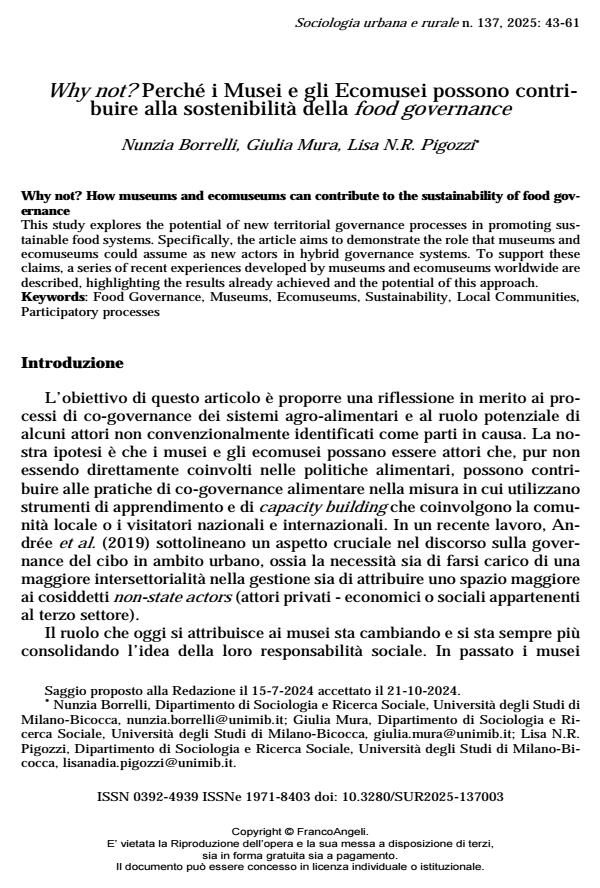
Qui sotto puoi vedere in anteprima la prima pagina di questo articolo.
Se questo articolo ti interessa, lo puoi acquistare (e scaricare in formato pdf) seguendo le facili indicazioni per acquistare il download credit. Acquista Download Credits per scaricare questo Articolo in formato PDF
FrancoAngeli è membro della Publishers International Linking Association, Inc (PILA), associazione indipendente e non profit per facilitare (attraverso i servizi tecnologici implementati da CrossRef.org) l’accesso degli studiosi ai contenuti digitali nelle pubblicazioni professionali e scientifiche.
This study explores the potential of new territorial governance processes in promoting sustainable food systems. Specifically, the article aims to demonstrate the role that museums and ecomuseums could assume as new actors in hybrid governance systems. To support these claims, a series of recent experiences developed by museums and ecomuseums worldwide are described, highlighting the results already achieved and the potential of this approach.
Parole chiave:Food Governance, Museums, Ecomuseums, Sustainability, Local Communities, Participatory processes
- Andrée P., Clark J. K., Levkoe C. Z., Lowitt K. (2019). Introduction - Traversing theory and practice: Social movement engagement in food systems governance for sustainability, justice, and democracy. In Andrée P., Clark J. K., Levkoe C. Z., Lowitt K. (eds). Civil society and social movements in food system governance. London: Routledge.
- Andrew N. L., Allison E. H., Brewer T., Connell J., Eriksson H., Eurich J. G., Tutuo J. (2022). Continuity and change in the contemporary Pacific food system. Global Food Security, 32: 100608.
- Atkociuniene V., Vaznoniene G., Kiaušiene I. (2022). The role and functions of stakeholders in the development of local food systems: case of Lithuania. European countryside, 14(3): 511-539.
- Bennett T. (2005). Civic Laboratories: Museums, Cultural Objecthood, and the Governance of the Social. Cultural Studies 19(5): 521-547. DOI: 10.1080/09502380500365416
- Borrelli N., Davis P. (2012). How culture shapes nature: Reflections on ecomuseum practices. Nature and culture, 7(1): 31-47.
- Borrelli N., Davis P., Dal Santo R. (2023). Ecomuseums and Climate Change. Milano: Ledizioni.
- Borrelli N., Marsden T. (2018). Moving Up and Down the Scale. Sociologia urbana e rurale, Suppl. 115: 11-26.
- Bourdieu P. (2017), Habitus. In Rooksby E., Hillier J. (eds) Habitus: A sense of place. London: Routledge.
- Borrelli N., Mela A. (2018). Food, city and territory: Some reflections from a socio-spatial point of view. City Territory and Architecture, 5: 1-8.
- Brenner N. (2001). The limits to scale? Methodological reflections on scalar structuration. Progress in Human Geography, 25(4): 591-614. DOI: 10.1191/030913201682688959
- Cars G., Healey P., Madanipour A., De Magalhaes C. (eds). (2017). Urban governance, institutional capacity and social milieux. London: Routledge.
- Davis P. (2011). Ecomuseums: a sense of place. London: A&C Black.
- Davis P. (2007). Ecomuseums and sustainability in Italy, Japan and China: concept adaptation through implementation. In Knell S., Macleod S., Watson S. (eds.) Museum Revolutions. London: Routledge.
- De Varine H. (2005). Le radici del futuro: il patrimonio culturale al servizio dello sviluppo locale. Bologna: CLUEB.
- Emerson K., Nabatchi T., Balogh S. (2012). An integrative framework for collaborative governance. Journal of public administration research and theory, 22(1): 1-29.
- Frantzeskaki N., Dumitru A., Anguelovski I., Avelino F., Bach M., Best B., Rauschmayer F. (2016). Elucidating the changing roles of civil society in urban sustainability transitions. Current Opinion in Environmental Sustainability, 22: 41-50.
- Gaitán-Cremaschi D., Klerkx L., Duncan J., Trienekens J.H., Huenchuleo C., Dogliotti S., Contesse M.E., Benitez-Altunaz F.J., Rossing W.A.H. (2020). Sustainability transition pathways through ecological intensification: an assessment of vegetable food systems in Chile. International Journal of Agricultural Sustainability, 18(2): 131-150. DOI: 10.1080/14735903.2020.1722561
- Glin L.C., Oosterveer P., Mol A.P.J. (2015). Governing the Organic Cocoa Network from Ghana: Towards Hybrid Governance Arrangements? Journal of Agrarian Change, 15(1): 43-64.
- Habermas J. (1987). Theory of communicative action. Volume Two: Lifeworld and system: A critique of functionalist reason. Boston: Beacon Press.
- Halliday J. (2022). Conceptualisations of Urban Food Governance. In Moragues-Faus A., Clark J.K., Battersby J., Davies A. (eds). Routledge Handbook of Urban Food Governance. London: Routledge.
- Hauenschild A. (2022). Claims and reality of new museology: Case studies in Canada, the United States and Mexico. Lisbona: Editores Universitários Lusófonos.
- Healey P. (1999). Institutionalist Analysis, Communicative Planning, and Shaping Places. Journal of Planning Education and Research, 19(2): 111-121. DOI: 10.1177/0739456X9901900201
- Healey P., Cars G., Madanipour A., De Magalhaes C. (2017). Transforming governance, institutionalist analysis and institutional capacity. In Cars G., Healey P., Madanipour A., De Magalhaes C. (eds.). Urban governance, institutional capacity and social milieux. London: Routledge.
- Hjalager A.M., Wahlberg M. (2014). Museum guests as contributors to regional food innovation. Museum Management and Curatorship, 29(1): 50-65. DOI: 10.1080/09647775.2013.869854
- Huttunen S., Ojanen M., Ott A., Saarikoski H. (2022). What about citizens? A literature review of citizen engagement in sustainability transitions research. Energy Research & Social Science, 91: 102714.
- International council of museums (2022). La vecchia definizione di Museo di ICOM. Testo disponibile al sito: www.icom-italia.org/vecchia-definizione-di-museo-di-icom/ (consultato il 09/07/2024).
- Jessop B. (2013). Hollowing out the ‘nation-state’ and multi-level governance. In Kennet P. (ed.) A Handbook of Comparative Social Policy, Second Edition. Cheltenham: Edward Elgar Publishing.
- Johnston C., Andrée P. (2019). Pathways to co-governance? The role of NGOs in food governance in the Northwest Territories, Canada. In Andrée P., Clark J. K., Levkoe C. Z., Lowitt K. (ed.). Civil Society and Social Movements in Food System Governance. London: Routledge.
- Kooiman J. (2003). Societal Governance. In Katenhusen I., Lamping W. (eds). Demokratien in Europa. Wiesbaden: VS Verlag für Sozialwissenschaften.
- Latour B. (1983). Give Me a Laboratory and I will Raise the World. In Mulkay M., Knorr-Cetina K. (eds.). Science observed, Perspectives on the Study of Science. London: Sage.
- Maia C., Arcela W., Alves L. (2020). O pensamento poético-museal de Mário Chagas, Testo disponibile al sito: https://galerialavandeiracontato.medium.com/entrevista-o-pensamento-poetico-museal-de-mario-chagas-334c64e3d017 (consultato il 09/07/2024).
- Manganelli A. (2022). The hybrid governance of urban food movements: learning from Toronto and Brussels. London: Springer Nature.
- Manganelli A., Van den Broeck P., Moulaert F. (2020). Socio-political dynamics of alternative food networks: a hybrid governance approach. Territory, Politics, Governance, 8(3): 299-318. DOI: 10.1080/21622671.2019.1581081
- McGhie H. (2023). Connecting the 21 Principles of Ecomuseums, the Sustainable Development Goals and Climate Action. In Borrelli N., Davis P., Dal Santo R. (eds). Ecomuseums and Climate Change. Milano: Ledizioni.
- MINOM (2017). Córdoba Declaration: A museology that is not life-oriented is not worthy, XVIII International MINOM Conference, Córdoba, 9-14 October.
- Moutinho M. (2007). Definição evolutiva de Sociomuseologia. Cadernos de sociomuseologia, 28: 1-22.
- Mura G., Aleotti F., Diamantini D. (2022). Il manuale della sostenibilità per le imprese. Innovazione, sviluppo e ambiente. Milano: Mondadori Università.
- Musei del Cibo (2023). Mission dei Musei del Cibo di Parma. Testo disponibile al sito: https://www.museidelcibo.it/chi-siamo/mission-dei-musei-del-cibo-di-parma/ (consultato il 09/07/2024).
- Newell J. (2020). Climate museums: powering action. Museum Management and Curatorship, 35(6): 599-617. DOI: 10.1080/09647775.2020.1842236
- Pigozzi L., Borrelli N., Dal Santo R., (2022). Ecomuseums, the SDGs and Climate Action: The Ecoheritage Project. In Borrelli N., Davis P., Dal Santo R., (eds). Ecomuseums and climate change. Milano: Ledizioni.
- Pappalardo G. (2021). Paesaggi tenaci: Il processo ecomuseale del Simeto. Milano: FrancoAngeli.
- Reed M. S. (2008). Stakeholder participation for environmental management: a literature review. Biological conservation, 141(10): 2417-2431.
- Reed M. S., Vella S., Challies E., De Vente J., Frewer L., Hohenwallner-Ries D., Van Delden H. (2018). A theory of participation: what makes stakeholder and public engagement in environmental management work? Restoration ecology, 26: S7-S17.
- Renting H., Wiskerke H. (2010). New Emerging Roles for Public Institutions and Civil Society in the Promotion of Sustainable Local Agro-Food Systems. In Darnhofer I., Grötzer M. (eds) Building Sustainable Rural Futures: The Added Value of Systems Approaches in Times of Change and Un-certainty 9th European IFSA Symposium. University of Natural Resources and Applied Life Sciences: Vienna, Austria. Testo disponibile al sito: https://www.cabidigitallibrary.org/doi/full/10.5555/20133409964 (consultato il 10 ottobre 2024).
- Rota M. (2019). Musei per la sostenibilità integrata. Milano: Editrice Bibliografica.
- Somerville P., Haines N. (2008). Prospects for local co-governance. Local Government Studies, 34(1): 61-79. DOI: 10.1080/03003930701770488
- Vergo P. (ed) (1989). New museology. Isligton: Reaktion books.
- Weber N., Christophersen T. (2002). The influence of non-governmental organisations on the creation of Natura 2000 during the European Policy process. Forest policy and economics, 4(1): 1-12. DOI: 10.1016/S1389-9341(01)00070-3
- Zago M. (2018). Il ruolo delle comunità locali e dei turisti nella valorizzazione dei saperi tradizionali: l’esperienza degli ecomusei del gusto. Futuribili, 23(1-2): 193-209.
Nunzia Borrelli, Giulia Mura, Lisa N.R. Pigozzi, Why not? Perché i Musei e gli Ecomusei possono contribuire alla sostenibilità della food governance in "SOCIOLOGIA URBANA E RURALE" 137/2025, pp 43-61, DOI: 10.3280/SUR2025-137003