Quo vadis, diaspora? Riflessioni su sviluppo e partecipazione
Titolo Rivista MONDI MIGRANTI
Autori/Curatori Marco Zoppi
Anno di pubblicazione 2025 Fascicolo 2025/2
Lingua Italiano Numero pagine 23 P. 213-235 Dimensione file 231 KB
DOI 10.3280/MM2025-002010
Il DOI è il codice a barre della proprietà intellettuale: per saperne di più
clicca qui
Qui sotto puoi vedere in anteprima la prima pagina di questo articolo.
Se questo articolo ti interessa, lo puoi acquistare (e scaricare in formato pdf) seguendo le facili indicazioni per acquistare il download credit. Acquista Download Credits per scaricare questo Articolo in formato PDF
FrancoAngeli è membro della Publishers International Linking Association, Inc (PILA), associazione indipendente e non profit per facilitare (attraverso i servizi tecnologici implementati da CrossRef.org) l’accesso degli studiosi ai contenuti digitali nelle pubblicazioni professionali e scientifiche.
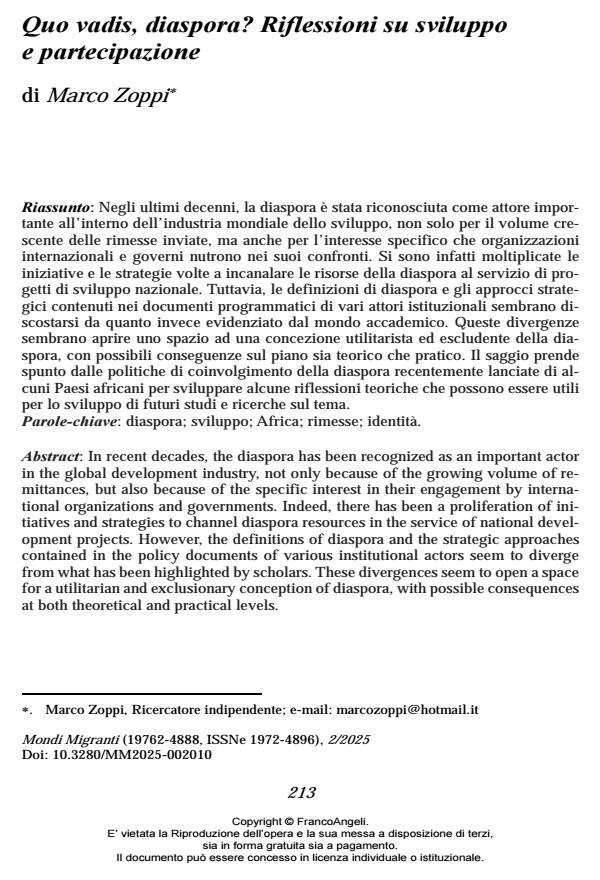
Negli ultimi decenni, la diaspora è stata riconosciuta come attore importante all’interno dell’industria mondiale dello sviluppo, non solo per il volume crescente delle rimesse inviate, ma anche per l’interesse specifico che organizzazioni internazionali e governi nutrono nei suoi confronti. Si sono infatti moltiplicate le iniziative e le strategie volte a incanalare le risorse della diaspora al servizio di progetti di sviluppo nazionale. Tuttavia, le definizioni di diaspora e gli approcci strategici contenuti nei documenti programmatici di vari attori istituzionali sembrano discostarsi da quanto invece evidenziato dal mondo accademico. Queste divergenze sembrano aprire uno spazio ad una concezione utilitarista ed escludente della diaspora, con possibili conseguenze sul piano sia teorico che pratico. Il saggio prende spunto dalle politiche di coinvolgimento della diaspora recentemente lanciate di alcuni Paesi africani per sviluppare alcune riflessioni teoriche che possono essere utili per lo sviluppo di futuri studi e ricerche sul tema.
Parole chiave:diaspora; sviluppo; Africa; rimesse; identità.
- African Union – AU (2019). Diaspora Mapping and Research Study in Five European Countries. Addis Ababa: CIDO; https://www.giz.de/de/downloads/2018%20Diaspora%20Mapping%20S tudy%20Europe%20ENG.pdf
- Ahmed Ismail I. (2000). Remittances and Their Economic Impact in Postwar Somaliland. Disasters, 24, 4: 380-389; DOI: 10.1111/1467-7717.0015
- Asiedu E., Tebkieta A. Tapsoba e Gelb S. (2024). Migrant Resource Flows and Development in the Global South. In: Heaven Crawley e J. Kofi Teye, a cura di, The Palgrave Handbook of South-South Migration and Inequality (pp. 519-542). New York: Palgrave Macmillan.
- Asscher O. e Shiff O. (2019). Diasporic stances, homeland prisms: representing diaspora in the homeland as internal negotiation of national identity. Diaspora Studies, 13, 1: 1-15; DOI: 10.1080/09739572.2019.168581
- Bernal V. (2020). African Digital Diasporas: Technologies, Tactics, and Trends. Diaspora Studies, 12, 1-2: 1-10;
- Brubaker R. (2005). The ‘diaspora’ diaspora. Ethnic and Racial Studies, 28, 1: 1-19; DOI: 10.1080/014198704200028999
- Butler K. (2001). Defining Diaspora, Refining a Discourse. Diaspora: A Journal of Transnational Studies, 10, 2: 189-219.
- Carrier N.C.M. e Elliot H. (2018). Entrust we must: The role of “trust” in Somali economic life. DIIS Working Paper, No. 2018, 2; https://www.econstor.eu/bit- stream/10419/184852/1/DIIS_WP_2018_2.pdf
- Clifford J. (1994). Diasporas. Cultural Anthropology, 9, 3: 302-338; http://www.jstor.org/stable/656365
- Cohen R. (1997). Global Diasporas: An Introduction. London: Routledge. Commonwealth Secretariat (2024). Charting a Course for Diaspora Investment in Kenya; https://production-new-commonwealth-files.s3.eu-west2.amazonaws.com/s3fs-public/2024-03/charting-a-course-for-diasporainvestment-in-kenya.pdf
- Demissie F., a cura di (2015). Africans on the Move Migration, Diaspora and Development Nexus. London: Routledge.
- Dufoix S. (2008). Diasporas. Berkeley: University of California Press.
- Elmi M.A. e Ngwenyama O. (2020). Examining the use of electronic money and technology by the diaspora in international remittance system: A case of Somali remittances from Canada. Electronic Journal of Information Systems in Developing Countries, 86: e12138.
- Eriksen T. (2014). Globalization. London: Bloomsbury.
- European Union Global Diaspora Facility – EUDiF (2020a). Diaspora engagement mapping – Kenya; https://diasporafordevelopment.eu/wp-con- tent/uploads/2020/07/CF_Kenya-v.2.pdf
- European Union Global Diaspora Facility – EUDiF (2020b). Diaspora engagement mapping – Uganda; https://diasporafordevelopment.eu/wp- content/uploads/2020/11/CF_Uganda-v.2.pdf
- Galstyan N. e Ambrosini M. (2022). Diasporas and Collective Remittances: From State-Driven to Unofficial Forms of Diaspora Engagement. International Migration Review, 57, 2: 652-680; DOI: 10.1177/0197918322110357
- Horst C. (2008). The transnational political engagements of refugees: Remittance sending practices amongst Somalis in Norway: Analysis. Conflict, Security & Development, 8, 3: 317-339.
- Human Rights Watch (2024). World Report 2024 – Eritrea; https://www.hrw.org/world-report/2024/country-chapters/eri- trea#:~:text=Eritrea%20continues%20to%20suppress%20basic,violations%20in%20Ethiopia's%20Tigray%20region.
- International Centre for Migration Policy Development – ICMPD e Organizzazione Mondiale per le migrazioni – OIM (2015). A Survey on Migration Policies in West Africa. Berna: ICMPD e OIM; https://publica- tions.iom.int/books/survey-migration-policies-west-africa
- Kessy A.T. e Shayo H.E. (2022). Tanzania’s diaspora engagement: The need for a paradigm shift in diaspora engagement and investment policies. Research in Globalization, 5, 1-10;
- Kieh G.K. (2016). Africa and the new globalization. London: Routledge.
- Koinova M. e Karabegovic D. (2017). Diasporas and transitional justice: transnational activism from local to global levels of engagement Global Networks, 17, 2: 212-233.
- Lusaka Times (2020). “ECZ committed to ensure Diaspora voting is actualized in 2026”. 25 ottobre; https://www.lusakatimes.com/2020/10/25/ecz- committed-to-ensure-diaspora-voting-is-actualized-in-2026/Manor I. e Adiku A.G. (2021). From ‘traitors’ to ‘saviours’: A longitudinal analysis of Ethiopian, Kenyan and Rwandan embassies’ practice of digital diaspora diplomacy. South African Journal of International Affairs, 28, 3: 403-427; DOI: 10.1080/10220461.2021.194891
- Mazzucato V., Bart van den Boom e N.N.N. Nsowah-Nuamah (2008). Remittances in Ghana: Origin, Destination and Issues of Measurement. International Migration, 46, 1: 103-122; http://dx.doi.org/10.1111/j.1468- 2435.2008.00438.x
- Newland K. e Erin Patrick (2004). Beyond remittances: the role of Diaspora in poverty reduction in their countries of origin. Washington: Migration Policy Institute for the Department of International Development; https://www.migrationpolicy.org/sites/default/files/publications/Be- yond_Remittances_0704.pdf
- Ngikang K.E. (2020). Diaspora, Home-State Governance and Transnational Political Mobilisation: A Comparative Case Analysis of Ethiopia and Kenya’s State Policy Towards Their Diaspora. Migration Letters, 17, 1: 71-80;
- Nti K. (2014). ‘Uniting the African family’: monuments, tourism, development, and neoliberalism in Ghana – Historic African Diaspora relations. Third World Studies, 31, 2: 113-125.
- Organizzazione mondiale per le migrazioni – OIM (2023). Thematic Brief; https://www.migrationdataportal.org/sites/g/files/tmzbdl251/files/2023- 09/GDI%20Briefs_Diaspora.pdf
- Organizzazione mondiale per le migrazioni – OIM (2020). Contributions and Counting. Ginevra: OIM; https://publications.iom.int/system/files/pdf/contributions-and-counting.pdf
- Organizzazione mondiale per le migrazioni – OIM, e Migration Policy Institute – MPI (2012). Developing a Road Map for Engaging Diasporas in Development: A Handbook for Policymakers and Practitioners in Home and Host Countries. Ginevra: OIM.
- Page B. e Mercer C. (2019). Diaspora and development. In: Robin Cohen e Carolin Fischer, a cura di, Routledge Handbook of Diaspora Studies (pp. 320-327). London e New York: Routledge.
- Ponzanesi S. (2020). Digital Diasporas: Postcoloniality, Media and Affect, Interventions, 22: 8: 977-993; DOI: 10.1080/1369801X.2020.1718537
- Reis M. (2004). Theorizing Diaspora: Perspectives on “Classical” and “Contemporary”. Diaspora. International Migration, 42, 2 : 41-60;
- Repubblica del Benin (2001). Politique nationale pour les Beninois de l’exterieur. Cotonou: Repubblica del Benin; https://www.ccme.org.ma/images/activites/fr/2009/05/M_J_B_Alok- pon_-_Benin.pdf
- Repubblica federale della Nigeria (2021). Lusaka: Missione in Nigeria dell’Organizzazione mondiale delle migrazioni; https://nidcom.gov.ng/wp-content/uploads/2021/06/NATIONAL-DIA- SPORA-POLICY-2021.pdf
- Repubblica del Kenya (2024). Kenya Diaspora Policy. Nairobi: Ministero degli Affari Esteri e della Diaspora; https://mfa.go.ke/wp-content/uploads/2024/05/Draft-Diaspora-Policy-2024-23.05.2024.pdf
- Repubblica del Malawi (2017). Malawi diaspora engagement policy. Lilongwe: Repubblica del Malawi. https://www.malawiembassy.de/Natio- nal-Diaspora-Engagement-Policy-Final.pdf
- Repubblica dello Zambia (2019). Diaspora Policy. Lusaka: Ministero degli affari esteri della Repubblica dello Zambia.
- Safran W. (1991). Diasporas in Modern Societies: Myths of Homeland and Return. Diaspora: A Journal of Transnational Studies, 1, 1: 83-99. https://dx.doi.org/10.1353/dsp.1991.0004
- Segal Uma A. (2019). Globalization, migration, and ethnicity. Public Health, 172: 135-142;
- Unione Africana (2003). Protocol on amendments to the constitutive act of the African Union. Addis Ababa: UA; https://au.int/sites/de- fault/files/treaties/35423-treaty-0025_-_PROTO- COL_ON_THE_AMENDMENTS_TO_THE_CONSTITU- TIVE_ACT_OF_THE_AFRICAN_UNION_E.pdf
- Vertovec S. (2000). Religion and Diaspora. Paper presentato alla conferenza New Landscapes of Religion in the West, School of Geography and the Environment (pp. 27-29). University of Oxford; https://pure.mpg.de/rest/items/item_3012230_1/compo- nent/file_3012231/content
- Zoppi M. (2021). Horizons of Security: The Somali Safety Net in Scandinavia. Lanham: Rowman and Littlefield.
Marco Zoppi, Quo vadis, diaspora? Riflessioni su sviluppo e partecipazione in "MONDI MIGRANTI" 2/2025, pp 213-235, DOI: 10.3280/MM2025-002010