Benchmarking Sustainability: A Comparative Case Studies Analysis of ESG Practices in the Heating, Ventilation, and Air Conditioning Industry

Titolo Rivista MANAGEMENT CONTROL
Autori/Curatori Monica Veneziani, Marcello Cosa, Riccardo Torelli, Dina Lucia Todaro
Anno di pubblicazione 2026 Fascicolo 2025/3
Lingua Inglese Numero pagine 24 P. 65-88 Dimensione file 154 KB
DOI 10.3280/MACO2025-003004
Il DOI è il codice a barre della proprietà intellettuale: per saperne di più clicca qui

Qui sotto puoi vedere in anteprima la prima pagina di questo articolo.

Se questo articolo ti interessa, lo puoi acquistare (e scaricare in formato pdf) seguendo le facili indicazioni per acquistare il download credit. Acquista Download Credits per scaricare questo Articolo in formato PDF
Anteprima articolo

FrancoAngeli è membro della Publishers International Linking Association, Inc (PILA)associazione indipendente e non profit per facilitare (attraverso i servizi tecnologici implementati da CrossRef.org) l’accesso degli studiosi ai contenuti digitali nelle pubblicazioni professionali e scientifiche

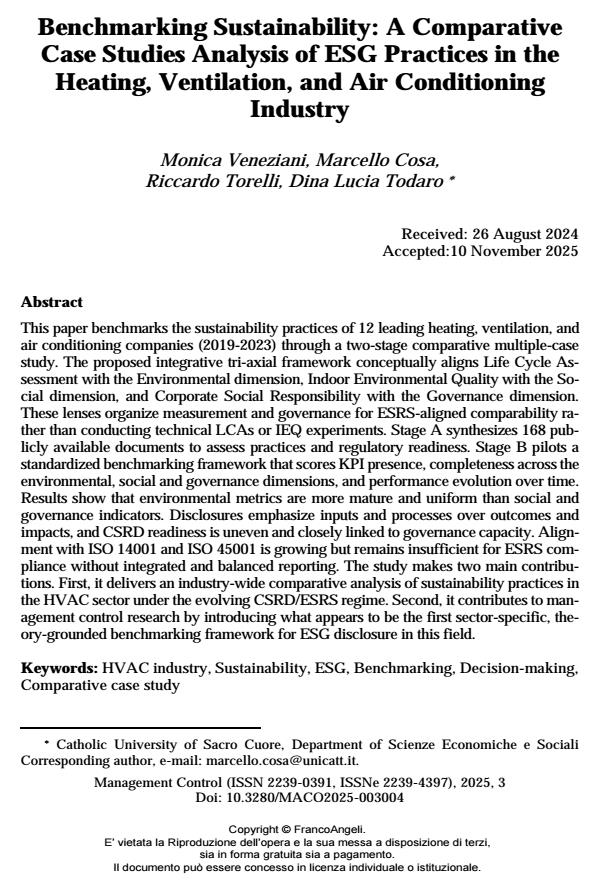
This paper benchmarks the sustainability practices of 12 leading heating, ventilation, and air conditioning companies (2019-2023) through a two-stage comparative multiple-case study. The proposed integrative tri-axial framework conceptually aligns Life Cycle Assessment with the Environmental dimension, Indoor Environmental Quality with the Social dimension, and Corporate Social Responsibility with the Governance dimension. These lenses organize measurement and governance for ESRS-aligned comparability rather than conducting technical LCAs or IEQ experiments. Stage A synthesizes 168 publicly available documents to assess practices and regulatory readiness. Stage B pilots a standardized benchmarking framework that scores KPI presence, completeness across the environmental, social and governance dimensions, and performance evolution over time. Results show that environmental metrics are more mature and uniform than social and governance indicators. Disclosures emphasize inputs and processes over outcomes and impacts, and CSRD readiness is uneven and closely linked to governance capacity. Alignment with ISO 14001 and ISO 45001 is growing but remains insufficient for ESRS compliance without integrated and balanced reporting. The study makes two main contributions. First, it delivers an industry-wide comparative analysis of sustainability practices in the HVAC sector under the evolving CSRD/ESRS regime. Second, it contributes to management control research by introducing what appears to be the first sector-specific, theory-grounded benchmarking framework for ESG disclosure in this field.

Parole chiave:HVAC industry, Sustainability, ESG, Benchmarking, Decision-making, Comparative case study

  1. Alazazmeh, A., Asif, M. (2021), Commercial building retrofitting: Assessment of improvements in energy performance and indoor air quality, Case Studies in Thermal Engineering, 100946.
  2. Al-Hajaya K., Almahameed E.A.A., Sawan N., Altarawneh M.S., Eltweri A., Salem R. (2025), Audit Committees and the Quality of Standalone Sustainability Reporting, Considering the Moderating Role of External Assurance: Evidence From the Global Chemical Industry, Business Strategy and the Environment, 34(5), pp. 6210-6228.
  3. Ali B. M., Akkas M. (2023), The Green Cooling Factor: Eco-Innovative Heating, Ventilation, and Air Conditioning Solutions in Building Design, Applied Sciences, 14(1), 195.
  4. Alsayegh M., Rahman R., Homayoun S. (2020), Corporate Economic, Environmental, and Social Sustainability Performance Transformation through ESG Disclosure, Sustainability, 12(9), 3910.
  5. Asim N., Badiei M., Mohammad M., Razali H., Rajabi A., Lim C.H., Ghazali M.J. (2022), Sustainability of Heating, Ventilation and Air-Conditioning (HVAC) Systems in Buildings—An Overview, International Journal of Environmental Research and Public Health, 19(2), 1016.
  6. Asimakopoulos G., Whalley J. (2017), Market leadership, technological progress and relative performance in the mobile telecommunications industry, Technological Forecasting and Social Change, 123, pp. 57-67.
  7. Bhalerao S.A., Kumar, S., Nair, N. (2024), Safety, health and environmental (she) risk assessment and strategies to create a sustainable safety culture in diversified HVAC industry, Environmental Engineering and Management Journal, 23(8), pp. 1673-1685.
  8. Botejara-Antúnez M., González Domínguez J., García-Sanz-Calcedo J. (2023), Life cycle analysis methodology for heating, ventilation and air conditioning ductwork in healthcare buildings, Indoor and Built Environment, 32(6), pp. 1213-1230.
  9. Brown D., Martiskainen M. (2024), How sociotechnical norms shape transition pathways: The co-evolution of three European heating, ventilation, and cooling (HVAC) regimes, Energy Research & Social Science, 107, 103346.
  10. Buonasera A., Noto G., Vermiglio C. (2024), Performance management systems for sustainability in SMEs: An interventionist approach, Management Control, 3/2024, pp. 39-59. DOI: 10.3280/MACO2024-003003
  11. Castellano N., Felden C. (2021), Management Control Systems for Sustainability and Sustainability of Management Control Systems, Management Control, 2/2021, pp. 5-10. DOI: 10.3280/MACO2021-002001
  12. Ceglia F., Marrasso E., Roselli C., Sasso M. (2021), An innovative environmental parameter: Expanded Total Equivalent Warming Impact, International Journal of Refrigeration, 131, pp. 980-989.
  13. Christensen P.H., Robinson S., Simons R. (2022), Institutional investor motivation, processes, and expectations for sustainable building investment, Building Research & Information, 50(3), pp. 276-290. DOI: 10.1080/09613218.2021.1908878
  14. Conradi-Galnares E., Blandón-González B., Marrero-Meléndez M. (2025), Life Cycle Assessment (LCA) Fundamental Principles, In Mercader-Moyano P., Porras-Pereira P. (eds), Life Cycle Analysis Based on Nanoparticles Applied to the Construction Industry, pp. 27-41. Cham, Springer. DOI: 10.1007/978-3-031-79115-4_2
  15. Council of the EU. (2025), Simplification: Council gives final green light on the ‘Stop-the-clock’ mechanism to boost EU competitiveness and provide legal certainty to businesses, 285/25, 14/04/2025. Retrieved from https://www.consilium.europa.eu/en/press/press-releases/2025/04/14/simplification-council-gives-final-green-light-on-the-stop-the-clock-mechanism-to-boost-eu-competitiveness-and-provide-legal-certainty-to-businesses/pdf/ (accessed 13 August 2025).
  16. Delgado-Ceballos J., Ortiz-De-Mandojana N., Antolín-López R., Montiel I. (2023), Connecting the Sustainable Development Goals to firm-level sustainability and ESG factors: The need for double materiality, BRQ Business Research Quarterly, 26(1), pp. 2-10. DOI: 10.1177/23409444221140919
  17. Dion H., Evans M. (2024), Strategic frameworks for sustainability and corporate governance in healthcare facilities; approaches to energy-efficient hospital management, Benchmarking: An International Journal, 31(2), pp. 353-390. DOI: 10.1108/BIJ-04-2022-0219
  18. Duma D., Pollitt M.G., Covatariu A. (2024), Regulatory learning in the face of net zero climate policy: The case of the UK, Review of Industrial Organization, pp. 1-26.
  19. EFRAG. (2024a), Connectivity considerations and boundaries of different Annual Report sections. Retrieved from https://efrag.sharefile.com/public/share/web-sa809d85e758e44aea39de8cdb9aa48fd (accessed 14 July 2024).
  20. EFRAG. (2024b), European Sustainability Reporting Standards (ESRS), Set 1, Retrieved from https://xbrl.efrag.org/e-esrs/esrs-set1-2023.html (accessed 10 August 2025).
  21. EFRAG. (2025), Revised ESRS exposure drafts and public consultation. Retrieved from https://www.efrag.org/en/amended-esrs-0 (accessed 13 August 2025).
  22. Eisenhardt K.M. (1989), Building Theories from Case Study Research, Academy of Management Review, 14(4), pp. 532-550.
  23. Elo S., Kääriäinen M., Kanste O., Pölkki T., Utriainen K., Kyngäs H. (2014), Qualitative Content Analysis: A Focus on Trustworthiness, Sage Open, 4(1). DOI: 10.1177/2158244014522633
  24. Esposito P., Garzella S., Lavorato D. (2024), Integrated reporting o disintegrated reporting? Un’analisi teorica per una proposta empirica di reale integrazione, Management Control, 3/2024, pp. 87-110. DOI: 10.3280/MACO2024-003005
  25. European Commission. (2014), Directive 2014/95/EU of the European Parliament and of the Council of 22 October 2014 amending Directive 2013/34/EU as regards disclosure of non-financial and diversity information by certain large undertakings and groups. Retrieved from https://eur-lex.europa.eu/legal-content/EN/TXT/?uri=CELEX%3A32014L 0095 (accessed 10 July 2024).
  26. European Commission. (2019), The European Green Deal, COM(2019) 640 final. Retrieved from https://eur-lex.europa.eu/legal-content/EN/TXT/HTML/?uri=CELEX:52019DC0 640 (accessed 10 August 2025).
  27. European Commission. (2022), Directive (EU) 2022/2464 of the European Parliament and of the Council of 14 December 2022 amending Regulation (EU) No 537/2014, Directive 2004/109/EC, Directive 2006/43/EC and Directive 2013/34/EU, as regards corporate sustainability reporting. Retrieved from https://eur-lex.europa.eu/legal-content/EN/ TXT/?uri=CELEX:32022L2464 (accessed 10 July 2024).
  28. European Commission. (2023), Q&A on the adoption of the European Sustainability Reporting Standards (ESRS). Retrieved from https://ec.europa.eu/commission/presscorner/detail/en/qanda_23_4043/smo (accessed 11 July 2024).
  29. European Commission. (2025), Directive (EU) 2025/0044 of the European Parliament and of the Council of 26 February 2025 amending Directives (EU) 2022/2464 and (EU) 2024/1760 as regards the dates from which Member States are to apply certain corporate sustainability reporting and due diligence requirements. Retrieved from https://eur-lex.europa.eu/legal-content/EN/TXT/HTML/?uri=CELEX:52025PC0080 (accessed 13 August 2025).
  30. European Parliament. (2025), Sustainability and due diligence: MEPs agree to delay application of new rules. Retrieved from https://www.europarl.europa.eu/news/en/press-room/20250331IPR27557 (accessed 13 August 2025).
  31. Fasoulis I. (2021), Understanding CSR and sustainability integration patterns into the corporate governance and organisational processes of a ship management company: a case study, World Review of Intermodal Transportation Research, 10(3), pp. 245-268. DOI: 10.1504/WRITR.2021.117678
  32. Fisk W., Singer B., Chan W. (2020), Association of residential energy efficiency retrofits with indoor environmental quality, comfort, and health: A review of empirical data, Building and Environment, 180, 107067.
  33. Fornasari T., Traversi, M. (2024), The Impact of the CSRD and the ESRS on Non-Financial Disclosure, Symphonya, 2, pp. 117-133.
  34. Fusco F., Civitillo R., Ricci P., Morawska S., Pustulka K., Banasik P. (2021), Sustainability reporting in justice systems: a comparative research in two European countries, Meditari Accountancy Research, 30(6), pp. 1629-1657.
  35. García-Sanz-Calcedo J., de Sousa Neves N., Fernandes J. (2020), Measurement of embodied carbon and energy of HVAC facilities in healthcare centers, Journal of Cleaner Production, 289, 125151.
  36. George A.L., Bennett A. (2005), Case Studies and Theory Development in the Social Sciences, Cambridge, MA, MIT Press.
  37. Global Reporting Initiative (2024), Full set of GRI Universal Standards. Retrieved from https://www.globalreporting.org/how-to-use-the-gri-standards/gri-standards-english-language/ (accessed 10 August 2025).
  38. Gutterman A.S. (2023), CSR Governance and Organizational Culture, SSRN Electronic Journal, pp. 1-38.
  39. Hummel K., Jobst D. (2024), An Overview of Corporate Sustainability Reporting Legislation in the European Union, Accounting in Europe, pp. 1-36. DOI: 10.1080/17449480.2024.2312145
  40. IEA (2023), Tracking Clean Energy Progress 2023, International Energy Agency, Paris. Retrieved from https://www.iea.org/reports/tracking-clean-energy-progress-2023 (accessed 12 August 2025).
  41. ISO (2006), ISO 14040:2006 – Environmental management – Life cycle assessment – Principles and framework. International Organization for Standardization.
  42. Kathiravel R., Zhu S., Feng H. (2024), LCA of net-zero energy residential buildings with different HVAC systems across Canadian climates: A BIM-based fuzzy approach, Energy and Buildings, 306, 113905.
  43. Ketokivi M., Choi T. (2014), Renaissance of case research as a scientific method, Journal of Operations Management, 32(5), pp. 232-240.
  44. Khandelwal A. (2020), Case Studies of Sustainable Road Transport Practices in Different Industry Sectors in India, International Journal of Mathematical, Engineering and Management Sciences, 5(6), pp. 1091-1107.
  45. Khovalyg D., Kazanci O.B., Halvorsen H., Gundlach I., Bahnfleth W., Toftum J., Olesen B. (2020), Critical review of standards for indoor thermal environment and air quality, Energy and Buildings, 213, 109819.
  46. Kiamili C., Hollberg A., Habert G. (2020), Detailed Assessment of Embodied Carbon of HVAC Systems for a New Office Building Based on BIM, Sustainability, 12(8), 3372.
  47. Lee V., Marasini D., Dong W., Lee H.J., Lee D. (2021), Comparative study of key supply chain management elements in sustainability reports, Businesses, 1(3), pp. 168-195.
  48. Lim A., Yoon M., Kim E.H., Kim H.A., Lee M.J., Cheong H. (2021), Effects of mechanical ventilation on indoor air quality and occupant health status in energy-efficient homes: A longitudinal field study, The Science of the Total Environment, 785, 147324.
  49. Lima L., Gomes da Trindade E.L., Alencar L.H., Alencar M. (2021), Sustainability in the construction industry: A systematic review of the literature, Journal of Cleaner Production, 289, 125730.
  50. Meeroff D., Scarlatos P., Bloetscher F., Sobel L. (2020), Implementation of Sustainability Practices in the Hospitality Industry, Journal of Service Science and Management, 13(2), pp. 189-208.
  51. Miettinen M. (2024), Are materiality determination practices evolving in the wake of increasing legislation on sustainability reporting? Findings from EU pharmaceutical companies’ reports, International Journal of Law and Management, 66(3), pp. 363-392. DOI: 10.1108/IJLMA-09-2023-0221
  52. Mordor Intelligence. (2023), Residential HVAC Market Size & Share Analysis - Growth Trends & Forecasts (2024-2029). Retrieved from https://www.mordorintelligence.com/industry-reports/residential-hvac-market (accessed 11 July 2024).
  53. Nagy R., Krídlová Burdová E., Harcárová K., Vilceková S. (2022), Influence of the Heating System on the Indoor Environmental Quality - Case Study, Buildings, 12(8), 1088.
  54. Novianti N., Rahmi S., Zaitul Z. (2022), Effect of Corporate Governance on Corporate Social Responsibility and Firm Values: Empirical Evidence from Manufacturing Companies in Indonesia, Ekonomis: Journal of Economics and Business, 6(1), 249-254.
  55. O’Neill N.F., Ma J.M., Walther D.C., Brockway L.R., Ding C., Lin J. (2020), A modified total equivalent warming impact analysis: Addressing direct and indirect emissions due to corrosion, Science of The Total Environment, 741, 140312.
  56. Obiuto N.C., Ebirim W., Ninduwezuor-Ehiobu N., Ani E.C., Olulawal K.A., Ugwuanyi E.D. (2024), Integrating sustainability into HVAC project management: challenges and opportunities, Engineering Science & Technology Journal, 5(3), pp. 873-887.
  57. Palacios J., Steele K., Tan Z., Zheng S. (2021), Human health and productivity outcomes of office workers associated with indoor air quality: A systematic review, MIT Center for Real Estate Research Paper, (21/14).
  58. Pang Z., O’Neill Z., Chen Y., Zhang J., Cheng H., Dong, B. (2023), Adopting occupancy-based HVAC controls in commercial building energy codes: Analysis of cost-effectiveness and decarbonization potential, Applied Energy, 349, 121594.
  59. Petersen A.C., Herbert S., Daniels N. (2022), The likely adoption of the IFRS Foundation’s proposed sustainability reporting standards, The Business and Management Review, 13(2), pp. 28-38.
  60. Plando I.C. Jr. (2023), Impact of Refrigerants Transition on HVAC System Performance and Environmental Sustainability, International Journal of Advanced Research in Science, Communication and Technology, 3(2), pp. 866-871.
  61. Próchniak J., Ploska R. (2023), WIG-20 Warsaw Stock Exchange Companies: Are They Ready for Governance Matters Disclosures Based on EU Sustainable Reporting Standards?, Annales Universitatis Mariae Curie-Sklodowska, Sectio H – Oeconomia, 56(5), pp. 227-246.
  62. Qin H., Yu Z., Li Z., Li H., Zhang Y. (2024), Nearly Zero-Energy Building Load Forecasts through the Competition of Four Machine Learning Techniques, Buildings, 14(1), 147.
  63. Rochlitzer D., Lützkendorf T. (2022), Management and communication of HVAC-specific life cycle-related information-filling the gaps for sustainability assessment of buildings, In IOP Conference Series: Earth and Environmental Science, 1078(1), 012104, IOP Publishing. DOI: 10.1088/1755-1315/1078/1/012104
  64. Sardana D., Gupta N., Kumar V., Terziovski M. (2020), CSR ‘sustainability’ practices and firm performance in an emerging economy, Journal of Cleaner Production, 258, 120766.
  65. Seawright J., Gerring, J. (2008), Case Selection Techniques in Case Study Research: A Menu of Qualitative and Quantitative Options, Political Research Quarterly, 61(2), pp. 294-308. DOI: 10.1177/1065912907313077
  66. Slorach P.C., Stamford L. (2021), Net zero in the heating sector: Technological options and environmental sustainability from now to 2050, Energy Conversion and Management, 230, 113838.
  67. Spanò R., Martino I., Spagnuolo F., Allini A. (2024), Bitter Sweet Symphony? Insights into the discrepancy between managers and organizations towards ESG, Management Control, 2 Suppl./2024, pp. 75-97. DOI: 10.3280/MACO2024-002-S1005
  68. Srikandi D., Sutopo W., Hisjam M., Istiqomah S. (2022), Commercializing a Technology Use Global Business Strategy approach: A Lesson Learned from HVAC Companies, In 12th Annual International Conference on Industrial Engineering and Operations Management, Istanbul, Turkey, pp. 3079-3090, IEOM Society International. DOI: 10.46254/AN12.20220564
  69. Stanca S. (2023), Improving Energy Efficiency in a Building Using Passive Energy-Saving Measures, Journal of Applied Engineering Sciences, 13(2), pp. 269-274.
  70. Su L., Swanson S. (2019), Perceived corporate social responsibility’s impact on the well-being and supportive green behaviors of hotel employees: The mediating role of the em-ployee-corporate relationship, Tourism Management, 72, pp. 437-450.
  71. United Nations. (2015), Transforming our world: The 2030 Agenda for Sustainable Development, United Nations General Assembly. Retrieved from https://sdgs.un.org/publications/transforming-our-world-2030-agenda-sustainable-development-17981 (accessed 12 August 2025).
  72. Thakur A. (2024), Intelligent HVAC Control Systems for Smart Infrastructures, In Ordóñez de Pablos P. (ed), Digital Technologies for a Resource Efficient Economy, pp. 216-227, IGI Global.
  73. Velte P. (2022), Meta-analyses on Corporate Social Responsibility (CSR): a literature review, Management Review Quarterly, 72, pp. 627-675.
  74. Voss C., Tsikriktsis N., Frohlich M. (2002), Case research in operations management, International Journal of Operations & Production Management, 22(2), pp. 195-219. DOI: 10.1108/01443570210414329
  75. Wang C., Xu A., Jiao S., Zhou Z., Zhang D., Liu J., Ling J., Gao F., Rameezdeen R., Wang L., Wang Y., Zuo J. (2020), Environmental impact assessment of office building heating and cooling sources: A life cycle approach, Journal of Cleaner Production, 261, 121140.
  76. Wankhar V., Fukey L., Sinha M. (2021), Toward Sustainability 4.0: A Comprehensive Analysis of Sustainability in Corporate Environment. In Chakraborty C. (ed), Green Technological Innovation for Sustainable Smart Societies, pp. 67-87, Springer. DOI: 10.1007/978-3-030-73295-0_4
  77. Wieteska-Rosiak B. (2025), Integrating the circular economy into ESG in the real estate sector: Current practices, challenges, and pathways to standardization, Real Estate Management and Valuation, 33(2), pp. 109-122.
  78. Yacob P., Wong L.S., Khor S. (2019), An empirical investigation of green initiatives and environmental sustainability for manufacturing SMEs, Journal of Manufacturing Technology Management, 30(1), pp. 2-25. DOI: 10.1108/JMTM-08-2017-0153
  79. Yin, R.K. (2018), Case Study Research and Applications: Design and Methods (6th ed.), Sage, Thousand Oaks, CA.
  80. Zhang T., Zhai Y., Ma X., Shen X., Bai Y., Zhang R., Changxing J., Hong, J. (2021), Towards environmental sustainability: Life cycle assessment-based water footprint analysis on China’s cotton production, Journal of Cleaner Production, 313, 127925.

Monica Veneziani, Marcello Cosa, Riccardo Torelli, Dina Lucia Todaro, Benchmarking Sustainability: A Comparative Case Studies Analysis of ESG Practices in the Heating, Ventilation, and Air Conditioning Industry in "MANAGEMENT CONTROL" 3/2025, pp 65-88, DOI: 10.3280/MACO2025-003004